Blog

  • Top 3 EZ-GO Golf Cart Steering Problems

    Top 3 EZ-GO Golf Cart Steering Problems

    Steering problems in EZ-GO golf carts can be due to worn-out tie rod ends, loose steering components, and misaligned wheels. To fix this problem, inspect and replace damaged parts, tighten loose connections, and ensure proper wheel alignment.

    Above all, regular maintenance and lubrication will help prevent steering problems from occurring again.

    Even though your golf cart is still in top condition, it can experience steering problems, especially when you drive it often on uneven or rugged terrain. This happened to my recently purchased 2013 EZGO RXV electric golf cart. I got it with a drop spindle lift kit and custom tires, and the steering was extremely loose. 

    Being mechanically inclined, I tried replacing the steering gearbox and the steering. Still, the steering remained a little loose. Upon researching other golf cart owners who have experienced similar issues, I discovered this is a widespread problem, particularly with people using EZGO.

    I had a productive chat with the local technician in the area and did further mechanical practice to figure out the most common causes of steering problems, how to trace them, and their perfect quick fixes. 

    Generally, a steering wheel that makes the cart turn too little, too much, or not at all is already a problem. No matter the cause, the fixing process takes patience because it concerns the steering. 

    It all comes down to knowing what to look for and how to tackle the particular issue. 

    1. The Steering Is Misaligned

    Misalignment of the steering is one of the common problems diagnosed with defective EZGO Golf Carts. The primary cause of this misalignment is when the wheel is turned excessively to either left or right with the steering. 

    The Solution 

    In such a situation, all you need is a tweak in the alignment system—a steering adjustment—to get the steering more responsive. The following steps can guide you on how to go about the process: 

    Step 1: Use an adjustable wrench to loosen the central shank nut attached to it. 

    TIP: If you remove the nut, the steering wheel may pop out, so be conservative

    Step 2: Tap the wheel with a rubber mallet on both sides and pull it upward. I recommend using a rubber mallet instead of the metal punch many technicians use because it helps prevent damage while loosening it. 

    Step 3: Once the steering wheel comes off, put it back on and make the threads on either side of the steering rack even. 

    Step 4: Check and ensure the shaft twists aren’t interacting with the jam nuts in the rack. You can make this happen by adjusting or tightening the routing wheel with a wrench. 

    Step 5: Rotate the wheel to the center and align it to your preferred adjustment. Bring it back to the default position and repeat on the opposite side. 

    After doing this, you are probably dealing with loose steering and still find your EZGO golf cart giving you problems. 

    2. The Steering Is Loose

    When fixing loose steering problems in golf carts, an area of focus is the tie rod. Adjusting the tie rod of your EZGO cart will fix loose steering. But in rare cases, the problem is traced to bushings, pinion and rack arrangements, or even the steering box. 

    I will not dwell on the possibility of a steering box, pinion, or rack arrangement because the critical solution usually replaces those parts due to worn-out problems. You can contact a technician for such a task. 

    However, if the loose steering is traced to the tie rod adjustment, it needs tightening. Here’s how to fix it:

    The Solution 

    Before you proceed with the steps, I recommend you get a small floor jack to lift the cart due to the limited ground clearance of these vehicles. You also need to attach wheel chocks to the back wheels. Now follow these steps: 

    Step 1: Use the wheel to turn the rack to one side.

    Step 2: Locate the bottom adjustment nut and loosen it with a wrench. Remember to use a flat screwdriver if what controls the middle adjustment is a screw. If it’s a nut, then the Allen wrench will work perfectly.

    Step 3: Rotate the middle adjustment clockwise to attach to the rack. Again, turn counter-clockwise by a 22.5- to 45-degree angle. Repeat this step to assess the binding.

    Step 4: Lift the cart to remove the jack, then remove the chocks once they are firm on the ground.

    Step 5: The connection between the steering and wheels must be tight and synchronized with the entire machinery.

    TIP: If the steering wheel is not binding well when rotating the middle adjustment clockwise to attach to the rack, the tie rods may be faulty and need replacement. 

    3. The steering is hard 

    I have read and seen many technicians talk about fixing EZGO golf cart steering problems on forums, but only a few people address the issue of stiff steering in these carts. 

    At one time, the 2013 EZGO RXV Electric had a complex steering problem. The wheels move in direct proportion to the steering wheel. But when making a turn, it feels like there is an immediate resistance to the turn, followed by breaking through that resistance for less than a quarter turn. It will often occur in both directions.

    If this situation sounds familiar, you shouldn’t hesitate to change parts without knowing the problem. 

    In most situations, stiff steering on EZGO golf carts is traced to a faulty steering box. However, the culprits can be the ball joints and the steering wheel. 

    The Solution 

    Before calling the attention of a dealer technician, I had pulled the steering wheel, but all looked normal at that end. I replaced the left front A-Arm because the bolt was severely worn and off-center, but that didn’t make a difference. 

    Upon the inspection of the dealer technician, the steering box was the culprit. More precisely, the steering column had to be replaced because it got bent at the joint where the yoke goes into the steering box. 

    So, if your EZGO golf cart develops stiff steering, the steering box is a significant area to look at above everything else. 

    Still No Dice? 

    If you’ve tried all the above fixes and your EZGO golf cart isn’t as responsive as it used to be, then there’s possibly more than meets the eye (especially if you’re running on older models like 1989 EZGO RXV and 1996 EZGO TXT model)

    In such a situation, you need the help of a technician to take a professional look at the problem. But remember that no matter the model you use, new or old, steering problems can surface anytime.

    Golf courses are uneven or rugged terrain, and the steering wheel can get off-centered or loose when dealing with it. 

    So, above all, inspect the steering wheel periodically and adjust it whenever necessary, using the right tools. Most routine front suspension and steering maintenance consists of periodic inspections for loose, worn, or damaged components, alignment checks, and lubrication of ball joints and wheel bearings.

    EZGO manufacturer has guided you through their models’ maintenance, repair, and service procedures.  

  • Gas Golf Cart Hesitate When Accelerating

    Gas Golf Cart Hesitate When Accelerating

    The main reason why the EZGO Gas golf cart hesitates when accelerating is that it has a dirty carburetor. However, in some cases, the culprits could be a problem with the throttle sensor or wiring, a low battery, and a fault in the motor or controller.

    To solve this issue, check the rubber boot and clean it if you spot any dirt. If that doesn’t fix it, troubleshoot for throttle, battery, motor, and controller defects.

    Problems with accelerators are common in golf carts. Numerous users on various online communities have mentioned that the Ezgo Gas model has acceleration issues. I realized this when it happened with my EZGO TXT gas golf cart recently.

    You are probably familiar with fixing accelerator issues in an average car. Still, I eventually realized that the methods and solutions differ from those you can apply to carts.

    The Gas Club Car is typically expected to start immediately when pressing the gas pedal. But several times during the round, the pedal is pushed, and there is a hesitation. 

    In my situation, I even had to push the pedal to the floor before the starter engaged and the engine started. Being mechanically inclined, I tried a bunch of troubleshooting, which failed until I could fix it with the help of the technical support personnel.  

    In this article, I’ll show you how the acceleration hesitation is solved on an Ezgo gas golf cart and other alternative troubleshooting tips you can try if there’s still no dice. 

    The Fix That Worked For Me

    After doing a lot of guesswork, I still had problems with my Club Car hesitating while starting. For context, I had ticked the following solutions: 

    • Purchased the highest Cold Cranking Amp battery
    • I Checked the pedal linkage – from pedal to governor (controller) and from that top to the carburetor.
    • I checked the starter generator belt, and it’s tight.
    • I checked the voltage of the battery, and it is 12.83 volts.
    • Removed and cleaned all the connections.
    • I installed a new ground wire from the battery to the starter/generator.

    After all these measures, the hesitation was still happening. However, some of these steps have worked for many. But mine was different. Recently, I even had a problem where the starter would continue to run even though the cart was turned off, and the spark plug wire was pulled.

    I realized that I had to seek more professional help. The diagnosis at the workshop revealed that the cart’s voltage regulator was terrible. I also had to replace the solenoid. Upon putting a battery analyzer on the battery, it showed less than 200 CCA.

    I had to replace the battery with a new one (800 CCA), and now it started and ran like a new cart. The hesitation when accelerating my Ezgo gas club cart disappeared after I replaced the voltage regulator, changed the solenoid, and got a better battery. 

    If you’re facing a similar situation, this can be a direction for you. But remember that yours may not be as severe as mine. You could only have a dirty carburetor and no further technical issues. 

    This is why I encourage you to identify the culprit before making any technical changes when your golf cart hesitates when accelerating. After a deep conversation with the technical personnel who attended to me and further research, I gathered the common causes that make particular Ezgo gas golf carts hesitate when you pedal the acceleration.

    6 Most Common Possible Reasons Why Gas Golf Carts Hesitate When Accelerating

    If your EZGO Gas golf cart hesitates while accelerating, the reason can be traced to any of these issues:

    1. The carburetor is clogged with dirt and restricts fuel and gas flow to the engine.
    2. The throttle cable isn’t in the correct position.
    3. The battery is low or has a weak charge, which makes it unable to provide enough power for acceleration.
    4. A fault in the motor or controller causes it not to provide the necessary energy for smooth acceleration.
    5. A problem with the throttle sensor or wiring is blocking the proper signals to the motor for consistent acceleration. 
    6. Limited power output settings or programming limitations.

    Some of these issues will require the intervention of a technical expert. But before you go through that hassle, here are the basic steps you can take that can most likely solve the issue and get your cart to work correctly:

    How To Fix Gas Golf Cart Hesitate When Accelerating

    Fixing the accelerator problems of a gas golf cart is easier once you can pinpoint the source of the problem. First of all, open the hood, identify the symptoms, then consider the following troubleshooting attempts: 

    Step 1: Thoroughly examine the cable connections and condition

    The first step is to look at the cable connections. Are there loose connections or defective wires? This could be a significant reason. Replace the faulty cables. If you can’t identify any, reattach the wires tightly to the parts they belong to. 

    Poor cable connections are a commonly reported culprit for hesitation when accelerating Gas golf carts. But it may not solve the problem permanently. But it’s worth a try.

    Step 2: Clean the carb

    Detach the carburetor from the engine and other parts, then remove the piston and float assembly, for example, a piston, float chamber, throttle valve, and other factors.

    You can spray this carburetor cleaning solution on all surfaces using a small plastic brush and thoroughly scrub all the parts and places. 

    After thorough cleaning, use a small cloth to remove residual solvent and reattach the component.

    Step 3: Test the solenoid with a multimeter.

    If there are no problems with the wire and the carb is clean, test the solenoid using a multimeter. Since this component is responsible for allowing the electrical current from your battery to provide power to the entire cart, it can cause hesitation during accelerating when it’s faulty. 

    First, detach the wires of the component and keep the terminals separated from each other to identify the resistance[ohms] of the solenoid on the multimeter. If it’s beyond 0.4 ohms, the solenoid is wrong, and you should replace it. 

    Step 4: Try changing the battery 

    A faulty battery is another common reason for hesitation when accelerating. The power supply from the battery weakens over an extended period of usage. It’s an easy but expensive solution. However, this may not be an issue if your cart is new. 

    Still No Dice? 

    After trying all these measures, and your Ezgo gas golf cart still stalls when accelerating, it means there’s more than meets the eye. It means the issue is coming from somewhere we’re not looking. 

    Consider the weight or cargo on the golf cart. Excess weight can affect acceleration, so remove unnecessary items and see if anything changes. 

    If that’s not the case, consider having a qualified mechanic or technician diagnose the problem. Occasionally, hesitation when accelerating stems from complex engine or drivetrain issues. 

    The Cost Of Fixing Gas Golf Cart Accelerator Problems

    If you take your cart to a qualified technician to fix accelerator issues, they will most likely replace some components, as seen in my case. Of course, it can be cheaper if you only get the diagnosis and do it yourself. 

    But a professional will charge for replacement parts and work hours. For an Ezgo golf cart, new batteries can cost around $1,000, while a speed controller system costs as much as $280. Expect to pay about $30 for the carburetor and solenoids each, depending on the voltage and type. 

  • DIY Retractable Golf Net

    DIY Retractable Golf Net

    Create a DIY retractable golf net by attaching a durable mesh to a PVC frame. Install a simple pulley system at the top to allow easy extension and retraction. Secure the pulley end to a fixed point and the other to a handle. That way, you can practice your swings freely and conveniently, then stow them away effortlessly.

    Buying an all-in-one golf simulator is expensive – from a high-quality tracking system and projector to turf, screen, and enclosure. The DIY approach to building a simulator experience isn’t easy, especially if you work with a limited space like your garage. 

    I have built a DIY simulator setup in my garage for winter practice, and I remember having a golf net that made it almost impossible for me to have a car in the garage. I contemplated rigging up a retractable net that hangs from the garage door track. 

    In this article, I will show you how I achieved this by doing some netting and wrapping it around a weighted PVC at the bottom, then using pulleys and rope to raise and lower it. And I’m going to tell you upfront that this method stopped the golf ball before it whacks into the garage door. However, I gained utmost satisfaction after purchasing the Spornia SPG-7 net, which I will now recommend in a heartbeat for anyone looking for a DIY retractable golf net today. 

    So before we dive into the step-by-step DIY procedure for creating a golf net, here’s why you may want to consider saving yourself the stress and getting Spornia.

    DIY Retractable Golf Net – Spornia SPG-7 Practice Net 

    Retractable Golf Net

    $290

    • DIMENSION:  7ft. x 7ft. x 7ft. high + Roof
    • Noise Reduction Target Sheet
    • Roof attachment for missed/errant shots 
    • One circular chipping basket

    The Spornia SPG-7 net folds up easily and allows you to park the cars in the garage if that’s your area of setup. 

    It’s an ideal option if you’re interested in a golf net that you can store away and park without any worries of shanks and pop-ups, thanks to the extra side netting that comes as an add-on. It connects via Velcro on every foot. 

    I like the automatic Ball Return to your feet for constant practice. It’s easy and instant to set up and take down, and it also comes with a target sheet that protects and absorbs ball impact. 

    It comes with: 

    • SPG-7 Golf Practice Net (Dimensions: 7ft. x 7ft. x 7ft. high + Roof) 
    • Noise Reduction Target Sheet
    • Roof attachment for missed/errant shots 
    • One circular chipping basket

    If you’re looking for a DIY retractable golf net idea, you won’t go wrong with the Spornia practice net, especially if you’re working with limited space. I love how Golf Quest unboxes and explains the benefits and potential downsides of this DIY option in the video below:

    Now, if you don’t wish to shell out close to $300 for this DIY retractable option, you can make one from scratch. Building your DIY net can cost you less than $100, although the cost will depend on the net size you’re going for.

    Materials For DIY Retractable Golf Net From Scratch

    There are many creative ways you can construct a golf net. But for a standalone haul, here are the basic things you need to put together to make things work:

    MaterialsQuantityPriceWhere to buy
    A high-impact netting (get a little more than your intended net size)1$40Check on Amazon
    1.5″ PVC pipes (10′ for a 10ft x 10ft net, depending on your preferred size)5$12.59Check on Amazon
    Pulley system (pulleys, rope, and hooks)1$26Check On Amazon
    1.5″ PVC 5-way cross fittings2
    1.5″ PVC elbow fittings2
    screw hooks or eye hooks
    Other materials such as Measuring tape, Marker, handle or grip, anchors (wall anchors or stakes)

    The Process

    Follow these steps for a DIY approach to making a retractable golf net:

    Step 1: Design Planning

    Determine the desired dimensions of the golf net and frame. Standard sizes are about 10 feet wide, 7 feet tall, and 3 feet deep. Sketch a plan for the structure, considering the placement of the pulley system and how it will retract.

    Step 2: Cutting PVC Pipes

    Cut the PVC pipes to the required lengths using a saw. You’ll need four vertical pipes (height of the net) and two horizontal pipes (width of the net). Cut additional pieces to create the top crossbar and base.

    Step 3: Assemble the Frame

    Assemble the PVC frame using connectors. Attach elbows to the top of the vertical pipes to form the upper corners. Connect horizontal lines to the elbows, including the top of the frame.

    You can use tees to join the vertical pipes with the base pipes.

    Step 4: Attaching the Net

    Spread the golf netting and attach it to the frame using screws and a drill. Start from the top and work down, ensuring the net is taut.

    Attach the netting to the frame’s crossbar, sides, and base.

    Step 5: Installing Pulley System

    Mount the pulleys at the top corners of the frame, ensuring they are aligned. Thread the rope through the pulleys, forming a loop. Tie a knot at one end to prevent slipping.

    Step 6: Installing Eye Hooks

    Attach eye hooks to the wall or another sturdy structure above the area where the net will be used. Make sure the pins are aligned with the pulleys on the frame. 

    Step 7: Attaching Handle and Test the Retraction

    Attach a handle or grip to the loose end of the rope that hangs down from the frame. Pull down on the handle to extend the net fully. Test the retraction by pulling the handle again, allowing the pulleys to back up the net.

    Step 8: Securing Base and Stakes

    If you’re using the net indoors, secure the base of the frame to prevent tipping.

    If using outdoors, drive stakes into the ground to stabilize the frame.

    Test the net by hitting golf balls into it. Make any necessary adjustments to the frame or netting for stability and functionality.

    You can paint the PVC pipes to improve appearance and durability. But now, you have a retractable golf net that you can extend for practice and retract when not in use for convenient storage.

    I hope you found this guide helpful. If you feel stuck in any of the processes, feel free to share your thoughts in the comment, and I’ll be happy to put you through.

  • Turf Factory Direct Reviews

    Turf Factory Direct Reviews

    Turf Factory Direct (TDF) is a popular recommendation in various golf communities as a supplier of premium artificial grass products, especially for putting greens. Their lineup includes Putting Elite, Birdie Put Elite, Nylon Putt, Supreme Fringe, and Elite Fringe, among others, which are all priced below $4 per square foot.

    If you’re looking for putting greens for a miniature golf course, an eighteen-hole course, or your own personal putting green right in your backyard, several different types of putting greens are available to fit your needs. 

    If you’re about to trigger on putting turf but haven’t decided between TFD Elite and other rival options like the STI NP50, you must have noticed that there aren’t many reviews out there regarding the performance of putting greens made by TFD. 

    Fortunately, I have samples from TFD, and they seem nice. The customer support was beneficial, and the price was reasonable. However, my findings with this turf go beyond the obvious.

    I have written this article to give you a comprehensive idea of how the artificial putting green sold at Turf Factory Direct measures up to help you decide if it’s worth your consideration. 

    Turf Factory Direct Putting Green Options

    Not all green turf is made the same way, so Turf Factory Direct carries a wide variety of artificial turf. Some of their products are slick, which is a good idea if you want your golf balls to move more quickly. Some turf models have a thicker composition. 

    Here are the major options, along with their price: 

    ImageProductDetailPrice
    Birdie Putt Elite

    Birdie Putt Elite

    • It is super realistic that they have grain (the foam mimics grain), so you can put it into the grain or down-grain
    $2.89 
    Nylon Putt Extreme

    Nylon Putt Extreme

    • Texturized yarn for a higher level of play
    $3.69
    Nylon 36 UR

    Nylon 36 UR

    • 24 oz polyurethane backing for dimensional stability
    $2.59
    Putting Elite

    Putting Elite

    • Mid-weight texturized nylon and the most popular option from TFD for DIY
    $3.39
    Two-Tone Putt

    Two-Tone Putt

    • Dual-color for a natural-looking, non-infill putting green.
    $3.39
    Putt Putt

    Putt Putt

    • Perfect for commercial putt-putt courses and unsuitable for backyard putting greens because it’s the lightest option –  with a face weight of 25 oz.
    Pric$1.55
    Poly Putt

    Poly Putt

    • For use as sand-filled putting material
    $2.29
    Elite Fringe

    Elite Fringe

    • Perfect tone pairing for TFD putting greens and features perforated holes for drainage
    $3.19
    Supreme Fringe

    Supreme Fringe

    • Doubles as a pet turf option
    $3.39

    TFD options make one realize that not all turfs are created equal. The popular options among their models are the Birdie Putt Elite and the Putting Elite. My review is going to focus on the Putting Elite design.

    TFD Putting Elite Material

     TFD Putting Elite is a mid-weight texturized nylon with a face weight of 36 oz per sq.yd. It is the brand’s most popular putting green on the market, and people order this design to create DIY or professional putting green surfaces from novice to pro golfers.   

    I like the compatibility of this turf. At just 7/16″, it rolls out and putts, or you can add silica sand infill to increase the stimpmeter speed.

    TFD Putting Elite Material  Specifications 

    Color: Turf Green
    Face Weight36 oz.
    Backing25 oz. Natural Rubber Backing
    YarnTexturized Nylon
    WarrantyTen year
    Width15′
    Minimum Order15’x15′
    LengthCustom Length
    Pile Height7/16″

    Shipping Issues

    Shipping issues and installation services Turf Factory Direct offers have attracted decent reviews so far. Many users are satisfied with how this design works for them. However, I still recommend you read about their Shipping information before purchasing any of their putting green turf. They all have different size specifications for order. 

    Is Turf Factory Direct Putting Green Worth It?

    The excellent pricing is the first and apparent good side of shopping a putting green from Turf Factory Direct options. 

    Their putting turf rolls well enough and is durable enough to double as stance material. I particularly like that the Putting Elite turf design has a 15’ width. My 3rd stall in my garage is 15ft wide x 20ft long, so it was pretty convenient for me to cover the entire space in putting turf. 

    If you’re looking for a perfect or professional grade putting turf, other premium options like PrimePut and SIGPRO Double Break Putting Green offer better value than the options listed on TFD. 

    However, suppose you need a nice-looking turf that works for simulator play, rolls decent enough for occasional putting practice, and costs less than $5 a square foot. In that case, Turf Factory Direct is an excellent option. 

    It all comes down to knowing precisely what you want and deciding based on that. If you care about the rollout or how it interacts with your ball for that purpose, it will be easy to identify which TFD putting mat will suffice for your situation. 

    Above all, seek quality. The last thing you want is strands flaking off and making a mess over time. Thankfully, the TFD putting greens has a track record of standing the test of time. 

  • Flightscope Mevo Plus Troubleshooting

    Flightscope Mevo Plus Troubleshooting

    Common issues with Flightscope Mevo Plus include connection problems, no reading or inaccurate data, and device freezing. To troubleshoot, ensure your device is registered, the Bluetooth is enabled, the device is properly positioned, and the firmware is updated.

    Calibrate before use, provide proper lighting, and maintain consistent ball striking. To prevent freezing, restart the Mevo Plus. If issues persist, you may have a defective product and can contact customer support for assistance.

    The Flightscope Mevo Plus is an expensive golf simulator aid with many training features for indoor and outdoor golf experiences. However, many users face one issue or another with this device, especially those who are setting it for the first time. 

    As a tech support representative at my office, I get calls from Mevo Plus users, especially about complaints about the device failing to read shots. If this is happening to you, there’s particular troubleshooting for your situation to get it working correctly again. 

    Flightscope Mevo lowest Price: ShopIndoorGolf.com.

    However, before attempting any fixes, ensure you have covered the basic need-to-dos. For example:

    • Is the device fully charged? 
    • Does it meet the distance requirement of 8ft behind the ball and 8ft in front of the net to work optimally? 
    • Are the tilt and camera alignment on target?
    • Is there proper illumination?

    If you checked all these and the Mevo Plus still gives you an issue, there’s more than meets the eye. In the rest of this article, I will walk you through the various common problems reported about this device and the troubleshooting tips that have been tried, tested, and trusted to solve these problems. 

    Overview Of Flightscope Mevo Plus Troubleshooting

    In case you’re in a hurry, here’s a tabular illustration of the various Mevo Plus technical issues and their ideal fixes. I encourage you to read to the end to see a step-by-step process for these fixes. 

    FlightScope Mevo Plus IssuesHow To Fix
    Mevo Plus Not Reading ShotsRegister your device
    Short-lived connection between your device and the Mevo PlusEnsure sleep mode isn’t on. It might be a defective unit
    Mevo Plus has Inaccurate readings Ensure proper alignment and lightning. Calibrate the device
    Compatibility issuesUse a compatible device for the Mevo Plus as specified in the manual
    Mevo Plus App Crashes Restart app. Restart phone. Upgrade app. Check compatibility
    Mevo Plus Audio/Sound IssuesEnsure the device is not set to mute, and troubleshoot for damaged speakers by testing with headphones.

    Mevo Plus Not Reading Shots

    When the device fails to read shots, it means that even after setting up the device, hearing the “ready” audio, and taking a swing, the device still won’t provide any data about that swing, even though it presents a graphical display of the shot. 

    The Cause

    Essentially, Mevo Plus fails to read your shots because the device is not registered. Flightscope introduced the registration system on the app in the wake of 2022. If you bought it without registering, the device may fail to record your image. 

    Meanwhile, note that this is the ultimate diagnosis for this issue, provided that you’ve looked into proper lightning, tilt, and camera alignment and distance requirements have been met. 

    Solution 

    To get the Mevo Plus device to record your shot correctly, you’ve got to register the device. 

    • First, ensure your iPad is connected to the device
    • Then return to the app and click on the gear icon at the top right corner of the page
    • Click on “Flightscope Add on”
    • Click “register your memo plus” 

    Once you successfully register the device, return to full swing and attempt to take a shot. By now, the device should read all photos. 

    Short-lived connection between your device and the Mevo Plus

    Another common problem with the Mevo Plus is that, for many new users, the longest they can hold the connection between the unit and their device (usually iPhone) is five minutes, after which it would disconnect or after the first shot. 

    This is a terrible situation because when it happens, the quick fix is to shut the device down and then power it on again, which is disappointing. Here’s the actual cause

    The Cause

    Many things could cause a short-lived connection between your device and the Mevo Plus. Often, the device goes into its power saver mode after 30 seconds. If you have this setting activated, then this becomes an idea. 

    You also want to check the device’s sleep mode to see if it influences this defect. With these two possibilities out of the way, you’re using a defective unit. 

    The Solution

    Some users’ Mevo+ holds a connection with their phone, computer, etc., without any issues. So, it may not be a problem with the unit itself. 

    • Try connecting to something else to rule out phone issues.
    • If there are no red flags, loom into the sleep and power saver modes. 
    • If nothing raises an alarm, the unit is defective, and you have to ship it back for inspection and then repair or replacement. 

    You can contact Flightscope customer support for help in that area.

    Mevo Plus Inaccurate readings 

    If your Mevo Plus is not giving accurate readings of your shot by an extensive margin, the culprit will most likely be tracked to calibration issues. 

    The Causes 

    When you get a Mevo Plus unit, the ideal recommendation is to calibrate it to give accurate readings. If something goes wrong in this aspect, then the device will not provide helpful data. Also, you may get less accuracy if you don’t regularly check and clean the device to prevent damage and buildups. 

    Solution 

    • Make sure you have the latest firmware.
    • Pick a flat surface and position the device safely from the hitting area.
    • Enter the correct ball data – type, altitude, temperature, etc.
    • Ensure no loose connections between the Mevo Plus and other devices.

    If issues persist, contact Flightscope’s technical support team.

    Compatibility Issues

    If your Mevo Plus device has connection issues, looking at the compatibility area is worthwhile. What mobile devices are compatible with Mevo?

    For Apple products, the device works only with iPhones and iPads with iOS 12 or later, Bluetooth LE 4.0, and supports UART/Serial Port Emulation service with RX and TX characteristics. Andriod products work only with version 6.0 or later (devices made in 2015 or later), 

    Mevo Plus App Crashes 

    Another prevalent issue that Mevo Plus owners often report is that the app crashes frequently.

    When you try to open the app, it gets stuck in the loading screen, and the app stops responding for a few seconds, leading to a black or white screen of death. 

    The Cause

    After crashing, the app often creates an error message explaining why it works that way. Sometimes, it’s because several apps, like the E6, work in the background. In other cases, you use an outdated version of the pp for the Mevo Plus. 

    Meanwhile, App Cache and data could also be the culprit. 

    Solution 

    • Close the app entirely to avoid running in the background. Then, reopen it.
    • Update the app to the newest version if available.
    • Force Stop the app. Go to Settings > Apps or App Management. Search for the app you want to stop and then tap on it.
    • Restart your phone
    •  Check the date and time setting of the device and configure it properly so it can communicate with the app server without issues.
    • Ensure your device is compatible.

    Mevo Plus Audio/Sound Issues

    For any issue related to the audio output from your Mevo Plus device, check if your phone volume is not set to mute. 

    Once that is confirmed, then look into the settings section of the Mevo Plus app and see if the volume or sound is not turned off. You can even verify this by opening a different app and checking if the audio is working on that app. 

    Ultimately, if there are no dice, it’s a sign of damaged speakers, but connect your device to headphones to be sure of this before taking any action. 

    The Takeaway

    So far, we’ve experienced some famous Flightscope Mevo Plus problems and their respective troubleshooting approaches. 

    Remember that the Mevo+ uses your WiFi connection to communicate, so if you want to connect to the internet to play games, you need to find a way to establish another WiFi connection. 

    Also, if you’re on a cell phone or iPad with mobile data, I recommend you turn it off temporarily while you do the registration process to fix the reading of the shot problem. 

    Again, you don’t have any background apps running when you use the Mevo Plus app, as it has been known to cause problems. 

    I hope the details in this article helped you fix the issues you’re facing with your Mevo Plus device. 

    If there’s a defect I didn’t mention, feel free to share it in the comments, and I’ll be happy to contribute. 

  • Divot Board Review: My New Favorite Training Aid

    Divot Board Review: My New Favorite Training Aid

    Golf is a sport where even the slightest error can adversely impact the shot you play, making the game one of the most difficult to master. To help players improve their game of golf, there are many different tools and inventions on the market.

    However, in all of my time practicing golf, I’ve used countless golf training aids, devices, and tools to improve my game. To be honest, all of them have failed to help me achieve my training goals, except the Divot Board.

    This post will be a Divot Board review, where I will go over the different features and how it has helped me improve my game. Keep reading until the end to find out whether you should invest in this golf swing trainer.

    Let’s get started!

    What Is a Divot Board?


    What Is a Divot Board?

    The Divot Board is one of the best training aids I’ve come across in a long time. It is a board that provides immediate feedback on your golf swings regardless of where you are practicing. The Divot Board does not require any setting up. Simply unbox the Divot Board, grab your club, and start swinging.

    What’s great about the Divot Board is that you don’t need a golf ball to practice your swings. With every hit, the divot shows you the pattern of your swing.

    It helps you identify your movements, allowing you to adjust the next shot. The product is easy to use, and you don’t need a mobile phone app.

    Lowest Price —-> Click Here

    Why Should You Use a Divot Board for Golf?

    why use divot board

    Over the years, I’ve spent a lot of money on golf training aids. From a swing trainer to a weighted golf club, putting mat, an impact bag, and other products.

    There are all sorts of devices, gadgets, and training aids on the market to assist golfers in practicing their swings and getting better at the other aspects of the game.

    However, most of the inventions or products on the market are junk, and they won’t help improve your game. In fact, you’ll find yourself frustrated trying these tools and might eventually give up. Golf can be enjoyable and relaxing, but if you’re not playing it right, you might feel demotivated and ready to quit.

    I experienced something similar. After investing thousands of dollars into getting the right gear, buying a training aid, and using the different products, I felt like giving up on the sports. My swing was completely off no matter what until a professional golfer recommended using the Divot Board.

    After giving the game one last chance, I decided to buy the Divot Board and see what it’s all about. The moment I started using it, my swings slowly began to feel more natural and became more consistent.

    I found myself enjoying the sport with every shot I made, hoping that the next one would be even better, and let me tell you something: the next swing always got better!

    There are a few reasons why I found the Divot Board extremely useful as a training aid, and I’m sure you’ll benefit from it as well, especially if you’re a beginner at the game.

    Some of the things about the Divot Board that helped transform my golf experience include the following:

    The Divot Board Gives Immediate Feedback

    Ground contact is one of the most important ball-striking fundamentals that most golfers don’t talk about. When you hit the range to practice swings, having immediate feedback is essential in improving your game.

    However, playing on artificial turf has some limitations, and one of the biggest problems is the inability to measure ground contact due to a lack of feedback.

    Golf is all about learning. If you don’t have feedback on your swings, you won’t know what’s wrong and how to improve your game.

    With the Divot Board, you can instantly see the ground contact and the impact of your shot after every swing. It helps you understand where you’re hitting on the divot, the pattern of your shot, the direction of your swing, and other helpful information. This real-time feedback lets you make the necessary adjustments to improve your game.

    When I first got the Divot Board, there were no buttons, wires, or any form of connectivity. It almost felt like someone played a prank on me. To tell you the truth, after using countless training aids, the Divot Board is the best investment I’ve made so far. It became my daily golf swing trainer and helped me improve my swings.

    There are many electronic devices on the market that help track your movements and tell you what’s wrong. These are expensive, and you have to wait until the end of the game to learn more about your swing patterns. This can adversely affect the learning curve.

    The Divot Board is one of the most simple and great golf training aids ever made. It gives the golfers crystal-clear feedback. Is my clubface slightly open at impact? Am I hitting the ball too high or too low on the face? It tells you all of this and more in an instant!

    Lowest Price —-> Click Here

    The Divot Board Helps You Track the Ball Flight

    Divot Board Helps You Track the Ball Flight

    The Divot Board eliminates all the guesswork and helps you analyze your ball flight by simply looking at the pattern on the board.

    Most golfers are unaware of how their golf club interacts with the turf during practice sessions. The divot board acts as a diagnostic tool that you can use to correct your swing and become a consistent ball striker.

    By looking at the divot pattern on this simple-to-use swing path trainer, you will be able to determine:

    • If you’re hitting the board too far behind or in front of the golf ball;
    • Whether you’re hitting the ball on the heel or toe of the clubface; and
    • Your swing path.

    Let’s talk numbers for a moment. Before using the divot board, my average score for 18 holes was around 90. While not terrible, I knew I could do better. After integrating the divot board training aid into my practice routine, I started to notice a significant improvement in my ball striking.

    My average score dropped to 78 within a matter of months! That’s a seven-stroke improvement, all thanks to the ability to analyze and refine my swing using the divot patterns left behind on the Divot Board.

    The Divot Board essentially acts as your personal golf swing coach. It doesn’t just show you where your divot starts; it paints a clear picture of the entire path your club took through impact.

    If you’re experiencing a slice or hook, you can quickly identify the angle at which your clubface met the ball. This invaluable information, combined with instant feedback, allows for precise adjustments in real-time, turning those errant shots into straight drives down the fairway.

    Lowest Price —-> Click Here

    The Divot Board Is Extremely Convenient

    Any golfer understands that the equipment they invest in must be light and agile. They can’t be running around the golf course with something that is bulky. Fortunately, the Divot Board is extremely convenient to carry, as it is incredibly portable.

    This swing path trainer aid comes with a rubber grip that provides stability during practice sessions, and you can easily clip it onto your bag. Whether it’s a quick session at the range after work or an impromptu practice session on the course, the Divot Board is easy to carry and always ready to help you improve your game.

    How to Use the Divot Board to Improve Your Game

    Use the Divot Board to Improve Your Game

    Unlike most golf swing trainer aids, the Divot Board is simple to use. Before you start using the equipment, make sure that you have sufficient space to swing the club.

    Here is a quick four-step process to help you get started with your Divot Board:

    1. Make sure you position the board so that it aligns with your intended target. Step up to the board as you would with a real golf ball and assume your swinging stance.
    2. Once you’re ready, take the swing as if you were hitting an actual golf ball.
    3. The divot board will provide instant feedback. Your swinging action would make ground contact, turning the board from green to white. Analyze the divot pattern according to the instructions provided to determine how your next shot should be.
    4. Reset the board with your foot by brushing the turf in the opposite direction. Repeat steps one to three as many times as you want to improve your swing path.

    Final Thoughts – Should You Invest in the Divot Board?

    Buy Divot Board

    The Divot Board is all about swinging and learning more about your swing action by studying the divot. It is more than a swing trainer aid. It’s a diagnostic tool.

    Before you purchase this perfect training aid, here are a few things you should know about it:

    • The board is raised off the hitting surface;
    • It’ll eventually wear out; and
    • It’s not cheap.

    That said, the Divot Board is one of those products that actually help measure ground contact and improve your swing.

    If you’re serious about improving your golf game, do yourself a favor and invest in the Divot Board. It is one of the greatest golf training aids money can buy!

  • WeckMethod’s RMT Club Reviews: Worth The Buy?

    WeckMethod’s RMT Club Reviews: Worth The Buy?

    The RMT Club from WeckMethod is a useful tool for functional strength training, mobility training, and high-intensity (HIIT) training for specific sports, including golf. Many golfers use it to increase club head speed and swing movement. The product does exactly as advertised. But it’s pricey and probably not worth the hype.

    It’s no news that the market is filled with gimmicky fitness products that waste your time and money. So, having instant reservations is normal when encountering training aids like the RMT Club.

    Having recently built a gym in my home as a golfer, I wanted something to help with my golf turn and to have some weight on the end to increase speed. Many recommendations on golfer forums pointed at the RMT club. I purchased the 4-pound model and examined how the product measures up closely.

    Indeed, the RMT club from WeckMethod is built well and does what it says, which I appreciate, but is it practical? You will find out in this article.

    I will also walk you through this training club’s key features, specs, and performance, as well as how it benefits a golfer. You will learn the highs and lows of the RMT club, which will help you decide whether it’s worth your consideration.

    RMT Club Specifications

    The RMT Club works by creating enhanced rotational power, thereby strengthening your core and hips and letting you effectively serve “through” the ball. Here are the key specifications of the RMT club:

    WeckMethod’s RMT Club

    WeckMethod RMT Club Review

    $109.95

    • Available in 2 lbs., 4 lbs., 6 lbs., and 8 lbs.
    • Improved mobility and power
    • Increase club head speed
    • Increase rotational power
    BrandWecmethod
    ColorBlack
    BindingMisc.
    WeightAvailable in 2 lbs., 4 lbs., 6 lbs., and 8 lbs.
    Circumference 20.5″
    Height21″
    Price$109.95

    Many golfers use it to improve and strengthen their shoulders, back, arms, and core to build more power and speed in the backhand and forehand.

    However, its use is not limited to golfers. Tennis players and fitness professionals take advantage of this tool as well.

    RMT Club Key Features

    The RMT Club features a patented design, and professional athletes and trainers use it in virtually every sport because of its versatility and unique training benefits.

    Unlike a kettlebell, dumbbell, or other traditional training equipment, the RMT Club incorporates the following key features:

    Key FeaturesBenefit
    Fixed reinforced handleIt makes the club connect multi-directional movement and increased range of motion.
    Internal shifting weightIt allows the club to create dynamic resistance, act as a counterweight, or provide audible feedback so that you achieve proper positioning, timing, and coordination with the aid of the sound of the internal rattling.
    Durable and flexible club headThe club can absorb the maximum impact.

    One thing I particularly love about the RMT club is the audible feedback from the shifting weight. It helps me position cues, establish fluid movement patterns, and intensify resistance when changing direction.

    Unlike most other training aids, this one engages your entire body and creates counter/anti-rotation.

    I also like that you can smash the club head against padded surfaces when completing a functional movement pattern with absolute peace of mind. The club can absorb impact, which means reduced injury risk no matter where you choose to train.

    How Does the RMT Club Benefit a Golfer?

    Although you will find many gym enthusiasts and tennis players with the RMT club, it’s a popular training instrument among pro golfers. It is little wonder why it has gained Golf Digest’s “Best in Golf” award for four years running.

    Regarding golf, RMT design and how it works allow you to condition your body and improve swing mechanics, rotational power, strength, and shoulder stability.

    But as I continue using it twice a week, I realize it goes beyond these. It helps with mobility, trunk rotation, and balance. Whether you’re a new golfer or experienced, here’s how Wechmethod helps with their RMT club:

    1. To increase club head speed: Since the RMT club has shifting weight, exercising with it can help build speed, power, and timing in your swing by strengthening your arms and trunk.
    2. For improved mobility and power, you can do certain exercises with the RMT club that increase the mobility and range of motion needed to create a fluid, powerful swing on the golf course.
    3. Rotational power is one of the key elements to achieving a fantastic drive through the golf call with power. The RMT club engages your hips, pelvis, and core to develop rotational power.

    What Does the RMT Club Come With?

    When you purchase a new RMT club from WeckMethod, you get the following accessories:

    • The RMT Club head
    • Instructional book/guide
    • Drills, training, and workout video
    • 1-year manufacturer’s warranty

    RMT Club Pros and Cons

    If you’re planning to buy the RMT club from WeckMethods, keep the following pros and cons in mind:

    What I like about this training club

    • Effective for improving mobility and flexibility.
    • It’s impressive that the brand offers structured and progressive training programs via YouTube and on its websites.
    • The club can be adapted for various fitness levels and goals.
    • Works for many sports
    • It’s compact, so it won’t take up space even though you have all the lines.

    What I don’t like about this training club

    • I’m convinced that alternatives such as Orange Whip work much better for movement tempo and swing training.
    • It’s expensive compared to many options on the market, such as the Plastic Indian Club.

    What Exercises Can You Do With The RMT Club As A Golfer?

    Exercises like ground strikes, samurai squats, lunges, the scoop, the bailer, the windmill, and the shoulder-to-shoulder swing are popular routines that I do to improve my gameplay as a golfer.

    I like how Niel, in the video below, demonstrated how he uses the RMT Club to improve his game:

    These are exercises you can emulate with the club to see the effect. Meanwhile, the RMT Club is shipped with a wall chart of recommended activities.

    The product also comes with a DVD displaying a 40-minute workout and a breakdown of 21 exercises. WeckMethod goes all in to show you how to use their product.

    Their YouTube channel shows a wide range of step-by-step exercises to try with the RMT club as a golfer.

    RMT Club: My Honest Opinion

    Since I bought the 4 pound RMT club, I have to confess that I only use it 1 to 2 times per week, but not in any structured way. While purchasing this training aid, I probably had some visions of how great I could get if I just had that one golf product to help me generate speed and build muscle.

    But I suppose that’s where a lot of us get it wrong. These brands use models with the ideal body type, which is probably a 28 handicap, to demonstrate the use case of their training club, which creates the false idea that their club will magically take us from a 100 handicap to a single digit handicap (a little exaggeration here).

    Having used the RMT Club for a while, I believe it’s good but not great. Surprisingly, this is the opinion of many golfers who have tried the product.

    If you are super disciplined and can build a program yourself that you can stick to and follow, then the RMT may be worth your investment. If not, I’d recommend you get the kettlebell alternative instead and do swings and other exercises.

  • GS Pro Vs TGC 2019 Golf Simulator

    GS Pro Vs TGC 2019 Golf Simulator

    The GS Pro simulator software is a cheaper option and is constantly upgraded. TGC, on the other hand, has video-gamey and quality graphics. The presence of crowds and commentary adds to a more realistic golfing experience. The best option for you boils down to preference and budget.

    GS Pro and The Golf Club 2019 (TGC) are among the most popular home golf simulator software products on the market right now, and many golf simulator owners are wondering which one they should buy. But I have realized that people want to know which programs are worth the money.

    When building my simulator, I had a gaming PC with an i9-12900K and 3080 Ti,  the Flightscope Mevo + launch monitor, and a 4K BenQ laser projector. I eventually settled on GS Pro because of the affordability and constant improvement of the software. But I won’t be in a hurry to recommend it without a proper explanation.

    Over time, I also purchased the TGC 2019 and have been able to compare both programs side-by-side based on relevant aspects such as price, graphics, customer support, user interface, courses, compatibility, game modes, and multiplayer options.

    At the end of this review, you should better know what is best for you and your home golf sims.

    GS Pro Or TGC 2019 Golf Simulator Compared

    ImageProductDetailPrice
    GS Pro

    GS Pro

    • Affordable
    • Constant Updates
    • User-Friendly Interface
    • Realistic Nature Graphics
    Buy Now
    TGC 2019

    TGC 2019

    • High-Quality Graphics
    • Large Course Library
    • Crowd and Commentary
    • Established Community
    Buy Now

    User Interface 

    The Golf Club 2019 was originally developed as a PC or console game by HB Studios. It carries over a quick interface with many gaming artifacts, such as avatars you can customize and reward points you can earn.

    Unfortunately, these don’t have any impact at all on the simulated version of the game.

    On the other hand, GS Pro has been developed solely as a golf simulator platform by simulator golfers. This explains why the interface is simple and easy to navigate. It has nothing in there that you won’t want to use.

    The graphics quality

    Many enthusiasts place graphics display as the number one priority for golf simulators. In all fairness, the graphics on The Golf Club 2019 and GS Pro are amazing.

    TGC 2019 is somehow a video game that some people like and others dislike. I love the graphics on TGC because they’re realistic and don’t leave out little features like divot pitch marks on the greens and sand trails where the ball is rolled through the bunkers.

    Don’t get me wrong, though. GS Pro has done a wonderful job in terms of graphics. But you don’t get that same video game feel. They tend to be more nature-driven to make it feel like you play real-life golf, but the overall graphics have no finer detail.

    However, I love the recent update on the GS Pro, where we now see features like sand splashes when playing shots out of the bunkers, among others.

    Courses Available 

    TGC has hundreds if not thousands, of courses you can play due to the build-your-own golf course capability, which allows anyone to design and create their system and upload it for others to play.

    Many of these courses are poorly designed, but creators have created thousands of real-life golf courses from around the world, such as Augusta National and Whistling States, using Lidar technology that helps to emulate every detail, from hills and undulations to tee positions.

    While writing this review, GC Pro, on the other hand, only has >400 courses available for you to play, such as Pacific Dunes 2020 (L) and Wolf Creek Golf Club. The good thing is that these courses are expertly made and are pretty much exact recreations of real classes.

    So, for GS Pro, you can be sure not to see amateur-designed or trash-to-play courses.

    Audio Quality 

    In both pieces of software, you get a variety of soothing nature sounds, like birds chirping away and wind blowing softly through the trees.

    However, I am biased toward favoring the TGC 2019 sims regarding audio quality because it also provides a quite sarcastic commentator (John) talking to you through your round (this can be turned off if you prefer it).

    On TGC, you can also play games with a crowd watching you, which is quite a nice feeling, especially when you get applauded for hitting a good shot.

    Unfortunately, GS Pro has no commentator or crowd watching you play. But I get a round of applause sound effect when I hold out from 90 yards on the practice range. But I’m positive that GS Pro may add crowds and commentary in future updates.

    Performance

    TGC 2019 has fixed penalties for wherever you land. For example, if you land on a heavy roof, your shot will have a 14-distance liability. If you land in the light rough, it will have seven sentences.

    If you land on the fairway bunker or any bunker more than 40 yards away from the pin, your shot will have a seven-distance penalty.

    GS Pro is a little more dynamic regarding penalties, and it’s considered much more realistic and true to life. Here’s what I mean:

    For example, when you land on the roof, the penalty will depend on your shot’s launch angle, which stops you from smashing a three-wood out of the heavy top.

    Apart from these, I like that GS Pro factors in your lie on every shot. At the bottom of the screen, you’ll see some numbers that indicate either a left- or right-hand lie before you take a picture.

    Overall, these small features built into GS Pro recreate golfing conditions much more accurately and true to real-life conditions than those in TGC, as far as performance goes.

    Availability and compatibility

    Both the TGC and GS Pro are available to buy as digital downloads, and currently, they’re only available to us on Windows PCs. At the time of writing, you can’t use them on iPads, tablets, or Macs.

    According to the manufacturers of both programs, you need a powerful gaming PC or laptop to run them smoothly. And by “powerful,” it means your device’s graphics card.

    GS Pro recommends a slightly more powerful GTX 1070 graphics card, while TGC will run smoothly on a GTX 1060 graphics card. But it’s always good to have something more powerful than these.

    For launch monitors

    Both the GS Pro and The Golf Club 2019 are compatible with various launch monitors. Here is a rundown of all the launch monitors that each product is compatible with:

    GS Pro TGC 2019
    SkyTrakSkyTrak
    Garmin R10Flightscope X3 and Mevo +
    Uneekor QEDTrackman 4
    Foresight GC2, GC3, Bushnell Launch Pro, and GCQuadErnest Sports
    FlightScope Mevo + and X3GSA Golf
     Garmin R10
     Foresight, GC3/Bushnell Launch Pro
     Uneekor QED and Eye XO
     Pro Tee United

    Multi-Playability and Gaming Modes

    Both pieces of software allow you to play locally at home and online with people worldwide.

    You can have up to four players simultaneously playing on TGC 2019 and eight on GS Pro.

    We must admit that the TGC is a little more established and has been around longer. I can create and join online communities and play as much as possible. There’s even an official Pro Tee that follows the same schedule as the PGA Tour, which is pretty cool.

    On the other hand, GS Pro users are super active and connect mostly on Discord to arrange and play online events and competitions.

    Regarding game modes, both options give you different options, such as stroke play, match play, alternative shots, and more.

    Meanwhile, the TGC 2019 does not have scramble mode.

    Price

    TGC 2019 costs around $980 on Shop Indoor Golf for a lifetime subscription. So, once you’ve bought it, you don’t have to pay anything else. GSPro, on the other hand, costs $250 per year as an annual subscription model. However, you can buy the GSPro as a lifetime purchase for $550, but then you won’t be able to access any future updates to the software.

    Meanwhile, you can buy TGC 2019 with an annual subscription as well, which is around $480, but for that price, you get more value for your money just by buying it outright.

    Customer Support 

    I have to say that TGC is good at getting back to customers when they have issues, and I experienced this firsthand. However, GS Pro trumps TGC in customer service and support, especially due to their Discord channel called SGT Simulator Golf Tour, and the members there are very active. They are amazing at helping you troubleshoot any problems you might have with the software.

    Another huge plus for GS Pro in terms of support is that they constantly update the software, showing they listen to their community about which upgrades they would like to see in the next releases.

    Final Remark

    It’s tough to pick which of these pieces of software is the best, especially coming from someone who has tested and enjoyed both options.

    You won’t be disappointed in whichever option you choose because they are both amazing. However, one outdoes the other in certain areas.

    For example, if wishes were horses, I’d prefer to merge GS Pro and all its features with TGC’s graphics, commentary, and crowds. But that isn’t possible. And again, budget is a factor.

    So, if push comes to shove and I have to recommend one for a new golf simulator owner, I recommend the GC Pro. My reason is that it’s cheaper and constantly getting improved or upgraded. So, a new buyer would see this as better value for money than the TGC 2019.

    P.S. No free The Golf Club 2019 or GS Pro demos are available. However, GS Pro does offer a 7-day refund policy, so if you don’t like it or it doesn’t work well with your PC, you can get a full refund within the said number of days. The best way to try the TGC is to buy the PC or console version of the game for about $20 and play it to see how you like it.

    Ultimately, I hope you find this guide helpful. If you’d love to know anything about this software that I didn’t mention, feel free to share it in the comment section, and I’ll be happy to help.

    Thanks for reading.

  • R-Motion Golf Simulator Review: Still Worth The Buy?

    R-Motion Golf Simulator Review: Still Worth The Buy?

    R-Motion golf simulator and swing analyzer is a bang for a buck. Pricing under $300, the device is a valid option for a quick and fun way to enjoy golf when you can’t go into a golf course.

    It measures ball speed, club speed, smash factor, swing path, distance, and the launch angle. However, R-Motion has been discontinued, so there’s no customer support. The simulator has a track record of giving Inconsistent readings for short chips and needs a hitting mat and impact net for better performance.

    Even though Rapsodo, the manufacturer, doesn’t appear to sell this model any longer, several recommendations on various golfers’ online communities point to this R-Motion as one of the viable options for “accurate and affordable” performance. 

    The reviews on R-Motion are mixed. If you’re considering getting the R-Motion golf simulator, you need a compact, less complex, and affordable training device to help you improve your game. 

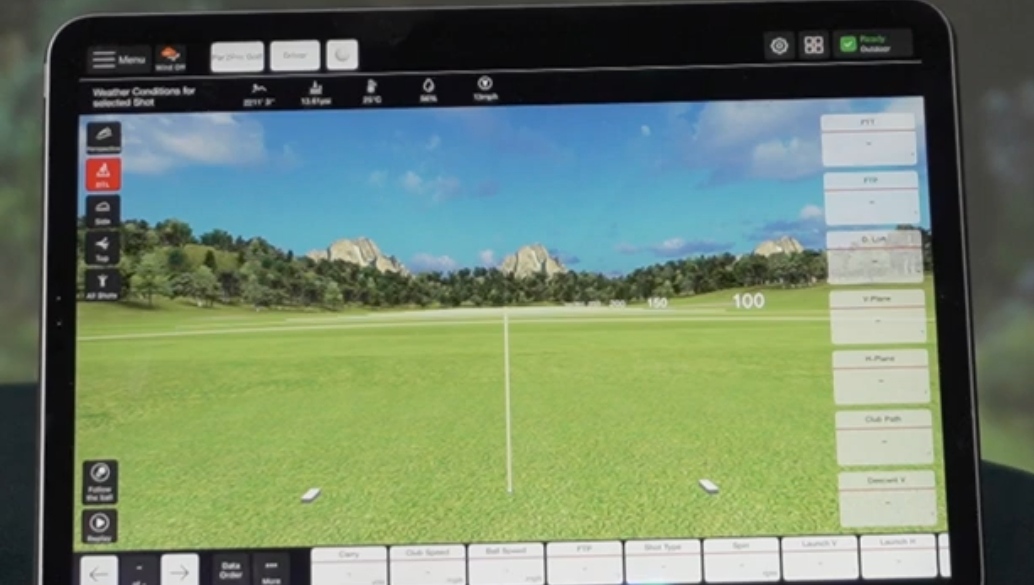
    The R-Motion golf simulator uses photometric technology, which measures swing and ball data and provides instant feedback on a range of clubhead and ball statistics. It measures clubhead and golf ball contact data with a high-speed camera while the device’s software calculates the ball trajectory and distance.

    R-Motion Golf Simulator

    $48

    • R-Motion includes club-attached sensors to capture swing data, such as club speed, path, face angle, and impact conditions, providing insights for improvement.
    • it delivers a lifelike virtual golf experience, allowing play on various courses from home.
    • Simple attachment of sensors to golf clubs, software installation on a computer or device, and optional projector/screen connection make it user-friendly.
    • Real-time feedback on swing metrics helps users analyze their shots and make necessary adjustments.

    When I went to a set-up shop for the off-season, I realized Rapsodo discontinued the whole program of the R-Motion and not just the device itself – software that I needed to update. 

    People still use the dongle and 14 clips, and I brought it to an indoor practice facility last week, along with a Foresight tracking system. The two systems track different data points, so it is difficult to tell whether R-Motion was accurate or not.

    However, the R-Motion was close for the most part, and the flight path was comparable. There were shots that the two provided very different numbers.

    In the rest of this article, you will learn all you need to know about the Rapsodo R-Motion Golf Simulator and Swing Analyzer to help you determine if it’s worth your investment. 

    Rapsodo R-Motion Golf Simulator Specifications

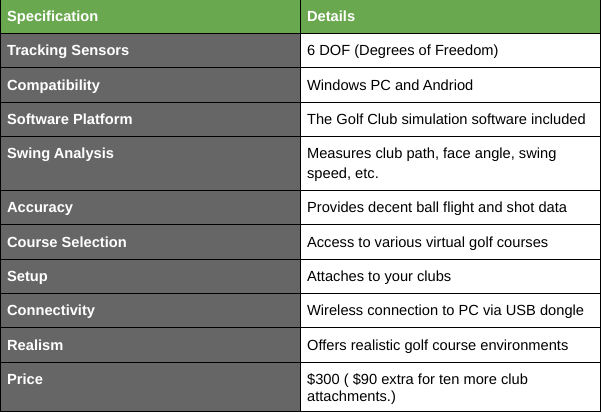
    Here’s a tabular list of some relevant specifications for the R-Motion Golf Simulator:

    Key features

    The Rapsodo R Motion golf simulator is a sensor you clip to your golf clubs to detect swings. You then sync the sensor with your phone or PC to obtain important swing data. Here are the key features of this club: 

    1. Swing analysis: The R-Motion system includes sensors that attach to your golf club and capture data about your swing, including club speed, path, face angle, and impact conditions. This data is then used to provide insights into your swing mechanics and helps you identify areas for improvement.

    2. Realistic simulation: The system works with The Golf Club simulation software to provide a virtual golfing experience. It tracks your club’s movement and translates it into a simulated golf shot on a screen. This allows you to play rounds of golf on various virtual courses without leaving your home.

    3. Ease of setup: It’s an easy-to-use option since the sensors attach to your club without requiring significant modifications or adjustments. The software is typically installed on a computer or other compatible device, and you might need to connect to a projector or screen for the virtual course display.

    4. Accuracy: The R-Motion isn’t as advanced as some high-end golf simulators, but it offers reasonable accuracy in capturing swing data and translating it into virtual shots. The number of attachments you use, the sensor calibration, and the club type will also influence the accuracy.

    5. Data feedback: The system typically provides real-time feedback on your swing data, allowing you to see the results of your shots, analyze your swing metrics, and make adjustments accordingly.

    6. No golf mat or net: The Golf simulator does not come with an itstanglet or catch; you must purchase them separately. However, you can achieve a more immersive experience by hooking your laptop to a projector and ng into a net.

    You should go with a short throw projector like this BenQ MW632ST WXGA  short throw projector so that you can eliminate shadows.

    Accessories

    You get one standard tracker or sensor when you purchase the R-Motion golf simulator. The package also comes with the following accessories: 

    • Classic owner manual to put you through the setup steps
    • Four durable clips are available as standard. (You can supplement t the sensor by buying spinster clips, which cost close to $100 more, so you don’t have to remove and install them for every one of your clubs.)
    • Software is included in the “lite” version. It has 15 virtual golf courses and a driving range. You can download it for free.
    • You can access the app from your Google Play Store.

    How To Use R-Motion Golf Simulator: Step-by-Step Guide

    It’s super easy to work with the R-Motion, but most cases where it gives wrong data are traced to improper installation in the first place. Here’s a step-by-step guide to help you get started:

    Step 1: Unboxing and Initial Setup

    Unbox the R-Motion Golf Simulator package and identify the sensor, the clip, the charging cable, and the manual. Then, Charge the sensor using the provided charging cable. It has to be a fully charged sensor before using it. 

    Step 2: Installing the App

    Now, you must install the compatible app on your device (smartphone, tablet, or computer). You can find the app on app stores or the R-Motion website. Download and install the app that corresponds to your device’s operating system.

    Step 3: Mounting the Sensor

    Attach the clip to your golf club (preferably the club you’ll be hitting the most shots with).

    Slide the R-Motion sensor into the clip securely. Ensure it’s positioned so that the camera faces you as you hold the club, as this will determine the accuracy of your shots.

    Step 4: Connecting the Sensor

    Turn on your R-Motion sensor by pressing the power button. Open the installed app on your device and use the app’s instructions to establish a Bluetooth connection between the sensor and your device.

    Step 5: Calibrating the System

    Follow the app’s on-screen instructions to calibrate the sensor. You’ll need to set up a few parameters like club selection, lengths, and ball position. 

    Step 6: Starting a Session

    Once calibrated, you’re ready to start a golf session. Choose a golf course or range to play on using the app. The app will display available options. Select the club you’ll use from the app’s menu for the shot.

    Step 7: Taking Shots

    Position the ball on a hitting mat and address the ball as you would on an actual golf course. Make your swing, aiming to hit the ball cleanly and squarely.

    The sensor will track your swing and ball data, and the app will display the shot’s outcome, including distance and direction.

    After each shot, the app will provide data about your image, including distance, ball speed, launch angle, and more. You can use shot analysis to identify areas for improvement in your swing and gameplay. 

    I particularly love how GolfAllYear demonstrated the setup process in the video below.

    Pros And Cons

    The R-Motion is a discontinued product, so there’s no support for it. However, if you’re lucky enough to get this on the market, here are a few pros and cons that I noticed while testing this simulator and swing analyzer that you should keep in mind: 

    What I like about the R-motion Golf simulator

    • Good graphics
    • Easy-to-use lightweight sensor clips
    • Gaming features such as 15 courses, a driving range, and a multiplayer option
    • Easy to put together
    • It’s not expensive. It has an auto rewind feature to monitor your ball flight closely.
    • Compatible with any golf club, including your own

    What I like about the R-motion Golf simulator

    • There have been growing reviews on how connecting to the dongle is challenging.
    • It doesn’t come with a hitting mat and impact net 
    • Inconsistent in reading short chips
    • No official product support
    • It doesn’t work with the Mac operating system

    The Price

    You won’t find the R-Motion kit listed or available on the official Rapsodo website because it’s discontinued.  I have linked to it on Amazon a number of times here, but it’s hit and miss if it’s in stock.

    However, the golf simulator retails for around $300 through Amazon, Walmart, and other online shopping platforms. You could even get a more affordable deal at Ebay. 

    However, the standard purchase comes with the sensor, four club attachments, and a “Lite” version of The Golf Club game with fifteen courses and a driving range.  

    You’ll spend an extra $90 to purchase ten more attachments, which you can use on your other golf clubs. 

    Wrapping up

    With a single golf simulator kit, you can obtain club data, including club path, swing speed, and club face angle, and b, all data such as shot distance, side spin, back spin, ball speed, and launch angle. It’s a bang for a buck. 

    However, based on the entertainment factor, ease of use, and ability to improve the user’s game, I will choose a better alternative, like the eOptishot 2, over the R-Motion. 

    Indeed, Raposodo R Motion will give you robust shot data, but it reads inaccurately sometimes, and it’s a discontinued product. 

    If you must buy a Rapsodo compact and budget-friendly simulator, I recommend the brand’s latest Mobile LaunchMonitor instead, which uses more effective radar technology. 

  • Cube Golf Cart Review

    Cube Golf Cart Review

    The Cube golf cart is super compact and sticks out from many other push trolleys I’ve tried regarding maneuverability. However, the negative reviews about its flimsy handle appear to be valid. I walk a lot, and the course isn’t too hilly. But after a couple of months, the handle won’t stay locked. The Cube golf cart design is cheap but not ideal for long-term intensive use. 

    After coming across the 9-hole study by Dr. Neil Wolkodoff of the Colorado Center of Health and Sports Science, I became more interested in push trolleys than two-seater golf carts after learning that players who used a push cart burned 718 calories during their game. 

    The redesigned Cube trolley has been Motocaddy’s best-selling push trolley for the last couple of years, especially given that it’s 40% smaller than typical push trolleys while still retaining a lot of functionality.

    Cube Golf Cart

    Cube Golf Cart Review

    $149

    • Quick Setup and Fold-Down
    • Its compact size, especially when folded down, ensures excellent portability, making it easy to fit in small car trunks.
    • Despite its simplicity, the cart provides storage spaces for a scorecard, drink, keys, wallet, rangefinder, and more, enhancing convenience on the course.

    I have been using the Cube Cart 3 model cart for about five weeks now, and the most lovable thing about this product has to be how it collapses into a relatively small compact unit. The wheels are easy to put on and take off, and it is lightweight. 

    Suppose you’re planning to purchase the Cube Cart 3. In that case, this article will interest you because I have explained in detail, in the rest of this article, my experience using the Cube Cart 3, its vital specifications, benefits, and areas where this cart could have been better. 

    Cube Cart 3 Specifications

    Below are the key specifications of the Cube Cart 3: 

    Weight14.5 lbs 
    Compact folded size21″ x 13″ x 17″
    Folding systemTwo-step folding system 
    Handle mechanismThree height-adjustable positions
    TiresFriction-free oversized wheels with maintenance-free rubber tires
    Material Rubber
    Color optionsCharcoal + (Blue, Black, Red, Lime, White)
    Price$149.97

    Key Features 

    First of all, the back wheel base of this cart isn’t broad enough, and the coach is very lightweight. So it’s best used on flat golf courses

    If you are playing a hilly course, it is tough to balance walking on the side of a hill where one back wheel is lower than the other. But away from that, here are the key features of this push trolley that make it stand out.

    Easy Set-Up and Fold-Down

    CUBE boldly claims its push cart is the world’s fastest 2-step folded golf cart. Setting it up or breaking it down is seamless when you pull the cart from your car trunk or are ready to put it back into the trunk for transport. 

    To assemble the cart, you only have to:

    • Pull the locking lever upwards
    • This will release the folding lock
    • Use the locking lever to pull the frame upwards until fully extended.

    Breaking down the unit also has a straightforward process: 

    • Release the locking lever 
    • Lower the handle
    • Push the upper bag support down towards the front wheel
    • Resecure the locking lever.

    Compact Size 

    The compact size of the Cube Cart 3 is perhaps the most impressive feature of this push cart, especially when it’s folded down. 

    The last thing I want when using a push cart is less portability, especially when I don’t have a big trunk. 

    I like that the folded-down CUBE Push Cart fits into it with ease. 

    Spaces and Accessories

    Being a simple construction, it’s pretty impressive that the manufacturers could still integrate standard storage spaces for a scorecard and a drink. There’s also an accessory compartment for keys, wallet, rangefinder, and what have you.

    The blessing of this cart, as far as storage spaces go, is that I no longer need to dig through my bag to locate things like golf balls since I can toss them into the compartment.

    The Performance

    The first noticeable feature of the Cube golf cart that hints at its performance is the easy-run, friction-free, oversized wheels. The rubber tires are also maintenance-free. 

    Cube also uses a smarter-designed braking system that takes effect when you step on the small peddle. I prefer this system to struggle with push carts with the hand-operated brake system. 

    I have made many reservations about the quality of this push cart’s handle. Still, the silver lining is its adjustable height control, offering three different setting options. 

    Sometimes, the front wheel pulls to one side. When this happens, How do you adjust the front wheel on a Motocaddy Cube?

    You can adjust the alignment by the tiny screws on each side of the front wheel. So if your cart is veering right, turn the left screw counterclockwise and the right screw clockwise (and vice versa)

    Cube Golf Cart Pros And Cons

    Cube Golf Cart gets a lot of love because it’s lightweight, folds up nice and small, and fits into even a tiny car trunk. So, in terms of compatibility, it’s a perfect product. However, after testing this cart for about five weeks, I was able to identify the following pros and cons of this push cart:

    What I like about the Cube golf cart

    • The wheels are wide and lightweight, so it’s seamless moving in the morning dew of the fairway or the long, rough.
    • The back rack has notches that are spaced perfectly for stand bag
    • The spacing of the handle is comfortable
    • The handle is adjustable in 3 modes, an essential aspect for a golfer like me who is 6-2.”
    • It’s a reasonably priced golf cart to keep your clubs rolling.

    What I don’t like about the Cube Golf cart

    • It is not compatible with every golf bag type, especially ones that have kickstands with full-hinged systems, because the legs extend as the cart rolls along.
    • The cup holders will only accommodate narrow bottles (read: 20oz soda cans) and won’t sit in modern wine bottles. 
    • It is not the most durable option in the market, especially compared to Sun Mountain Golf Speed Cart V1R.
    • My iPhone “plus” doesn’t fit with the enclosed tray. This may be nitpicking, but it’s essential to know that not all phone types will fit into this compartment. 

    My Final Take

    After combing through dozens of reviews on this push golf cart, I noticed that many people consider it for its portability. 

    The Cube golf cart has a small footprint when folded, is relatively easy to open and close, and is lightweight for lifting into and out of the car trunk. The brake works efficiently, too, and it locks nicely. Now for the bad: The manual says the front wheel is adjustable for alignment. 

    Unfortunately, the product is somewhat flimsy due to its lightweight nature and will likely be unstable on hilly terrain. No matter how carefully I maneuvered the cart up or down hills, it always seemed to tip and once nearly tipped over. 

    The umbrella holder also has a flimsy feel. While it holds an umbrella securely, the holder and the upper structure are made from plastic, so the umbrella sways fore and aft as you walk. 

    Overall, I’ll call this a decent golf cart if you like to walk a lot. Some flaws may be nitpicky, but this is not a valid option if you want something extremely sturdy. 

    Let me know what you think about this Cube golf cart in the comments.

  • Ellewee Golf Cart Review

    Ellewee Golf Cart Review

    Ellewee golf cart storms the market uniquely. It answers the prayer of golfers and course managers looking for a compact, fast, eco-friendly, affordable cart to move around the fairway.

    I particularly enjoy the engine brake for safe downhill riding and the gyroscope that saves the cart from tipping over. Selling for only $6,500, the Ellewee golf cart takes time to charge and doesn’t have a canopy or windshield to save you from sun, rain, and dust. So brace up!

    It’s super interesting to see how technology in the golf industry has spread its tentacles from clubs and balls into on-course mobility. It gets more interesting when we consider models like the four-wheel single-rider vehicle produced by Ellewee.

    According to the manufacturer, their golf carts, produced in two main lineups – Easy and X models – and powered by a lithium battery, hold a charge for up to four rounds a day or about 65 kilometers. 

    I decided to purchase the Ellewee Easy Golf cart buggy listed on PowerHouse. The initial goal was to test the machine, see how it lives up to the hype, and give an honest review. But gladly, at the moment, it has become the present replacement for my Axis NV ACE. 

    In the rest of this article, I will walk you through all you need to know about Ellewee carts for golf courses. The information you gain from this article should help you decide if this model is worth your investment. 

    Ellewee Golf Cart

    Ellewee Golf Cart Review

    $4,950

    • Single Rider Efficiency: Takes approximately 25% less time compared to ordinary two-seater and four-seater golf carts.
    • Low Turf Impact: Tires run at just 3.2 PSI, reducing damage to the golf course turf compared to the typical 5.7 PSI of other golf carts.
    • Electrified Power-Train: Powered by a cutting-edge power-train control system developed by Cabeco, a renowned automotive manufacturer.
    • Green and Affordable: Ellewee is the first green and affordable multi-purpose vehicle in its class.

    Ellewee Easy Golf Cart Buggy Specification

    Below are the specific and technical details of the Ellewee Easy Golf cart model I currently use: 

    Dry weight (with battery) 160kg (350lb)
    Total weight (Dry weight + Max load)320kg (705lb)
    Max load front multi-holder 30kg (66lb)
    Max load rear multi-holder 30kg (66lb)
    Lithium Battery 48V 63Ah or 48V 100Ah
    Recharge 15A/h
    Factory speed setting 20 km/h (12mph) (there’s an optional maximum speed of 25 km/h)
    Ground clearance10 cm (4in)
    Seating capacity One occupant
    Parking brake Electric (switch controlled)Electric (controlled by switch). It has a mechanical drum brake on each side
    Motor 1500 W, 3500 rpm
    Tire size16 x 7,50 – 8 (Turf)
    Rim size 8 x 5,5 (Alluminuim)
    LightsFront light LED, 12V Rear Light LED, 12V
    Motor controllerASI USB outlet 2 x 5V 3.1A

    Ellewee Golf Cart Key Features

    What makes the Ellewee carts stand out from the crowd (which is already saturated by the Big 3 – Yamaha, Club Car, and EZ-GO) is that it’s a single rider that has been tested to take roughly 25% less time than when using ordinary two-seater and four-seater golf carts. 

    However, after using the Ellewee Easy for a few months, which shares a lot of similarity with the Ellewee X model, I could identify other unique features of this golf cart that underscores what the manufacturer claims on the website. For example: 

    • The tires cause less damage to the turf because they run at just 3.2 PSI, almost half of the typical golf cart PSI of 5.7.
    • Ellewee offers gyro control, GPS, lane assist, and auto-breaking because it is powered by an electrified power-train control system developed by Cabeco, a world-renowned automotive manufacturer. 
    • It is the first green, affordable, multi-purpose vehicle.

    The Appearance

    The Ellewee Easy and X golf cart models look a lot alike. But there’s a noticeable difference in utility, especially haulage. Easy Golf Cart lets you carry your golf bag at the front, while the X model puts the cargo holder at the rear. 

    Available in only super matt black, dental white, and deep blue metallic, Ellewee golf carts are designed with ATV in mind but move like a scooter. 

    The Performance

    Ellewee golf carts need 4 AGM 12-volt batteries to run, and it has a simple charging system. However, telling when the battery will go out is always unpredictable. This applies to all electric golf carts

    On the performance side, the single-seater cart lessens its speed whenever the charge goes down. It has a charging time of 8 hours, which is a relatively slow charge compared to most other electric golf carts. Let’s not talk about when the batteries get older and perform less in holding heads. 

    This scooter-like golf cart may only be your best option if you can commit to a particular charging routine. 

    The Speed

    The first bold claim that the Ellewee brand slams to our face is that the single riders make your rounds 25% faster than two-seaters. 

    After testing the Easy Buggy model, I am happy to see that this lives up to the hype. What is even more interesting is the comfortable feel during this fast ride. 

    I like the large and lightweight wheels. It takes 50% less air pressure than my Axis NV ACE cart. Even though the low air pressure will eventually make the tires wear down quickly, I can enjoy a smooth and comfortable ride. 

    The price

    Ellewe golf carts sell for different prices depending on the dealer you shop from. However, the price for the two significant lines is between $4,950 and $7,500, depending on the year model. 

    Generally, Ellwee X comes at around $6.500. At the same time, Ellwee Easy Resort costs nearly $8,000.

    This is a pretty affordable option for a golf cart, especially if you’re not looking for a group travel around the golf course and only need a single-seater transport vessel. 

    The Pros and Cons

    I always say there’s no perfect golf cart out there. I almost challenged this idea when I tested the Yamaha Drive-2 EFI QuieTech. But for the Ellewee tech, there are some areas I believe the manufacturer can improve upon, even though it’s an excellent cart. 

    What I like about this golf cart

    • It has a stylish appearance that makes heads turn 
    • The gyroscope saves the cart from tipping over.
    • It moves you faster than ordinary two-seater golf carts
    • You have peace of mind regarding turf damage risk
    • It’s an eco-friendly cart 
    • Geo-fencing keeps you away from off-limit areas.

    What I don’t like about this golf cart 

    • No weather protection. Since it’s a scooter-like golf cart, it has no canopy or windshield for sun, rain, and dust. 
    • The charging time can be shorter.

    My Final Take

    Most golf cart manufacturers focus on creating a sweet mix of incredible looks and excellent performance. That’s what sells in the cart industry. And in my opinion, and based on my experience driving the Ellewee Easy cart, this brand has done a pretty good job in that objective. 

    Being a one-person golf cart, you no longer need to get on a crowded golf cart or pay the cart rental fee. This is a central, unique point of this cart. But at the same time, it’s an egg and omelet situation because the coach doesn’t provide a canopy that saves you from the sun or rain.

    But as long as it carries all my golf clubs and all other needed golf accessories and takes me faster, I think it’s a bang for the buck. 

    Still, it’s somehow difficult to see the real value in this cart when you rent it because you won’t get as much rental fee as a gas golf cart or a 4-seater electric golf cart.

    It all comes down to your preference.

  • Ballnamic Review: Is The Tool Worth It?

    Ballnamic Review: Is The Tool Worth It?

    The Ballnamic App by Ping is a ball-fitting app that crunches data from your input and Ping’s testing to offer recommendations of the five best golf balls you should be playing based on your level. It isn’t tied to a brand or even year of a golf ball and costs $39 for the fitting for one year, with the ability to adjust your preferences and inputs up to five times during this time.

    No matter how you look at it, $39 could be a deal or a waste of money. The Ballnamic app has got many golf enthusiasts talking in recent times. I have tried lots of balls over the past couple of years of getting more into golf, and, to be honest, I didn’t have much confidence that I’d benefit from the app but was interested in what it would suggest.

    So, I considered it a good opportunity to document my entire process of using this app and share with you what you should know about the Ballnamic app from a consumer perspective.

    The American sports equipment manufacturing company Ping has always been an innovator in the golf industry. Ball fitting isn’t new, but the way Ping applied their vast amount of ball data toward online fitting through the Ballnamic app is impressive. Let’s begin with how the app works:

    How Does the Ballnamic Ball Fitting App Work?

    Ballnamic is a web-based ball-fitting tool that uses your swing data and performance preferences to match a specific ball for you.

    It allows you to answer a series of questions about your games, such as swing characteristics and launch conditions, and the website recommends a series of balls, each with a specific score on a 100-point scale, to determine the best match for you.

    Marty Jertson, Ping’s vice president of fitting and performance, told Golf Digest, “One of the most exciting advancements is that we decouple and approximate a ball’s initial launch conditions with its aerodynamic performance.”

    So after you input your swing information, launch conditions or yardages with the driver and 7-iron, and playing preferences (trajectory, feel, short-game spin preference, etc.), you will receive a report of the top five best-matched balls on a 100-point scale.

    The Ballnamic fitting database includes 45 multilayer urethane balls, including Snell, Srixon, TaylorMade, Titleist, Kirkland, Maxfli, Bridgestone, Callaway, Cut, Mizuno, OnCore, Vice, Volvik, Wilson, and XXIO. But it’s constantly being updated.

    Here’s a step-by-step process for using the app to get my ball fitted:

    Using the Ballnamic Fitting Tool: A Step-by-Step Review

    The ball fitting process on the Ballnamic website is a six-procedure data input journey.

    1. Your profile
    2. Driver
    3. Irons
    4. Wedges
    5. Finishing touches
    6. Result

    I’ll walk you through the steps and how I got my golf ball recommendations after inputting details on these areas on the website.

    Step 1: Your Profile

    On the profile section, you have to input your handicap, your current ball model and year, and your zip code, which will tell you your typical playing temperature and altitude to provide the most accurate fitting.

    Step 2: Driver Details

    On the driver’s detail page, the tool will require your launch conditions, including the ball speed, launch angle, spin rate, height preference (mid-high trajectory), and wind performance.

    One thing I love about this section is that you can choose if you don’t know your launch conditions.

    Step 3: 7-iron details

    The Ballnamic tool asks for the ball speed, launch angle, spin rate, and steep landing angle on the iron details. If you prioritize stopping power, consider selecting a more vertical landing angle. But a shallower trajectory preference may be more ideal on soft greens.

    Step 4: Wedge details

    You must first choose how much you want the wedge to spin. And, if you play bump and run chip shots, the high greenside sound is likely unimportant. But the tool gives you the option to choose that. I recommend you choose high importance if you play on a firm and fast green. All the same, you can’t go wrong with a moderate option.

    Step 5: Finishing touches

    In the final section, you get to choose your ball’s softness and firmness preferences and your price preference.

    The waiting time to get a result is very short. In a few seconds, you get a list of five golf balls, ranked on a scale of 0 to 100 percent, matching the data you’ve inputted about your gaming characteristics.

    Step 6: The Result

    As you can see in my case below, the Titleist ProV1X is the best for my game, with a 95.4% match, followed by the Callaway Chrome Soft X, with a 92.9% match.

    Also Read: What are Black Level Golf Balls?

    Is the Ballnamic Fitting Tool any help?

    While the value that pings bring to the industry with the Ballnamic fitting tool can’t be ignored, the virtual aid has faced its fair share of criticism. Prominent brands like Titlest have their own free version of the ball fitting tool, and people tend to compare them with Ballnamic.

    For example, people have expressed how generic the questions on the ballnamic fitting process are.

    Credit: Reddit r/golf

    But there have been contradictory testimonies of how the tool’s recommendations have helped people change their yards for the better.

    In my case, I’m satisfied with the recommendation the tool gives me, and it has substantially helped my game. While others may argue that it’s a “different strokes” situation, the Ballnamic delivers value, and I like that it’s not tied to a particular golf ball brand.

    If the pricing is steep, you can peer with other golf buddies and pay about $10 each. That way, you all maximize the tool’s value while everyone gets a fitting since it lasts for a year, and you can adjust your preferences and inputs up to five times during this time.

    Ballnamic pros and cons

    After testing the Ballnamic web-based ball fitting tool, here are the few pros and cons I noted:

    What I like about the tool

    • The process is straightforward to use.
    • It produces quick results.
    • Brand-agnostic ball fitting
    • The data is proven and substantial.
    • It’s an affordable option to get a proper fitting.
    • Backing of a reputable brand in the golf industry

    What I don’t like about the tool

    • Since it has a 24-hour work window, it can experience data overload.
    • Ballnamic currently supports the U.S. only.
    • They only test balls of 3-piece construction or greater at a price point of $20 or higher. (They update the database of golf balls at least twice a year based on the timing of commercial launch dates, so that’s good to know.)

    Final Remark

    Many of us only do ball fittings when a ball brand offers a free fitting. It is not always easy to find a true brand-agnostic ball fitting. I have observed that many stick with the popular ProV1 because it’s an option you “can’t go wrong with. But is it truly the best ball for your particular game?

    Ballnamic introduces a matrix that includes most ball models and can dial specific details into your swing. Reviewers like myself and other golf enthusiasts have offered various ball reviews or tests.

    While there are mixed reactions to the performance of this tool, we have to admit that nothing on the market currently compares to it. $39 may be the cost of a dozen golf balls. But by plugging in your game specifications and paying that amount, you can learn which golf balls are best for you.

    I’m pleased with the results because I can now play a different ball than before the fitting. And it’s a tool I can recommend to any golfer.

    What do you think about the Ballnamic app? I’d love to read your thoughts in the comment section.

  • Carbite Putter Review – PT Series Explained

    Carbite Putter Review – PT Series Explained

    Carbite putters are made with a cast 304 stainless steel head with a CNC-milled microgroove face that allows you to roll your putts beautifully. The PF 334 and PT 335 carbide putter models are ideal if you like traditional blade shapes. However, if you prefer a larger mallet style for stability, the PT 336 and PT 337 are worth considering. These models are available in lengths of 32″ to 36.”

    Carbite isn’t a new brand, but it may be unfamiliar to some. This could be the ideal brand if you want to get a custom fit and dial in your putting. I know that many golfers like heavy putters. I had played with a Carbite ZH for 20 years, which was “polar balanced” and was a good putter. Since I’m 5’8″ tall, I cut both putters to 29″ from 33. I recently found out about the PT series and decided to test it.

    I like to get over the ball, and I found through practice that the lower on the shaft I placed my hands, the more accurate I was. If you care to shorten your putter, you will find that the head will “feel” heavier after you cut it.

    Many people want to know what is special about the Carbite putter family and how it can help anyone looking for an ideal custom fitting. If this is you, then you’ve landed on the right page.

    Carbite Putter

    Carbite Putter Review - PT Series Explained

    $29.99

    • 304 stainless steel cast construction
    • The Carbite PT Series can be built at 32′′–36′′
    • The Carbite PT Series comes standard with two 5-gram weights

    Carbite Putters: Key Features

    Based in Carlsbad, California, Carbite was founded in 1988. In 1992, Carbite’ introduced “Polar Balanced” technology, which combines heavy tungsten at the heel and toe with lightweight materials in the putter head. Here are the key features of these putters:

    • A larger sweet spot so that square hits are solid and consistent and off-center sensations perform better.
    • Adjustable weight: They come with a five-gram weight as standard, but the stores have access to putter fitting weight kits, and you can buy additional weights in case you want a heavier putter.
    • 304 stainless steel cast construction
    • CNC-milled microgroove face that gives you a great forward roll on your ball to get your ball tracking toward the hole and minimize the deviation
    • It is constructed from 304 stainless steel.
    • Top and bottom sight lines It helps to set the putter head square and ensures the putter’s lie angle is matched correctly to the target line.
    • Micro Groove Technology: The soft 304 stainless steel face features an interwoven face pattern, significantly improving forward roll and reducing skidding off the face.
    • The Carbite PT Series can be built at 32′′–36′′.
    • Weights can be purchased separately or as a kit—available weights: x2 10-gram, 15-gram, and 20-gram weights.
    • The Carbite PT Series comes standard with two 5-gram weights.

    Carbite Putter Models

    There are four models in the range of Carbite putters:

    The PT334: The PT334 takes the design of a traditional blade-style putter, which has been replicated by companies worldwide for several years. It features a plumber’s neck design and a beautifully polished sole. It also has a PVD matte black finish, which I like because it reduces glare.

    The PT335: Similar to the previous model, the PT335 takes on a blade-style design. But what separates it from the PT334 is the slant neck design instead of the plumber’s neck.

    The key difference between these two constructions is how the putters sit in balance. If you have more of an arc-style stroke or prefer one with a little more towing, the slant neck design of the PT335 will favor you.

    If you like more stability in your putter head (the mallet style) or need to improve your putting, you should look into the PT336 or PT337 models of the Carbite Putter family.

    The PT336: The PT336 has a different appearance with its dual fan design and wide MOI, which is pretty long in its head to offer more stability. If you need a straight-through putting stroke, the center shaft of this model will help you achieve that.

    The PT337: Many golfers who use the PT337 model want to maximize the benefits of the P336 but with a blade-style design. It has a more generous mallet side with a double width.

    Tips on Using Carbite PT-Series Putters

    Another important feature in the three blade-style models of the Carbite PT series is the white line indicator on the putter head that lets you know when you hold it up correctly.

    The white lines on the putter would match up when you placed them correctly. It also helps to get the right length for this putter.

    When you go for a fitting for your ideal putter length, the part of the blade-style putter’s sole with the white line should be squarely on the ground, not toe down or heel up.

    When the sole is heeled up, it can cause you to miss the putt to the left. You might push it off to the right if it’s toe-down. So, the dual straight line will help you maintain the correct position of the putter on the ground. This allows you to strike it out of the center.

    The highlight of Carbite Putter Value is that it allows you to get a custom weight and length of the putter to make more putts at a super affordable price point.

    You May Also Like: The Oxygen Putter Review

    Wrapping up

    Putters are very personalized items. So it is normal to see things differently when reviewing brands like Carbite.

    When I stand over the PT series, it feels great, and my results are often excellent. It is a style of putter that suits my game. But I understand this won’t be the same for everyone.

    So, I strongly recommend you speak to one of your team members at your local golf store, and they can show you what the Carbide range is all about and how it can potentially help your game with the option of custom fitting.

  • Lowes Golf Cart Reviews

    Lowes Golf Cart Reviews

    Lowes is a popular home improvement store with a golf cart section. The top options are the Massimo Electric GMF2X, Kandi 2-seat, Axis NV ACE, and the Coleman Black Electric Golf Cart, a famous offer. 

    Five months ago, I got the Coleman Black Electric Golf Cart, and then two weeks later, my father-in-law gifted me the Yamaha Drive-2 EFI QuieTech. I’ve always been a fan of Yamaha, but Coleman from Lowe’s seems affordable for many. 

    I have written this article to review the Lowe’s golf carts, but I will pay more attention to my experience with the Coleman while comparing it with other Lowe’s golf cart offers. 

    4 Top Lowes Golf Cart Offers

    ImageProductDetailPrice
    <a href="https://www.lowes.com/pd/Massimo/5013582179">Massimo Electric Golf Cart GMF2X</a>

    Massimo Electric Golf Cart GMF2X

    • Stylish.
    • Digital instrument panel
    • Built-in Bluetooth sound system.
    $9,879
    <a href="https://www.lowes.com/pd/Coleman-Powersports-Coleman-DR48V-B-L-Electric-Golf-Cart/5013732301">Coleman Black Electric Golf Cart</a>

    Coleman Black Electric Golf Cart

    • Affordable for its value 
    • Spacious
    $9,499
    Kandi 2-seat Electric Golf Cart

    Kandi 2-seat Electric Golf Cart

    • Compact, maneuverable electric golf cart for two passengers only
    $8,549
    <a href="https://www.lowes.com/pd/Axis/5013317025">Axis Golf Cart</a>

    Axis Golf Cart

    • Sturdy construction for rough terrain and fairways
    $8,549

    * Prices noted on the chart above are based on the official Lowe’s website listings.

    My Lowe’s Coleman Kandi Cart Golf Cart Review 

    Coleman is under the Craftsman label, but Kandi is the company that makes it. After driving this cart for a few months, I’ve identified some areas I genuinely love about the coach and some areas that could have been changed or improved. 

    If you’re also considering a golf cart from Lowes, the Coleman may pique your interest, and I will show you the areas to consider before throwing your money into this unit. 

    The key features

    1. Turn signals are installed close to the steering wheel and horn.

    2. Front and rear seatbelts. Also, grab handles for the rear passengers 

    3. It has an extra two at the rear that doubles as a rear bed to give it a pickup-like appearance for added storage if you don’t have four passengers. 

    4. Extended top roof, which is unique because many golf carts have a top that covers only up to half the length of the Coleman EV cart roof. So, the extension shades the extra two passengers at the back.

    5. Armrest for rear passengers with integrated cupholders and slots for cellphones or other valuables

    6. Fold down the windscreen

    7. There’s a storage underneath the rear seat.

    The Appearance

    The Lowe’s Coleman golf cart is elegant and stylish. I particularly love the diamond-style stitching of the seats. It has excellent craftsmanship. However, the quality of the frame can be better, especially when I compare it with my new Yamaha Drive-2 EFI QuieTech. Some of the components of this golf cart look cheap, but it does the job pretty decently. 

    The front seat has a full LED display, storage on either side, cup holders, and a fold-down windscreen. The cart is available in a matte black finish or silver, the only two color options from Lowe’s. 

    The Performance

    Equipped with a 48-volt AC motor, this model provides smooth acceleration and can reach a top speed of 25 mph. It has a full suspension, front disc brakes, rear drums, and great coil-over shocks, and the cart comes already lifted from the factory. The cart also has sealed batteries and onboard chargers; you only need a cord. 

    However, one thing I don’t like about this Lowe’s cart is that it has no regenerative breaking, making it unfriendly. It has a quarter inch on the brake pads, and if you’re pounding on the brakes going down a grade, they will wear out extremely quickly. 

    Speed

    The Coleman golf cart has a top speed of 20 mph, but it has a 5,000-watt motor, the same size as other Lowe’s carts that are 25+ mph. Coleman Powersports states this model is 20 mph and 40 miles on full charge.

    Customer Support and Warranty 

    The Coleman golf cart from Lowe’s comes with Coleman’s back warranty for two years. They’ve also got over 800 nationwide stores, and people talk about their excellent customer support. 

    However, the challenge with these Chinese products is that finding replacement parts may take time and effort. 

    The Downsides of This Cart

    There’s no perfect cart out there, but the Coleman Cart showed me a lot of red flags. If you’re planning to cop this Lowe’s golf cart, keep the following downsides in mind: 

    • The cup holders are small. There are only three small ones across the front and one that would fit a smaller koozie, but that’s all about it. Nowadays, people have larger containers and Yeti’s that may need to fit into the size of the cupholders.
    • Also, the storage compartment below this Coleman cart’s steering wheel needs to be bigger. I could barely fit a baseball cap into the space, which makes it less utilizable. 
    • When you fold down the rear seat, you are supposed to find a cooler in the compartment underneath the bed. However, the Coleman doesn’t come with a more astonishing insert, and you’ll have to purchase it separately for about $100, which is silly. 
    • This is nitpicking, but not everyone likes the ridiculously loud backup speaker. You can enter through the driver’s front wheel, where you find two smaller round speakers for parking breaks and backup sound. So, you disconnect it to discontinue the sound. 

    Final verdict: Should You Buy A Lowe’s Golf Cart?

    After testing the Coleman from Lowe’s, I’m sad to conclude that despite being a good-looking unit, I won’t hastily recommend it to any interested person, even though they are on a budget. The features are decent, and the cart moves you from point A to B around the golf course with no issues, but I’ll pass on the Coleman and keep my Yamaha or even go with another Lowe’s golf cart like the Axis NV ACE. 

    I’ve been testing golf carts for a while now, and It’s fair to conclude that on the top of the scale, especially in terms of proven name and solid products, Club Car takes the number one position ahead of EZgo and Yamaha. 

    If you must step down from this trifecta, consider newer manufacturers like Icon, Advanced EV, and Evolution, who are already doing a great job competing with the Big 3 (Club Car, Yamaha, and Ezgo). Still, they may be here ten years from now. This is a significant concern when you are considering other component replacements. But their affordability makes them worth considering.

    Based on my conversations with people and comments on Facebook groups, the bottom of the scale has to be buying a golf cart from a big box store. I have no hard feelings about Lowe’s golf carts, but I’ve read about people being completely helpless when they had an issue with their cart because the store wouldn’t fix the problem and the local dealers couldn’t get parts, or they didn’t want to touch a coach from a big box store.

    So Lowe’s may exclusively have some golf carts, but there are more downsides to consider than the good sides. 

    I hope you found this article helpful. 

  • Oxygen Putter Review – All You Need To Know

    Oxygen Putter Review – All You Need To Know

    Oxygen storms the putter market with two product lines: the Oleander and the Trillium Putter, selling for $129 and $119, respectively. The Oleander Putter dramatically enhances the visual interpretation of a golf putt using break lines, while the Trillium is a traditional blade putter with incredible consistency and feels old-school.

    One of the most neglected areas of the golf game by beginners is the putting green. The sad truth is that poorly made putters can and will sabotage short games and stunt potential growth. Having spent the last 30 years in the golf industry, I have used a lot of golf. I recently found a video online where professional PGA-certified golf instructors tested the Oxygen putter at the PGA merchandise show demo day in Orlando, Florida.

    I became interested in this brand and decided to purchase and test the two lines. Upon further research, I discovered that The Golf Channel’s Matt Ginella chose Oxygen Putters as his ‘Best New Product’ at the PGA merchandise show. I also realized a buzz on forums like GOLFRX about what this putter model does to golfers’ short game.

    In the rest of this article, I will walk you through a full review of Oxygen putters and all you need to know about these models to help you decide whether it’s worth your consideration.

    Oxygen Putter Models

    Currently, there are two models of the Oxygen putters:

    • Oxygen Oleander Putter
    • Oxygen Trillium Putter

    The brain behind these duo putters is Bernie Fay, owner of The MISIG (Most Important Stretch In Golf), a golf stretching, swing training, and exercise or cardio device.

    These sets stand out from the many options on the market because they are made with bone piano keys for a golf putter insert face, unlike the popular plastic insert face or metal or alloy aluminum, brass, or copper.

    Also, these oxygen putters are made with sheepskin leather grips instead of rubber grips, which makes them feel softer and silkier. “It carries the feel of a putt through the hands much better than rubber,” Bernie says.

    Oxygen Putter Specifications

    Below is a quick rundown of the comparison of both putters:

    SpecsOxygen Oleander PutterOxygen Trillium Putter
    Forgiveness and feelingThe cavity is hollow and filled with proprietary injected foam or polymer.An “old school” blade putter with proprietary insert face backing
    Design3-dimensional raised putt breaking lines for visual interpretationCNC-milled face
    FaceBone Piano Key Insert FaceBone Piano Key Insert Face
    Shaft34″34″
    Loft3.53.5
    Lie7171
    Toe HangMedium Medium
    Grip designSheepskin LeatherSheepskin Leather
    Custom embroidered head coverIncluded Included
    Price$129$119
    ImageProductDetailPrice
    <strong>Oxygen Oleander Putter</strong>

    Oxygen Oleander Putter

    • Visual interpretation design
    • Unique appearance and material design
    • Ideal for beginners
    Buy Now
    Oxygen Trillium Putter

    Oxygen Trillium Putter

    • Unique appearance and material design
    • Excellent feel and grip
    • Ideal for those who still like the traditional blade-style putter
    Buy Now

    Using the Oxygen Oleander Putter

    The most fascinating thing about the Oxygen Oleander putter has to be the brilliant visual interpretation design on the putter head that gives you a directional prediction of how your next golf putt will go on the green.

    As you can see in the image below, the putter has raised three-dimensional putt break lines.

    When you hit the ball directly on the face of the first line, the putt rolls straight and then breaks left to right late. Hitting the putt on the front of the second line will make it break left to right early, then move straight.

    The third line will make the putt roll left to right and break over the entire putt, while hitting the ball on the face of the fourth line will give you a straight putt and a “double breaking” putt.

    The fifth line on the Oleander putter head causes the putt to break right to left over the entire putt, while the sixth line causes the putt to break right to left early and then roll straight. When you hit the ball on the face of the seventh line, the putt rolls straight and then breaks right to the left.

    See how the Oxygen Oleander putter works in the video below:

    What I like about this putter

    • Visually creates a much better target line.
    • Ideal for beginners
    • Great feel and grip
    • Unique appearance and material design
    • 60-day free returns

    What I don’t like about this putter

    • Not customizable
    • It can be expensive for budget-conscious golfers who do not want used products.

    You May Also Like: The Carbite Putter

    Using the Oxygen Trillium Putter

    The Trillium golf putter features a solid 431 stainless steel head, CNC milled face, and concert-grade piano key insert face.

    The CNC-milled microgroove face gives you a great forward roll on your ball to get your ball tracking toward the hole and minimize the deviation. If you like more stability in your putter head (the mallet style) or need to improve your putting, the Trillium model is an ideal option.

    Like the Orleander putter, this model has a silky smooth real leader grip, which puts me in full control of my putting better than rubber grips.

    What I like about this putter

    • Ideal for those who still like the traditional blade-style putter
    • Again, excellent feel and grip.
    • Unique appearance and material design
    • 60-day free returns

    What I don’t like about this putter

    • I couldn’t pinpoint a particular defect in this putter.
  • Tommy Armour Golf Club Review – The 845-MAX Iron

    Tommy Armour Golf Club Review – The 845-MAX Iron

    Tommy Armour (TA) clubs are actually good, but they are not the right fit for all players. After testing the popular models, the A1 and 845 irons, I realized that these clubs are forgiving and will best benefit higher handicappers and beginners. And you can find them at affordable price points today. So it’s a budget-friendly alternative to the big names.

    I grew up playing knockoff Armour 845s, and I loved the clean, thin topline and lack of offset with the head (I speak for many golfers when I say big, bulky irons are overrated).

    About seven years ago, I looked for a new iron set and tried many different options until I considered the Taylormade 2005 Rac TP’s, but the $1000 price was too steep for my budget.

    Fortunately, I found a Tommy Armour Silverback 845m set in a golf warehouse. As always, these golf clubs have appealing looks and a convincing price tag (roughly around $399 in my case).

    But similar to many golfers’ perceptions of Tommy Armour clubs today, I was concerned that I wasn’t good enough to play a blade. To my surprise, as soon as I started hitting them in the store, I fell in love with this set—it includes a driver, 3 and 5 woods, 4 and 5 hybrids, and 6-AW.

    I decided to write an extensive review of how these golf clubs work and the kinds of players they will benefit. If you’ve been considering the Tommy Armour Golf Club, this review will walk you through the important things you need to know to help you make a better decision.

    Tommy Armour Golf Club – 845-MAX Iron

    Tommy Armour Golf Club- The 845-MAX Iron

    $63/Iron

    • High distance potential: The Tommy Armour TA 845-MAX 7-iron falls into the super game improvement category, offering impressive distance compared to other game-improvement irons.
    • Forgiving appearance: The club’s design, including a large cavity, thick topline, and decent offset, instills confidence and suggests forgiveness.
    • Lower-spin design: These irons have a lower spin profile, which can help achieve the desired distance while still generating enough spin for control.

    Tommy Armour 845-MAX Specifications

    The Tommy Armour 845-MAX irons come in a 5-iron through AW set, and you can use graphite shafts or lightweight SL85 steel shafts.

    Iron56789PWAW
    Loft24°27°31°35°40°45°50°
    Length38.5″37.75″37.25″36.75″36.25″35.75″35.5″

    Tommy Armour Golf Club: My Review

    1. Game-improvement iron for distance: The TA 845-MAX 7-iron is categorized under the super game improvement category, so it was not surprising that I experienced more space than the game-improvement counterparts. Perhaps this attribute comes at the expense of workability and stopping power.
    1. Loft performance: When I compared the TA’s performance with the Taylormade 2005 rac TP’s I planned to cop, I did notice that the 845-MAX 7-iron was three degrees weaker than its counterpart.
    1. Spin and decent angle: The ugly side of these irons, as far as stopping power goes, is that they don’t help to shoot lower scores because the TA 7-iron has a stop angle of between 44 and 48 degrees. I recorded 48.7 degrees in my testing. This may not be a big deal for golfers who don’t pay attention to decent angles. But let’s face it, hitting greens is hard, especially if you are in the super game improvement category.

    From my experience with this set of irons, I’ll call them lower-spin. The steep descent angle gave me enough spin. At the same time, it has a low enough spin to reach the desired distance.

    1. Accuracy: Again, Tommy Armour golf clubs are pretty old. So, I can develop several clubs in a similar category—modern ones—that will outperform the TA 845-Max accuracy-wise. Still, these irons produced a consistent shot shape, shot after shot, and misses were less frequent offline. They didn’t do a satisfactory job of shaping the ball at will, but I’m pleased with the straighter ball flight and tighter dispersion pattern I got.
    1. Appearance: I like the standard and stylish appearance of the Tommy Armour golf clubs. From a glance, the physical features reveal that it’s a forgiving iron. From the large cavity to the thick topline, the decent offset volume and colors are all on point.

    6: Feel: Many owners have confessed how impressed they are with the solid impact that the 845-MAX offers. When you give it a well-struck shot, it rewards your effort with a good feeling. Most importantly, I like how my mishits had the right feedback for me to know about them.

    Tommy Armour pros and cons

    Over the years, I have hit a lot of irons, and it didn’t take long for me to pinpoint the highs and lows of my experience hitting the Tommy Armour 845-MAX irons.

    Here are the benefits and disadvantages to keep in mind or expect when using this set of irons:

    What I like about the Tommy Armour golf clubs

    • Ideal for beginning golfers who want to improve their game
    • Works well for budget-conscious high-handicappers
    • It can help improve your game, as slower swing speeds prefer lighter clubs.
    • Wedge selection got easier with a reasonable loft without sacrificing distance.
    • Affordable old-timey golf clubs
    • You can choose between steel or graphite shaft options.
    • Decent amount of offset

    What I don’t like about Tommy Armour golf clubs

    • The design of the club head makes the appearance too busy. A little simplicity would be better. But this can still be considered nitpicking.
    • Mid-handicappers or expert golfers won’t find value in these old sets of irons.

    Final Remark

    The deal with Tommy Armour golf clubs is that they don’t have maximum feel and performance. There are modern clubs that will serve such values better. But if you’re a higher handicapper or beginner and use outdated clubs and lack forgiveness, you will find this Tommy Armour to be a blessing to your game.

    Most of the options of Tommy Armour clubs listed for sale on platforms like eBay are between the driver and putter lines, and you can find irons for men and women golfers.

    If you’re looking for the highest-performing set of clubs on the market, Tommy Armour isn’t the best place to look, especially when compared to the real big names like Callaway, Taylor Made, Ping, Titleist, etc.

    But I haven’t heard anybody complain about them to me. While the Tommy Armour brand falls into the lower tier, they make quality sets.

    Ultimately, as they say, it’s not always about the arrow; sometimes, it’s the archer. In other words, you can have the best modern golf club, but if you can’t square the clubface at impact, no matter the brand, that ball isn’t giving you a perfect flight.

    So, try any Tommy Armour golf club you have and compare its performance to your current clubs to see if it’s worth replacing.

  • Hisun Pulse Golf Cart Review

    Hisun Pulse Golf Cart Review

    The HIsun Plus golf cart is a good-looking vehicle that also comes at a pretty affordable price compared to many alternatives in the market currently. It doesn’t have the best speed capacity and is not ideal for rugged terrain, but it does a decent job of moving around the fairways and taking on four passengers. 

    Hisun has been in the cart manufacturing industry for years, and they have a series of electric golf carts that have won the hearts of many. If you’re interested in the Hisun Pulse model, there are some things you need to know before going ahead with the purchase. 

    The current talk of the town, as far as golf carts from Hisun go, is the ACE NV unit, but some people still have interest in the Pulse unit. In the rest of this article, you will learn the specifications, key features, pros, and cons of the Hisun Puls Golf cart. This should help you decide if it’s worth your investment or not.

    Hisun Pulse Golf Cart Review

    Hisun Pulse Golf Cart Review

    $7,999

    • Battery Life: 4 x 48V/120Z batteries with a VRLA Charger (intelligent DC 48V/25A).
    • Charging Time: 10 hours
    • Seating Capacity: Four passengers

    The Appearance

    The model has a hard top and a two-piece windshield, but it doesn’t fold down into slots with rubber clamps, as seen in the ACE NV. It has Mirrors on each side for rear visibility.

    There are turning signals installed into the bumper. The model also has a front headlight. What’s nice about the headlight is that it’s low and doesn’t light up the neighbor’s houses but still gives you a grand vision of where you’re driving. 

    The cart has 18 x 8.50-8 turf tires designed for roads and grass, but it won’t tear up your lawn like an actual UTV would. The Hisun Pulse comes in red and has a 4-inch ground clearance. 

    The Dashboard

    There’s a lot of storage on the dashboard, including two cup holders for both sides and two tabs with dual USB slots where you can charge phones and other accessories. It has a crucial place and digital screen behind it where you can see your speed and miles range. Above the dashboard, there’s a lovely extensive mirror with multiple layers, which is also adjustable. 

    Meanwhile, the Hisun Pulse will run approximately 42 miles on flat ground, which most golf carts don’t do with a 48-volt system. 

    Comfortability

    Regarding comfortability for any golf cart, the seating is the first place to look at. The cushion of the Hisun Plus Golf cart has high-quality multiple-layered foam and additional stitching details to give you that comfort that you need on your back and bottom. 

    The legroom space for the front passengers is also ample. However, more could be done for the rear passenger seat. 

     Operation 

    The brake features a system self-adjusting mechanical rear drum and electric suspension. For the steering, it has a two-way pinion and rack system with an automatic clearance compensation function. 

    You can find the control direction at the bottom of the seat. Once you turn the key on, you can pick between forward or reverse. The HIsun Pulse is an elementary and easy-to-use unit. 

    What To Consider Before Picking An Electric Golf Cart

    When buying an electric golf cart, several key features must be considered to ensure you make the right choice for your needs. While you have a model from Hisun in mind, you can compare its value alongside other alternatives with these factors in mind:

    1. Battery life and range: 

    The battery is a crucial component of an electric golf cart. Look for carts with good battery life and a sufficient range to cover your intended usage without frequent recharging. The Hisun Pulse golf cart is 4 x 48V/120Z and uses a VRLA Charger – Intelligent DC 48V/25A. You can consider other powerful alternatives if this doesn’t suit your intense daily usage. 

    2. Charging time:

    Most Hisun golf cart models take 10 hours to charge, which applies to their famous ACE NV neighborhood cart. Consider how long it takes to charge the cart’s battery fully. Faster charging can be convenient, mainly if you have limited downtime between rounds.

    3. Seating capacity: 

    Golf carts have various seating capacities, typically ranging from 2 to 6 seats. The Hisun Pulse only accommodates four passengers. Does this suit the number of passengers you’ll be carrying regularly? If there are more, then alternative models like the Axis. Also, check for features that enhance passenger comfort, such as comfortable seats, ample legroom, and convenient storage options.

    4. Terrain and performance: 

    Consider the terrain you’ll use the golf cart on. Some coaches, like the Hisun Pulse, are designed for smooth fairways, while others have better off-road capabilities. 

    5. Warranty and Support: 

    Research the manufacturer’s warranty and after-sales support. A good warranty can provide peace of mind in case of any issues.

    6. Budget: 

    You want to set a budget and look for options within your financial range. Remember that more features and higher quality may come with a higher price tag. But you can always find a decent brand-new golf cart for around $10,000 to $20,000.

    Finally… 

    Overall, the Hisun Pulse is a decent electric golf cart. I like the appearance and the reasonable performance. 

    However, this cart is only for some. It may work well for moving around your property, but there are better options if you want a heavy-duty, value-packed vehicle. 

    Before making a final decision, I’ll advise you to visit local dealerships, test-drive the models you’re interested in, and gather as much information as possible about the features, warranties, and pricing.

    Feel free to seek ideas from friends or fellow golfers to gain valuable insights into your preferred unit’s performance and satisfaction.

  • Eyeline Golf Review

    Eyeline Golf Review

    Eyeline golf makes golf training aids that are designed, in their own words to “shatter your personal best.”  With a bold proclamation like that, I had to dive in and see what all the fuss is about.

    They want you to “experience the fun of improvement,” which is something that I echo when I train people on improving their golf game.

    Official Website —>  EyelineGolf.com

    eyeline golf

    About Eyeline Golf

    Founded by passionate golfers to create training aids to make everyone have more fun playing the sport of golf, the company boasts 15 of the top 20 players in the world use at least one of their tools in their daily practice routines.  That statement right is one that many golf brands, no matter if it’s a major company like Titleist or Callaway, simply cannot make.

    The company is run by CEO Sam Froggatte, a Kansas City native who got into the game of golf during his teens.  He started as a caddy in high school in addition to being a part of the course watering crew before making his high school golf team and obtaining a scholarship to play golf at the University of Colorado.  Before getting into the golf industry as an Independent Sales Rep, he was with IBM.  Along with his son, Grant, he founded Eyeline Golf in 2002 and released the putting alignment system that he personally designed.

    The company has grown to offer over 50 products that are sold globally.  Their products rank in the best putting mirrors not only with me, but with the best golfers in the world!

    Popular Eyeline Golf Products

    #1:  The Late Night Training System $299

    Late night golf training package
    Take advantage of possibly the best value in golf training aids.

    —> Learn More

    This golf training aid allows you to work on your game any time, anywhere.  It includes a bundle of the company’s top training aids that you can use in virtually anywhere.  Upgrade your golf with this popular bundle of the following products and save $125 versus purchasing them individually.

    The Roll the Rock Putting Matt ($225 Value)

    This is an entertainment hub that has many games of skill you can play to enhance your putting skills.  You can play this alone and work on your putting or get a competition going with friends.  The ball rolls right back to you which allows you to get in a lot of reps and it’s engineered to give you pace control.

    Check Point Swing Laser System ($125 Value)

    This personal swing trainer works for golfers of all skill levels to get your swing plane working to perfection.  The laser dot is traced on the path stripe, and if the dot is on the stripe, you are in the perfect swing plane.  You’ll obtain a more straight, consistent golf shot that you can work on from anywhere.

    Groove Putting Mirror – ($60 Value)

    This putting mirror is used by 16 of the best 20 players in the world, so why not add this to your arsenal?  Built with home training in mind, you simply lay this flat, line it up, view your lines, and gain confidence.  You can view your putter face alignment and eye position with ease with this revolutionary golf putting mirror used by the top pro’s on tour.

    Myroll 2 Color Golf Ball ($20 Value) 

    When you take the perfect golf stroke the center line on the ball will go straight, it’s as simple as that.  Bring your focus using the red Impact Ball line so you can hit the ball square.  If you leave your putter face closed or open you’ll make the center line wobble, signaling you didn’t hit the ball square.  This is a very simple way to find out where your putting game currently is.

    —>Visit Eyeline Golf 

    Create a more powerful golf swing using this simple tool that you can use just minutes a day to improve your game.  Any time you swing your club at the Impact Cube, your club head will highlight any inefficiency in your swing.  As an example, I used this product and immediately found out that my hands were trailing the club when I made impact.

    As you do more reps with this product, you’ll create a swing that fully connects at impact giving you more powerful, consistent golf shots.  Eyeline Golf has a series of videos you can view that will show you many of the practice routines that will elevate your game in as little as five minutes per day.

    —-> Read More

    Overall I found Eyeline Golf products to be among the best out there for improving your golf game from anywhere, at any time.  There is a reason the company has so many top professionals using their devices to help them rack up PGA Tour wins!  And yes, I looked into it, even Phil Mickelson uses these products!

    Do you really need any other endorsement?


  • Axis Golf Cart Reviews

    Axis Golf Cart Reviews

    The Axis EV golf cart (Ace NV) will accommodate four passengers. It runs on a 48-volt electric motor with a charger included and gets a full charge in 10 hours with a 43-mile range. It features four built-in USB ports, a rear flip cargo seat, and a 2-year warranty. It’s an affordable cart for neighborhood and golf course driving, selling for $8,999 on the Hisun website but exclusively available at Lowe’s.

    Golf carts keep improving each year as the electric vehicle revolution sets in. Consequentially, manufacturers are pushing industrial design, and Axis is one of these guys.

    If you are just beginning your search for new (or used) golf carts for sale, you might have come across the Axis Ace NV, among other popular options like Club Car and EzGo. In this review, I’ll take you through a thorough review of the Axis EV golf cart and what you should expect when you purchase this cart.

    Axis Golf Cart

    Axis Golf Cart

    $8,499

    • Battery Capacity 48V 150AH
    • Max Power 13.4 HP/RPM
    • L x W x H: 107″ x 48″ x 79.5″
    • Vehicle Weight: 1221.36 LBS

    Axis Golf Cart Specifications

    The distinctive details about this cart are the 43-mile driving range, 10-hour charge time, automatic CVR clutch, and foldable rear cargo bed.

    But beyond these features, here are the key specifications of this cart:

    EngineElectric
    Battery capacity48V 150AH
    Max power13.4 HP/RMP
    Max torque39.8 FT/LBS
    Max speed20 MPH
    TransmissionAutomatic CVT/direct drive motor
    GearsReverse, neutral, and forward
    Dimension size107″ x 48″ x 79.5″
    Ground clearance5.3″
    Front axle load410lbs
    Rear axle load811lbs
    Passenger capacity 4
    Warranty2-year limited
    Color available Coastal blue and black
    Price$8,499

    Axis Golf Cart Availability

    The Axis EV golf cart is also marketed as a neighborhood car. It is exclusively available at Lowe’s Hardware, the second-largest hardware chain in the United States after Home Depot.

    Hisun makes the cart, and they have a large assembly plant in McKinney, Texas; their services are available at several dealers if you need them.

    Axis golf cart features

    1. The tires of this golf cart are 12 inches with a 3-inch lift, which is excellent. The tires are also built for off-road adventures, which makes them ideal for driving through golf courses.
    1. Turn signals are installed close to the steering wheel and horn.
    1. high-beam and low-beam headlights.
    1. A full windshield that separates—one folds up into the roof, and the other folds down.
    1. It has an extra two at the rear that double as a rear bed, giving it a pickup-like appearance for added storage if you don’t have four passengers. According to Axis, this bed can hold up to 400 pounds.
    1. There’s storage underneath the rear seat.
    1. The extended roof is unique because many golf carts have a top that covers only up to half the length of the Axsis EV roof. So, the extension shades the extra two passengers at the back.
    1. It has a horizontally placed mirror at the top of the roof, which gives the driver plenty of rear visibility.
    1. One large mirror on each side is also adjustable.
    1. There are four USB charging ports in total—two inside each compartment on the dashboard.
    1. Two large cup holders are also placed on the front passenger side of the dashboard.

    The Appearance

    The Axis golf cart is a decent-looking vehicle. There is nothing particularly grand about the unit’s appearance, but I love the extensive shade and rugged-looking tires. It’s also compact and value-packed.

    Related: EVolution Golf Cart Reviews

    Meanwhile, it’s only available in coastal blue and black colors, which limits options for interested buyers online and for most other brands that offer customization.

    The Batteries

    Four AGM batteries power the Axis EV golf cart. These batteries are heavy but not as severe as six lead-acid batteries or flooded batteries. This is the part where I envy models like the Evolusion Classic 4 Plus.
    Nevertheless, the batteries on the Axis golf cart are sealed and maintenance-free. The brand doesn’t have a lithium battery option yet.

    I also like the charger because it automatically shuts off when the battery is full. If you’re taking a long trip, you can take advantage of this and leave the cart plugged in. Meanwhile, the cable charger is 10 inches long.

    Speed and performance

    In my experience, the Axis golf cart goes between 22 and 24 miles per hour at top speed. This contradicts the specification listed on Lowe’s hardware page, which is 15 miles per hour.

    The ground clearance is also decent because it gives you easy access in and out of the car, especially for a person like me, who is six feet and two inches tall.

    The Price 

    The Axis golf cart costs $8,499 on the manufacturer’s official website. However, this is simply the manufacturer’s suggested retail price.

    Depending on where and how you eventually get yours, destination charges, taxes, license fees, or dealer preparation can apply.

    For instance, I got my Coastal Blue Axis golf cart for $9,200. I live in Brackettville, Texas. This is a decent price for a brand-new golf cart that doubles as an electric neighborhood vehicle.

    Is it worth the buy?

    If you’re looking for an electric neighborhood vehicle or golf cart, the Axis golf cart is worth considering. However, there’s nothing grand about this unit.

    It is good-looking and does the job of a Trike or even Yamaha, and the price point is also reasonable. The customer support is also decent; you will find this running at many dealerships. So, overall, it’s a great cart to buy if you’re looking for something average that can stand the test of time.

    Let me know what you think about this golf cart in the comments.

  • EVolution Golf Carts Reviews

    EVolution Golf Carts Reviews

    The EVolution golf cart may have more “features” than many popular models. It’s also affordable, but it doesn’t have the best reputation for durability. It can be a great-performing cart, but be ready to deal with parts unavailability and not-so-great aftermarket support. After researching and testing the EVolution, I recommend someone interested in an electric golf cart stick with one of the “big three: Club Car, EZGO, or Yamaha.

    Despite being in the golf industry for more than ten years, the EVolution company may not have as good a reputation as many of its rivals. However, the premium cart manufacturer claims to be producing the  ‘quickest and most capable golf carts in electric vehicle history.’ The unique selling point of their models is that they are fully electric and have great looks.

    I’m three weeks into ownership of one of these, the Classic 4 Plus. It has the larger motor and battery of their two options (lithium batteries). In all fairness, I like it so far. However, some areas make me bat my eyebrows.

    In this article, I have reviewed all you need to know about EVolution golf carts, including their other models. We will also take a bird’s-eye view of what other users say about this cart to help you decide if the brand is worth your consideration.

    EVolution Golf Cart Models

    EVolution has a long list of models for personal golf cart vehicles. While we cannot focus on all models in a singular article, I will focus on the model I’ve worked with and touch on the researched information from other users who have tried different models. Here is a list of models available from EVolution:

    Cart SeriesUnique features
    Classic seriesIt is the best value pick and has good looks.
    Carrier seriesSix to eight seats. Basically, to demand transportation
    Turfman seriesFor rugged and heavy-duty usage
    Forrester seriesFor rough terrain
    ImageProductDetailPrice
    Classic series

    Classic series

    • 6.3kw motor
    • 9-inch touchscreen with Speedometer display, backup camera, stereo system, and Bluetooth connection
    • 48V AC Induction motor drive system
    • 144″ x 55″ x76″
    Buy Now From $8,499 – $9,999
    Carrier series<br>4 Seater

    Carrier series
    4 Seater

    • 48V AC Induction motor drive system
    • 400A EVOLUTION controller
    • 103″ x 55″ x 74″
    Buy Now $13,999
    Turfman series

    Turfman series

    • 4KW
    • 48 Volts
    • Evolution Lithium Battery
    • 2 Passenger + Golf Attachment
    Buy Now $13,999
    Forrester series<br>6 Seater

    Forrester series
    6 Seater

    • 148″ x 55″ x 87″
    • 48V AC Induction motor drive system
    • 400A EVOLUTION controller
    • 6.3kw motor
    Buy Now $11,540 – $14,130

    The Car App Connection

    Some models of the EVolution cart feature car app connections, so you can download the company’s mobile app and connect it to your golf cart from your phone. It means that you can access charging and other controls from your phone.

    The premium features

    The Evolution Cart is a premium miniature vehicle. It features top qualities such as a luxury steering wheel, two-tone seats, Bluetooth speakers, color-matched inserts on the wheel, and a touchscreen. The company also offers custom color options and seating arrangement options built to match.

    The Touchscreens

    The touchscreens on the dashboard of some of the EVolution carts are impressive, especially as seen in the Carrier Plus models.

    These touchscreens are 9 inches long and give you access to activated radio, music, movies, a speedometer, or even a backup camera.

    The lithium power system

    The EVolution cart uses lithium batteries. They are expensive upfront but last a long time and are incredibly easy to care for. So, one of the best parts of owning this cart is that you no longer have to set reminders to fill your batteries with water. They are also easy to clean.

    The lithium batteries make the golf cart lighter in weight than other options. This is reflected in its improved speed.

    My Classic 4 Plus tops out at 30 mph and gets there quickly. I had tested the lithium EZGO and a Yamaha before buying this one three weeks ago, and it would leave both of them behind.

    The ride and handling are also lovely. It feels more stable than the lifted EZGO I drove during testing.

    How long does an EVolution golf cart battery last?

    According to EVolution, their golf cart batteries typically last 4–10 years. In other words, you can expect the lithium-ion battery to work optimally for between 2,000 and 5,000 charging cycles.

    The Warranty

    Another exciting aspect of purchasing an EVolution golf cart is the warranty. The company offers a 2-year warranty for parts and labor, which is good compared to most other brands. A 4-year warranty is placed on the charger and controller of the cart, no matter the model.

    As for the lithium battery, it comes with a five-year warranty. The frame is the only component with a lifetime warranty on the EVolution cart.

    The customer service

    One thing about customer service is that you can’t know how helpful they are until you’ve used the product for a while and have developed issues that require you to make contact.

    With just three weeks into ownership, I don’t have first-hand experience with how helpful the EVolution cart’s customer service or help is. Still, my findings revealed that local West and East Coast dealers provide support.

    However, many users are not hesitant to come out and say how poor the customer service for this brand is compared to other top brands.

    The Cost 

    Depending on the series, model, and year of manufacture, EVolution golf carts range from $10,000 to closer to $20,000. Many buyers work with local dealers to see what deals they can get within this price range.

    The process is similar to acquiring an average car. I had to work with my dealership to get the Classic Four Plus. But the pricing of this particular brand is no different from other rivals like EZ Go, but it’s a bit pricier than Club Car.

    Pros and cons

    Evolution may come packed with features, but it has highs and lows. If you’re looking to buy from this brand, keep the following pros and cons in mind:

    PROSCONS
    Options for different uses (golf course, work, rugged terrain)Older cart models have been reported to develop motor problems.
    Made with premium featuresPotential battery issues over time
    The speed is impressive (you can go from 0 to 25 mph in 5 seconds).
    Solenoid can break
    Slick lookingYou can’t adjust the side mirrors vertically.
    You can drive it on the streets. 

    Is it worth buying?

    In terms of performance, the EVolution golf cart is a beautiful option. However, the verdict changes when we throw service and parts availability into the discussion. People who have not used the coach for more than two years may have different views because of the warranty.

    But after my in-depth conversation with a dealer who has tried to partner with the ‘value brand,’ it’s apparent that it doesn’t work out because they have little to no access to replacement parts, a proper service manual, and a wiring diagram.

    There’s no doubt that the features of EVolution golf carts are fantastic. The overall performance is excellent, but more and more users are saying the support on the back end is just as bad.

    So far, with my Classic 4 Plus, I’ve not experienced brakes squeaking or rubber tires rooting out, even though I’ve read that this is a common issue with the EVolution carts. Perhaps it’s because I’m only three weeks into its usage.

    If you are okay with paying above $10,000 for short-term usage of your cart or waiting for replacement parts and finding nobody willing to work on them, then there’s no issue.

    However, suppose you’re intent on long-lasting durability and access to replacement parts in case of any defects or upgrade needs. In that case, I recommend you get a Yamaha, such as the QuieTech EFI and PowerTech AC models I’ve used.

    My Final Take: Time Will Tell

    In all fairness, I’m only three weeks into owning the EVolution Classic 4 Plus golf cart. So, it will be a long shot to come to a verdict. Performance-wise, I like the coach. The aesthetic is also impressive. The fit and finish are good. And it applies to other models.

    Generally, the cart is lovable. Aside from the low-quality factory speakers I replaced with this $50 pair from Amazon, it now sounds ten times better.

    However, with advanced research and combing through reviews and testimonies from other users who have owned the cart for three years, I discovered this is not the best EV cart out there.