Category: Golf Talk

  • Why Are Ping Eye 2 Irons Illegal? (Explained)

    Why Are Ping Eye 2 Irons Illegal? (Explained)


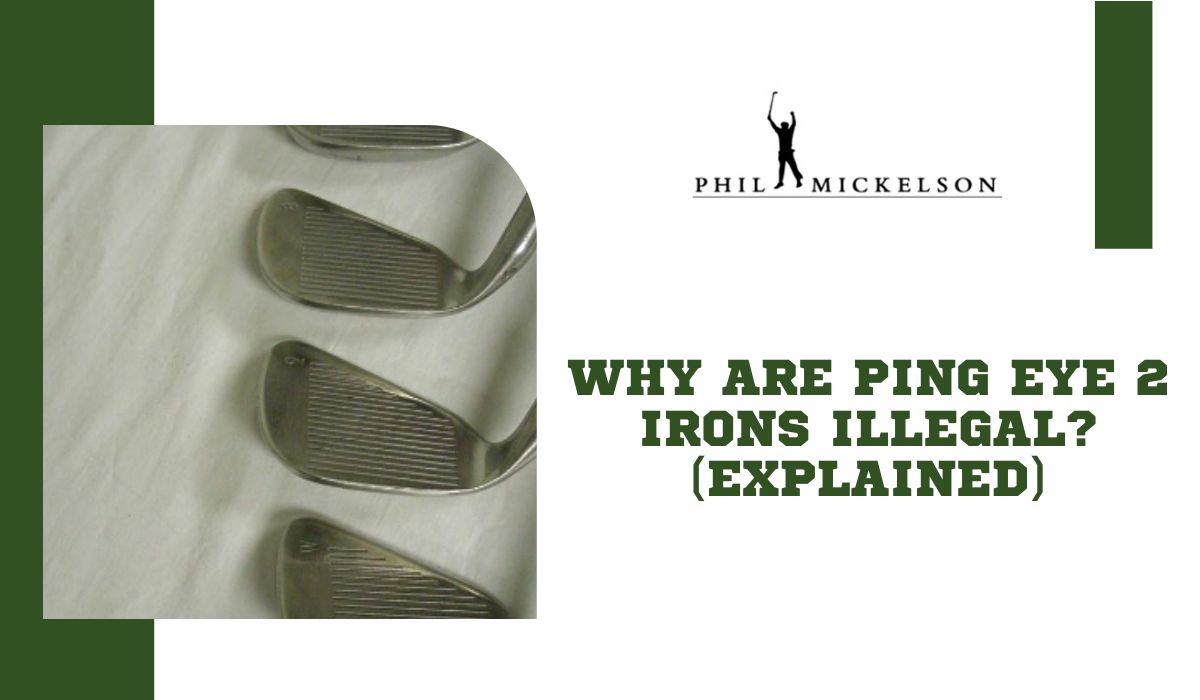
    Ping Eye 2 Irons are illegal because they are designed with square grooves, which doesn’t conform with the United States Golf Association (USGA) and R&A rules, as it gives players an unfair advantage of excessive spin on the golf ball. However, Ping Eye 2 irons manufactured after April 1990 without the square or U-shaped groove pattern are not illegal.


    If you’re a lover of vintage clubs, you’ve probably heard about the Ping Eye 2 irons, which had groove controversy and lawsuit issues in the 80s—when they were newly manufactured. If you plan to use these old clubs, you need to know which of their product lines are legal for competitive games and which have been grandfathered.


    In the rest of this article, you will learn why the Ping Eye 2 irons were banned and other relevant details you should know if you plan to start using this set of clubs. Before diving fully, look at the key areas of the Ping Eye 2 irons construction.

    Ping Eye 2: Iron Construction


    When the Ping Eye 2 irons rolled out first in 1982, they became famous for their extreme perimeter weighting, such that the clubs resist twisting at impact for increased forgiveness.


    Here is a short table showing the key features of Ping Eye’s two irons:


    Shaft Options Ping JZ series steel, Ping 350 Series graphite
    Groove Design V-shaped (1982), U-shaped (1984–1985), box groove (1986 onwards)
    Club Head Design Offset and Cavity Back
    Special Design Extreme-Perimeter Weighting
    Forgiveness Enhanced by Perimeter Weighting and Offset Design
    Game Improvement Emphasizes speed and forgiveness
    Sole Design Patented design with a top rail undercut
    Material Tungsten (for increased perimeter weighting)

    So What Makes the Ping Eye 2 Iron Illegal?

    The main point of contention revolves around the grooves on the Ping Eye 2 iron clubface.


    Unlike most golf clubs with round grooves, the Ping Eye 2 irons stand out with their square or U-shaped grooves. The issue, as flagged by the USGA, is that these grooves can make the golf ball spin more than clubs with round tracks. 


    Why does this matter? The extra spin can give players an unfair advantage, especially in tricky situations like wet or long grass, where clubs with round grooves might struggle.


    The USGA argued that the unique groove design of the Ping Eye 2 irons allows players to have better control over the ball’s flight and landing.


    This provides an edge that goes against the fair play principles in golf.

    What’s wrong with the Square Grooves design of Ping Eye 2 that makes it illegal?


    Square or “U” grooves in golf clubs caused a stir due to debates about how they improve players’ games (in the wrong way).


    The PGA Tour briefly banned them, not for being inherently illegal but because of a rule indirectly affecting the clubs.


    This groove’s shape, depth, and spacing go against the stipulations of the USGA.


    People argue whether square grooves give golfers an advantage; some studies say no, while others claim a slight boost in spin rates from rough terrain.


    The controversy peaked when Ping Eye-2 irons, with square grooves, were banned for supposedly aiding golfers too much. Despite this, the 40-year-old Ping wedge stayed legal after a successful lawsuit against the USGA in 1990, making all square-headed clubs okay.


    However, the golf governing bodies, the USGA and R&A, said square or “U” grooves are illegal in PGA tournaments.


    So, the beloved square grooves were replaced with less effective V-shaped grooves, changing equipment rules significantly.

    Is there a penalty for using non-conforming Ping Eye 2 irons in competitive play?

    Using the wrong Ping Eye 2 irons in a competition can lead to penalties or getting kicked out.


    The punishment depends on the event rules, but usually, players get a two-stroke penalty for each hole played with the non-approved club.


    This adds up quickly, affecting their overall score and position in the competition.


    In more severe cases, players may be disqualified from the event entirely.


    So, if you’re playing a not recreational game, ensure that you double-check that your gear follows the competition’s guidelines.

    How to Identify Non-Conforming Irons


    All Ping Eye-2 irons are legal now, but you must distinguish between old and new ones. The older ones are okay because of a particular rule, while the newer ones got changed to follow the rules.


    To tell the difference, check the patent number. It might have once-illegal grooves if you don’t see a bump or plus sign.


    For more details, this is a handy list by the USGA that tells you what golf gear is legal or not.


    It covers balls and drivers and gives guidance on clubs and balls.

    What Year Did They Stop Making Ping Eye 2?


    The original Ping Eye 2 irons were made until March 1990, but Ping kept making a slightly updated version after that.


    People argue about the exact date when they stopped, but there are indications that all Ping Eye 2 irons, no matter the grind version, stopped being made around 1985.

    Can You Still Play Ping Eye 2 Irons?

    Yes! People still use Ping Eye 2 irons. If the irons were made before 1990, they are allowed in most golf tournaments, following rules from organizations like the USGA.


    The catch is that the irons might not be allowed in some tournaments, mainly due to rules set by the USGA.


    But for most casual and amateur games, Ping Eye 2 irons are still good to go. Some professional events also permit them, depending on the specific model and when they were made.


    Despite occasional debates about the design, these irons are still popular among golfers.


    Their unique style and history make them stand out.


    So, while there might be some restrictions in specific tournaments, Ping Eye 2 irons remain a favourite choice for many golfers. Unfortunately, you can only get them second-hand.

    Why does Ping Eye 2 sell for so much?


    Ping Eye 2 golf clubs are pricey when resold because they’re considered timeless and good to play with.


    People want them, so there’s a high demand. This is why all used clubs, not just Ping Eye 2, cost a lot now—it’s essential supply and demand.


    Even if you look for other 5-7-year-olds and in good shape clubs, you’ll find them selling for $700–$800 for a set.


    The Ping Eye 2 stands out because it has a unique “illegal groove pattern,” which generally would be a problem, but it got an exemption until 2024, making it even more special and valuable.

    Key Takeaways


    • The Ping Eye 2 clubs come in different versions. The early ones (1982–1984) have ‘V’ grooves; the next ones have square grooves, and later models feature ‘U’ grooves.
    • Ping Eye 2 Irons are illegal because they are designed with square grooves, which doesn’t conform with the United States Golf Association (USGA) and R&A rules.
    • Ping Eye 2 irons manufactured after April 1990 without the square or U-shaped groove pattern are not illegal.
    • These clubs might not give you as much distance as modern irons because newer irons use better technology with stronger lofts and improved materials, leading to faster ball speeds and more space.
    • Even though Ping Eye 2 irons are considered non-conforming for official competitions, you can still use them for fun and casual play.


    I hope you found this helpful.


  • Do Scores Reset After the Cut?

    Do Scores Reset After the Cut?

    No, golf scores do not reset after the cut. After the cut is made in a golf tournament, players who qualify continue to carry forward their scores from the previous rounds into the remaining rounds of the competition. The player with the lowest total score at the end of the tournament is declared the winner.

    Understanding the cut rules adds strategy and significance to a golf tournament. The cut is usually made after the first two rounds, with only a certain number of players advancing based on their scores. This ensures intense competition, involving only those with a realistic chance of contending for the title. Every stroke becomes crucial as players strive to cut, making the early rounds pivotal in shaping the showdown. It also keeps the tournament exciting by focusing on the top-performing golfers.

    In this article, you will learn about the cut rules to fully understand the answer to the question: do scores reset after the cut?

    What is the cut rule in the PGA?

    In regular PGA Tour tournaments, the cut rule determines which golfers continue playing after a certain number of holes. After 36 holes, the field is trimmed to the lowest 70 scores and ties. If this results in more than 78 golfers making the cut, a second cut occurs after 54 holes, again selecting the low 70 scores plus ties.

    PGA Tour events consist of 72 holes played over four days. The 36-hole cut happens after the second round, usually on Friday. This means that after the second round, there will be around 154 golfers, but only about 70 will continue into the third round.

    Golfers who don’t cut are said to have “missed the cut,” while those who continue have “cut.” Typically, the first cut to the lowest 70 scores is sufficient, and the second cut is rarely needed, occurring only in a few tournaments each year on the PGA Tour. Other tours don’t use the second-cut rule.

    According to a post by ESPN, starting this year, 2024, the PGA Tour will introduce notable changes to its cut rule in response to competitive challenges, particularly from the LIV Golf League.

    Eight designated tournaments will now have smaller fields of 70 to 80 players, removing the cut rule for these events. This change is intended to guarantee significant prize money, eliminate cuts, and motivate top players by awarding FedEx Cup points, resulting in a more exciting and competitive atmosphere.

    What is the Master Cut Rule?

    In the Masters Tournament, scores don’t start over after the cut. Players get stuck with them throughout the golf event, which usually has 72 holes, like in major tournaments such as the PGA. The cut happens after two rounds, and players who match a specific score get to play in the last two rounds, avoiding elimination.

    During the first two days, players are grouped randomly or based on their fan bases for media attention. But after the cut, players who made it through are grouped based on their scores. Usually, the top 50 players and those with similar scores continue to the last round while the rest are out.

    In the third and fourth rounds, players are paired based on their standings, with the lower-scoring players going first in the morning, gradually moving up the leaderboard. The scores from day three also affect how players are paired in the final round.

    Resetting scores after the cut wouldn’t make sense because scores are crucial for pairing players in the later rounds. The cut is generally within ten strokes of the leader unless someone is way ahead after two rounds. Everyone within ten strokes still has a chance to make an impact with a strong weekend. Simply put, scores keep adding up.

    Players who don’t cut are out of the tournament, while those who do continue to play on Saturday and Sunday. At the end of all four days, the player with the lowest total score wins the tournament.

    How Does the Master’s Scoring Work?

    Understanding how scores work in the Masters Tournament is crucial to figuring out which players move forward. In golf, a course has 18 holes, each with a par rating of 3, 4, or 5. The total par for the entire course usually ranges from 70 to 72. A player’s score starts at level par on the first tee and serves as their running total throughout the game.

    If a player finishes a hole with a par score, like three strokes on a par 3, their running total stays the same. Going under par on a hole means subtracting that score from the overall total, while going over par adds to the running total. The goal is to finish the game with as few strokes as possible, aiming to be under par.

    At the Masters Tournament, players are ranked after two rounds based on this scoring system. The top 50 scores and ties then move on to the next rounds, with the overall scores used on the last day to determine the winner. Players who don’t cut have to withdraw from the tournament. With its focus on being under par, this scoring system is a distinctive feature of the Masters Tournament.

    How many golfers cut?

    Typically, in a golf tournament, the cut is set to include around 70 golfers who perform the best in the initial rounds.

    However, not cutting doesn’t signify the end of a golfer’s career; it’s a shared experience even for the top players. Take Tiger Woods, a golf legend who, despite his immense success, missed the cut 20 times from 1999 to 2019.

    The cut is a crucial part of tournaments, ensuring that only the top-performing players advance to the later stages. It adds an element of competition and challenges even the most skilled golfers. This system encourages consistency and excellence throughout the tournament.

    Do players who miss the cut get paid?

    Players only get paid if they make the cut in many professional golf tours, like the PGA Tour and DP World Tour. Usually, the top 65 players (and ties) in regular events make it to the final rounds and earn money, while the others get nothing. This system helps focus the competition on the weekend, ensuring that only those with a real chance of winning continue to play.

    However, there are some exceptions, especially in major tournaments where the number of players cutting varies slightly. For instance, it’s the top 50 at the Masters, the top 70 at the PGA Championship and the Open, and the top 60 at the US Open. Interestingly, even those who miss the cut in Majors get paid, perhaps as a small reward for qualifying for one of golf’s most significant events.

    In some recent Majors, players who missed the cut received $4,000 at the 2023 PGA Championship, $10,000 at the 2023 Masters, varied amounts at the 2022 Open Championship, and $10,000 at the 2022 US Open.

    Conclusion

    To truly understand the dynamics of a golf tournament, it’s essential to realize that golf scores aren’t reset after the cut. The cut rule, intended to ensure that only the top-performing players move on to the later stages, adds excitement to the event and contributes to its overall competitiveness and thrill.

    So, next time you watch a golf tournament, knowing about the cut rule will enhance your understanding of how players navigate each round to claim victory ultimately.

  • What percentage of PGA players never win?

    What percentage of PGA players never win?

    Approximately 90% of PGA players participating in the PGA Tour never win. Although pinpointing this exact percentage is challenging, roughly only 10% of players will achieve victory at least once on the PGA Tour.

    Securing a victory on the PGA Tour is a significant challenge in the professional golf arena. Players holding a PGA Tour card are pitted against the top golfers globally, making it a tough competition.

    Earning a PGA Tour title is no walk in the park due to the high level of competition. Some players can have successful careers without clinching a victory, while others may win multiple events and secure lifelong membership.

    In this article, I will shed light on the percentage of PGA players who never win a tournament but are still shockingly doing well in their careers.

    Who are the most successful PGA players without a PGA win?

    As stated earlier, 90% of PGA players participate in the tour but never win. Here, I’ll list some top players you might already know and probably look up to who have never won a PGA tour.

    1. Brett Quigley

    Brett Quigley, a professional golfer, has an extensive career playing on both the PGA Tour and the PGA Tour Champions. Despite participating in most PGA Tour events without securing a victory and making 408 starts, he has consistently cut over 50% of the time and achieved five runner-up finishes.

    While he hasn’t won a PGA Tour event, Quigley has found success on the Champions Tour, winning the Morocco Champions in 2020 and the Constellation Furyk & Friends in 2023. In his lengthy and prosperous career, he has earned over $14 million and notched 39 top-10 finishes on the PGA Tour. Additionally, he has been a reliable performer on the Champions Tour, winning multiple times and finishing in the top 10 in the Charles Schwab Cup standings on numerous occasions.

    Quigley’s best showing in a major championship was a tie for 8th at the 2005 PGA Championship. He also contributed to the United States Ryder Cup team, being part of the winning team in 2006.

    1. Brian Davis

    Brian Davis, a former professional golfer from England, played on the PGA Tour from 2004 to 2021. Despite a successful career, he didn’t secure a win in any PGA Tour event.

    Davis won two international tournaments: the 2000 Peugeot Open de Espana and the 2004 ANZ Championship on the European Tour. He also achieved multiple top-10 PGA Tour finishes and earned over $13 million.

    In 2010, Davis was in a playoff with Jim Furyk at the Verizon Heritage tournament. In an honorable move, he called a penalty on himself for accidentally moving something in a hazard, resulting in a two-stroke penalty that cost him the tournament.

    After retiring from professional golf, Davis became a golf coach and commentator.

    1. Brendon de Jonge

    Brendon de Jonge, a professional golfer from Zimbabwe, has been on the PGA Tour for quite a while. Although he hasn’t won a PGA Tour event, he secured a victory in the Xerox Classic on the Korn Ferry Tour in 2008.

    Throughout his career, de Jonge came close to winning, with a notable runner-up finish in the 2014 McGladrey Classic, where he lost in a playoff. He also achieved numerous top-10 finishes in PGA Tour events, with seven in 2010 being his most successful year.

    In major championships, de Jonge’s best performances include a tie for 26th at the 2011 PGA Championship, a tie for 28th at the 2014 U.S. Open, and a tie for 37th at the 2014 Masters Tournament. 2008, he was recognized as the Nationwide Tour Player of the Year.

    Despite not claiming a victory on the PGA Tour, de Jonge has had a successful career, earning over $12 million in prize money and maintaining consistent performance on the tour for many years.

    1. Cameron Tringale

    Cameron Tringale is a professional golfer from the United States. He was part of the PGA Tour from 2010 until 2022, when he left and joined LIV Golf. His only professional win was in a team event at the Franklin Templeton Shootout 2014. Despite being consistent on the PGA Tour, he never won an individual event, a record for the highest career earnings on the tour without a win.

    Tringale’s best finishes in major championships include T14 at the 2022 U.S. Open and T26 at the 2021 Open Championship. He also finished runner-up at the 2015 Zurich Classic in New Orleans.

    Even though Tringale hasn’t won an individual event on the PGA Tour, his steady performances have earned him respect as a reliable player.

    1. Jeff Overton

    Jeff Overton, a former American professional golfer, played on the PGA Tour from 2005 to 2017. Despite not winning a PGA Tour event, he had a successful career, coming close to victory at the 2010 Greenbrier Classic. He held a three-shot lead after 54 holes but was surpassed by Stuart Appleby’s remarkable 4th round score of 59, securing his 9th PGA Tour win. After this event, Overton entered the top 50 of the Official World Golf Ranking.

    In 2017, Overton faced a turning point in his career. A procedure meant to help a herniated disc resulted in a life-threatening infection in his spine, leading to emergency surgery. After overcoming the illness, he returned to the PGA Tour at the 3M Open in 2022. Although he didn’t win, he made notable shots and cherished moments with his family, including his wife and two daughters.

    Despite not clinching a PGA Tour victory, Overton had a prosperous career, making nearly 300 starts and earning over $12 million in on-course earnings. He also contributed two points to the 2010 Ryder Cup at Celtic Manor.

    1. David Hearn

    David Hearn is a professional golfer from Canada who has been on the PGA Tour since 2004. He has had a successful career with two wins in professional golf, one on the Nationwide Tour and another on the Canadian Tour. However, he has not yet secured a victory in a PGA Tour event.

    Hearn has been close to winning a PGA Tour event multiple times. In 2015, he finished tied for second at the Greenbrier Classic, losing in a playoff to Danny Lee. Another notable finish was a tie for third place at the 2016 RBC Canadian Open. Despite these near victories, Hearn has not won a PGA Tour event.

    1. Brandt Jobe

    Brandt Jobe is a professional golfer who has played on the PGA, Nationwide, and Champions. While he hasn’t won a PGA Tour event, he has achieved success in various tournaments.

    Jobe’s notable victories include the 1996 Nike Louisiana Open, the 2003 Permian Basin Open, and the 2019 Boeing Classic. He also won at the 2017 Principal Charity Classic on the Champions Tour.

    Despite not clinching a victory on the PGA Tour, Jobe has had a prosperous career as a professional golfer, earning over $10 million in total career earnings. He has also finished three times in the top 25 of the PGA Tour money list.

    Who Has the Best Winning Percentage in PGA Tour History?

    Tiger Woods holds the record for the best winning percentage in PGA history, winning 22% of the ranking tournaments he played. This means he emerged victorious in 93 out of 421 tournaments, winning approximately one game for every five starts. His remarkable achievement highlights his dominance in golf.

    Tiger Woods shares the highest number of PGA Tour victories (82) with Sam Snead, including 15 major championships.

    Currently, Rory McIlroy, the world number one, has a success rate of 8.3%, winning 31 out of 372 ranking tournaments. While not as high as Woods’ record, it still showcases McIlroy’s impressive skill and consistency on the golf course.

    Considered one of the greatest golfers, Jack Nicklaus, the all-time major champion, has a winning rate of 12.5%. Over his 30-year career, Nicklaus cut 85% of tournaments and finished as a runner-up 58 times.

    Do PGA players get paid if they don’t win?

    PGA players receive payment only if they cut into two rounds in a tournament. The cut is a set point that determines which players continue to the final rounds. The top 65 players and ties who cut earn money among regular PGA Tour events, while the rest receive nothing.

    However, there are exceptions, and some tournaments, like the Masters, pay golfers even if they don’t cut. For instance, at the 2023 PGA Championship, players who missed the cut still earned $4,000. Similar arrangements were made in other majors, such as the 2023 Masters, the 2022 Open Championship, and the 2022 U.S. Open, where players who missed the cut received varying amounts.

    Exempt PGA Tour players also receive a guaranteed base income of $500,000. Rookies can claim this amount upfront and earn additional prize money only when they surpass the $500,000 base. Importantly, if they don’t reach that $500,000 threshold, they don’t have to return the initial money. This structure ensures PGA Tour players a minimum income of $500,000 per season.

    Conclusion

    Taking on the PGA Tour is challenging, especially with fierce international competition. However, when you delve into the stories of golfers like Brett Quigley and Cameron Tringale, you realize that success goes beyond simply winning. It involves maintaining consistency, earning substantial money, and making a lasting impact on the sport. These narratives demonstrate the various paths to triumph in professional golf, showing that a rewarding career isn’t solely dependent on winning a PGA Tour title.

  • How Much Does the Worst Pro Golfer Make?

    How Much Does the Worst Pro Golfer Make?


    The worst player on the Ladies Professional Golf Association (LPGA) Tour for 2022 earned just $4,660 from four events, cutting once. While on the PGA Tour, Mike Balliet, who finished lowest in the Schwab Cup money list, earned just $736.


    Determining the earnings of the worst golfers on the PGA and DP World Tours depends on various factors, including limited tour status for some players, leading to pressure and potential low earnings.


    If you focus on the pro golfer’s earnings on the PGA Tour player’s statistics page, you may not grab the complete picture because it reflects the total official money earned by a player on the PGA Tour for his career—not the career money.


    This article will examine how much earnings professional golfers who don’t play well each week make. You will also learn how much money lower-ranked players earn despite their poor play.


    Let’s start by referencing previous seasons to see how the worst players on the main tours pulled for that year.


    Case Study on How Much Worst Pro Golfers Make


    If you recall the 2019 season, statistics of the seasons showed that $5,910 was the lowest money made on Tour, which Jonathan Kaye pulled.


    He only made one cut on the PGA Tour in the 2018–2019 season in an alternate event and finished tied for last.


    To stay in the game for the next season, golfers need to be in the top 125 money-earners. In 2018–2019, this meant earning at least $878,000.


    Interestingly, even if a player like Kaye didn’t win any tournaments, only made about ten cuts, and had just one top-10 finish, he still made the cut for the next season and earned $878,000.


    This highlights the financial stability within the professional golf scene, where even the lowest earners can secure their spot for the following season.


    Famous Tournaments and Earnings Worst Pro Golfers Make From Them

    Here are some famous tournaments and how much they have to offer the worst pro golfers.


    Year in view: 2022


    Tournament Earnings of the lowest-ranking golfer
    PGA tour $30,000 as prize money for completing the session
    U.S. Open Tournament $19,000 to $25,000
    The European Tour €50,000 (approximately $58,000)
    FedEx Cup around $40,000 to $50,000.
    Web.com tour $12,000 for the entire season.
    The Challenge Tour €8,000 (around $9,300) for a whole season.
    The Ladies Professional Golf Association (LPGA) Tour $4,660 from four events


    When you look at the earnings alone, it may seem like a decent amount to make as a low-ranking pro golfer. However, it is ins