Category: Golf Club Review

  • Ping G2 Irons Specifications (Full Details)

    Ping G2 Irons Specifications (Full Details)

    Ping G2 irons offer forgiveness with large, perimeter-weighted heads. Available in standard, slower swing speed (G2 E.Z.) and ladies models (G2 L), all G2s feature steel shafts and a focus on off-center hits.

    Forged in 2003, PING’s G2 irons weren’t about looks but results. These babies were built for mid-to-high handicappers, offering easy forgiveness and smooth swing mechanics.

    I loved my G2s so much that I gifted them to my godson when he started playing. Even years later, they’re still helping him improve. That’s the beauty of these irons. If you want to boost your game and ditch the inconsistency, the G2s might be your secret weapon.

    Let’s review this iron’s specifications, key features, and other relevant information to help you determine if it’s a good fit for you.

    Ping G2 Iron Specifications

    • Construction: 16-4 Stainless Steel
    • Finish: Brushed
    • Target Handicap: 15 and up
    • Ball Flight: High
    • Offset: large but progressive
    Club Loft Lie Length Bounce Offset Weight
    3 Iron 21.00° 59.32° 38.750″ 2.00° 0.300″ D0
    4 Iron 23.80° 60.02° 38.250″ 4.00° 0.290″ D0
    5 Iron 27.00° 60.75° 37.750″ 6.00° 0.280″ D0
    6 Iron 30.50° 61.50° 37.250″ 7.50° 0.260″ D0
    7 Iron 34.30° 62.28° 36.750″ 9.00° 0.250″ D0
    8 Iron 38.30° 63.10° 36.250″ 10.00° 0.240″ D0
    9 Iron 42.50° 63.95° 35.750″ 11.00° 0.230″ D0

    How the Ping G2 Irons Work

    The G2 iron is made from a type of stainless steel called 16-4. Like all Ping irons, it’s created using a unique Ping casting technique that makes it solid yet soft.

    The heads of these irons are more significant than usual, with a thick sole. This oversized sole does two things:

    • It helps to make the ball fly higher by lowering the club’s center of gravity.
    • It prevents the club from digging too much into the ground when you swing.

    You’ll also notice a black piece at the back of the club’s cavity.

    This piece helps fine-tune the club head’s weight and moves the center of gravity away from the front of the face.

    Color Dots on Ping G2 Irons: Meaning

    When choosing a golf club from Ping, pay attention to the dot color on the club. This dot tells you the angle of the club’s tip, which affects how you swing it.

    You’ll probably want a club with an “upright” adjustment if you’re tall, while shorter folks might prefer a “flat” adjustment. This is because your height changes how you swing the club.

    The chart below from Ping shows the matching of each dot color to these specific angles. So, if you’re tall, pick the dot color that matches the “upright” grade, and if you’re short, go for the “flat” one.


    IMAGE


    Using a club that matches your height and swing style can significantly affect how well you play.


    That’s why someone might like a club like the three-iron from Ping—it fits them perfectly and helps them play their best on the course.

    Ping G2 Irons Performance Review

    The PING G2 irons are great for golfers because they’re easy to use and give a soft feel when you hit the ball.

    They have a design that spreads the weight around the edges of the club, making it more forgiving when you don’t hit the ball perfectly in the middle.

    This quickly reminds me of the classic PING Eye 2 irons.

    Each iron on the G2 set is subtly offset, promoting straight trajectories for improved accuracy.

    These irons are made with careful attention to detail, so they’re consistent in how far they hit the ball and how they react when you hit it. They’re also designed to help you strike the ball straighter, which is always a plus.

    If you struggle with hitting long irons (the ones with higher numbers like 2-iron or 3-iron), PING has notable replacements for them that are easier to use.

    These replacements have wider bottoms, which makes them glide through the grass more easily when you swing.

    Ping G2 Iron Shaft Specs

    The Ping G2 clubs come with two main types of shafts: the CS Lite steel shaft and the TFC 100 graphite shaft.

    The CS Lite is popular because it’s lightweight but strong and suitable for most players. The TFC shaft is better if you don’t swing the club as fast.

    The Ping G2 Iron has a regular steel shaft material measuring 37.25 inches. The Golf Pride Tour Velvet is a standard size. Is the grip capping the shaft?

    Ping G2 Irons Value Today

    I recently found a deal where someone is selling a set of Ping G2 irons (5-pw) for $300. They’re also throwing in a jet-speed hybrid and a three-wheel for $350

    The PGA value guide says the Ping G2 irons were worth about $78 in 2015, compared to the current market situation; the price seems fair. But since these irons are from 2003, like the Super Steels, I think I’d prefer to spend more on something newer.

    The seller mentioned that the back weights are missing on the nine and P.W. clubs. I’m not sure if this affects the deal’s value. I’m using Taylormade super steels, but I’m not a big fan of them.

    Interestingly, Ping G2 irons are becoming popular again. While enjoying my M3s, I wish I had a 3i instead of a G.W. I like their sole grind feature. It makes them very versatile.

    Ping G2 Irons Specifications Handicap

    The Ping G2 clubs are great for players between high and mid handicaps.

    P.S.: They all have the same basic design but are tweaked to suit different players.

    Final Thoughts

    There are many good things to say about the Ping G2 irons. From the specifications, you can quickly tell whether it’s a good fit for you.

    I lost my G2 clubs. I gave them to my godson a couple of years ago when he was big enough for adult-sized clubs, and he still uses them.

    After I got my own set, I brought my dad a G2-4 iron. He struggles with using hybrid clubs for some reason, but he likes and uses the G2

    As a player with a high handicap, you can’t go wrong with this one.


  • Callaway X20 Iron Review: Lofts and Specs

    Callaway X20 Iron Review: Lofts and Specs

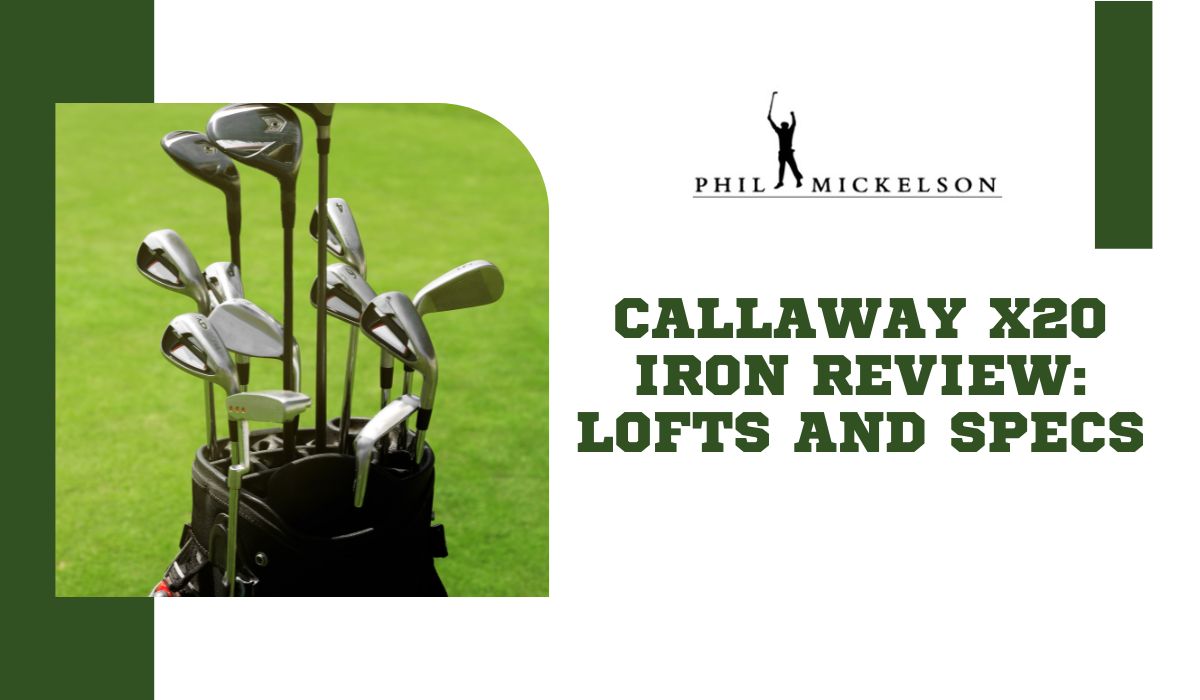
    The loft options of the Callaway X20 irons range from 18.00° on the two iron to 41.00° on the nine iron. On specifications, the iron has a set makeup from 2 to 9: Uniflex, Stiff, and Regular flexes; 37.25 inches in length; steel and graphite shafts; and PW, GW, SW, and LW as additional clubs.

    Callaway irons have unique design features. They have notched perimeter weighting to make them more stable, a more extensive back cavity to forgive mistakes, and a system that lowers the center of gravity to make them more durable and reduce errors. However, it’s not a club for every kind of player.

    Before spending around $150 for the used set (that’s the deal you find these days), you’ll want to first know the lofts and specifications of the X20s to help further determine if it’s an excellent fit for your game and level of play.

    Callaway X-20 Iron Loft Specifications

    Here are the loft options in full detail for each club in the Callaway X20 iron set:

    Club Loft Lie Length Bounce Weight
    2 Iron 18.00° 60.00° 39.500″ 0.50° D2/D0 (steel/graphite)
    3 Iron 21.00° 60.50° 39.000″ 1.00° D2/D0 (steel/graphite)
    4 Iron 24.00° 61.00° 38.500″ 1.50° D2/D0 (steel/graphite)
    5 Iron 27.00° 61.50° 38.000″ 2.00° D2/D0 (steel/graphite)
    6 Iron 30.00° 62.00° 37.500″ 2.50° D2/D0 (steel/graphite)
    7 Iron 33.00° 62.50° 37.000″ 3.00° D2/D0 (steel/graphite)
    8 Iron 37.00° 63.00° 36.500″ 4.00° D2/D0 (steel/graphite)
    9 Iron 41.00° 64.00° 36.000″ 5.00° D2/D0 (steel/graphite)
    PW 45.00° 65.00° 35.500″ 7.00° D2/D1 (steel/graphite)
    AW 50.00° 65.00° 35.500″ 11.00° D2/D1 (steel/graphite)
    SW 55.00° 65.00° 35.250″ 11.00° D4/D3 (steel/graphite)
    LW 60.00° 65.00° 35.000″ 15.00° D4/D3 (steel/graphite)

    Callaway X20 Irons Specifications

    Set Makeup 2, 3, 4, 5, 6, 7, 8, 9
    Hand Availability Left, Right
    Flex Uniflex/Stiff/Regular
    Grip Golf Pride Multi Compound/Black Widow Tour Silk
    Length (6 iron) 37.25 inches
    Lie Standard
    Additional Clubs PW, GW, SW, LW
    Shaft Types Steel, Graphite
    Price The price for the entire set ranges from second-hand purchases. You can find the best deals on eBay, sold auctions starting at $150

    Callaway X20 Iron Performance Review

    These clubs have a reputation for style and performance, thanks to Callaway’s long-standing legacy of crafting top-notch golf equipment. The X-20 series comes in two versions: the standard and the Tour.

    While I can’t speak much for other clubs on the set, I’ve had much experience, particularly with the 4-iron through sand wedge, equipped with Callaway’s steel “uniflex” shafts.

    What sets these irons apart is their clever design.

    They’re built with features like “Extreme Notch Weighting,” which spreads the weight around the club head for better forgiveness and control.

    Plus, they have a lower center of gravity (CG) than previous models, making it easier to hit higher shots with more distance.

    Callaway’s “Core Technologies” signature is also on display here. This includes variable face thickness (VFT) for faster ball speeds, a design that redistributes weight for stability, and Tru-Bore Technology for a smoother feel.

    They’re especially great for average- to high-handicap players who want clubs that look good in their bag and feel comfortable swinging.

    These irons proved forgiving during testing, meaning even off-center hits stayed relatively on target. However, if you like to shape your shots, you might find it challenging with these clubs.

    I see the Callaway X-20 irons as a stylish and performance-driven option for golfers seeking consistency and improvement on the course.

    Callaway X20Irons: Pros and Cons

    Before rushing to buy the X20s, take note of these highs and lows of the club set:

    Pros 

    • The club set for the X20s is affordable.
    • The balance and feel are outstanding.
    • A low CG helps minimize errors.
    • Uniform impact across the face.

    Cons

    • Not quite as forgiving as comparative, newer irons (Ping G700, Mizuno JPX 900 Forged Irons, etc.)
    • Longer irons tend to launch relatively high.

    Callaway X-20 Irons Price

    You can still buy Callaway X-20 irons in many golf stores and online. Some people sell them for as little as $100 for the whole set.

    You might also see sets of X20s (from 4 iron to sand wedge) for about $175, or even find X-18s (from 3 iron to approach wedge) for around $150 if they’re in good shape.

    Just make sure to check their condition carefully before buying.

    Callaway X-20 Approach Wedge

    The Callaway X20 Approach Wedge is particularly useful for precise shots around the green.

    It fills the gap between the pitching and sand wedge, with a loft of around 50 to 52°.

    This loft strikes a balance, offering enough height and accuracy for most golfers. The club’s design maximizes forgiveness on off-center hits.

    Callaway X-20 Sand Wedge

    The Sand Wedge club among the Callaway X-20 iron sets is 35.25 inches long at the address.

    It uses the Callaway Stock Uniflex Flex Steel Shaft.

    The grip on this particular club is the Golf Pride New Decade Multi Compound Standard Grip.

    The loft and lie specs of the Sand Wedge Iron are 55.00° and 65.00°, respectively.

    Callaway X-20 Irons Release Date

    The Callaway X-20 irons came out in 2008, about 15 years ago. Even though they’re pretty old now, many golfers still love using them to improve their game. These irons are known for helping players lower their handicaps.

    Their continued popularity shows they’re still reliable and effective on the golf course. But, like many good old clubs, you can’t see them for sale. Most offers online are pre-owned.

    Final thought

    It was enjoyable hitting the Callaway X-20 irons. They look classy and sleek, not like beginner clubs.

    The narrower soles and compact heads let you hit aggressively with tight lies. Weighting in the club’s cavity boosts stability, even on off-center hits.

    They’re durable and perfect for serious learners. But there are better options for advanced players who need clubs for different types of shots.

    Now, what do you think?

    If you want to improve at golf, buying irons that make the game too easy, like the Callaway X-20s, is not a good idea.

    It’s better to go for something in the middle, like the Ping I5’s. This is not to criticize anyone’s skill level; I’m just saying it’s wiser to avoid what some people in the golf community call “shovels.”

    What do you think? Let me know in the comments.

  • Is a 50-gram driver shaft too light?

    Is a 50-gram driver shaft too light?

    Is a 50-gram driver shaft too light?

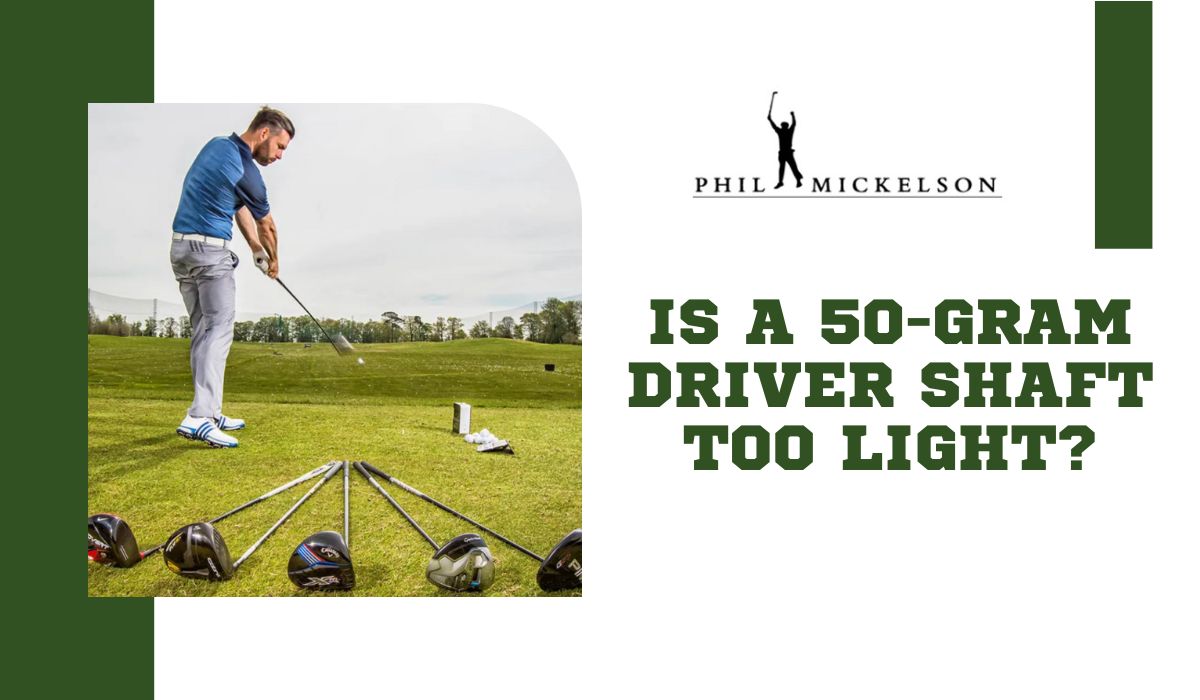
    Shafts that weigh 50 grams are very light and are popular among golfers who have trouble swinging the club fast. They also give a nice boost to the driving distance of senior players.

    I’ve always thought that, in terms of physique, a lighter shaft would translate into more club head speed, which may translate into 5 to 10 yards or more in the distance. However, I recently researched shaft weight selection more deeply and realized it all boils down to your swing speed.

    So, if you’re thinking of trying a 50-gram shaft for your driver and you’re hesitant because most OEM and aftermarkets are in the 60 to 70-gram range, that is normal.

    You want to be sure it’s the right driver shaft weight for your game. Read on to learn more about the 50-gram driver shaft.

    Specifications of 50-gram Gram Driver Shafts

    Details 50 Gram (1.76 oz) Shafts
    Players Beginners/Seniors
    Player Swing Speed Moderate
    Forgiveness Maximum
    Distance Moderate
    Control Maximum

    The Key Idea of Lighter Driver Shaft

    A lighter driver shaft helps you hit the golf ball more accurately and farther. Lighter beams make your swing faster, so you can hit the ball straighter and more powerfully.

    But there’s a downside.

    Lighter shafts are less forgiving. If you don’t hit the ball perfectly, it might not go as far as it would with a heavier rod.

    This makes more sense, especially when you consider the results from a test conducted by Golf WRX, which revealed that lighter shafts are best for experienced golfers who consistently hit the ball well.

    But what happens when you use a golf driver shaft that is too light?

    Using a golf driver’s’s’s shaft that’s too light can cause control and accuracy issues, leading to inconsistent shots and potential injury.

    While it might increase swing speed, it can sacrifice distance and control.

    Is 50-gram shafts too light?

    It depends on your swing speed. The 50-gram driver shaft is forgiving and easy to control when hitting your shots. These shafts are not too light for beginners and older golfers.


    • Beginners find them helpful because they’re easier to handle while learning the game.
    • As beginners get better at golf, they can switch to heavier shafts.
    • For older golfers, lightweight shafts are helpful because they might not swing the club as fast or as strongly as they used to.
    • Using a lightweight shaft helps them control the club better, making their shots more consistent.

    So basically, if you’re just starting golf or getting older and your swing isn’t as strong, a 50-gram driver shaft isn’t too light because it helps you control your shots better and makes the game easier to play.

    But then, you must seriously consider your swing speed and how it matches the driver shaft weight you want to use.

    It’s All About Your Swing Speed

    Choosing a heavier driver shaft makes you use more power, which increases your swing speed. This can help you hit better shots because your clubhead moves faster.

    But if you want a more accessible game and don’t need to hit the ball too hard, go for a lighter shaft.

    This is why swing speed is critical to knowing whether a 50-gram driver shaft is too light for you. Here’s a table to further help you identify this area:

    Average Swing Speed Driver Shaft Weight
    Less than 70 mph 40 Grams
    76-84 mph 50 Grams
    90-105 mph 60 Grams


    According to research from MyGolfSpy, golfers were tested using different shaft weights: one light at 55 grams and one heavy at 75 grams.

    Here’s what they found:

    • Most testers (80%) hit the ball farther with the lighter shaft.
    • However, more golfers (60%) got better overall distance with the heavier rod.
    • Also, 60% of players had faster ball speeds with heavier rods.
    • If you struggle to get the ball up in the air, a lighter post might be better for you.

    The best way to find the right weight for your driver shaft is by getting help from a pro. They’ll help you figure out what works best for you based on how you swing and play, with an emphasis on your swing speed.

    How Do You Know Your Swing Speed?

    The best way to know your swing speed is to use a launch monitor while hitting balls on the range. You can use the ones available at the local golf club or golf retail store if you don’t have any.

    How to Know If Your Driver Shaft is Too Light

    If your driver shaft feels too light, such that your wrists unhinge during your swing, it means the post is too light. This can cause issues with your swing path, like duck hooks and excessive draws.

    To fix this, Golf Digest coach Liam Mucklow recommends “switching to a heavier shaft for better control.”

    However, you can tell if the driver shaft is too flexible when the clubhead kicks up at impact and veers left (for right-handers).

    In other words, when you start having too many unwanted hooks, it can indicate a driver shaft that is too light or flexible.

    Understanding Driver Shaft Weight (Video)

    For a long time, graphite shafts have been popular in golf clubs. How heavy a post should have always been confusing for many players. Can lighter ones help golfers? How do you pick the right one?

    I like how golf equipment expert Michael Vrska explains all about shaft weight myths and how to choose the best equipment in this video:


    I’ve always stuck with shafts that weigh at least 60 grams for my driver.

    But Michael’s knowledge has me thinking about trying lighter ones this spring.

    In Summary

    Remember, it’s not just about looks when picking out a new driver. Pay attention to the shaft’s weight along with its flexibility and torque.

    Even small changes in weight, like 10 grams, can affect your swing—how it feels, how fast the clubhead moves, and how accurate your shots are.

    • It all depends on your swing speed, too. A 50-gram shaft will be too light if your swing speed is 90–105 mph.
    • A 50-gram driver shaft is excellent if you struggle with distance or want more consistency in your shots, giving you a forgiving club with a medium to high trajectory.
    • For more experienced players who want a lower ball flight but still some forgiveness, a 60-gram shaft is a good bet.
    • But this weight works well for most golfers.

    If you’re new to golf or still getting the hang of it, sticking with a 50-gram shaft can help you get better at hitting the ball where you want it to go.

    It’s perfect for moderate swing speeds (76–84 mph).


  • Ping Alta 55 vs. Tour 65 Shafts: Which Is Better?

    Ping Alta 55 vs. Tour 65 Shafts: Which Is Better?

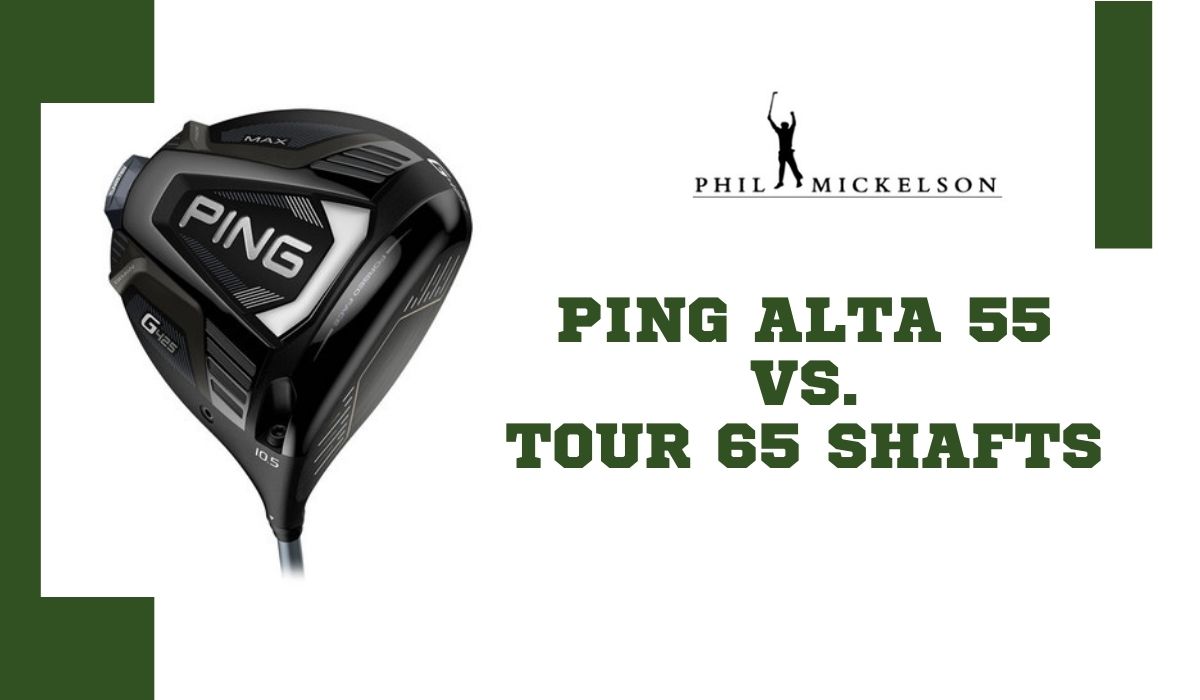
    The main difference between Ping’s Alta CB 55 and Tour 65 shafts is that the Alta 55 is a lightweight graphite shaft that is best suited for players who want improved launch and distance, while the Tour 65 will favour those who want more control and precision since it’s a mid-weight model.

    Recently, I broke the shaft on my Ping G400 (Alta CB 55 in Stiff) and needed a new one. The replacement I usually get costs about $100 online, but my local golf store offered me one from the newer Ping G425 for $60, including swapping the adapter.

    Out of curiosity, I decided to do comparative testing and more research to see if there would be a big difference if I went with the Tour 65 shaft instead. Then, I realized many players are similarly torn between these two shafts.

    In the rest of this article, you will learn about the specs, key features, pros, and cons of the Alta 55 and Tour 65 shafts; place them side-by-side to help you decide which is best for your game.

    Ping Alta 55 vs. Tour 65 Shafts Specs: Comparison Chart

    While the “Alta 55 vs. Tour 65” debate has been on a stretch, both shafts have identical profiles. Here’s a chart of the differences between the specifications of each shaft:

    Ping Alta 55 Ping Tour 65
    Flex options Soft Regular, Regular, Stiff and X-stiff Stiff
    Weight options 53.0g, 55.0g, 59.0g, and 63.0g 62 grams, 64 grams, or 66 grams
    Torque 5.9°, 5.0°, 4.9° and 4.2° 2.8 degrees
    Launch Mid – Low Low
    Spin Low
    Tip diameter 0.355 inches 0.355 inches (tapered)
    Butt diameter 0.58 or 0.60 inches 0.600 inches
    Material High-quality graphite High-quality graphite
    Length Allows for custom trimming and fitting Offered in different lengths to fit different clubheads

    Key Features of the Ping Alta CB 55 Shaft

    The Alta CB stands for “counterbalance,” which means it’s designed to help balance out heavier club heads.

    • When you place the Alta CB 55 shaft in your club, it changes color from copper to black, a nice extra touch.
    • You’ll often find the Alta CB Shaft as the standard option in the Ping G425 Driver and similar models like the G400, G410, G430, etc.
    • Depending on your play, you can choose between regular, stiff, and x-stiff versions of the Alta CB 55 shaft.
    • The shafts are mostly made of graphite.

    You can get the Alta CB for both irons and drivers, and they come in different colors, but black and red are the most common.

    Ping Alta CB 55 Shaft Pros and Cons

    If you’re not the best golfer and want a shaft that helps you hit the ball high up in the air consistently and feels excellent, you might want the Ping Alta 55. But before you buy it, here’s what you need to think about:

    PROS CONS
    More affordable than the Tour 65 It doesn’t offer as much control as its counterpart
    It gives you an improved distance You won’t get the speeds of the Tour 65 because it has been replaced with a better distance
    Best fit for players with slower swing speeds Not the best choice for lower handicappers
    It’s a lightweight shaft.
    It gives a higher launch angle.
    You can customise it freely.

    Key Features of the Ping Tour 65 Shaft

    The Tour 65 shaft, like its counterparts CB 55 and preceding the 75, is constructed from lightweight graphite.

    • It is offered in regular, x-stiff, and stiff versions.
    • The torque of the Tour 65 shaft varies between 2.7 and 3.6 degrees, providing options for different swing preferences.
    • The Tour 65 features Ping’s proprietary rib structure, focusing on stability during the swing and reducing unwanted vibrations.
    • The shaft has a stiff tip and a soft lower midsection for better feel and feedback.

    Within Ping’s G400 line, the Tour 2.0 Chrome 65 Shaft and Black 65 Shaft are available, both manufactured by UST Mamiya and Aldila under different parent companies.

    Ping’s strategy of sourcing from multiple suppliers minimizes potential supply disruptions.

    While the Tour 2.0 Chrome 65 and Black 65 shafts are similar in performance and features, some golfers perceive differences in feel.

    The chrome shaft tends to feel softer, whereas the black shaft feels stiffer, as confirmed by Ping’s assessments in the video below:

    Ping Tour 65 Shaft: Pros and Cons

    If you’re a low handicapper thinking about getting the Tour 65 shaft, let’s look at the good and bad things about it before you decide.

    PROS CONS
    A stiff tip provides a low launch and less spin, making it ideal for controlling ball flight. Some players don’t like the stiffness of the shaft because it can be harsh
    A solid choice if you want low-launch, low-spin ball flight It does not give high-launch or high-spin ball flight
    Consistent ball flight is due to the stability, thanks to the low torque. If you’re very intentional about a soft, responsive feel, the Tour 65 may be a little disappointing.
    The best option to achieve improved distance and accuracy

    Ping Alta 55 vs. Tour 65: Swing speed

    The Ping Tour 65 Shaft is best for golfers who swing fast and want their shots to fly low with less spin. It also provides reasonable control and stability.

    Experienced golfers who swing consistently and aggressively prefer getting the best distance and ball flight.

    The Tour 65 shafts are also suitable for players who want a solid feel when they hit the ball, giving them a stable swing.

    Meanwhile, for Alta 55 shafts, if your swing speed is between 90 and 95 mph, you should pick a regular, slightly stiffer, or stiff flex. Most golfers choose stiff shafts for fast swings and regular flex for slower swings.

    Even though the Alta CB 55 helps shots go high, it can lead to more missed hits and foul shots. Also, the spin between 3000 and 3300 is too high.

    Ping Alta 55 vs. Tour 65: Which One Should You Choose?

    If you swing the golf club slower and want help hitting the ball higher and farther, go for the Alta 55 shaft. But if you swing fast and want to focus on speed and control, go for the Tour 65 shaft.

    The answer is to get fit!

    You have to get a professional fitting to pick the right PING shaft for you. Alternatively, you can use the Ping Shaft App since it’s Ping.

    This app looks at your swing inputs, clubhead speed, downswing, and desired trajectory.

    Then, it suggests the best shaft from PING’s massive collection of over 1,000 options, including aftermarket options. This helps your fitter find the perfect shaft to improve how you drive the ball. You can learn more about Ping’s fitting help here.


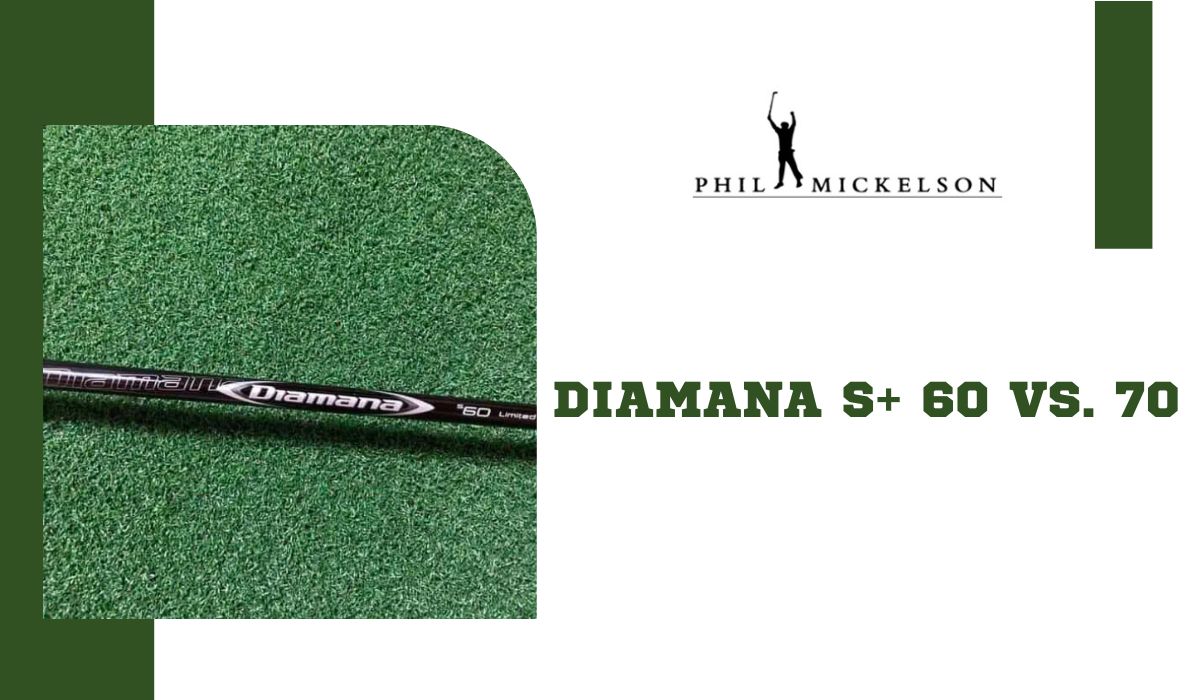
  • Mitsubishi Diamana S+ 60 vs. 70: Which is Better?

    Mitsubishi Diamana S+ 60 vs. 70: Which is Better?

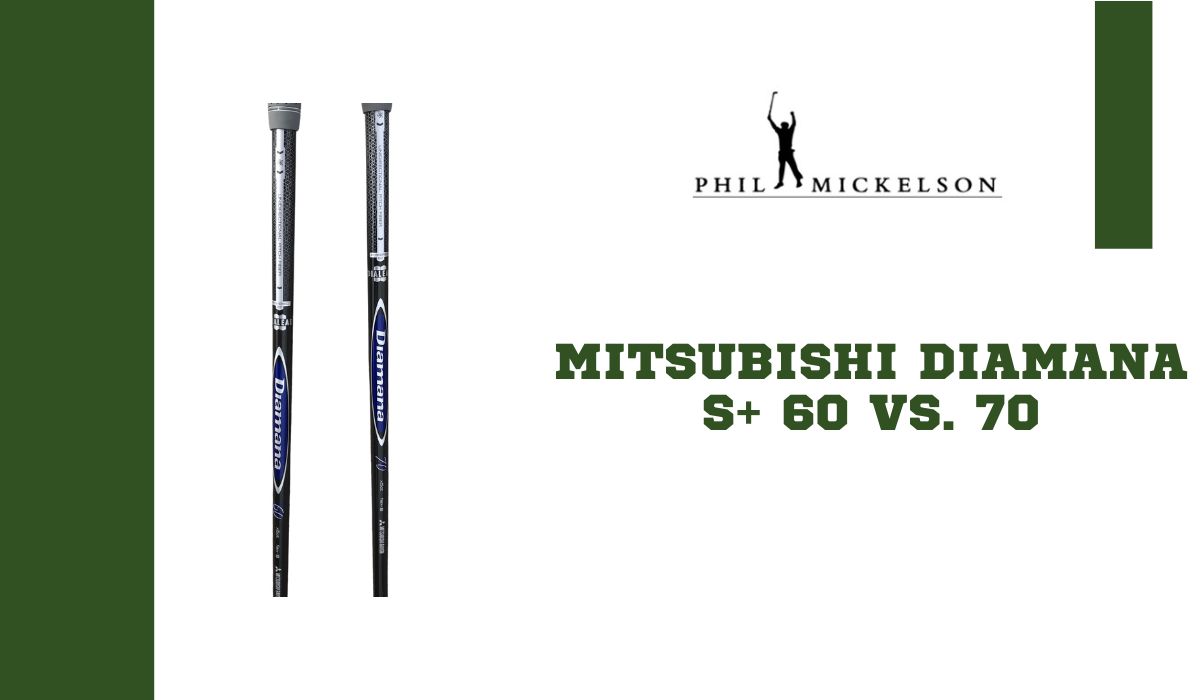
    The main differences between the Mitsubishi Diamana S+ 60 and 70 shafts come down to how heavy and flexible they are. The S+ 60 is lighter and more flexible, which can help you swing the club faster and hit the ball farther. S+ 70 is heavier and stiffer, giving you more control and accuracy when hitting the ball.

    The Mitsubishi Diamana S+ series, which includes the 60 and 70 models, is among the most popular shafts demanded by players who want a balance of power and control. However, it is easy to be torn between two options. I bought the S+ 60 and 70 shafts to try in my Ping G25.

    In the rest of this article, I have detailed the key features and specifications that make each shaft stand out and the things to look out for to help you identify which is best suited for your kind of game.

    Mitsubishi Diamana S+ 60 vs. 70 Specs: Comparison Chart

    Diamana S+ 60 Shaft Diamana S+ 70 Shaft
    Flexibility Mid- to Mid-High Mid– to Mid-High
    Trajectory High Mid
    Weight 59 grams 71 grams
    Tip Diameter 0.335 inches 0.335 inches
    Butt Diameter 0.600 inches 0.600 inches
    Torque 4.4 degrees 3.3 degrees
    Spin Mid-High Low-Mid

    Mitsubishi Diamana S+ 60 vs. 70: Main Differences

    The S+ 60 and S+ 70 shafts differ in weight and flexibility, giving golfers options to fit their swing preferences.

    • The S+ 60 shaft is lighter than the S+ 70 shaft. This means it can help you swing the club faster and hit the ball farther.
    • On the other hand, the S+ 70 shaft is a bit heavier, giving you more control over your shots and making them more accurate.
    • If you want more distance, go for the lighter S+ 60 shaft.
    • Choose the slightly heavier S+ 70 shaft if you prefer accuracy and control.

    So you can see that it’s all about what feels best for you on the golf course.

    Mitsubishi Diamana S+ 60 vs. 70: My Full Review

    First, the weight differences

    When you compare the Diamana S+ 60 and 70 shafts, you’ll notice one is lighter (the S+ 60) and the other is a bit heavier (the S+ 70). This weight difference affected how I swung and performed on the golf course.

    The S+ 60 feels light in my hands; I could swing faster and control my shots more easily.

    The S+70 feels more solid during the swing. In all fairness, this did help me hit the ball more accurately.

    The S+60 shines more in spin.

    During testing, the Diamana S+ 60 shaft made the ball go higher and spin more than the S+ 70 shaft.

    This will only help golfers who want their shots to go farther.

    On the other hand, the S+ 70 shaft makes the ball go lower and spin less, which can help golfers who hit the ball too high or with too much spin.

    So before deciding which to go for, you want to now think about how you hit the ball.

    The Diamana S+ 70 favours players with faster swing speeds.

    The Diamana S+ 60 shaft is made for golfers who swing the club at a moderate speed.

    It helps balance control and power by giving shots more height and spin, making them go farther and land more accurately.

    But it was straightforward to notice how the Diamana S+ 70 worked well for a player on the course with a faster swing.

    During testing, it kept the ball lower and with less spin. This made it easier to control and gave it a straighter path through the air.

    Contrary to popular opinion, the S+ 60 was more responsive than the S+ 70 shaft.

    The Diamana S+ 60 shaft is more flexible than the S+ 70, so it wasn’t surprising when it gave a smoother and more responsive swing.

    This flexibility increases the distance you hit the ball and makes your swing feel more effortless.

    The S+ 70 shaft is stiffer. You can trust it for stability and a consistent ball flight.

    It’s suitable for golfers who prefer a stronger, more controlled swing and want to ensure their shots stay on target.

    So, if you’re looking for a shaft that offers more whip and responsiveness, go for the S+ 60. But if you want stability and control in your swing, the S+ 70 might be your better choice.

    Both shafts did indeed affect my playing style differently.

    During testing, the slower swinger on the golf course had trouble getting enough distance with a heavy, stiff S+ 70 shaft.

    Now, think about it: if you slice the ball (sending it off course to the right for a right-handed player), you could do better with the stability of the S+ 70 shaft.

    On the other hand, a golfer who hooks the ball (sending it to the left for a right-handed player) might benefit from the forgiving nature and higher launch angle of the S+ 60 shaft.

    Why It’s Hard to Pick Between the S+ 60 and 70 Easily

    These two options share vital features that make it hard to spot which outperforms the other easily.

    Both shafts offer stability and control, meaning you can confidently hit accurate shots. They also provide a smooth feel and give feedback so every swing feels good and helps you improve.

    Secondly, they both help you launch the ball high, giving your shots an excellent trajectory on the course.

    With a high launch angle, these shafts deliver striking trajectories that set you apart on the course.

    Mitsubishi Diamana S+ 60 vs. 70: So Which Is Better?

    It all boils down to what you want from the sticks.

    If you swing the golf club slower and more smoothly and want the ball to go higher with some spin for forgiveness, go for the Diamana S+ 60 shaft. It’s also good if you like a lighter shaft to help you swing faster.

    But if you swing the club faster and more aggressively and want the ball to go lower with less spin for better control, choose the Diamana S+ 70 shaft. It’s better to prefer a heavier, stiffer shaft to give you a more direct ball flight.

  • Tommy Armour Reviews (The 845-MAX Irons)

    Tommy Armour Reviews (The 845-MAX Irons)

    The Tommy Armour 845-Max irons are an excellent option for beginning golfers on a tight budget who want to improve from a high handicap. It will also benefit slower-swing-speed players who prefer lighter, easy-to-swing clubs. Aside from their busy appearance, these irons are a buzzkill for mid-to-high handicap players.

    As enticing as any reasonably priced golf club may appear, golfers will always want to know if it is good. Last week, I made a poll seeking the opinion of fellow golfers on which set of irons would be ideal for a teenager just starting golf, and the Tommy Armour 845 Max Irons from Golf Galaxy were suggested the most.

    I used the older version of this club in my early years of playing, so I decided to do more profound research and tests on the 845-MAX irons. They come in a 5-iron through-AW set and sell for just $299.98 (at the time of publishing).

    P.S. I was allowed to choose between lightweight SL85 steel shafts or graphite shafts at no additional charge.

    So what’s the Tommy Armour 845 Max Irons all about? What makes it a special iron, and who is it meant for? Read on to find out more.

    Tommy Armour 845Max Irons Specifications

    These irons were known for being game-improvement clubs designed to provide forgiveness and distance for golfers looking to enhance their performance. Here are the key specs:


    Model  Loft (degrees) Lie (degrees) Length Swing Weight
    5 Iron 22 61.5 38.25” D2
    6 Iron 25 62.0 37.625” D2
    7 Iron 29 62.5 37.00” D2
    8 Iron 33 63.0 36.50” D2
    9 Iron 38 63.5 36.00” D2
    PW 43.5 64.0 35.50” D2
    AW 49 64.0 35.25” D3


    Tommy Armour 845 Max Irons: Full Review

    I observed that one of the common reasons people turn to irons like the 845 Max is to achieve more distance. I had ensured that while testing these clubs, I paid more attention to the distance improvement, but there were other areas where this club excelled.

    First Impression (Iron Design)

    The 845-MAX has:

    • Large cavity
    • Thick topline
    • A decent amount of offset
    • Bold colours, logos, and accents on the back of the club

    If you study the designs of many competing clubs in this category, you will notice that they now have hollow-bodied and muscular backs.

    So when you have 845 MaX with all its vast logos and odd colours, you may not be comfortable with it.

    But the feel of the TA-845 MaX iron is solid. Well-struck shots will give you this buttery feel, and mis-hits offer enough feedback to know where you missed it.

    How’s the Tommy Armour 845 Max Irons distance?

    Let me start by saying the 845-MAX irons are under the extra game improvement category, so it’s even an expectation to get more distance than their game improvement counterparts.

    It also means that at first impression, I wouldn’t be surprised to realize the 845-MAX irons don’t do so well in looks, feel, sound, workability, and stopping power.

    But of course, with the TA 845-MAX 7-iron, I experienced the longest distance as far as testing game improvement irons go.

    Meanwhile, the loft of the 7-iron is three degrees weaker than the TalyorMade Stealth, a worthy counterpart.

    Are the Tommy Armour 845 Max Irons Forgiving and Accurate?

    Ball shaping with the TA 845-MAX wasn’t impressive, but the iron did perform excellently in accuracy.

    Beginner golfers will also benefit from the consistency of these irons during shot shaping, shot after shot. Also, misses were less offline.

    With the TA 845-MAX, you can expect nothing short of straighter ball flight and tighter dispersion patterns.

    There’s nothing special to this, though. You’d get it from most other modern game improvements or player irons.

    Tommy Armour 845 Max Price vs. Value

    The 2021 845 MAX irons are available in wedge, driver, fairway, hybrid, blade, and serrano putters. You can buy them from Golf Galaxy or Dick’s Sporting Goods for between $449.99 and $119.99 per set.

    Here’s a breakdown of the Tommy Armor 845 MAX clubs and their current prices.

    Tommy Armor 845 Clubs Cost per set
    2021: 845 MAX irons $299.98
    845 wedge $79.99
    845 drive $199.99
    845 fairway $149.99
    845 hybrid $129.99
    303 Milled Series Serrano Putter $199.99
    Impact No. 2 Wide Blade Putter $119.99

    These affordable clubs are ideal for beginners who don’t want to spend a fortune while starting without missing out on the value or performance that a decent iron would typically give.

    Will they be decent, especially for new players? Yes. You probably won’t even find new sets for a better price. But are they the best value for money in today’s market? I seriously doubt it.

    Some direct-to-consumer brands like Sub70, Hogan, Maltby, and so on are significantly better clubs, mainly because they come with better QC’d shafts for comparable or only slightly more cost.

    That being said, the differences aren’t a big deal for brand-new golfers.


    Tommy Armour 845 MAX Pros and Cons

    While the TA 845 MAX irons are excellent in performance and forgiveness, I do have some thoughts on the look and feel of the irons. So, if you’re looking to use this iron, take note of the following pros and cons:.

    Pros:

    • Not too many super game improvement irons have lofts as reasonable as those in the TA 845 MAX irons, so wedge selection becomes more accessible.
    • Excellent value for money at $299.98
    • Greatly recommended for new players who are intent on game improvement and savings, you can choose between steel or graphite shaft options at no additional cost.
    • The shaft is even lightweight, thus making it easy to swing.

    Cons;

    • It has a busy design on the club head with extravagant logos and colours, hindering a simplistic aesthetic not associated with modern golf.
    • Mid-to-high-handicap players won’t find these irons comfortable to play with.

    What Happened to Tommy Armour Golf Clubs?

    The Tommy Armour name used to mean something special. Tommy Armour, the silver Scott and legendary golfer in the Hall of Fame was an old-time player with some of the best irons ever.

    They were called the Tommy Armor 845 Silver Scott irons, and anybody who played golf in the ’80s or ’90s knows them because they were widely considered some of the best in golf history.

    The largest independent golf retailer in Spain, Golf Galaxy, and an American chain of sporting goods stores, Dicks, bought the rights to the Tommy Armor brand, and they’ve been re-releasing new renditions of clubs for quite a while now.

    They had the ones in the Atomic line, which I’ve never tried, the 845s, and now the 845 Max irons.

    Tommy Armor 845-Max Review: Final Remark

    Nothing you buy will immediately fix your game, like a magic pill. You still have to golf your ball, develop your skills, and play your short or long game off the tee.

    However, for someone like me who has struggled with distance, this TA 845-Max irons is the first club I’ve bought that has made a difference in my space.

    It’s super forgiving but not so much that you won’t feel what’s going on when you make an impact; there’s a tungsten weight in the toe, it’s a two-piece hollow construction, and the feel coming from these is butter.

    Overall, I recommend the Tommy Armour 845 Max irons for beginners and those on a tight budget who want to improve their game.

  • TaylorMade SIM2 Max Driver Adjustment Chart (Full Guide)

    TaylorMade SIM2 Max Driver Adjustment Chart (Full Guide)

    On your TaylorMade SIM2 Max Driver, you can adjust the loft and lie by 0.5° to 0.75° and the face angle from 1° to 2° via the hosel adapter. Adjustment on the ball flight (neutral, draw, or fade) is done via the movable weight track.

    However, you can rely on the Sim2 Max Driver Adjustment Chart to make these adjustments correctly.

    TaylorMade SIM2 Max Driver Adjustment Chart on Tables

    With the aid of this chart, you can gain a comprehensive overview of the available adjustments, their effects on ball flight, and recommended settings to achieve specific shot outcomes.

    Setting Loft (degrees) Face Angle (degrees) Lie Angle (degrees) Weight Distribution
    Standard 9 Slightly Open Neutral Neutral
    Higher 10.5 Slightly Open Neutral More Rearward
    Lower 8.5 Slightly Open Neutral More Forward
    Draw 9 Slightly Closed Neutral Neutral
    Fade 9 Slightly Open Neutral Neutral
    Max Draw 10.5 Slightly Closed Neutral More Rearward
    Max Fade 10.5 Slightly Open Neutral More Rearward
    Low Draw 8.5 Slightly Closed Neutral More Forward
    Low Fade 8.5 Slightly Open Neutral More Forward

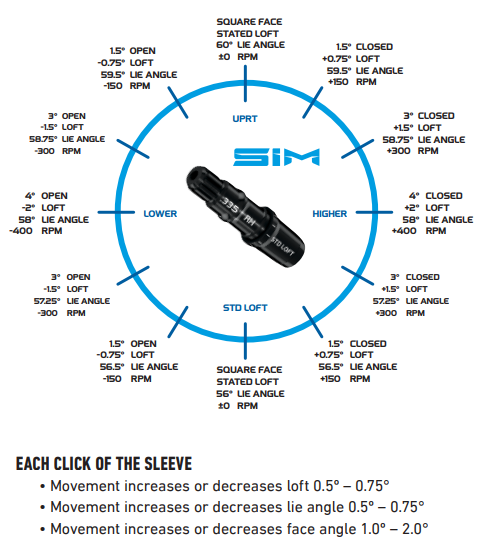
    Focusing on the hosel adapter, you can put it in 12 different modes, as shown in the diagram below and further explained in the table above.

    The loft changes at each position, such as 0.5°—0.75°, Lie 0.5°—0.75°, and Face Angle 1.0°—2.0°.

    As seen in the table above, standard means no adjustment, while lower means lower ball flight, less spin, and a 4° open face angle (fade, anti-draw).

    An upright setting is for a more upright lie, while a higher setting will give you higher ball flight and more spin. It also achieves a 4° closed face angle (draw, anti-fade).

    SIM2 Max Driver Adjustment Chart—Explained


    IMAGE


    Source: TaylorMade

    • Loft: The loft adjustment lets you change the driver’s loft angle to control your shots’ launch angle and spin rate. To adjust, loosen the screw on the driver’s hosel using the provided tool, then rotate the hosel to the desired loft setting. Typically, 1.5 degrees of adjustment are possible for the loft.
    • Face Angle: This adjustment alters the face angle of the club head, which can influence the direction your shots go. You have to first loosen the screw on the hosel and rotate the driver’s head to open or close the face angle slightly. This helps you correct a slice or hook.

    IMAGE


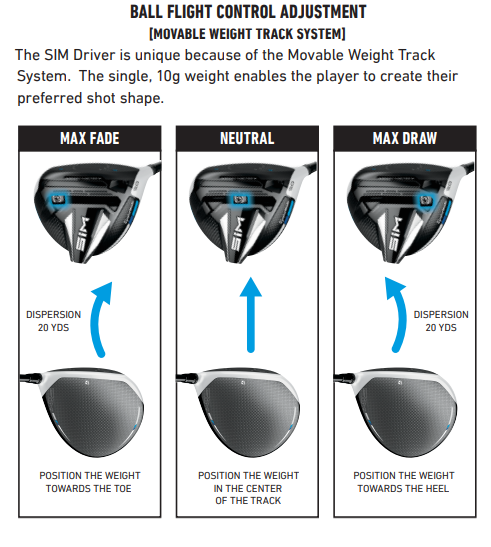
    • Draw and Fade Bias: Since the SIM2 Max Driver allows for draw and fade bias by shifting weights in the sole, you can use the included weights to change the placement in the sole of the driver’s head to prompt fade when you place it toward the toe.
    • Inertia Generator: This movable weight in the sole influences the driver’s overall stability and forgiveness. You can move it between the front and back positions to change the centre of gravity and optimize forgiveness or distance.
    • Hosel Sleeve: This one is responsible for the driver’s lying angle changes. When you loosen the screw on the hosel sleeve, you can easily adjust to your preferred lie angle setting for your swing and address.

    How Do You Adjust the SIM2 Max Driver? (VIDEO)


    IMAGE


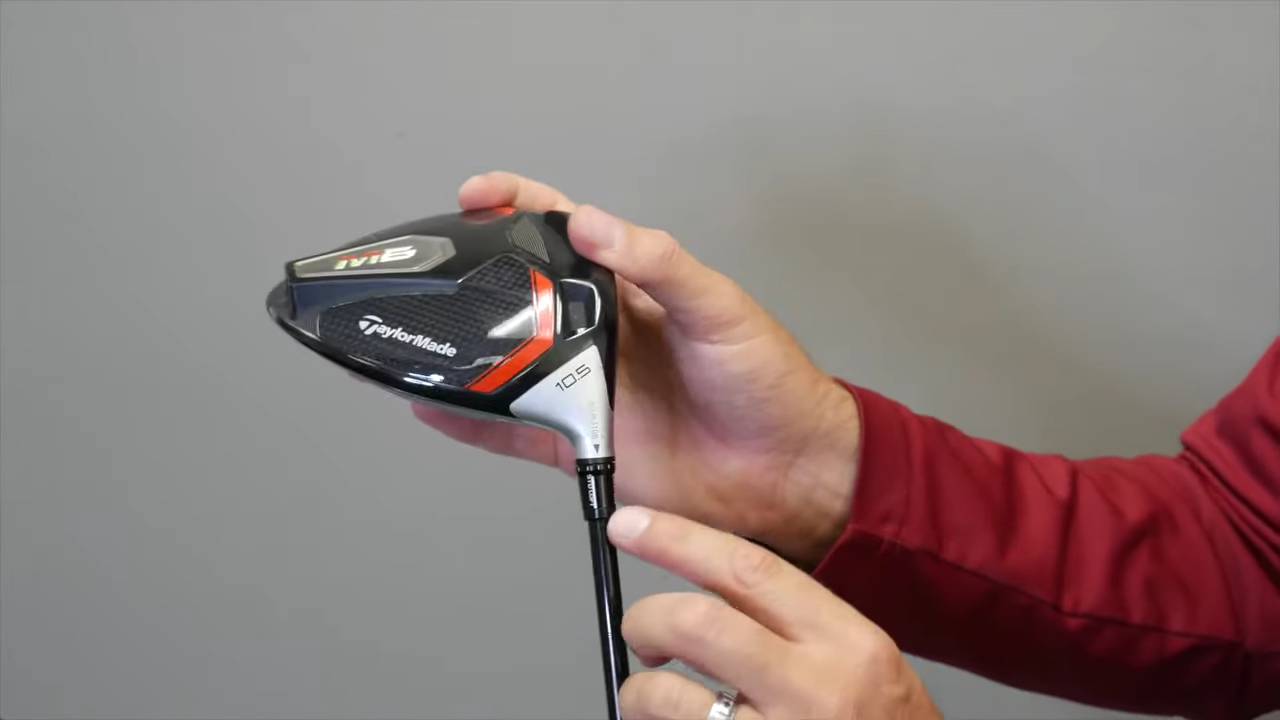
    Step 1: Loosen the adjustable hosel.

    Use the included wrench to loosen the screw on the adjustable hosel located at the base of the driver’s shaft.

    Turn the wrench counterclockwise until the hosel is loose enough to adjust.

    Step 2: Select the desired loft and face angle.

    Once the hosel is loose, you can adjust the loft and face angle.

    Align the small notch on the hosel sleeve with the desired setting on the hosel adjustment ring.

    Loft and face angle settings are typically marked on the sleeve.

    Step 3: Tighten the adjustable hosel.

    After selecting the desired loft and face angle, use the wrench to tighten the screw on the adjustable hosel by turning it clockwise. Stop turning when there is an audible clicking sound.

    Remember to tighten it securely to ensure the hosel stays in the chosen position during play.

    Step 4: Fine-Tune

    Adjusting the driver allows for customization based on your swing and preferences.

    You can experiment with different settings to find your game’s optimal loft and face angle combination.

    You may find this Thomas Campbell video helpful, where he further discussed the different settings available with the TaylorMade adjustable hosel and how they can help you hit better golf shots and improve your on-course performance:

    How Much Can You Adjust the Loft on a SIM MAX Driver?

    You can increase or decrease the loft on your TaylorMade SIM2 Max driver by 0.5° to 0.75°. This is done with the hosel adjustment.

    You can make 12 different adjustments to the loft, lie angle, and face angle.

    Don’t forget that the SIM2 MAX driver has four-degree sleeves supporting twelve loft, lie, and face adjustments.

    What do Upright Settings on TaylorMade Driver do?

    Adjusting the upright settings on your TaylorMade driver will cause the clubface to square up at the time of impact.

    So, it’s an ideal setting option if you encounter slices often because the clubface, which is now more inclined to the left of the target, will solve the slice issue.

    To achieve the upright setting adjustment of the TaylorMade SIM2 Max driver, you must select the UPRT LIE option. Here’s a step-by-step guide to get you through:

    • Position the TaylorMade wrench tip inside the screw at the rear of the clubhead.
    • Rotate the wrench to the left until the screw loosens.
    • Take the screw off the club hosel.
    • Replace the clubhead over the hosel once again, such that the arrow mark on the head
    • Ensure the UPRT LIE markings on the hosel adapter are aligned.
    • Tighten the screw with a few rotations of the wrench to put the clubhead back in shape.
    • Stop the rotation to the right once it produces a click sound.

    Note: Aligning the UPRT Lie marking on the hosel adapter does not impact the loft, but the lie angle is at the highest 60° setting.

    Before You Go

    With adjustments, you can fine-tune the Sim2 Max Driver for ideal launch conditions and increase palatable distance and accuracy for your playing style.

    However, you need the chart, especially for fine-tuning the loft, lie angle, and weight distribution.

    You can always access TaylorMade’s complete guide on their SIM tuning process HERE.

  • Mizuno MP 60 Review: Still a Good Iron to Use?

    Mizuno MP 60 Review: Still a Good Iron to Use?


    The Mizuno MP 60 iron isn’t the longest-hitting, highest-spinning, or most accurate iron, but it impressively blends the performance and head size of the MP-23 blades with the forgiveness you’d get from the MP-30 hybrids’. These irons are best for mid- to low-handicappers only.


    I firmly believe club preferences are personal to each individual. However, having played the MP-60s for about 13 years until I got new clubs this summer, these irons will definitely improve distance and dispersion.


    The Mizuno MP 60 has been gaining fresh attention in the golfing community recently, and given that I miss the feel of the Mizzys, I decided to test and create this review guide on the MP 60s, which I hope will provide you with more precise information on how these irons work and the category of players they are best for.

    Mizuno MP-60 Irons Specifications

    Words on the street concerning the MP-60s have always been that they are for serious golf players only.


    I also noticed that these irons lie flatter than most. However, there’s more to the specifications than this. Here are the key specs of this 16-year-old club:


    Iron 1 2 3 4 5 6 7 8 9 PW
    Loft 18 21 24 27 31 35 39 43 37
    Lie 59.0 59.5 60.0 60.5 61.0 61.5 62.0 62.5 63.0
    Length 39.25 38.75 38.25 37.75 37.75 36.25 36.25 35.75 35.50
    Offset 0.154 0.142 0.134 0.134 0.130 0.126 0.126 0.114 0.114
    Bounce 2 2 2 2 3 3 4 5 6
    Swing Weight


    Mizuno MP-60 Irons: Full Review


    • Date Launched: 2008
    • Material: Steel
    • Shaft Flex: Stiff, Regular
    • Set Makeup: 3, 4, 5, 6, 7, 8, 9, PW
    • Shaft Types: Steel, Graphite
    • Club length: From 32″ to 36.5″
    • Price


    The Design


    I can’t absolutely recall the first impression I had of the MP-60s at the time I first tried them in 2011. However, upon looking at it now, I can say the design of this club grabs attention more.


    With a closer look at the details, you will agree that there’s nothing too extra about it. The top line, offset, sole, and cavity sizes are all small to moderate.


    • The club head has a nice little gouge that provides that organic feel.
    • A very plain sole, organic toe, and heel profile
    • Plain black ferrets, which, again, speak loudly of the iron’s minimalism design
    • It features a Dynamic Gold True Temper steel shaft.
    • And golf pride grip


    One noteworthy area of the design is that it helps the stick reflect the quality of your swing and the direction of the clubface.


    The club cavity back also allows you to know where you made contact.


    Forgiveness


    The Mizuno MP-60 is notoriously famous for being less forgiving, especially for high handicappers or beginners.


    Although, during my testing, I did notice a fair amount of forgiveness. Because each time I miss the sweet spot a bit, they perform just fine.


    And when you hit them with a closed or open club face, they will draw or fade rather than go straight, like a lot of game improvement irons out there.


    So even when you do hit a bad shot, you may not get all the forgiveness you need with the MP-60s. You won’t reach the benefit of, say, the Big Berthas.


    But whenever you nail a hit with these irons, the feeling never gets old.

    Distance


    Just like when testing other clubs, distance has always been determined by the swing speed, shaft, and loft. So it wasn’t much of a surprise to see that the MP-60 iron did not go as far as the strongly lofted clubs that I’ve tried in the past.


    In all fairness, the lofts of these irons are more traditional. So, in terms of distance, especially as a handicapper, you shouldn’t expect much.

    Which Handicap Range Should Mizuno MP-60 Irons Use?

    While the Mizuno MP-60s have an ollow back design, they are not exceptionally forgiving, and it can be hard to get acclimated to the Dynamic Gold SL shafts. Hence, these irons will favor players who are 12 handicaps or lower.


    In other words, I would not recommend the MP-60s for low handicappers.


    If you’re in the latter category, you may still enjoy playing with these sticks since they are pretty easy to hit but don’t offer that much-needed forgiveness as with many newer game-improvement irons out there.

    Who Is The MP-60s For?


    If you want a club that allows you to know how your swing is going without being over-punished, then the MP-60s are ideal for you.


    Understandably, these are for serious golf players with lower handicaps. It will also appeal to players who value simple, uncomplicated irons.


    If you want to just slap at the golf ball and get a decent result, then I don’t recommend this iron.

    Mizuno MP-60 Irons: Pros and Cons


    Before you play with the MP-60s, consider these pros and cons:

    Pros

    • When you hit the sweet spot, the feeling of Mizuno forged is second to none!
    • They’re great out of the rough since they’re heavy.
    • Simple, minimalist design
    • Very workable.
    • The hollow back design, which is ideally supposed to assure moderate forgiveness,

    Cons

    • Not really forgiving
    • On mishits, you pay for it due to the increased workability of these irons.
    • If you have a reasonably low ball flight, you won’t like the shaft of this iron, as you’ll need something with a mid-kick point.
    • The lighter shaft’s feel requires some getting used to.
    • While they’re good-looking, they ding up pretty quickly in the bag, so you’ll need something to keep the clubs from banging together.

    Mizuno MP-60s Alternatives

    One of the most talked-about replacements for the MP-60s is the MP-64 irons.


    While these two are arguably the best Mizzy cavity backs ever made, the MP-64 isn’t the only perfect replacement.


    I would recommend the following irons if you want an alternative to the MP-60s:


    • Taylor-Made RAC LT
    • Mizuno MP-27 irons

    Mizuno MP-64 irons


    The clubs have a very shallow cavity, so they do offer a touch of forgiveness, but the main point of these irons is to deliver exceptional feel and more feedback. They are described as better player irons.


    Just like the MP-60s, the MP-64s are beautiful to look at and also compact enough to offer workability.


    What makes it better is the ample feel and forgiveness.


    However, it still shares a similar problem of not being overly long, and distance control can be an issue at times.

    Taylormade RAC LT


    The Taylormade RAC LT is a semi-cavity-back iron with a medium offset, a low center of gravity, a medium topline, and a midsized head shape.


    It is definitely easier to hit and is more forgiving on “miss-hits” than the MP-60s. But I found that the shaft seemed a bit “whippy”—for  a first-time user, it would appear as though the club was coming out of you during the swing (regular shaft).


    Upon comparing these two irons, I was able to hit the Mizuno MP-60 longer and more tightly bunched than the RAC LT (by about 5–10 yards).


    But many golfers have confessed how, on “off” days, the MP-60s provided complete feedback, which, in the long run, helped improve my swing and, thus, my game.

    Mizuno MP-27 irons


    If you want something like the MP-60s but still within the Mizuno line, then you can’t go wrong with the MP-27s, especially when you want a club that will be a hell of a lot more forgiving.


    With the MP-27s, you will get the most out of your game because you will start gaining a tremendous feel from the forging. And even when you play badly, they will not punish you as much as the MP-60s.


    Meanwhile, do not forget the bling-bling factor of the MP-60s, which will be standard everywhere shortly. On the other hand, MP-27s are Japan-only and will be unique amongst any four-ball!


    In terms of looks, the MP-60s obviously win. But not too many people look into these Mizzys for aesthetics alone.

    Final remark


    As I mentioned earlier, preference for clubs is a very personal thing. But then, you won’t enjoy the Mizuno MP-60s if it’s not your fit.


    If you can constantly strike the ball correctly, then I highly recommend these irons. If you are still struggling with average scoring, then the MP-60s are not for you.


    Summary Rating for the Mizuno MP-60 Irons


    Appearance 10
    Forgiveness 4
    Feel 8
    Distance control 6
    Spin Control 8
    TOTAL (50 points) 36/50 points


    While some people call the MP-60s the best club they’ve ever played with, others insist that they aren’t overly forgiving.


    So, if you don’t plan on consistently working on and molding your swing, then the MP-60s probably aren’t for you. If, however, you are willing to put in the time, these clubs will reward you.


    I particularly adore the ‘carvability’ that these clubs have helped add to my game, and that can be your story.


    I won’t recommend it for total beginners, but if you’re playing challenging courses that will find you with some tricky shots (and you’re ready for that), then the MP-60s are your sticks.


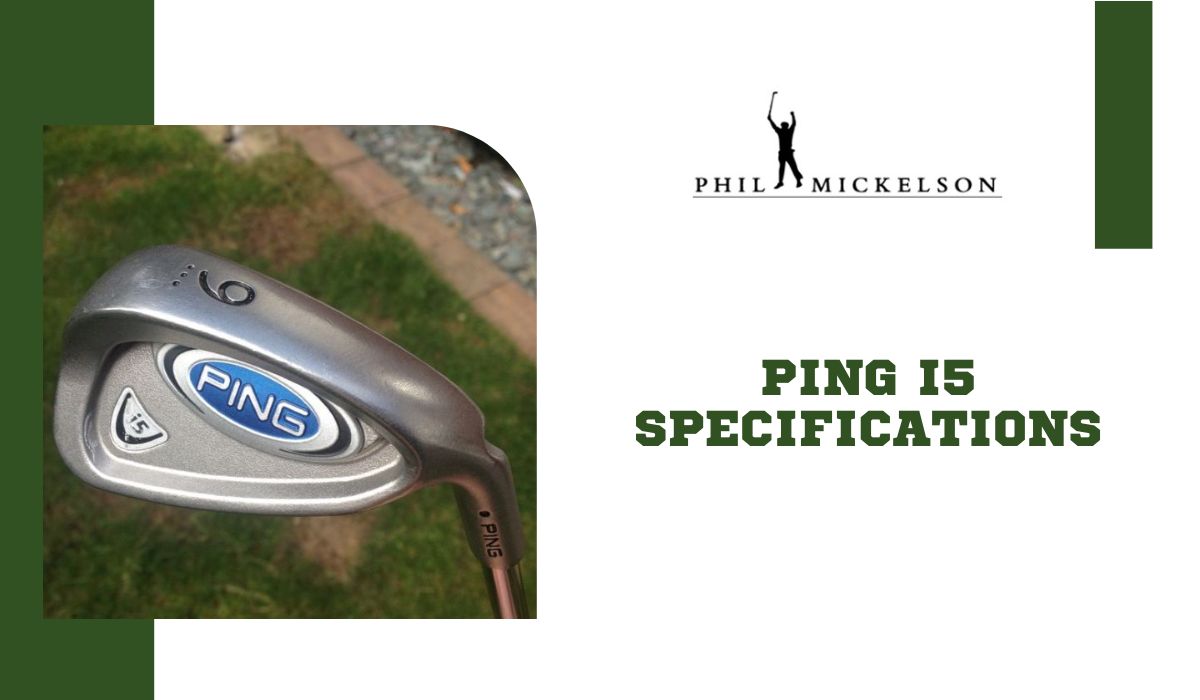
  • Ping I5 Specifications

    Ping I5 Specifications

    The Ping I5 is a stainless steel iron with a midsize and perimeter-weighted design. It has a reduced offset. The set includes 2 through 9 irons, a pitching wedge, a utility wedge, a sand wedge, and a lob wedge. Compared to the other Ping irons, the top line and sole of the Ping I5 are slightly thinner.

    During my test run with the Ping I5 irons, I was impressed by how the specifications translated into actual performance. The cavity-back design gave them a solid feel, and their forgiving nature became evident with every swing. I even had a funny moment where I found myself in a difficult situation, but the moderate offset of the I5s saved the day by helping me correct my shot and avoid any potential hazards.

    This article will give you a detailed overview of the features and specifications of the Ping I5 so you can decide whether to get it.

    Ping I5 Specifications

    Before I discuss the Ping I5 in detail, I’ll be sharing the specifications of this iron to give you a better overview.

    Club 2-iron 3-iron 4-iron 5-iron 6-iron 7-iron 8-iron 9-iron PW UW SW LW
    Length 39.25″ 38.75″ 38.25″ 37.75″ 37.25″ 36.75″ 36.25 35.75″ 35.50″ 35.50″ 35.25″ 35.00″
    Loft 18.00o 21.00o 24.00o 27.00o 30.50o 34.00o 38.00o 42.00o 46.00o 50.00o 54.00o 58.00o
    Lie Angle 58.67o 59.32o 60.02o 60.75o 61.50o 62.28o 63.10o 63.95o 64.38o 64.38o 64.70o 65.11o
    Offset 0.27″ 0.24″ 0.22″ 0.20″ 0.18″ 0.16″ 0.14″ 0.12″ 0.11″ 0.10″ 0.09″ 0.08″
    Swingweight D0 D0 D0 D0 D0 D0 D0 D0 D2 D4 D4 D6

    First Impression

    My first impression of the Ping i5 irons has been superb. A friend of mine who’s a mid-handicapper with a handicap of 14 was explicitly looking for irons that strike a balance between workability and forgiveness. The i5s fit the bill perfectly, avoiding the chunkiness of game improvement irons while forgiving enough for my skill level.

    Standing at 6 ft 5″, I appreciate the quality construction that allowed me to achieve a lower and more penetrating trajectory, which suits my game well, especially in windy conditions.

    The feel of the clubs is exceptional, considering they are cast iron. The custom fitting process further enhanced my experience, ensuring the clubs were tailored to my specifications. Shifting approach shots with greater control has significantly improved my game.

    The value for money has been outstanding after purchasing the set for £350, supposedly in near-new condition as an ex-demo. The irons have proven more accurate, offering the proper distance, spin, and accuracy balance.

    Features and Technology

    The Ping i5 irons boast various cutting-edge features and technologies, contributing to their premium performance. A standout feature is the Custom Tuning Port (CTP), strategically positioned on the back of the clubhead. Having experienced this firsthand during my custom fitting, I found that the more significant and profound CTP in the Ping i5 irons was crucial in optimizing the center of gravity (CG). This increased distance on off-center hits and enhanced the overall feel and control, elevating my confidence with each swing.

    Crafted from high-grade stainless steel, the Ping i5 irons deliver a solid and dense impact feel, improving my shot consistency. The satin-brushed finish adds a touch of elegance and minimizes glare, providing a sleek and polished aesthetic. The advanced internal weighting system is another noteworthy technology, fostering greater forgiveness and a higher launch angle. This aspect has been pivotal in enhancing the accuracy and consistency of my shots across the entire set, contributing to improved overall performance.

    A key design element that I appreciate is the progressive sole width. As I transition from long to short irons, the variation in sole width optimizes turf interaction and launch conditions. The broader sole on the longer irons aids in getting the ball airborne, while the narrower sole on the short irons enhances playability and control. This feature has played a significant role in shaping my approach shots with increased precision.

    Forgiveness

    I didn’t expect much forgiveness when using the Ping i5 irons. Although not as compact as irons like the Ping i10s, they still possess the performance profile of a player. The initial impression behind the ball suggested sophistication that typically doesn’t align with forgiveness. However, my experience quickly proved me wrong. Using the 7-iron extensively, I was pleasantly surprised as I effortlessly squeezed upwards of 160 yards out of it.

    The feedback from my friends who tested it matched my thoughts. The clubface felt noticeably bouncy upon impact, and the data from the launch monitor supported the fact that these irons produced a hot sensation. The average ball speed of 111 MPH with the 7-iron made it clear that the Ping i5s provided impressive distance. It is essential to mention that these testers had mid-to-high handicaps but had no difficulty achieving impressive distance with these irons. The forgiving nature of these clubs was a game-changer for players like me, as they offered a level of playability that surpassed expectations.

    However, it’s important to note that the Ping i5s are inclined to draw the ball, particularly for those who may not be very precise with their swing. The average deviation is around 4 yards, so it’s something to remember. Nevertheless, the i5 irons have a midsize design that finds a good balance, featuring a cavity that provides a decent amount of forgiveness without being overly deep. The smooth leading edge also allows for smooth interaction with the turf, making it easier for high handicappers like myself to use.

    Comparison with Other Alternatives

    When comparing the Ping I5 irons with other alternatives like the TaylorMade SIM2 and Titleist T300, each set presents distinct features catering to different player preferences.

    The Ping I5 irons are recognized for their solid feel and forgiveness. With a cavity-back design, they provide stability, particularly aiding off-center hits. These irons offer a good balance of distance and playability, making them suitable for mid-handicap players. The moderate offset contributes to correcting slices and promoting a straighter ball flight. The Ping I5’s performance shines through its forgiveness and overall reliability.

    On the other hand, the TaylorMade SIM2 irons focus on explosive distance, incorporating Speed Bridge technology to enhance ball speed and forgiveness. Ideal for those prioritizing long shots, the SIM2 irons also feature inverted cone technology for improved accuracy. They balance forgiveness and workability with a moderate offset, making them a strong contender for players seeking distance and playability.

    The Titleist T300 irons stand out with Max Impact Technology, a high MOI, and tungsten weighting for a low center of gravity. Geared towards players transitioning from game improvement to more advanced clubs, the T300 irons offer forgiveness and increased ball speed. The flexibility in shaft selection, including True Temper AMT steel shafts or Mitsubishi Tensei AV Red AM2 graphite shafts, provides customization options. While they have less offset than the TaylorMade SIM2, the T300 irons compromise between forgiveness and distance.

    Below is a table that provides a clear and concise side-by-side comparison of the main features of these irons. This will help you easily understand the specific offerings of each iron.

    Irons Ping I5 TaylorMade SIM2 Titleist T300
    Hand Orientation Right-handed and left-handed Right-handed and left-handed Right-handed and left-handed
    Shaft Material Steel Steel Steel
    Flex Regular, Stiff Regular, stiff, amateur, ladies R300, S300, Mitsubishi Tensei AV Red AM2
    Set Composition 3-PW (3-9 irons plus pitching wedge) 4-PW (4-9 irons plus pitching wedge) 4-PW (4-9 irons plus pitching wedge)
    Grip Standard grips are included, but custom grips can be fitted. Standard grips are included, but custom grips can be done. Standard grips are included, but custom grips can be done.
    Price $299 $351.99 $143

    Pros and cons

    Before closing off for the day, I need to share some upsides and downsides I observed when using the Ping I5.

    What I liked

    • Ping is known for its top-notch custom club fitting service. The color code system indicates the lie angle and ensures every golfer gets a personalized fit.
    • The Ping i5 irons have stood the test of time, demonstrating their durability and quality.
    • Despite over a decade old, these irons perfectly balance control and forgiveness. They offer forgiveness for high-handicap players, resulting in impressive apex height.
    • Consistent distance control is a hallmark of the Ping i5 irons, making them reliable on the course.
    • The moderate sole width and smooth leading edge create a pleasing turf interaction experience.

    What I Didn’t Like

    • Didn’t i5 irons lack the latest features and technology in newer irons?
    • These irons are easy to hook, so golfers must be mindful of swing accuracy to avoid excessive draw shots.
    • While the Ping i5 irons deliver reliable performance, their sound and feel might not align with the characteristics of more recent models.

    Final Thoughts

    The Ping i5 iron is a robust and reliable choice for experienced golfers seeking top-notch performance. With advanced technology, premium materials, and innovative design features, the i5 has established itself among the best irons in today’s market. Today’s today’septional performance on the golf course, offering a harmonious blend of accuracy, distance, and forgiveness, makes it a valuable asset for those with high expectations for their iron set. The durability stemming from its premium construction ensures the Ping i5 will remain a trusted companion for years. The Ping i5 iron is the ideal investment for golfers ready to elevate their game, delivering on its promise of excellence.

  • Ping I20 Irons Specs

    Ping I20 Irons Specs

    The Ping i20 irons have a progressive set design that allows for a high launch with long irons and a controlled flight with shorter ones. These irons have a large cavity area and a low Custom Tuning Port (CTP), which provides forgiveness and a sleek, classic Ping vibe. Additionally, incorporating high-density tungsten toe weight enhances stability, resulting in a solid feel at impact for consistent ball striking.

    Having used the Ping i20 irons occasionally on the golf course, I am always amazed by their impressive specifications. The progressive set design ensures consistent performance, allowing for a high launch with the long irons and controlled flight with the shorter ones. These irons have proven to be versatile in rescuing me from tricky situations.

    However, on one memorable day using this iron, I unintentionally hit a shot that rebounded off a tree and landed closer to the pin than my intended target. The forgiveness of the i20s turned this unexpected mishap into a hilarious triumph, leaving me impressed and amused by their capabilities.

    In this article, I’ll discuss the features and specifications of the Ping I20. I’ll also try to share my experience so you can determine if purchasing it is a good decision.

    Ping I20 Specifications

    The PING i20 iron set was designed for players seeking a balance of distance and shot-shaping control. Here’s an overview of the critical specifications of the PING i20 irons:

    Iron Loft Angle Lie Angle Length Bounce Angle Offset Swing Weight
    4 Iron 24o 60.5o Standard 0o Moderate D2
    5 Iron 27o 61.5o Standard 0o Moderate D2
    6 Iron 30o 62o Standard 1o Moderate D2
    7 Iron 33o 62.5o Standard 2o Moderate D2

    First Impression

    When I first got my hands on the Ping i20 irons, their sleek design stood out the most. The cavity back is seamlessly blended with the classic Ping look. The new custom tuning port played a big role in this. The refined size, placement, weight, and appearance of the CTP gave the irons a modern feel, even though they were released in 2012. The previous bulky and not-so-attractive CTP design was completely transformed with the Ping i20, giving the irons an overall contemporary look.

    As I started testing the Ping i20 irons, my impression of the iron solidified further. The easy launch capability of these irons was especially impressive. This would be a massive advantage for high-handicapped players who struggle to get the ball in the air. Even mid-handicap players would benefit from the steep descent angles around the green, making these irons versatile in all situations. Even though the 9-iron had a relatively weak loft of 41°, it still performed impressively.

    Features and Performance

    The PING i20 irons combine forgiveness and precision through a sophisticated blend of technology, making them suitable for a wide range of golfers. One notable technological update is the introduction of the “toaster” style tuning port in the cavity, replacing the elliptical PING logo badge found in previous models.

    The Custom Tuning Port (CTP) vertical design and stabilization bars within the cavity enhance the overall feel and contribute to a thicker impact area. The strategic placement of the CTP allows for a lower center of gravity (CoG), providing options for customized weight positioning and swing weights. This adaptability ranges from 3 to 28 grams, accommodating different shaft lengths and weights.

    The cavity structure design of the i20 irons emphasizes their technological prowess. The cavity is cut perpendicular to the ground in long irons, pulling the CoG back to increase ball flight. Conversely, the cavity is cut closer to the face for shorter irons, moving the CoG down and forward, offering a more comprehensive range of trajectory options.

    Including stabilization bars behind the face enhances the overall feel of the irons, ensuring consistent and precise yardages, a crucial aspect of distance control for skilled players. With their advanced technology, the PING i20 irons strike an impressive balance, delivering forgiveness and precision to enhance the performance of golfers at all skill levels.

    Forgiveness

    The forgiveness of the Ping i20 irons was noticeable in my personal experience, especially when transitioning from the long irons to the mid irons. The pronounced offset, which decreases as you move down the set, made the long and mid irons much more manageable. Testing with high-handicap players showed that aligning with the long irons became easier, leading to straighter flights and better-shot dispersion.

    The set’s ability to mask inward misses was awe-inspiring, with shots made towards the hosel exhibiting straighter trajectories than expected. However, the dynamics changed when testing the scoring irons, particularly the seven iron, which had significantly less offset than its predecessor. This adjustment posed initial challenges, highlighting the need for adaptability as I moved through the set.

    The Ping i20 irons exhibited a natural high launch, especially when tested with mid-handicap players. However, the narrower toe area of the shorter irons posed challenges in drawing the ball. Although the distance achieved with the 7-iron was average, peaking at 152 yards, the forgiveness of these irons offered a significant advantage, catering to the unique requirements of various handicaps within the set.

    Comparison with Other Alternatives

    The comparison of the Ping i20, i25, and i200 irons provides insights into the distinct characteristics of each series, catering to diverse golfer preferences.

    The Ping i20 irons feature a large cavity area and a low Custom Tuning Port (CTP), resulting in a high launch and a low Center of Gravity (CG). With high-density tungsten toe weight enhancing forgiveness and stability, these irons offer a sleek, classic Ping vibe. Suitable for both high- and mid-handicappers, the i20 irons maintain a modern appearance and are easy to launch.

    Moving to the Ping i25 irons, a larger cavity area and smaller overall head size despite wider soles distinguish them from the i20. Less noticeable custom tuning ports in the mid and short irons balance game improvement with workability, appealing to mid- to high handicappers. Offering forgiveness and distance like the i20, the i25 irons boast a sleek and appealing design with a more game-improvement feel without sacrificing workability.

    The Ping i200 irons focus on forgiveness, distance, and a soft feel. A 30% thinner face enhances ball speed, while weight distribution increases the Moment of Inertia (MOI) for improved forgiveness. The higher leading edge and more bounce on the sole make these irons easier to hit, and the hydro pearl finish ensures consistency even in wet conditions. The i200 irons, with a sleek appearance and a thinner face, provide a crisp feel at impact, emphasizing consistency over extreme distances.

    To make things easier, here’s a side-by-side comparison of some key features of these irons:

    Features Ping I20 Ping I25 Ping I200
    Cavity Area Large cavity area with a custom tuning port (CTP) for high launch and low CG. Larger cavity area with less offset throughout the set. Sleek appearance with a thin face and water-resistant finish.
    Forgiveness With high forgiveness on mishits, shots launch high with ease. Game improvement feels good without sacrificing workability. It is forgiving with consistent performance.
    Visual Design Sleek, classic Ping vibe with a modern appearance. Appealing design, trimmer heads, less noticeable CTP Sleek appearance, crisp feel.
    Player Range Better players in the 10–5 handicap range. Mid- to high handicappers. Consistent performance for various skill levels.
    Hand Orientation Right-handed and left-handed configurations. Right-handed and left-handed configurations. Right-handed and left-handed configurations.
    Shaft Material It comes with steel shafts and graphite. It comes with steel shafts and graphite. Comes with steel and graphite.
    Flex Options Available in Regular®, Stiff (S), and sometimes Extra Stiff (X). Available in Regular®, Stiff (S), and sometimes Extra Stiff (X). Offers various flex options (R, S, and X) based on custom fitting.
    Set Composition The standard set includes 3–9 irons and, optionally, a pitching wedge (PW) or gap wedge (GW). The standard set includes 3–9 irons and, optionally, a pitching wedge (PW) or gap wedge (GW). Standard set composition with customization options.
    Grip Options Various grip options are available, including proprietary grips and other popular brands. Different grip options are available, including proprietary grips and other popular brands. Different grip options are available, including proprietary grips.
    Price Range $255-$618 $275 $356-$502

    Pros and cons

    Before I wrap things up, I highlight the advantages and disadvantages I observed using the Ping I20.

    What I liked

    • The i20 irons offer brilliant distance control, which is crucial for consistent performance on the golf course.
    • These irons provide remarkable consistency in terms of ball flight and shot dispersion.
    • The i20 irons exhibit forgiveness even on off-center hits, making them suitable for a wide range of golfers.
    • Ping offers custom fitting options, allowing players to tailor the clubs to their swing characteristics.

    What I Didn’t Like

    • Some purists might find the non-blade styling a bit “chunky.” However, this aesthetic preference is subjective.
    • If you’re a traditionalist who prefers sleek blade-style irons, the i20’s appearance may not match your taste.

    Who Should Use the Ping I20 Irons?

    The Ping i20 irons are particularly well-suited for golfers falling within the handicap range of 20 to 12, offering a balanced set of features that cater to the specific needs of players within this skill level. The progressive CG is a notable advantage for better players in this range. The low CG in the long irons provides forgiveness, while the gradual increase as you move through the set enhances workability, making them an ideal choice for those looking to refine their game as they approach the green.

    Due to this progressive CG design, mid-handicappers can benefit significantly from the Ping i20 irons. The forgiveness in the long irons ensures a forgiving launch. At the same time, the ability to manipulate shots becomes more pronounced with the mid-iron set, allowing for increased precision as players approach the green.

    Even high handicappers stand to gain from the user-friendly characteristics of the Ping i20 irons. These irons’ easy launch and feedback are advantageous for players still developing their skills. The toe weighting effectively mitigates mishits, and the clubs support correcting common issues like slices.

    Final Thoughts

    The Ping i20 irons showcase Ping’s dedication to innovation and performance in golf clubs. These irons have proven their versatility, appealing to many players, including tour professionals and mid-handicappers. The i20’s progressive set design, which offers a high launch with a long and controlled flight with shorter irons, ensures reliability on the course. Whether it’s the ease of launch or the consistent ball striking, the Ping i20 irons retain their reputation as a reliable choice for golfers who desire a balanced blend of performance and playability.

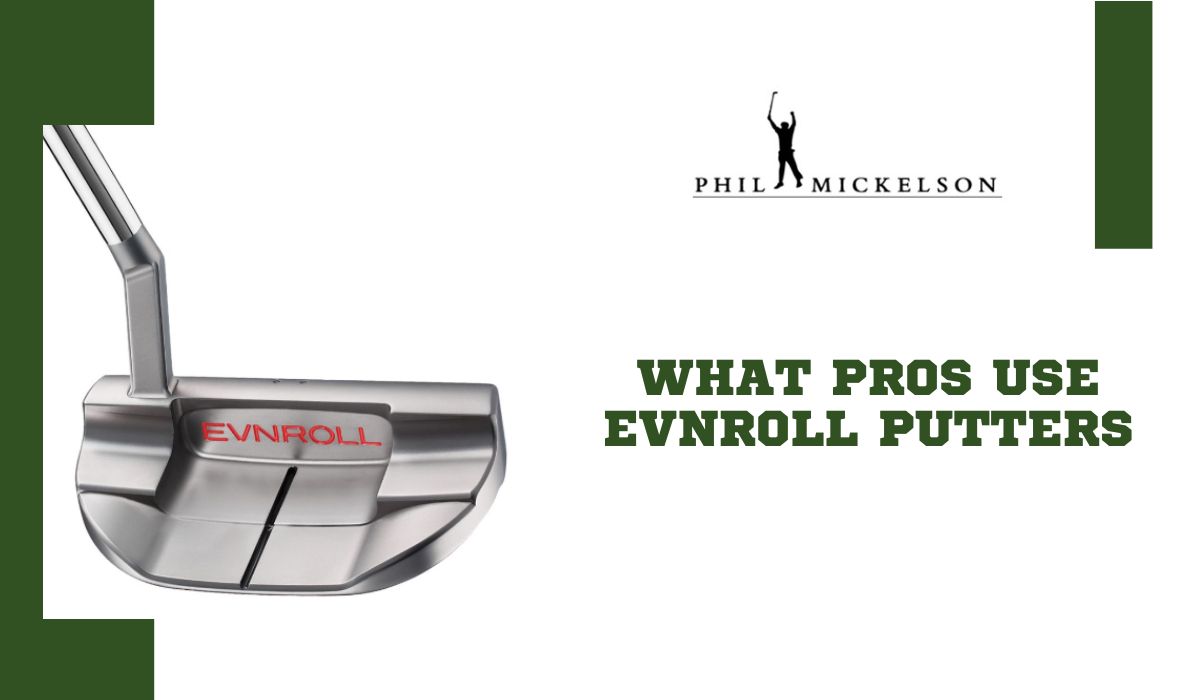
  • What Pros Use Evnroll Putters

    What Pros Use Evnroll Putters

    Evnroll putters have become popular among professional golfers like Tommy Fleetwood, Zac Blair, and Ian Poulter. The fact that these pros choose Evnroll highlights the effectiveness and appeal of these putters, demonstrating the brand’s recognition and acceptance in professional golf.


    Selecting the right putter has become increasingly complex in today’s golf world, given the vast array of options available. Among the many choices, Evnroll putters stand out as a compelling option. Considering that nearly 40% of a golfer’s shots occur on the putting green, finding the right putter cannot be overstated. This is evident on the PGA Tour, where the precision and performance of Evnroll putters have gained recognition, making them a focal point for those seeking to improve their short game.


    If you want an Evnroll putter but are curious to know if any pro golfers are using it, you’ll get the answer and more in this article.

    Evnroll Putters Construction and Technology

    The precision and advanced technology of Evnroll putters have greatly impacted my approach to improving my putting performance. One standout feature is the SweetFace, which has variable-width channel technology. It significantly reduces the dispersion of mis-hit putts and ensures consistent distance control. This intricate design guides the golf ball toward its target on off-center hits and enhances energy transfer, improving my overall putting experience.


    The strategically designed channels in Evnroll putters, wider in the center and gradually narrowing towards the heel and toe in a V-shape, have personalized my putting journey. This intentional calibration redirects my putts off the sweet spot, ensuring smooth travel along the target line. The increasing spacing between channels away from the center provides a larger surface area for higher energy transfer, showcasing Evnroll’s dedication to consistency. This feature resonates deeply with my quest for precision in putting.


    Evnroll’s commitment to personalization continues with various hosel options in the V-Series model. There are six putter heads with four interchangeable hosels, including long slant, long plumber, short plumber, and short slant. This allows me to tailor my putter to correct various putting strokes according to my preferences.


    The Midlock putting grip, a thoughtful addition, caters specifically to my choice of arm-locking the putter. It reduces shaft lean, encourages a one-piece takeaway with the shoulders, and minimizes wrist movement, providing me with a personalized touch for optimal control and stability.


    The Gravity Grip, a breakthrough in putter grip technology, has further enhanced my connection with the putter. It is crafted from super lightweight EVA foam and features a 70-gram steel shaft running 1/2 inch below the grip. This design allows my hands to feel the precise angle of the putter face, connecting them with the putter head for a square impact before and after contact. This underscores Evnroll’s commitment to elevating my overall experience through innovative features tailored to my preferences.

    Pro Golfers Who Are Using the Evnroll Putters

    Evnroll putters offer golfers a reliable tool to enhance their short game, boost confidence, and potentially improve their scores. Despite being more expensive, the advanced technology and endorsements justify the investment for those seeking consistent and precise putting on the greens. Here are some notable pros who use the Evnroll putters:


    • Brandt Snedeker: A seasoned veteran on the PGA Tour, Brandt Snedeker has made a name for himself with his precision putting. Known for his accuracy and consistency, Snedeker switched to an Evnroll putter and experienced positive results. These putters are designed with innovative technology to enhance roll consistency and minimize mishits, making them popular among pros like Snedeker.


    • Lydia Ko: Among the top female golfers globally, Lydia Ko has also embraced the Evnroll putter. Her short-game prowess is well documented, and the Evnroll putter has become integral to her toolkit. The combination of feel, alignment aids, and performance benefits has contributed to her confidence in the greens.


    • Tommy Fleetwood: Tommy Fleetwood, a prominent figure on the European Tour, has added Evnroll putters to his collection. Fleetwood’s precision and accuracy on the greens have been crucial to his success in various tournaments. One of Fleetwood’s preferred choices is the Evnroll ER5 Hatchback putter, known for its high performance, adjustable weights, and distinctive alignment features. What sets Fleetwood apart is his adaptability, as he has even experimented with a unique putter purchased on eBay for £90, showing his willingness to explore different options.


    • Zac Blair: Zac Blair, a well-known player on the PGA Tour, openly supports Evnroll putters. Blair is recognized for his exceptional putting skills and has used the Evnroll ER1TS model during tournaments. Choosing this particular Evnroll putter likely contributes to Blair’s proficiency on the greens, ultimately aiding his success in professional golf.


    • Ian Poulter: Ian Poulter, famous for his charismatic and enigmatic presence on the golf course, has consistently used Evnroll putters since 2018. Poulter’s commitment to the armlock putting technique has made him a formidable force on the greens. Carrying the Evnroll Tour ER putter in his bag, Poulter benefits from the SIK Pro C-Series Armlock putter, allowing him to control his arc effectively. The patented Descending Loft Technology ensures a consistent launch, regardless of the strike location on the putter’s face.

    What Evnroll Putter Length Do Pros Use?

    According to the PGA of America, the average PGA Tour player, typically around 6 feet tall, tends to use a putter of 33.5 inches. This is notably shorter than the standard putter length of 35 inches.


    A golfer’s height often influences putter length. For instance, the standard recommendations suggest that a 33-inch putter is suitable for golfers between 5’2″ and 5’4″, while a 34-inch putter is recommended for those between 5’6″ and 5’8″. These guidelines help align the putter with the golfer’s physique, promoting a more natural and comfortable stance.

    Top 3 Evnroll Putter Models Used by Pro Golfers

    If you were considering pro golfing and that made you wonder if any pros use the Evntoll putter, here are some Evnroll putter models some notable pro golfers have used:


    1. Evnroll ER1

    The Evnroll ER1 putter has made a significant impact on my golf game. Its blend of control, roll, and forgiveness is outstanding. The putter’s innovative technology and features contribute to its exceptional performance.


    The milled face of the Evnroll ER1 is truly revolutionary. Its unique pattern, covering the entire surface, provides a consistent milling experience. When I run my finger across it, I feel the precision, transforming the entire face into a sweet spot. This ingenious design guarantees a smooth roll for the ball, even on off-center putts, making distance control extremely accurate.


    I have found the alignment aids on the top line of the putter to be incredibly helpful. There are two dots on each side of the center cavity sightline, which guide the positioning of the ball. This ensures that my putts consistently stay on the high side of the hole, ultimately improving my accuracy.


    The Evnroll ER1 offers three length options (33 inches, 34 inches, and 35 inches), each corresponding to a specific head weight. This customization ensures optimal balance and distance control, catering to individual preferences and adding to the putter’s versatility.


    Pros

    • Its unique face grooves, wider in the middle and narrower towards the edges, provide consistent distance control and a smoother roll.
    • It appeals to players who prefer a traditional blade with its visually appealing design, enhanced feel, and improved roll.
    • Players can choose from a range of high-quality stock grips for the ER1 to add a personal touch.


    Cons

    • Some golfers may feel that the customization options for the ER1 putter are more limited compared to other putters.
    • It is classified as a high-end putter with a higher price tag.


    1. Evnroll ER2

    The Evnroll ER2 putter has revolutionized my putting game on the greens. With its Face Groove Technology, the putter ensures a consistent roll no matter where I strike the ball on the face. This personalized design philosophy perfectly resonates with Evnroll’s commitment to delivering even and reliable ball rolls.


    As an avid user of the ER2 model, I’ve found that the blade putter aligns seamlessly with my slightly arcing and straighter strokes. What sets the ER2 apart is its ability to provide the most consistent roll among all putters, giving me a satisfying feel with every stroke. Incorporating alignment dots and a line on the flange makes lining up shots effortless, enhancing my accuracy on the green.


    With 15 degrees of toe hang, the ER2 accommodates my slight arcing stroke, allowing for a smooth and natural putting motion tailored to my game. The stainless steel head contributes to the putter’s aesthetics and generates a satisfying “click” on impact, further enhancing the feel of each putt.


    Pros

    • The ER2 putter enhances performance on the greens by providing a controlled and consistent roll across different putt lengths.
    • It sets up perfectly with its sophisticated finish and wide blade shape.
    • It minimizes the negative impact of mishits, offering forgiveness and instilling confidence in your putting stroke.


    Cons

    • Some players may need some time to adjust to its slower speed.
    • Compared to other putters, the customization options are limited.


    1. Evnroll ER8v Tour Mallet Putter

    The Evnroll ER8v Tour Mallet Putter, released in 2021, has quickly become my go-to putter on the green. It relies on the innovative Sweet Face Technology, elevating forgiveness, stability, and accuracy in my putting game and significantly contributing to improved performance on the green.


    The microgroove pattern on the face, coupled with the squared-backed mallet head, delivers a pleasing balance and a remarkable feel and sound upon impact that I find truly satisfying. This putter’s modern and stylish design goes beyond aesthetics; it boosts my confidence during shots thanks to its adjustable weighting features, gravity grip technology, and alignment aids, all working together to enhance my putting precision.


    However, although exceptionally smooth, the milled face occasionally reflects sunlight due to its steel composition, creating a minor inconvenience during play. Despite being a bit heavier than some alternatives, I’ve found that the Evnroll ER8v more than compensates for this with its advanced features, making it a valuable investment for someone like me who’s always looking to enhance consistency on the green.


    Pros

    • The ER8v incorporates Evnroll’s patented Sweet Face Technology, designed to deliver a consistent roll across the face. This leads to increased accuracy and fewer mishits.
    • This putter offers a high-end look with CNC-milled stainless steel, a sleek black flange line, and customizable neck options.
    • For an extra fee, you can opt for the gravity grip, which enhances face angle awareness and helps maintain a balanced tempo throughout your stroke.
    • It delivers a pleasant and muted “tock” sound upon impact, providing a consistent feel even on off-center strikes.


    Cons

    • Some players may not find the muted feel and lack of strong feedback appealing because it doesn’t provide sufficient sensory information about the quality of the strike.
    • The ER8v has a high price tag (over $400), which may discourage budget-conscious golfers.
    • Occasionally, the steel face of the putter can reflect sunlight, which could be distracting for certain players.

    Conclusion

    The fact that professional golfers like Tommy Fleetwood, Zac Blair, and Ian Poulter have adopted Evnroll putters shows the brand’s popularity and appeal among top players. By choosing Evnroll, these pros demonstrate the putters’ ability to enhance accuracy and consistency on the greens. The endorsement from skilled and diverse players within the golfing community reinforces Evnroll’s reputation as a reliable and high-performance choice for those looking to improve their short game.

  • Mizuno MP 33 Review and Specs

    Mizuno MP 33 Review and Specs

    The Mizuno MP 33 is a set of forged muscle-back irons that golfers highly covet. They are suitable for low- to mid-handicap golfers who value precision, shot-shaping ability, and a soft, responsive feel more than distance and forgiveness. The iron set is constructed with Select 1025 Mild Carbon Steel and includes a sole chamber and a computer-optimized sweet spot.


    Intrigued by my brother’s recommendation, I decided to give the Mizuno MP 33 irons a try. His excitement about how well they performed and their timeless appeal piqued my interest. As I brought them to the golf course, the irons exceeded my expectations—they offered a special combination of reliable feel and accuracy. This experience validated my brother’s suggestion, transforming it from a simple recommendation into a decision that significantly improved my overall experience on the course.


    In this article, I’ll be discussing the features and specifications of the Mizuno MP 33 in detail. With this, you will understand why lots of golfers like it and why you should purchase it.

    Mizuno MP 33 Specifications

    To kick it off, I’ll be sharing the specifications for the Mizuno MP 33 to give you a better overview of this iron.


    Iron 1 2 3 4 5 6 7 8 9 PW
    Loft 16o 19o 22o 25o 28o 32o 36o 40o 44o 48o
    Lie 59o 59.5o 60o 60.5o 61o 61.5o 62o 62.5o 63 63.5o
    Length (inches) 39.75 39.25 38.75 38.25 37.75 37.25 36.75 36.25 35.75 75.25
    Offset Little Little Little Little Little Little Little Little Little Little
    Material Select 1025

    Mild

    Carbon

    Steel

    Select 1025

    Mild

    Carbon

    Steel

    Select 1025

    Mild

    Carbon

    Steel

    Select 1025

    Mild

    Carbon

    Steel

    Select 1025

    Mild

    Carbon

    Steel

    Select 1025

    Mild

    Carbon

    Steel

    Select 1025

    Mild

    Carbon

    Steel

    Select 1025

    Mild

    Carbon

    Steel

    Select 1025

    Mild

    Carbon

    Steel

    Select 1025

    Mild

    Carbon

    Steel

    Shaft True Temper Dynamic Gold Steel True Temper Dynamic Gold Steel True Temper Dynamic Gold Steel True Temper Dynamic Gold Steel True Temper Dynamic Gold Steel True Temper Dynamic Gold Steel True Temper Dynamic Gold Steel True Temper Dynamic Gold Steel True Temper Dynamic Gold Steel True Temper Dynamic Gold Steel
    Grip Golf Pride Tour Velvet Golf Pride Tour Velvet Golf Pride Tour Velvet Golf Pride Tour Velvet Golf Pride Tour Velvet Golf Pride Tour Velvet Golf Pride Tour Velvet Golf Pride Tour Velvet Golf Pride Tour Velvet Golf Pride Tour Velvet

    Features and Performance

    The Mizuno MP-33 is a well-respected golf iron. It shows that Mizuno is serious about making great golf clubs. When I used it on the golf course, I noticed how it took the best things from its older versions, especially the MP iron series. It made me understand why, despite the advancements in golf club technology, the Mizuno MP-33 remains a popular choice among golfers.


    One cool thing about it is that it has the same face profile as the MP-9, which is a famous Mizuno iron. They mixed in the camber and radius with the sole from the MP-14, creating a mix that shows off the best of Mizuno’s irons.


    People like irons, like the MP-33, because they let you control how the ball flies. Mizuno kept this tradition by making the iron with Select 1025 Mild Carbon Steel using their “Grain Flow Forging” method. This technique guarantees a consistent feel and high quality, which sets the MP-33 apart in craftsmanship.


    The MP-33 has added features like a sole chamber and a sweet spot optimized by a computer. These things make it easier to control the ball and how it moves. The shape of the sole, with a bevelled trailing edge and a rolled leading edge, is designed to make the iron slide smoothly on the turf, so your swings are easier and you hit the ball better.


    All the irons in the set look and feel the same, with almost no difference. This helps a lot because it makes your shots more consistent and easier to control.


    The center of gravity (COG) in the MP-33 is placed lower than usual. This makes the ball go higher when you hit it. This special COG helps you launch the ball better, giving you an advantage when you play golf.

    Comparison with Other Alternatives

    While the Mizuno MP-33 showcases a classic design with a combination of features from its earlier models, it does come at a higher price. Golfers who are conscious of their budget may find the Titleist 620 MB and Callaway Apex MB to be attractive alternatives.


    The Titleist 620 MB is made from forged 1025 carbon steel and features tungsten weighting strategically placed to provide a solid feel and consistent performance. The inclusion of tungsten also improves forgiveness, making these irons suitable for players who prioritize control without sacrificing stability.


    On the other hand, the Callaway Apex MB targets players who highly value control and feel. Like their counterparts, the Callaway Apex MB irons boast a forged 1025 carbon steel body and incorporate tungsten weighting. These irons have a traditional shape that appeals to purists, offering the ability to shape shots and manipulate the ball’s flight.


    Below is a table that provides a side-by-side comparison of the key features of these irons, allowing you to easily understand what each one offers.


    Iron Mizuno MP 33 Titleist: 620 MB Callaway Apex MB
    Hand Orientation Left Right and left Right and left
    Shaft Material Steel Steel Steel
    Flex Stiff Stiff Stiff
    Set Composition 3-PW 3-PW 3-PW
    Grip Golf Pride Tour Velvet Golf Pride Tour Velvet 360 Golf Pride Tour Velvet 360 Soft
    Price $1,999.99 $1299.99 $1299.99

    Pros and cons

    Before concluding this article, it is important that I share the upsides and downsides I noticed when using the Mizuno MP 33.

    What I liked

    What I Didn’t Like

    • These irons are less forgiving than cavity-back designs, so they may not be the best choice for high handicap players.
    • The sweet spot on the Mizuno MP 33 irons is smaller than others, making it a bit more challenging to hit consistently.
    • The Mizuno MP 33 irons prioritize precision and control over distance. Therefore, golfers who prioritize distance may find other options more suitable.

    Final Thoughts

    The Mizuno MP 33 irons left a lasting impression on me, proving their timeless appeal. Even after more than two decades since their release, these irons continue to captivate players with their unique combination of demanding performance and unmatched feel. The classic, minimalist design not only showcases enduring elegance but also emphasizes the irons’ ability to surpass trends and maintain their aesthetic charm.

  • Diamana S+ 60 vs. 70

    Diamana S+ 60 vs. 70

    The main differences between the S+ 60 and Diamana S+ 70 are their weight and stiffness. The Diamana S+ 60 is lighter and more flexible, making it a good option for players who want to increase their clubhead speed and generate more distance. On the other hand, the Diamana S+ 70 is heavier and stiffer, providing more stability and control for golfers who want to improve their accuracy and consistency.

    As a passionate golfer, I test out different equipment to improve my experience on the golf course. I recently tested the Diamana S+ 60 and 70 shafts. The S+ 60 delivered a sweet balance, amping up my swing speed and providing a nice, smooth feel on impact. Its accuracy gave me better control over my shots, especially in those critical moments on the course. Meanwhile, the S+ 70 showcased better performance, boosting my drives with added distance and stability. I preferred it because it suited my powerful swings, enhancing overall accuracy.

    While testing out both shafts, I took note of my experience, and I’ll share it in this article. In this article, you’ll get a detailed comparison of the Diamana S+ 60 and 70.

    Specification Comparison

    Let’s dive into the details of the Diamana S+ 60 and 70 shafts to see how they stack up in specifications.

    Specification Diamana S+60 Diamana S+ 70
    Weight 59 grams 71 grams
    Flexibility Mid- to mid-high Mid- to mid-high
    Torque 4.4 degrees 3.3 degrees
    Launch High Mid
    Spin Mid-high Low-mid
    Trajectory High Mid
    Tip Diameter 0.335 inches 0.335 inches
    Butt Diameter 0.600 inches 0.600 inches
    Length 46 inches 46 inches
    Balance Point 8.5 inches 8.5 inches
    Ball Flight High Mid
    Swing Speed 80-90 mph 90-100 mph
    Launch Angle 12-14 degrees 10-12 degrees
    Spin Rate 3000-3500 rpm 2500-3000 rpm
    Trajectory Height 100-120 feet 80-100 feet
    Tip Stiffness Mid Mid
    Butt Stiffness Mid Mid
    Mid Stiffness Mid-high Mid-high
    Kick Point Low-mid Mid
    Price $290 $250

    First Impression

    The S+ 60 caught my attention from the get-go with its feather-light feel. As a golfer with a more relaxed tempo and a slightly slower swing speed, I found this shaft’s mid-to-mid-high flex profile to offer a smooth and forgiving response. The 4.4-degree torque rating translated into a pleasant, almost buttery feel during the swing.

    Switching over to the S+ 70 was like strapping on a power-packed engine. The first thing I felt was the substantial weight, and that’s not bad. The 3.3-degree torque rating kept things stable. This shaft felt right at home for someone with a faster swing speed and a more aggressive tempo.

    Performance

    The first thing I noticed about the Diamana S+ 60 was its lighter weight and enhanced flexibility. As I took my swings, the clubhead speed noticeably increased, translating into more distance and a higher launch angle. This shaft seemed tailored for golfers like me with a slower swing speed, offering a remarkable boost in ball speed and overall distance.

    On the flip side, the Diamana S+ 70 immediately felt different due to its heavier and stiffer build. The added stability and control were evident in my shots, providing a sense of confidence and accuracy. For those with a faster swing speed, like myself, the S+ 70 proved instrumental in maintaining control and achieving a penetrating ball flight.

    The different performance attributes of these shafts directly impacted my game. With the S+ 70, I experienced a more controlled trajectory, which was particularly beneficial when I needed accuracy. However, the S+ 60’s are lighter and more flexible and can allow you to overcome your slower swing speed, making a noticeable improvement in distance and launch.

    Reflecting on my experience, the decision between the Diamana S+ 60 and S+ 70 is highly personalized. Depending on the day’s requirements, I now have the flexibility to choose the shaft that complements my playing style. It became clear that factors like swing speed, tempo, and shot tendencies were crucial in this decision-making process.

    Ease of Use

    The S+ 60, with its lighter weight and more flexible design, offers a user-friendly experience, especially for golfers with a slower swing speed. The effortless nature of the shaft allows players to generate increased clubhead speed without feeling encumbered, promoting a sense of fluidity in each swing. The lightweight construction is particularly accommodating for those who may be new to custom shaft options or prefer a shaft that responds readily to their swing dynamics.

    Conversely, the S+ 70, with its heavier and stiffer build, may require a slightly adjusted approach. While the added weight contributes to stability and control, golfers with a faster swing speed may find it to be a natural fit. The stiffness, though enhancing precision, might necessitate a brief acclimatization period for those transitioning from lighter shafts. Once accustomed, the S+ 70 offers a user-friendly experience that aligns seamlessly with the playing style of those seeking enhanced accuracy and consistency.

    Price Value

    The price of a Diamana S+ 60 is about $290. But you can get it for as low as $100 if you patiently search the web.

    On the other hand, a used Diamana S+ 70 is usually sold for as low as $40, depending on its condition, while a new one costs about $250 on Amazon.

    Pros and cons

    While both the Diamana S+ 60 and 70 have amazing advantages for golfers, they also have some disadvantages, which I observed while testing.

    Diamana S+60

    What I liked What I Didn’t Like
    The Diamana S+ 60 is lighter and more flexible than the Diamana S+ 70, making it a good option for players who want to increase their clubhead speed and generate more distance. It may not be suitable for golfers who want to improve their accuracy and consistency. The shaft’s lightweight and flexible design may make it difficult to control for some players.
    The shaft’s unique bend profile helps golfers achieve a high launch with low spin, resulting in longer and straighter shots. It may not be ideal for golfers with a faster swing speed. The shaft is designed for golfers with a swing speed of 80–90 mph, which may not be suitable for all players.
    It offers a smooth feel and enhanced feedback, allowing golfers to judge the quality of their shots better.

    Diamana S+ 70

    What I liked What I Didn’t Like
    The Diamana S+ 70 is heavier and stiffer than the Diamana S+ 60, providing more stability and control for golfers who want to improve their accuracy and consistency. It may not be suitable for golfers who want to increase their clubhead speed and generate more distance. The shaft’s heavier and stiffer design may make it difficult to swing for some players.
    The shaft’s unique bend profile helps golfers achieve a mid-launch with low spin, resulting in longer and straighter shots. It may not be ideal for golfers with a slower swing speed. The shaft is designed for golfers with a 90-100 mph swing speed, which may not be suitable for all players.
    It offers a solid feel and enhanced feedback, allowing golfers to judge the quality of their shots better.

    Who Should Choose S+ 60 and S+ 70?

    Selecting the right golf shaft is akin to finding the perfect fit for your swing dynamics and playing style. The Diamana S+ 60 and S+ 70 offer distinctive options tailored to cater to specific golfer profiles.

    The Diamana S+ 60 is crafted for golfers with a slower swing speed, smoother tempo, and a desire for a higher launch with moderate spin. It’s an excellent choice for those who prioritize maximum distance and forgiveness. The lightweight nature of the S+ 60 also suits golfers seeking to generate more clubhead speed. If you resonate with a sense of belonging in the golfing community and envision yourself as a player with a moderate swing speed, the S+ 60 could be your perfect companion.

    Conversely, the Diamana S+ 70 is tailored for golfers with a faster swing speed, a more aggressive tempo, and a preference for a lower launch with less spin. This shaft is designed to deliver maximum control and accuracy, making it ideal for players who thrive on precision. If you see yourself as a golfer with a faster swing speed, aspiring for a penetrating ball flight, the S+ 70 is for you. It offers the stability and stiffness sought by those who crave control and precision in their shots.

    Final Thoughts

    If you’re looking for a shaft that can help you generate more clubhead speed and distance, then the Diamana S+ 60 might be a better option. However, if you’re looking for a shaft that can help you improve your accuracy and consistency, then the Diamana S+ 70 might be a better option.

  • Graphite Design YS 6 Review

    Graphite Design YS 6 Review


    The YS-6 shaft from Graphite Design is really old and not considered suitable by today’s standards, but it has proven itself as a top performer on the PGA Tour. Upon extensive testing, the shaft is a better fit for those without aggressive swings. Titleist 906F4 with this shaft is a killer.


    Graphite Design is a Japanese-based brand, and the YS 6 shaft is among their well-known products that have attracted a lot of attention in the golf community. The goal of the shaft is increased distance, responsive feel, and improved accuracy.


    But how does it measure up in these areas? How do you know if the YS 6 is a good fit for your game? Find out in this unbiased, extensive review of the Graphite Design YS 6 review.

    Graphite Design YS 6 Specs


    The key features of these old shafts are: 335″ tip diameter, ultralight, and mid-flex points for all skill levels of golfers, and it uses the highest grade of modulus graphite. Here are its exciting specs:


    Available Flexes Bend Point Launch Angle Color Shaft Length Torque Weight (gr) Tip Diameter Butt Diameter Parallel Tip Section
    Regular Mid Mid Blue/Silver 46″ 3.5 65 .335 Parallel .600 3.5″
    Stiff Mid Mid Blue/Silver 46″ 3.5 66 .335 Parallel .600 3.5″
    X-Stiff Mid Mid Blue/Silver 46″ 3.5 67 .335 Parallel .600 3.5″


    Graphite Design YS 6 Review Swing Speed


    The major highlight of the YS 6 shaft performance is that it is designed to promote mid- to mid-high launch angles and low- to mid-ball spin rates.


    Graphite Design YS 6 Flex Chart


    Flex Driver Swing Speed (MPH) Carry Distance (Yards)
    Regular

    Stiff

    X-Stiff

    80 to 90

    90 to 105

    105 to 115

    190 to 220

    220 to 260

    260 to 290


    Remember, extra-stiff graphite weighs in at around 80 grams, while its steel counterpart hits the scale at 110–130 grams.


    When you switch from steel to graphite, you usually cut the shafts 1/2″ longer to keep that swing weight vibe similar to steel.


    Here’s the magic: with lighter clubs and a longer shaft, my clubhead speed shot up by 2-3 mph (no kidding!).


    That’s the secret sauce for gaining that extra half-club distance when you make the switch to graphite.


    Of course, your mileage may vary, and it’s still crucial to match the shaft profile with your ideal ball flight.


    You can take a peek at the video below for a demonstration of intentional graphite design shaft selection:


    https://youtube.com/shorts/60RJyz0uJE0?si=ApPdVB2Tv_Z5MtWq


    Installing the Graphite Design YS6 Shaft


    YS6 is custom-assembled and will be ready to install into your driver’s head right out of the box. All you need is your original driver wrench to screw in the shaft. This shaft comes installed with a Tour Velvet 360 grip, so you can adjust the adapter settings.


    Here’s a step-by-step guide on how I installed the Graphite Design YS6 golf shaft in my Titleist 983K driver:


    Materials Needed:


    • Graphite Design YS6 Golf Shaft
    • Your driver’s head
    • Shaft adapter (if necessary)
    • Grip
    • Double-sided grip tape
    • Solvent
    • Shaft clamp
    • Razor blade or knife
    • Grip tape solvent
    • Rubber vise clamp or shaft holder


    1. Remove the old shaft (if applicable): If there’s an existing shaft, carefully remove it using a shaft extractor. Clean the hose to remove any residue.


    1. Apply grip tape and epoxy. Wrap double-sided grip tape around the shaft’s tip. Apply epoxy to both the shaft tip and inside the hosel. Insert the stick into the hosel, ensuring alignment.


    1. Secure the Shaft: Use a shaft clamp to secure the club while the epoxy cures. Ensure the shaft is aligned, and let the epoxy dry according to the manufacturer’s instructions.


    1. Install the grip: Once the epoxy is fully cured, install the grip using grip tape and solvent. Ensure the grip is aligned and pushed onto the shaft.


    1. Final Check: Confirm the shaft is securely attached, the grip is installed correctly, and the clubhead is aligned.

    Graphite Design YS-6 Equivalent


    Let’s say you bought an older club that had a GD YS6 as the shaft and want to remove it for a new adapter to use your current driver heads.


    For replacement, you first have to realize that the YS6 is an older shaft and is not very expensive now, but it is a higher-end type of shaft, especially back when it came out.


    If you want a different shaft but still want to enjoy the profile of the YS6, look at the GD MAD shaft. (an acronym for “Maximum Accuracy and Distance”)


    The standard MAD is available in 45, 55, 65, and 70 grams in flexes from A through S. The MAD PRO is available in 65 and 75 grams in S, X, and TX.


    It is not a perfect match for the YS6 shaft, especially considering how it is firmer in the middle, but it suffices for a profile equivalent.


    Getting the Right Fitting for the Graphite Design YS6 Shaft


    If you have a swing speed of between 86 and 95 mph, the YS6 Regular Flex will work best, while players with a 96 to 105 mph swing speed will get fitted for the Stiff Flex. The X-stiff flex shaft of the YS6 reaches for players with swing speeds between 105 mph and above.


    Remember, these recommendations are based on your driver’s swing speed.

    Final Remark on Graphite Design YS6 Shaft


    My experience with the YS-6 shaft on my 983K driver was a bit of a mixed bag.


    The shaft certainly packs a punch with its noticeable kick, but I found that without the right balance in stiffness and tipping, it tended to lead to unwanted hooks.


    As a swinger with a swing speed in the 95 to 98 mph range, I struggled to control it effectively, resulting in a lot of hooks during my rounds.


    The combination of the YS-6 and the deep-bore Titleist head created a very lengthy setup, but unfortunately, it didn’t quite suit my playing style. I know for sure that it could have paired well with the likes of 906F4.


    Here’s my overall rating on this old shaft:


    Factors Rating
    Handicap 12
    Swing Speed 95 mph
    Distance 240 yards
    Accuracy 8/10
    Flexibility Regular
    Laung angle Mid-High
    Overall Rating (out of 5) 3.8


    For those exploring Graphite Design products, I would suggest looking into alternatives like the YS-7 or the YS-Power series. These might be more suitable for individuals with a more aggressive swing, offering a better match in terms of control and performance.


    Keep in mind that my experience may not be universal, so I recommend you consider other options within the Graphite Design lineup to find the perfect fit for your specific swing dynamics.


  • Callaway Fusion Irons Review

    Callaway Fusion Irons Review


    If you are a mid-handicapper, you can undoubtedly take advantage of the extreme forgiveness of the Callaway Big Bertha Fusion irons. However, even with their 6-4 titanium face construction, these irons do not provide the much-needed workability.


    Callaway Golf’s Fusion is all about weight distribution technology. The Big Bertha Fusion Irons have been garnering some attention in the golf community, and more people want to know if these irons are worth using.


    What stood out for me in these irons is the dense titanium alloy cradle, lightweight 6-4 titanium face, and special vibration-dampening TPU SenSert. However, there’s more than meets the eye. Continue reading to learn about the Callaway Fusion irons and to see if they’re the right fit for you.

    Callaway Fusion Irons Specs


    Most people who have used the Big Bertha fusion iron testify that it feels well-balanced, and this was exactly my first impression. It also has some interesting specifications.


    Callaway Fusion Irons Key Features


    Features What It Means Benefit
    Tunite cradle Allows 77% of the mass to be positioned around the extreme perimeter of the iron. Ultra-high MOI and a low, deep CG
    TPU SenSert Reduces vibration for a great feel. Also, it eliminates the hollow sound and feel of an oversized cavity back. Response and crisp sound
    Lightweight 6-4 titanium face insert It is 22 percent lighter than a comparable steel face, so weight is distributed around the perimeter. Increased speed of the ball.
    Club head shape Enlarged sweet spot More accurate strikes


    First impression


    On paper, many Callaway irons can easily boast impressive features like a titanium face and tunite cradle, but the real test lies in performance.


    As someone who appreciates a blend of forgiveness and the ability to manipulate the ball, these irons from Callaway entirely meet expectations.


    Before making my purchase for this review, I had the chance to test a set with RCH 75i graphite shafts in regular flex, and the feel was nothing short of impressive.


    The uniflex shaft, designed to strike a balance between stiff and regular flex, leans slightly towards the stiff side. Given my contemplation about transitioning from stiff to standard posts, the Nippon 990 uniflex shaft emerged as an ideal fit for me. These shafts lean towards the lighter side of the stiff range, offering a comfortable yet responsive feel.


    Let’s remember that fusion irons have been on the market since 2002. The newer versions may not match the length and playability of the Great Bertha tungsten titanium irons or the excellence of the Big Bertha 2002 irons. Still, they offer a reliable and affordable alternative in the used market.


    Unlike the ERC Fusions, which fall short in comparison, the Big Bertha Fusion Irons deliver a level of craftsmanship reminiscent of the renowned Ping Eye2 irons.


    So, as a first reaction, I consider the Fusion irons a genuine steal for any golfer seeking quality in the game.

    Are Callaway Fusion Irons forgiving?


    The thoughtful design, with thick soles and a strategically placed low center of gravity in the head of the Callaway Fusion irons, allows for effortless high launches, which is particularly helpful for those struggling with consistently lowball flights.


    One distinctive feature that caught my attention is the slightly weaker loft, with the 9-iron boasting a 41° angle. However, the expansive sweet spot mitigates any concerns about lateral mis-hits.


    Although I noticed a slight drop in ball speed on off-center hits, the dispersion remained impressively tight.


    Still, the forgiving nature of these irons is good, as my shots, even on bad mis-hits, didn’t veer dramatically off course and often resulted in playable lies.


    Comparing them to other clubs from over two decades ago, the Callaway Irons from the mid-1990s through the mid-2000s have aged remarkably well in terms of forgiveness.


    However, acknowledging the advancements in golf technology, I can’t deny that the newer clubs are still notably superior in terms of forgiveness.


    While the Big Bertha Fusion irons are still suitable for casual play, it’s worth considering newer options for a more forgiving experience, especially if you’re looking to elevate your game.

    Who Should Use the Callaway Fusion Irons?


    Given their construction, technology, and performance, the Callaway fusion irons will fit best for high handicappers, usually beginners. The forgiveness from these irons will surely benefit mid-handsappers, but I didn’t feel the much-needed workability, which won’t be a deal breaker for high handicappers.


    The fusion irons are best appreciated for helping you correct big misses, which you will value more as a high handicapper.

    Callaway Fusion Iron Price

    If you’re buying pre-owned from platforms like eBay, expect to pay anywhere from $180 to $250 for a set of the Callaway Big Bertha Fusion irons.


    However, the newer model, “Great Big Bertha,” tungsten, is titanium and commands a premium, which explains why you can see them listed for around $1,750 on the official Callaway golf website.

    Callaway: Big Bertha Fusion vs. Fusion Wide Sole?

    While the Callaway Big Bertha Fusions are just a bit larger from heel to toe, the Wide Sole’s sole design allows each iron in the set to glide smoothly and efficiently through the turf to reduce clubhead digging or catching missed shots.


    On the Fusion Wide Sole, the titanium iron clubhead, 35% lighter than conventional steel, boasts a 25% larger size. Teaming the lightweight titanium with a dense “Tunite” sole insert lowers the center of gravity, aiding swift ball elevation.


    Final Thoughts


    Overall, the Fusion irons are strongly forgiving. They are ideal for beginners or high handicappers, especially if you don’t want to start with expensive irons.


    Some see a fair preowned deal on these irons. As long as they are in good shape, even getting set for $100 is a knockout deal.


    Ralphy Maltby, who measures and characterizes the physical characteristics of the club, describes the Fusion Irons as one of the most forgiving clubs out there.


    So, it’s a solid choice for high handicappers, as you can milk the forgiveness of these irons.


  • Callaway X20 Irons Review: Still Worth Using?

    Callaway X20 Irons Review: Still Worth Using?


    For a 16-year-old club, the Callaway X-20 irons still stand out for their enhanced confidence at address with a thick top line and excellent impact feel. The expanded cavity enhances forgiveness, ensuring consistency across the set. It’s affordable, and it will work well for beginners.


    The Callaway X20 irons were released in 2007, but people still seek them in 2024. Having used the steel shaft version of the X20 irons for about six years on the side, I have to confess that they are not the longest, but they do well for feel and control because I can hit the PW around 100 yards and 10 yards more for each club as you go up.


    If you’re looking to use the Callaway X20s and consider whether or not it’s ideal, this article is for you. This article will walk you through all you need to know about these irons to decide if they still have anything to offer the high-handicap golfer.

    Callaway X20 Irons Specifications


    You must have seen some say they have no plans to change from using the X20s in the foreseeable future because of how comfortable it is. But the reality is that these sets of irons are not for everyone. Here’s the specification for these irons.


    Set Makeup 2, 3, 4, 5, 6, 7, 8, 9
    Hand Availability Left, Right
    Flex Uniflex/Stiff/Regular
    Length (6 iron) 37.25 inches
    Lie Standard
    Additional Clubs PW, GW, SW, LW
    Shaft Types Steel, Graphite
    Price The price for the entire set ranges from second-hand purchases. You can find the best deals on eBay, with sold auctions starting at $150.


    Features That Make the Callaway X20 Still Relevant for Beginners

    Many people say the X20s are best for beginners, and I have many reasons to believe so. So before you rush into a purchase, you have to be sure of what you’re getting.


    As you read on, you will realize that the X20s have an excellent feel, distance, and feedback. But lofts are outdated, as others have said. To put it in a better perspective, the seven irons of the X20 are basically what most nine irons are today.


    Here are the key features of the Callaway X20 that make it ideal for high handicappers:


    • Notched Perimeter Weighting: The clubhead has weight distributed around the perimeter, creating a more prominent sweet spot and making off-center hits less punishing. This design helps beginners by reducing the impact of mishits, providing more consistent ball speed, and improving accuracy on imperfect shots.
    • Deep Cavity Backs: The back of the club head has a deep cavity, shifting weight away from the face. It increases the moment of inertia (MOI). It enhances stability and forgiveness, particularly for beginners who may not consistently strike the center of the clubface.
    • Progressive Wall Reduction System: The thickness of the clubhead walls varies throughout the set. Thinning the walls progressively from long irons to short irons allows for optimal weight distribution. It enhances forgiveness in the longer irons for maximum distance and increases control in the shorter irons for better shot shaping and accuracy.
    • Short, Straight, and Hollow Hosel Design: The hosel design is compact, straight, and hollow. This design helps in redistributing weight, contributing to a more forgiving and stable clubhead. It also assists in improving the feel and sound at impact.
    • Variable Face Thickness: The thickness of the face varies across different points on the clubface. Variable face thickness optimizes the performance of the club, providing a combination of high ball speed on center hits and improved forgiveness on off-center hits.
    • 180-Degree Undercut Channel: An undercut channel is created on the back of the clubhead. This design contributes to a more prominent sweet spot and increases face flexibility, promoting higher ball speeds and improved forgiveness of mishits.


    Testing the Callaway X20s: A Full Review


    These irons are probably closely related to the ex-Forge Blades, very similar in the style of the head, slightly thicker top-line, and pretty decent cavity back for some more perimeter weighting, which a blade won’t.


    Let’s now dive into a full review of these clubs.

    First Impression

    All the while I used the X20 irons, I never really thought how useful they could be for beginners or someone trying to make something serious out of a hobby. The first impression of these old irons is their compact profile.


    However, there are currently many smaller irons on the market with which the X20s don’t stand a chance to compete. But the blend of forgiveness and workability overall is very abundant in the X20s.


    Since I’m a low-handicapper, I asked two buddies who are high and mid-handicapped to give the clubs a try, and we realized an excellent all-around use of them.


    The first impression of appearance is a good one, too, mainly when you focus on the deep cavity backs. However, how do they live up to expectations in terms of actual performance?

    Forgiveness


    First of all, the Callaway X20 irons fall into the game-improvement category. This sets precedence for what to expect when buying them. If you play with irons long enough, you’ll realize they are among the most demanding clubs to master.


    Irons from Callaway falls under the category in which X20 is known for forgiveness and more distance, especially for the average player.


    Having played with the steel shaft version of the X20, they are certainly viable for beginners and high handicappers. Many people say it’s all about the technology in these 16-year-old clubs, but there’s more.

    Technology

    The Notched Perimeter Weighting and Progressive Wall Reduction System are the fundamental designs of the X20s.


    If you are an older golfer, you can take advantage of these features and keep the game fun for yourself. But for a mid-career player who is playing competitively, you may need modern equipment to keep up.


    For example, newer Callaway irons have the Callaway Tru-Bore® Technology, in which the shaft tip is extended down through the club head to improve stability and control.


    Some would argue that technology in golf irons hasn’t advanced as much as some will claim because newer irons only have longer shafts and juiced-up lofts, which is technically not ‘technology’ — just marketing’ or ‘chicanery.

    Price


    You can still find Callaway X-20 irons in many golf shops and online stores. People sell theirs for as little as $100 for the entire set.


    You can find a set of X20s (4-SW) with an asking price of $175 or the X-18s (3-A) in good condition and love them for around $150.


    The most important thing is to ensure they are in good condition before buying them. (More tips on this shortly.)

    Pros and Cons of Callaway X20 Irons

    Before rushing to buy the X20s, take note of these highs and lows of the club set:


    Pros


    • The club set for the X20s is affordable.
    • The balance and feel are outstanding.
    • A low CG helps minimize errors.
    • Uniform impact across the face.


    Cons


    • Not quite as forgiving as comparative, newer irons (Ping G700, Mizuno JPX 900 Forged Irons, etc.)
    • Longer irons tend to launch relatively high.

    Who Shouldn’t Use the Callaway X20 Irons?

    The X20 Callaway clubs are game improvement irons, so they are not recommended for pros or those with low handicaps.


    You will get the best out of these irons if you are between mid- and high handicaps because that’s when you can appreciate the consistency, accuracy, and easy launch from them.


    So, if you’re a serious beginner wanting to invest in irons to last, the X20s are an excellent place to start.


    But if you need something to suit the range of shots you want to pull off as a low handicapper, there are newer and better alternatives to try than the X-20 irons.


    I like how the Millennial Golfer demonstrated these findings in the view below:


    https://youtu.be/y86nemrD52o?si=MUbOgT5yLE3wtJcW


    What to Look Out For When Buying Used X20 Irons

    Maybe you’ve been keeping an eye on Craigslist and some other sites for the X20 irons. In many of the deals, you will find a used option. You may find, for example, a set of X20s (4-SW), and the asking price will start at $175 thereabout.


    One of the ways you can be sure it’s a good deal is to examine the clubs to ensure they are playable.


    • There should not be any signs of significant corrosion on the shaft or head.
    • The groves mustn’t be worn down.
    • They should be in decent shape.

    Callaway X20 Irons: Best Alternatives

    Ping’s G700 Irons


    Ping’s G700 Irons have a hollow body and thin face, so they offer a satisfying impact sound, excellent feel, and an appealing aesthetic.


    However, unlike the X20s, they are ideal for mid- to high-handicap players.


    I’ve not gotten to test these irons, but from my in-depth research, they deliver impressive ball speeds and easy launch, making them suitable for a diverse range of golfers.


    The Mizuno JPX 900 irons


    Just like the X20s, the Mizuno JPX 900 irons offer game improvement with variable face thickness, boron steel, and perimeter weighting.


    However, what is particular about the JPX 900s is that they are versatile for various players; they appeal to both game improvers and lower-handicap players, providing good spin for those who desire control.


    Final Verdict on Callaway X20 Irons Review


    The X20s are game-improvement irons, so it didn’t come as a surprise that, after testing, these irons proved to be fit for higher handicaps. Here’s my rating based on what I’ve seen in the usage of the X20 irons:


    Factors Points
    Appearance 6.5
    Forgiveness 8.0
    Distance 8.0
    Feel 8.0
    Price 9.5
    Total 40/50 Points


    I hit the PW 135 yards with these irons on average and have gone from a 27 handicapper to 16 in 12 months under close observation.


    So, you’ll get plenty of distance out of Callaway X-20 irons, and they’re also plenty forgiving.


    Those who can’t hit a PW past 90 yards with these only need to get some more lessons.


  • Are Nike golf clubs good?

    Are Nike golf clubs good?


    Yes, Nike golf clubs offer excellent performance and long-lasting durability. These clubs are specifically designed to minimize drag, boost clubhead speed, and provide golfers with increased forgiveness, control, and accuracy. Crafted from top-notch materials, Nike offers a comprehensive selection of golf clubs tailored to accommodate players of various skill levels and preferences on the course.


    Nike has established itself as a leading brand by seamlessly blending style, performance, and cutting-edge technology across clubs, apparel, and golfing gear. The company has made a significant impact on both world-class and local courses. The turning point for Nike in the golfing world came in the late 1990s when they signed the legendary Tiger Woods.


    From that era until 2016, when Nike ceased golf equipment production, the company was a prominent force in the market, driven by its commitment to innovation and delivering outstanding performance. Nike golf clubs have earned a positive reputation for their quality and performance. But are these golf clubs truly as impressive as the claims suggest, or is it just a case of excessive hype? To find out, I’ve opted to test their performance to see how they perform against other leading competitors in the market.


    In the rest of this article, I will take a closer look at Nike golf clubs, review their features and performance, and review some of the best golf clubs produced by Nike as well as some great alternatives in the market. Let’s begin.


    4 Reasons Nike Clubs Are Good Golf Clubs

    Nike Golf provides a wide array of clubs designed for golfers of varying skill levels. Their drivers are intricately designed to maximize distance and control, while their irons utilize cutting-edge materials like high-grade steel and titanium for improved control and playability.


    The brand also offers hybrids featuring club designs that achieve a harmonious blend of distance, accuracy, and user-friendliness. Furthermore, their wedges and putters showcase technologies such as sole grind and face inserts, enhancing spin and accommodating diverse putting preferences.


    This extensive range of clubs results from Nike Golf’s dedication to integrating innovative technology and advanced features, delivering exceptional performance for both novice and professional athletes. Now, let’s delve into some of Nike golf clubs’ key features and technologies.


    1. FlyBeam Technology

    Nike drew inspiration from their footwear by integrating FlyBeam technology into the design of golf clubs. This flybeam feature, which is integrated into drivers, serves to enhance stability and power transfer during the swing. The lightweight yet sturdy nature of the FlyBeam feature minimizes energy loss, allowing golfers to generate higher clubhead speeds.


    The FlyBeam structure acts as a stabilizing force at the moment of impact, effectively preventing unwanted twisting of the clubhead. This feature significantly enhances accuracy, ensuring that each shot is executed precisely on the golf course.


    1. Convert Cavity Back Design

    By strategically placing weight in the cavity back of the irons, Nike achieves a unique balance that caters to a broad spectrum of golfers. This design element is particularly advantageous in providing the blend of distance and control that iron offers.


    1. Variable face thickness and head shape

    VFT optimizes ball speed across the entire face for Nike drivers and irons. This feature is particularly impactful on off-center hits, providing golfers with increased forgiveness. Even when the ball is not struck in the center of the clubface, golfers experience consistent performance, fostering confidence and mitigating the impact of slight mishits.


    Nike also optimized the shape and contours of their clubhead by utilizing insights from aerodynamics research in their drive design. This design aims to reduce drag, amplify clubhead speed, and result in longer drives.


    1. Materials and Construction:

    Nike clubs are made from cutting-edge materials such as high-grade steel, titanium, graphite, and composite materials, aiming to balance durability and performance. The incorporation of titanium and composite materials in drivers is not only for their lightweight characteristics but also for their ability to withstand wear and tear, ensuring long-term resilience and consistent performance.


    1. Customization features through Adjustable Loft and Face Angle Technology:


    Nike golf clubs incorporate customization with adjustable loft and face angle technology. The adjustable loft feature enables golfers to modify the angle of the clubface, influencing the trajectory and distance of their shots.


    Golfers can seamlessly adjust the loft to optimize their launch angle, ensuring the ball flight suits their playing style. This feature allows for corrections in shot direction, promoting a more accurate and consistent performance. Whether seeking a draw, fade, or a straight shot, you can fine-tune the face angle to align with their preferred ball flight pattern.


    1. Pricing value

    Nike golf clubs stand out among other competitive brands due to their balance of price and performance. Although Nike golf clubs come with a premium price tag, being more expensive than some alternatives, the overall value they deliver in terms of performance, feel, and longevity often justifies the investment. Golfers can experience high-end features, exceptional feel, and durability, contributing to a superior playing experience.


    Pros of Nike Golf Clubs:

    • Innovative Technologies: Nike integrates cutting-edge features like FlyBeam for enhanced performance.
    • Forgiveness: These clubs reduce the impact of off-center hits, enhancing accuracy.
    • Exceptional Feel: Nike clubs provide a responsive and satisfying feel upon impact, improving control over shots.
    • Aesthetically Pleasing Design: Nike golf clubs are known for their sleek, modern aesthetics, appealing to those who appreciate stylish equipment.


    Cons of Nike Golf Clubs:

    • Limited Custom Fitting Options: Nike lacks extensive customization choices for tailoring clubs to individual swing characteristics.
    • Limited Club Options: While offering a solid range, Nike may not have the same breadth and variety as other established golf club manufacturers.
    • Price Point: Using premium materials and innovation increases price points, potentially deterring budget-conscious golfers.


    Top 5 Nike clubs

    Nike VR Covert Driver

    What immediately caught my eye on the Nike driver was the striking red color on the crown, coupled with the iconic Nike Swoosh near the hosel. The 460cc head, predominantly red on the sole, cleverly hides the cavity and is engineered to redistribute weight to the driver’s heel and toe.


    This clever design enhances stability at impact, offers greater forgiveness, and delivers improved results, especially on off-center strikes. I appreciated the classic shape of the driver at the address, adding to its overall appeal.


    The adjustability options from 8.5 to 12.5 stood out during testing. The FlexLoft adjustability system allows for loft adjustments from 8.5° to 12.5°, enabling independent face angle adjustments. This flexibility allows me to raise the loft without increasing spin. I could adjust the low-spin head without significantly affecting spin, providing the option for a higher-lofted club with a lower spin.


    The inclusion of Nike’s NexCOR face technology, featuring a variable-thickness face, not only feels great but also enhances forgiveness.


    The VR_S Covert proved remarkably easy to hit, with a satisfying contact feel at impact. While sacrificing a bit of distance, these irons offer forgiveness you truly appreciate, especially if you struggle with your iron game. The clubs have a pleasant weight and are more forgiving than most intermediate clubs, with a light and well-balanced feel.


    Notably, they lack the excessive offset seen in some game-improvement irons, and their setup on the ball is aesthetically pleasing. The springy, variable-thickness face ensures a nice distance, even on off-center hits. I found these irons to be particularly rewarding for mitigating my specific mis-hits.


    What I liked:

    • The vibrant red color on the crown adds a visually appealing touch.
    • The driver’s design ensures stability and forgiveness, especially on off-center strikes.
    • The flexibility the adjustable features offer allows you to customize the clubs to suit your preferences.


    What I didn’t like:

    • While the vibrant red color is distinctive, it might not align with everyone’s visual preferences.
    • The irons do not offer the most distance.


    NIKE VR FORGED PRO-COMBO IRONS

    I liked the design of the Nike VR Forged Pro Combo Irons. Despite not being chrome-plated, they boast a beautiful shine that doesn’t cause glare issues, and the matte look on the face adds a distinctive touch.


    The 3, 4, 5, and 6 irons incorporate a pocket cavity filled with Nike’s ‘shot-making gel’, elevating shot precision. On the shorter clubs, the split cavities aim to enhance shot precision and forgiveness.


    I noticed that these clubs are slightly heavier. It gives off the vibe that these clubs are crafted more for control and consistency than sheer power. Though listed as swinging D1-D3, they feel closer to the D3 side. They strike a well-balanced feel, slightly head-heavy, rewarding a confident yet controlled swing.


    This set stands out as Nike’s best for amateur players. The shot-making gel in the long irons significantly impacts the cavity backs on the short irons, providing both forgiveness and feel. It’s important to note that these irons are more for precision than distance.


    I have an average swing speed of 100+, so I opted for a stiff shaft set. The thinner and smaller club face allows for increased workability and feel. I did, however, notice that these clubs are not tailored for forgiveness or distance. With the 7-iron, I achieved a distance between 160 and 170 yards in calm conditions. If you are a golfer seeking clubs with reasonable power for striking balls, these irons will serve you well.


    Aesthetically, they are top-notch, featuring a thin top line and a cavity area with a captivating metallic powder look. Although not blade-like, they possess a striking appearance that draws attention.


    The shot dispersion is also impressive. Mishits are handled reasonably well, resulting in a slight distance reduction for my off-center hits.


    The sensation of swinging these clubs is delightful, providing high feedback without being intrusive. They offer a fair price point, competing favorably with major manufacturers’ top-of-the-line forged iron sets.


    What I liked:

    • The noticeable weight of the clubs provides a positive sensation, emphasizing control and consistency in my swings.
    • Aesthetically, they’re top-notch, featuring a thin top line and a captivating metallic powder look in the cavity area.
    • Excellent precision makes them suitable for games with reasonable power and proficiency in ball striking.
    • Impressive shot dispersion with minimal distance reduction on mishits.
    • The swing sensation is delightful, providing high feedback without being intrusive during my swings.


    What I didn’t like:

    • These irons aren’t designed for maximum distance.
    • Forgiveness might be limited compared to other alternatives on the market.


    Nike Vapor Fly Driller

    If you’re not a fan of bold and vibrantly colored clubs, the Vapor Fly might not be for you. The crown of the Vapor Fly has vibrant shades of blue and green.


    The crown’s standout feature is its lighter weight thanks to the thin titanium construction. It features a rounded, symmetrical shape, and the face strikes a balance that is not too shallow or deep. Another enjoyable aspect is the sound it produces—it’s not loud but rather understated. While the sound doesn’t offer extensive feedback, there’s excellent responsiveness regarding feel.


    The head loft is adjustable with the FlexLoft 2.0 adjustable hosel, allowing for variation through five lofts from 8.5° to 12.5° in 1° increments.


    Regarding performance, I noticed the Vapor Fly tends to fly, while drivers tend to fly straighter. Figuring out the optimal setting among “left, neutral, and right” might be subjective, especially for those dealing with a slice. Setting it to the right didn’t bring about any significant changes from my normal drive. Trying the left setting resulted in the ball landing around 8 feet away from the first point of impact.

    What I liked:

    • It was impressively lightweight, which improved swing speed.
    • Offers straighter drives, which improves accuracy.
    • The club offers a responsive feel during swings, increasing overall satisfaction.


    What I didn’t like:

    • The bold color scheme might not be everyone’s preference, especially for those who prefer a more traditional look.
    • Forgiveness for off-center shots is somewhat limited.
    • The price point is relatively high, considering other options in the market.


    Nike T40 Fairway Wood


    This 4-wood has an excellent cambered sole, making it easy to hit from any angle. I’ve found it to deliver good distance, and its small head with a square face allows for versatility in shot shaping.


    The clubhead is quite compact, almost akin to today’s hybrids. Its appearance reminds me of earlier models like the Titleist PT wood, specifically the 975F, which has a classic, pear-shaped look. Consistency is a standout feature; it’s easy to shape shots, has a low trajectory (especially with the steel shaft), and produces a satisfying, solid sound at impact. However, it doesn’t forgive off-center hits well, with the potential for a significant loss of distance. I would not recommend it for those seeking forgiveness or a high tolerance for mishaps.


    I would, however, recommend this club for players who enjoy shaping shots, particularly on par 5s or long par 4s. The feel is exceptional, and while it’s a bit heavier than other woods, it consistently delivers long and accurate shots off the tee. The low-to-mid ball flight, impressive distance, and great feel and control make it a valuable addition to my bag. Even though I typically lean towards steel shafts in my fairway woods, I’ve been pleasantly surprised by the significant improvement a premium steel shaft brings to the performance of this particular club.


    What I liked:

    • Delivers impressive distance
    • It stands out for its consistency in shaping shots, with a low trajectory and solid sound at impact.
    • Offers an exceptional feel, particularly for players who enjoy shaping shots.
    • Provides a desirable ball flight trajectory, enhancing control.

    What I didn’t like:

    • Not forgiving on off-center hits
    • Slightly heavier than some other woods
    • Lacks certain adjustability features compared to other modern clubs.


    Nike Method 005 Putters

    The Nike Method 005 putter’s elegant shape and generously sized, attractive clubhead were the first features that caught my attention. The clubhead is remarkably thin and has a noticeable length from heel to toe, likely attributed to material removal for the polymer fill, resulting in an extended head.


    Regarding the feel, the clubhead inserts with the polymetal insert offer a solid and clicky sensation. What stands out about the polymetal insert is its balanced feel, finding a sweet spot between softness and firmness.


    The putter face is milled, featuring additional grooves set into the face, although they don’t disrupt my stroke or technique. The design incorporates elements like a toe hang, a straight shaft for a confident setup, and a sight dot or small sight line for improved putt alignment.


    One downside is that I found the Nike Method 005 slightly on the light side. To address this, I used lead tape and a screw to craft a counterbalance weight plug. Placing this under the grip (70g) worked seamlessly with the center-balanced putter, resulting in an incredible feel and pure rolls.


    However, one significant miss from Nike is the lack of adjustable weights, a feature that could have added a personalized touch to the putter’s performance.


    What I liked:

    • I appreciate the alignment features, including a toe hang, a straight shaft, and a sight dot for improved putt alignment.
    • It offers an exceptional feel and consistent rolls.


    What I didn’t like:

    Forgiveness on off-center hits is limited.


    The 4 best alternative clubs that are currently available in the market

    While Nike golf clubs were recognized for delivering outstanding performance to golfers of all skill levels, the company has ceased the production of golfing equipment. Consequently, acquiring new Nike golf clubs can pose a challenge. Fortunately, there are exceptional alternatives that rival and, in some cases, surpass the performance and quality offered by Nike. Let’s explore some excellent alternatives that cater to the diverse needs of golfers:


    Taylormade Stealth 2 driver

    Adjustable hosel: Yes

    Lofts: 9°, 10.5°, 12°

    Left-handed option: Yes,

    Price: $449.98


    The Taylormade Stealth 2 driver had a carbon-blue design, giving it a modern and premium look that I love.


    The driver features a 60X carbon twist face encased by a polyurethane cover and a carbon-reinforced composite ring, creating a unified force in the driver’s head. This not only makes the club lighter but also enhances forgiveness.


    What stands out is the flexible Speed PocketTM design, engineered to maximize ball speeds and provide excellent forgiveness, especially on low-face strikes. The full-carbon body contributes to the lightweight feel of the club, optimizing launch and forgiveness.


    In terms of performance, I found the Taylormade Stealth 2 driver both long and forgiving, and I’ve seen an average of 230 yards with occasional hits reaching 250 yards. It added about 20 yards to my drive and made it much straighter. While the price tag is higher, the investment has proven worth it.


    I found the driver’s forgiveness to be remarkable. The sound on solid hits is satisfying, and the forgiveness shines, especially on fades. Hitting the sweet spot results in an impressive distance.


    The feel of the face is outstanding, and it comes with a high-quality shaft, grip, and head cover that all look great. After a few rounds, I noticed a significant improvement of 20–25 yards in the distance, which I verified at a local golf simulator. I highly recommend the Taylormade Stealth 2 driver to golfers of all levels.


    What I liked:

    • Maximizes ball speeds and offers forgiveness.
    • It has a lightweight design for optimal launch and forgiveness.
    • Solid hits produce a satisfying sound during play.
    • Quality components, including a high-quality shaft, grip, and head cover, provide an overall premium feel.


    What I didn’t like:

    • The Taylormade Stealth 2 driver comes with a higher price tag.
    • It lacks certain adjustable features compared to other modern clubs.
    • Aesthetic preferences for the color scheme and design may vary.


    Srixon Zx4 Mk I Iron

    Shaft flexes: stiff or regular

    Left-handed options: Yes

    Price: $1,199.99


    The ZX4 Mk II irons offered an excellent and forgiving experience tailored for mid-high handicap players like myself. The hollow head design and extra-strong lofts contribute to their playability.


    I find the slim stainless steel clubhead of the ZX4 Mk II to be visually appealing, providing a sleek and narrow look at the address. Combining an energetic, solid, stable, and soft feel with a premium forged feel adds to the overall satisfaction. This club is for you if you appreciate clean aesthetics, maximum forgiveness, and powerful distance.


    The MainFrame, characterized by a variable-thickness pattern of grooves, channels, and cavities on the iron face, impressively maximizes flex at impact. The 4i–7i features wide grooves and is suitable for longer shots in all conditions, while the 8i–AW has deeper, closer set grooves that enhance spin-on approach shots.


    I experienced consistent yardage and tight dispersion while testing these. Despite their slightly heavier feel, they are remarkably easy to hit, and I genuinely enjoy using them. I opted for the ZX5 MKII 6-PW and added the 4 and 5 irons to my set. They perform well off the tee for long Par 3’s, and their versatility shines in various situations, whether from the rough or the fairway. These irons provide great feel and forgiveness without compromising spin or distance.


    I’ve noticed a gain of at least ten yards per iron, possibly more. At the address, they look good, and the sole allows me to hit them with any lie. I highly recommend them to players seeking a stylish club with higher forgiveness and playability. They are, however, very expensive options on the market, but if you are willing to make a sizable investment, they will serve you well.


    What I liked:

    • The ZX4 Mk II irons are excellent and forgiving, perfect for mid-high handicap players.
    • The irons have a nice aesthetic, consistent yardage, and tight dispersion.
    • The irons offer great distance and good ball speed.


    What I didn’t like:

    • The slightly heavier feel might not suit everyone’s preference.
    • Forgiveness may not be sufficient for off-center hits.
    • The gain in distance might vary for individual players.
    • Not suitable for higher handicappers
    • A rather expensive option


    Callaway Paradym Hybrid

    Adjustable hosel: Yes

    Lofts: 18º, 21º, 24º, 27º

    Left-handed option: Yes

    Price: $269.98


    The Callaway Paradym hybrid features an eye-catching, sleek, glossy black and silver crown, and the adjustable golf weight adds a nice touch behind the face.


    This hybrid, shaped like a mid-sized wood, features a Cutwave Sole design. With high-density tungsten, the hybrid achieves a low center of gravity (CG), resulting in lower spin and enhanced ball speed.


    The high-strength 455 Face Cup, designed using A.I., is a standout feature that optimizes ball speeds and spin robustness across the entire face.


    The adjustable hosel sleeve, allowing for +2*/-1* of loft, is a handy feature that enables me to fine-tune trajectory and control according to my preferences.


    What impressed me the most was the club’s ability to produce a lively response even on off-center hits. It took some getting used to, but I found it easier to hit higher and more consistently than a 5-iron. The accuracy has been exceptional, addressing my need for a reliable club at this distance.


    I particularly appreciated the effectiveness of the Cutwave Sole design when playing on thick, wet grass. It facilitated a smooth connection with the golf ball, allowing for better control.


    These clubs are forgiving and offer a bit more length, making them suitable for my game. They make it easier to launch higher and farther, which benefits my slower swing speed.


    What I liked:

    • optimizes ball speeds and spin robustness across the entire face.
    • The adjustable hosel sleeve allows for loft customization, providing flexibility in optimizing trajectory and control.
    • The club offers a lively response even on off-center hits, making it easier to hit higher.
    • The Cutwave Sole design proves effective, especially when playing on thick, wet grass.


    What I didn’t like:

    • The slightly heavier feel may not suit every golfer’s preference.
    • The mid-sized design may not appeal to golfers who prefer a more compact hybrid shape.

    .


    Ping G430 Max Fairway Wood

    Adjustable hosel: Yes

    Lofts: 15°, 18°, 21°, 24°

    Left-handed option: Yes

    Price: $349.99


    The Ping G430 Max Fairway has a premium matte Carbonfly Wrap, designed to save weight, lower the club’s center of gravity, and boost ball speed. This feature also offers a variable-thickness, high-strength maraging steel face that wraps into the sole and crown of the stainless steel head.


    This design also ensures a stable connection between the club’s sole and crown, resulting in enhanced speed and a higher launch for greater distance.


    Adding to its performance, a strategically placed tungsten back weight extends perimeter weighting, providing maximum forgiveness, especially on off-center hits. I appreciate the Trajectory Tuning 2.0 feature, offering eight hosel positions to tweak loft (+/- 0.5°) and lie.


    The club consistently delivered impressive ball speeds during testing. The forgiveness was evident, with thinly-struck shots still covering respectable distances. Even well-centered strikes showcased impressive distances.

    What I liked:

    • Provided maximum forgiveness, particularly on off-center hits.
    • Trajectory Tuning 2.0 provides customization options.
    • The club delivers impressive ball speeds, catering to a broad range of players.


    What I didn’t like:

    • The club’s premium features may have a higher price tag than other fairway woods.
    • Not the easiest to fly low into the wind.


    Final Thoughts

    I’d say that Nike golf clubs, despite their discontinuation, have left a lasting legacy in the golfing world. The brand’s commitment to innovation and performance is evident in its range of clubs, from drivers to irons and putters. While Nike clubs may have limited customization options and a higher price point, they excel in providing cutting-edge features, forgiveness, and an exceptional feel.


    Alternatives on the market, such as the Taylormade Stealth 2 driver, Srixon zx4 mk ii irons, Callaway Paradigm hybrid, and Ping G430 Max Fairway Wood, showcase design, materials, and customization advancements. These alternatives offer various options to suit various playing styles, whether you’re seeking maximum forgiveness, precision, or versatility.
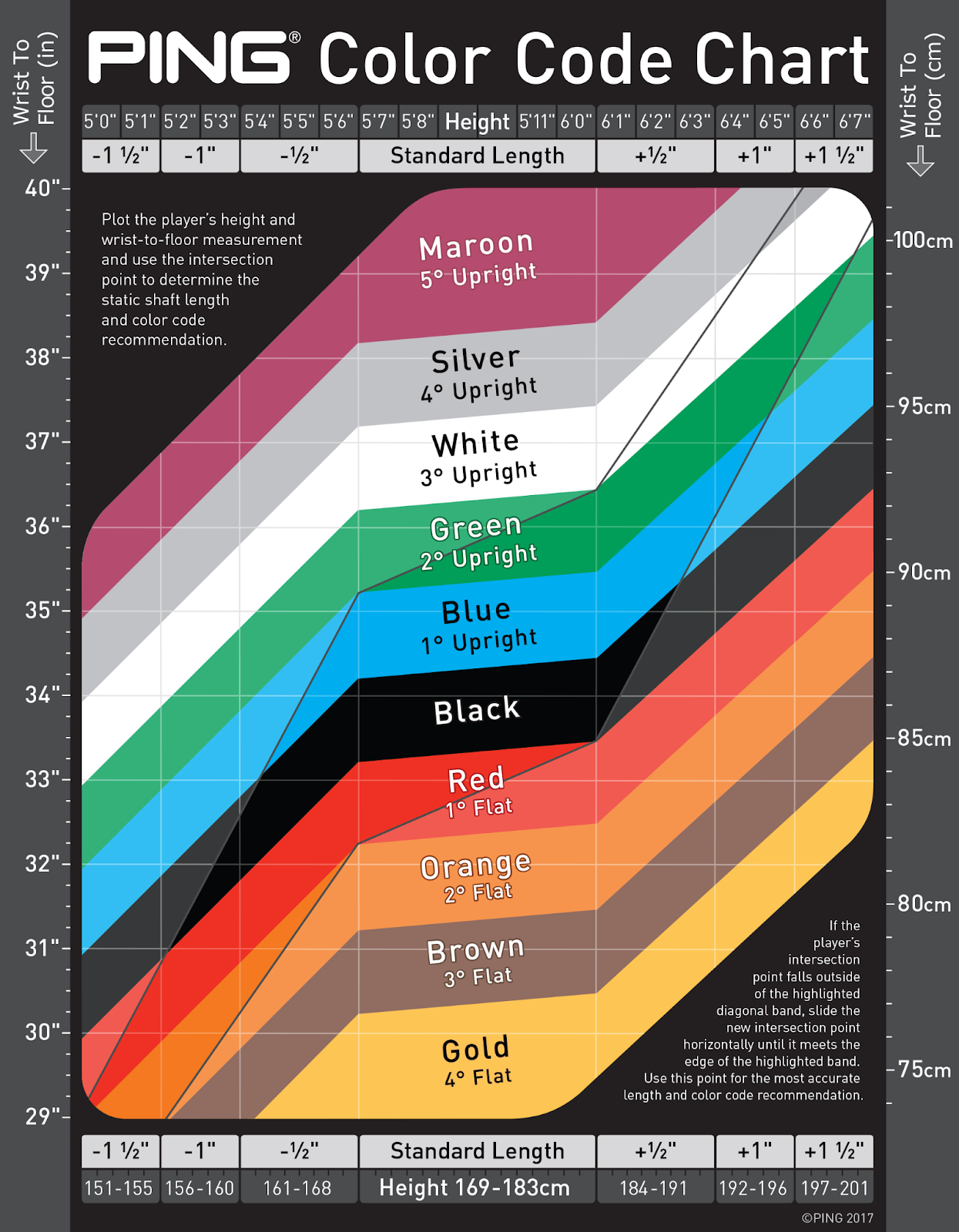
     

  • KBS Hi-Rev 2.0 Wedge Steel Shaft Review

    KBS Hi-Rev 2.0 Wedge Steel Shaft Review

    This shaft is designed to boost the loft of your wedge, delivering a higher launch and increased spin for those who prefer a softer and higher launch on shots. It’s an excellent choice for full swings. However, the limited flex option is a drawback, especially if you like experimenting with different playing styles.

    I used the Rifle 6.0.355 Shaft from Project X with my wedge for about six months. While this shaft offered remarkable solidity and stability during full shots, it was not the best fit for a lower handicapper like myself. The performance characteristics did not align with my preferences and skill level. Consequently, I embarked on a search for a more fitting wedge shaft.

    After thorough research and testing, I decided on the KBS Hi-Rev 2.0 Wedge Steel Shaft. This choice proved excellent for short chips and pitches, delivering a higher launch, increased spin, and satisfactory distance for full shots. However, I encountered one issue: hitting penetrating shots became more challenging with the KBS Hi-Rev 2.0 Wedge Steel Shaft.

    In the rest of this article, I will delve into a comprehensive review of the features of this shaft, its performance during testing, and its advantages, disadvantages, and pricing. Let’s dive in.

    KBS Hi-Rev 2.0 Wedge Shaft

    $41.99

    • Impressive stability for consistent performance.
    • Improved lower launch, contributing to a controlled trajectory.
    • The responsive 355 active tip section enhances swings.
    • Enhanced loft and spin provide better shot control.

    Specification

    This shaft provides a limited range of flex options compared to other alternatives. Below is a table outlining the key features of this shaft, offering a quick overview for easy reference.

    ShaftsKBS Hi-Rev 2.0 Wedge Shaft
    Weight115g
    Length37”
    Butt Diameter.600
    Flex system3-flex system
    Price$41.99

    Features

    The shaft has an active design that results in a smooth feel that truly allows you to sense your shot’s dynamics. If you’re seeking a wedge with a vibrant and silky feel, the HI-REV 2.0 is a commendable choice.

    Additionally, it incorporates a softer tip section and a smooth bend profile, further enhancing its overall performance.

    Performance

    Using the KBS HI-REV 2.0 shaft in my wedges has been highly impressive. Its high balance point made maintaining a suitable swing weight in extended-length builds easy. The shaft feels more active under the grip, and I appreciate its controllable tip stiffness.

    Compared to other options like the KBS 610, it has a distinct butt-end feel, but it’s a perfect fit for my LW, especially because I’m a high-speed player. The spin and smoothness it offers surpass what I experienced with the Dynamic Gold Wedge. The launch profile is similar, but I would caution high-spin players against using it in full-swing clubs.

    Despite its softer nature, the HI-REV 2.0 is surprisingly playable for full swings. In my experience, it provides an excellent feel and spin on touch shots, and I’ve noticed a commendable trajectory and spin on full shots. Transitioning from stiffer shafts to the recommended regular flex has positively impacted my short game.

    I’ve found that the shaft improves spin on short shots, behaving more like a stiff despite being a regular flex. It does require a bit of getting used to, but I see it as a substantial improvement over the standard stiff flex iron shafts in the rest of my set.

    However, I encountered difficulty hitting penetrating shots, although it’s not a dealbreaker. For players like me who prefer a softer entry for full wedge shots onto the green, the HI-REV 2.0 is a perfect choice. The active tip section is helpful, especially in navigating through sand, providing an easy pop-and-stop effect.

    In summary, the HI-REV 2.0 has significantly enhanced my green-side game. Placing it in my 60-degree wedge gives me the confidence to throw my hands and clubhead at the ball, achieving the desired loft angle for the shot. It delivers a smooth, active feel with lots of spin, making it a great choice for those looking to improve their short game.

    Pricing value

    The pricing of this shaft falls within the mid-range category at $41.99. While it may not be the most expensive option, more affordable alternatives are available. Despite its cost, it delivers commendable performance, making it particularly suitable for serious golfers and those with lower handicaps.

    Comparison alternatives

    The HI-REV 2.0 shaft has delivered a great feel, spin, and impressive trajectory on my full shots. However, I’ve noticed that it feels a bit bulky, impacting the overall sense of my swings. As an alternative, Project X Catalyst Graphite Iron Shafts offer stability, particularly when launching shots from challenging lies, and are more affordable than the HI-REV 2.0. The added forgiveness makes them seem a better fit for a high handicapper.

    Another alternative is the Rifle 6.0.355 Shaft by Project X. This particular shaft is a good choice, especially if you prioritize forgiveness, control, distance, and spin in your game. To help you make a well-informed decision, I will compare the features of these shafts side by side in the table below.

    ShaftsKBS Hi-Rev 2.0 Wedge Shaftrifle 6.0.355 shaft by Project XProject X Catalyst PVD Graphite Iron Shaft
    Weight115g120g57g
    Length41″ -37”41″41”
    Tip Diameter.335.355.370
    Butt Diameter.600 .587
    Flex system3-flex systems+4.0
    Price$41.99$46.99$19.98
    ImageProductDetailPrice
    KBS Hi-Rev 2.0 Wedge Shaft

    KBS Hi-Rev 2.0 Wedge Shaft

    • They are crafted for strength and responsiveness.
    • Maximum control and stopping power on the greens.
    • Balances stability and feel for versatile play.
    Buy Now For $41.99
    Rifle 6.0.355 shaft by Project X

    Rifle 6.0.355 shaft by Project X

    • Unique taper per inch for a custom feel on every club.
    • Balances stiffness and flexibility with a 6.0 flex rating.
    • Ensures a quick launch and a penetrating trajectory.
    Buy Now For $46.99
    Project X Catalyst PVD Graphite Iron Shaft

    Project X Catalyst PVD Graphite Iron Shaft

    • Stylish and durable PVD finish for enhanced aesthetics and longevity.
    • Crafted for optimal performance, it offers a blend of style and substance.
    Buy Now For $19.98

    Pros and cons

    If you’re a serious golfer seeking improved spin and a higher loft, the HI-REV 2.0 is a great option. However, it’s important to consider both the advantages and drawbacks. Let’s take a closer look at the pros and cons.

    What I liked:

    • Impressive stability for consistent performance.
    • Improved lower launch, contributing to a controlled trajectory.
    • Responsive 355 active tip section enhances swings.
    • Enhanced loft and spin provide better shot control.

    What I didn’t like:

    • Bulky feel impacts the overall swing experience.
    • Not suitable for slower swing speeds, limiting appeal.
    • There are few flex options, restricting adaptability for different swing styles.

    Final thoughts

    In conclusion, the KBS Hi-Rev 2.0 Wedge Steel Shaft is a solid choice for advanced golfers seeking enhanced spin and loft. While it has some drawbacks, its feel, responsiveness, and overall performance make it a worthy consideration, especially for lower handicappers.

    However, you may want to consider other alternatives based on your preferences and playing styles.

  • The 4 best shafts for wedges

    The 4 best shafts for wedges

    The best shaft for wedges should generate high spin, deliver outstanding control for a stable and predictable shot experience, and offer reasonable forgiveness, thereby boosting flexibility and stabilizing the clubhead.

    A while back, my 7-iron shaft broke while I was playing on the course. I needed a new one, and I wanted something that performed well and was durable. Although my previous shaft had offered remarkable performance, its quality was lacking. So, I did some research and testing to find four high-performing and long-lasting options.

    ImageProductDetailPrice
    KBS Hi-Rev 2.0 Wedge Steel Shaft

    KBS Hi-Rev 2.0 Wedge Steel Shaft

    • Active Tip Section
    • Signature step pattern
    • 3-Flex System
    Buy Now For $41.99
    Rifle 6.0.355 Shaft by X

    Rifle 6.0.355 Shaft by X

    • The most sophisticated shaft in golf
    • longer taper rates result in more energy transfer to the ball
    Buy Now For $46.99
    KBS 610 Wedge Steel Shaft

    KBS 610 Wedge Steel Shaft

    • Firm tip section
    • Larger butt section (.610)
    • Signature step pattern
    Buy Now For $39.99
    Project X Catalyst PVD Graphite Iron Shaft

    Project X Catalyst PVD Graphite Iron Shaft

    • Project X CATALYST Graphite Iron Shafts are available in 40, 50, 60, and 80-gram weight options.
    • The Catalyst Graphite Iron was designed to replicate steel alloys better than any other graphite.
    Buy Now For $19.98

    In the end, I chose the KBS Hi-Rev 2.0 Wedge Steel Shaft. This shaft worked well for me as a low handicapper with a high swing speed. It delivered excellent spin and significantly enhanced loft. However, it has a bulkier build than other options and is less forgiving. On the other hand, the Project X Catalyst PVD Graphite Iron Shaft is more forgiving, but it’s not the best fit for low handicappers like me.

    In the following sections of this article, I’ll explore the distinctive features that set these shafts apart as the top choices for wedges compared to other alternatives in the market. I’ll comprehensively review their performance during testing and delve deeper into each shaft’s advantages and drawbacks. Let’s get started.

    Specification comparison

    Before delving into the detailed reviews, let’s compare the key specifications of these shafts side by side. The table below outlines the essential features of each shaft to give you a quick overview in case you are in a hurry.

    ShaftsKBS Hi-Rev 2.0 Wedge Shaftrifle 6.0.355 shaft by Project XKBS 610 Wedge Steel ShaftProject X Catalyst PVD Graphite Iron Shaft
    Weight115g120g110g57g
    Length37”41”-37”37”41”
    Tip Diameter.335.355.355.370
    Butt Diameter.600 .610.587
    Flex system3-flex systems+ 4.0
    Price$41.99$46.99$39.99$19.98

    KBS Hi-Rev 2.0 Wedge Steel Shaft

    KBS Hi-Rev 2.0 Wedge Steel Shaft

    $41.99

    • I like how this shaft improves loft and spin, giving me better control over my shots.
    • It’s easy to shape shots, providing me with versatility on the course.
    • The stability it offers with each shot is impressive, ensuring a consistent performance.
    • The 355 active tip section adds responsiveness to my swings.

    The KBS Hi-Rev 2.0 Wedge shaft enhances overall performance and significantly boosts spin. If you face challenges getting the ball to launch high, this shaft is an excellent solution. It ensures ample spin, keeping your ball swiftly rolling across the greens after each shot. It’s worth noting that this shaft is specifically crafted for experienced and skilled golfers; if you’re a beginner, it may not be the most suitable choice for you.

    Features

    This shaft incorporates an active tip section, enhancing the effective loft of the club head for a higher ball launch and increased spin. Measuring approximately 37 inches in length, it is constructed from steel and boasts a heavier weight compared to many other available alternatives. Presented in a stylish silver color, it is well-matched for use with your wedge.

    Performance

    I’ve been using the KBS shafts in my wedges, which have made a noticeable difference in my game. The high balance point helps keep the swing weight down, especially in longer builds.

    I’ve found that they are more active under the grip, and the tip stiffness is controllable. It’s quite different from the.610 at the butt end, but it’s a perfect fit for my lob wedge, especially given my higher swing speed. I wouldn’t recommend it for full-swing clubs if you generate a lot of spins.

    These shafts have become my go-to for wedges because they deliver great feel and spin on touch shots while providing excellent trajectory and spin on full shots. The touch shots feel fantastic with just the right amount of spin. I’m getting a solid trajectory and spin.

    My shot game has significantly improved since I switched to these shafts. I used to have overly stiff shafts, and going with the regular flex, as recommended, has addressed the stiffness issue, especially in my irons.

    The feel and weight of the shaft are just right for me. The high balance point is a game-changer, lowering the swing weight of my wedge heads. I’ve installed these in my 54, 58, and 62-degree wedges, all in regular flex, and they consistently produce high, spin-rich shots.

    The regular flex plays more like a stiff. It takes a bit of getting used to, but I see it as a significant improvement over the standard stiff flex iron shafts in the rest of my set.

    It offers better balance and less spring at contact, allowing me to achieve the desired trajectory and RPM. The soft tip and excellent spin are particularly noticeable in my Miura K-Grind 2.0 60-degree wedge, perfect for green-side use.

    If you’re an advanced golfer looking for better spin and a higher loft, I highly recommend trying this shaft.

    What I liked:

    • I like how this shaft improves loft and spin, giving me better control over my shots.
    • It’s easy to shape shots, providing me with versatility on the course.
    • The stability it offers with each shot is impressive, ensuring a consistent performance.
    • The improved lower launch is a great feature, contributing to a more controlled trajectory.
    • The 355 active tip section adds responsiveness to my swings.

    What I didn’t like:

    • I wish there were more length options for better customization.
    • The limited flex options could be a drawback, especially for those with different swing styles.
    • The shaft feels bulky, impacting my swings’ overall feel.
    • Unfortunately, it’s not suitable for slower swing speeds, which might limit its appeal for some players.

    Rifle 6.0.355 Shaft by Project X

    Rifle 6.0.355 Shaft by Project X

    $46.99

    • I appreciate the great spin control, especially in forgiving situations on the course.
    • The shaft feels incredibly solid and stable when I take full shots, giving me confidence in my swing.
    • It’s highly responsive, creating a tangible connection I value during play.

    This shaft is a solid option if you prioritize forgiveness, control, distance, and spin.

    You should note that it may not deliver its best performance during full swings. Furthermore, it might not be the best choice if you are a handicapper or a beginner.

    Features

    The Project X shaft distinguishes itself through a meticulous approach, incorporating a unique constant taper per inch for each shaft in the set. This innovative feature ensures that each shaft is precisely tailored to meet the specific demands of every club in your bag, offering a customized experience across your entire set.

    Weighing a solid 120g and featuring a.600″ butt diameter, a.355″ tip diameter, and an S+ flex, this shaft spans a length from 41.00″ to 37.00″, emphasizing a low launch profile to cater to a variety of player preferences.

    Beyond its technical specifications, the Project X shaft offers a sleek design. The carefully considered spin number is another notable feature, strategically designed to elevate the functionality of the shaft on both chip shots and full swings.

    Performance

    I was pleased with this shaft’s outstanding tip stiffness, which effectively reduces spin and lowers ball flight while maintaining stability, which is crucial for handling my high swing speeds.

    Opting for the 6.0 flex, I found that it delivers the feel and liveliness of a softer shaft while holding up well to my swing speed. Despite being recommended for “aggressive transitions,” I discovered that even for smoother, fast swingers, dropping a flex maintained the desired feel and loading while still providing exceptional stability and performance.

    The iron club I used with this shaft type felt incredibly stable, offering a great balance between weight and responsiveness throughout the hitting zone. It’s solid on full shots and comfortable when making delicate shots around the green.

    Installing these shafts in my Srixon Z785 eased any concerns about launching too low—they were perfect. The strategic weight distribution, along with a truly impressive ball flight, made these shafts stand out.

    Moreover, I specifically sought out the same shaft for my Callaway irons, and this was the only place I could find the exact match to what came with the originals.

    For approaches of 100+ yards, these shafts delivered the penetrating ball flight and speed I desired, providing good control.

    What I liked:

    • I appreciate the great spin control, especially in forgiving situations on the course.
    • The shaft feels incredibly solid and stable when I take full shots, giving me confidence in my swing.
    • It’s highly responsive, creating a tangible connection I value during play.

    What I didn’t like:

    • Personally, I find the shaft a bit heavy, impacting the overall feel during my swings.
    • As a lower handicapper, it may not be the best choice for me, as the performance characteristics might not align with my preferences and skill level.

    KBS 610 Wedge Steel Shaft

    KBS 610 Wedge Steel Shaft

    $39.99

    • The firm tip section gives me a controlled and stable feel during my swings, especially on critical shots.
    • The larger butt section provides a solid grip, giving me more confidence throughout my swing.
    • It is very affordable, making it a budget-friendly option.

    This shaft is noteworthy for its affordability, making it an accessible option if you are on a budget. One of its distinctive features is its specialized design tailored specifically for wedges, which sets it apart as it’s not commonly available for entire iron sets. This makes it a particularly appealing choice for high handicappers looking to enhance distance and direction in their wedge play.

    Features

    The firm tip section of this shaft contributes to a more controlled and stable performance during the swing. This feature is particularly beneficial for golfers who seek a precise and consistent ball trajectory, especially in critical situations like approach shots or delicate chip shots around the green. The tip’s firmness helps minimize unnecessary bending, providing enhanced control over the clubhead and ball interaction.

    With a larger butt section measuring.610 inches, this shaft design offers improved stability and control in the golfer’s grip. A larger butt section can positively impact the golfer’s feel of the club, providing a more substantial grip that can instil confidence and control throughout the swing. This can be especially advantageous if you prefer a more substantial feel in the hands and are looking for increased stability during your swings.

    The signature step pattern of the shaft adds another layer of design sophistication. This step pattern is not just an aesthetic feature; it is functional in optimizing the shaft’s performance characteristics. The step pattern can influence the stiffness distribution along the shaft, affecting factors such as launch angle, spin rate, and overall feel.

    Performance

    This shaft has a smooth KBS feel, providing a great sensation in my swings. One of its standout features is its ability to produce a lower ball flight while maintaining sufficient spin. It is a solid middle ground between shafts that send the ball high up and those designed for a low-spin, low-trajectory profile. I’ve found it particularly effective for executing precise knock-down shots.

    What impresses me is the accuracy of this shaft. It consistently delivers a lower ball flight than the Dynamic Gold, yet it retains enough spin to help me hold approach shots on the green. The stiffness-to-flex ratio contributes to its accuracy, giving me the confidence to control my shots with the desired trajectory.

    However, I did notice an interesting detail: this shaft was missing the standard KBS sticker. It felt a bit odd, almost like it could have been any shaft with a PGA store sticker stuck on it. While this doesn’t affect its performance, the absence of the standard sticker raises some questions about the shaft’s branding.

    What I liked:

    • The firm tip section gives me a controlled and stable feel during my swings, especially on critical shots.
    • The larger butt section provides a solid grip, giving me more confidence throughout my swing.
    • It is very affordable, making it a budget-friendly option.

    What I didn’t like:

    • I wish it had more flex options; it’s only available in stiff, which may not suit everyone.

    Project X Catalyst PVD Graphite Iron Shaft

    Project X Catalyst PVD Graphite Iron Shaft

    $19.98

    • I appreciate the exceptional stability this shaft provides during my swings.
    • It offers good control over spin, which is crucial for precision in my shots.
    • Affordable an easy-to-use.

    This shaft stands out for its remarkably soft feel, providing a satisfying sensation during swings. Its key strengths lie in its forgiveness, offering a degree of leniency for off-center hits, and excellent control and responsiveness. Its affordability sets it apart even further, making it one of the most budget-friendly options available. This makes it an ideal choice if you seek a functional and reliable shaft for your wedges without breaking the bank.

    Features

    The Project X Catalyst Graphite Iron Shafts offer versatility with weight options ranging from 40 to 80 grams, catering to various golfer preferences. Specifically designed to emulate steel alloys more effectively than other graphite alternatives, the CATALYST Graphite Iron stands out in terms of performance and feel.

    These shafts are available in flex options 6.0 and 6.5, providing golfers with choices that suit their swing dynamics. The.355 tapered tip further adds to the adaptability of these shafts, fitting a range of iron heads. The stiff tip area notably enhances torsional resistance, creating a feel similar to steel shaft models. This feature is particularly beneficial for golfers who appreciate the stability and control associated with steel shafts but desire the lightweight advantages of graphite.

    Performance

    I recently reshafted my Ping Eye 2 Beryllium Copper irons with this shaft. The irons feel significantly more forgiving, providing a noticeable improvement in my overall performance.

    The stability offered by this shaft is remarkable, especially when launching shots from challenging lies. It maintained excellent stability throughout, allowing me to confidently handle various lies. The forgiveness factor is another standout feature that I genuinely appreciate.

    However, it seems this shaft is better suited for high handicappers; I have used other alternatives that provided better performance for my skill level as a low handicapper.

    What I liked:

    • I appreciate the exceptional stability this shaft provides during my swings.
    • It offers good control over spin, which is crucial for precision in my shots.

    What I didn’t like:

    • It gives an average feel when I go for full swings.
    • It’s not the best fit for low handicappers like me.
    • The shaft feels a bit too light for my liking and playing style.

    Features to consider when choosing shafts for your wedges

    Spin:

    One important thing I’ve learned when choosing shafts for wedges is to opt for a wedge shaft that promotes high spin; this characteristic is the secret sauce for achieving soft landings and minimizing unwanted roll after impact.

    I’ve discovered a well-executed shot with a wedge shaft designed for elevated spin. The ball lands gracefully, gripping the green and halting with minimal roll. This isn’t just about distance control; it’s about gaining the versatility to execute a diverse array of shots, adapting to different lies and pin positions with finesse.

    Control

    Make it a point to prioritize one with excellent control. A shaft that excels in control provides a stable and predictable feel throughout your swing, extending forgiveness to those off-center hits that inevitably occur.

    Shot after shot, this control ensures a more predictable trajectory, empowering you to achieve reliable results. Consider this shaft’s predictability for your game, allowing you to confidently navigate tight pin positions and intricate green contours. In challenging scenarios, your shaft will contribute to a more precise and dependable short game.

    A golf shaft with excellent control is your key to consistently delivering accurate and reliable shots, even when your swing isn’t flawless.

    Feel

    The tee feel of the shaft is a critical factor that directly influences your confidence and touch on those delicate shots around the greens. When making your choice, give meticulous attention to opting for a softer, more responsive shaft—a decision that can significantly impact your overall performance.

    I’ve tried shafts with a softer feel, and I’ve found that they are more responsive. They provide valuable feedback on the quality of your strikes, offering heightened sensitivity that allows for immediate adjustments to your swing. This adaptability becomes crucial when facing different lies, navigating varying turf conditions, or when specific shot requirements demand finesse.

    With a responsive shaft, you receive information about the strike and feel the nuanced interactions of the club head with the ball and the turf.

    Material

    When it comes to wedge shafts, the choice is between steel and graphite. Steel shafts offer stability and consistency. Wedge shafts crafted from steel deliver a robust and solid feel throughout the swing, fostering precision and accuracy in executing shots. This material is usually my preferred choice for the reliable feedback and control associated with the use of steel.

    Conversely, graphite offers a softer feel and reduces the overall weight of their clubs. Graphite shafts, known for their lighter weight than steel counterparts, contribute to a more effortless swing and an uptick in clubhead speed. Beyond the weight advantage, graphite can absorb vibrations more effectively, providing you with heightened feedback on their shots.

    The softer feel associated with graphite responsive touch makes it an ideal choice if you want to minimize the impact on joints.

    Final Thoughts

    All the shafts reviewed in this article have their strengths and considerations, so the choice ultimately depends on individual needs, playing style, and budget constraints. The KBS Hi-Rev 2.0 Wedge shaft offers you a significant boost in spin and high ball launch. It is, however, not suitable for beginners and is not as affordable as some other alternatives.

    On the other hand, the Project X Catalyst PVD Graphite Iron Shaft offers a remarkably soft feel, forgiveness, and excellent control at an affordable price. With weight options ranging from 40 to 80 grams and flexes 6.0 and 6.5, it caters to various golfer preferences. But do note that there are better choices for low handicappers.

  • Steadfast Golf Shaft Review 

    Steadfast Golf Shaft Review 

    Steadfast Golf Shafts may not be a popular name in the golf industry, but they have been making notable waves and gaining lots of love as affordable, high-quality shafts. According to the company, this carbon shaft’s unique selling point is its advanced technology and materials that can help golfers of all skill levels improve their game. But how true is this? I decided to test and review this shaft.

    After trying different stiff shafts for my Callaway Edge Big Bertha driver, I like this one the best. Long story short, I achieved a good distance and hit the shots straighter. However, the brand doesn’t seem to be doing enough to put out information that can help buyers know if this is truly what would help them. The Steadfast Golf shaft is worth the shot if it swings around 90 mph or less if you’re a senior player like me.

    In the rest of this article, I’ll walk you through this safe, how it performed, and other relevant details so you can better determine if it’s a good option for you. To begin with, let’s look at the specifications of the Steadfast golf shaft.

    Steadfast Golf Shaft Specifications

    The main gist about this shaft, the JUPITER ONE PLUS Driver Shaft, is that it’s designed with torque and balance. So it promises the best feeling and the most stable beams on the market.

    Steadfast Golf Shaft

    Steadfast golf shaft review

    $99

    • The Steadfast golf shaft is reasonably priced at around $100, making it a cost-effective option for golfers.
    • The shaft boasts innovative features, such as ultra-low torque, which can potentially enhance performance and accuracy.
    • Suitable for golfers with swing speeds of 95 mph or less, providing them with a good match for their playing style.
    Ladies70-74 mph223 CPM45g45.5 in. play length
    Senior70-89 mph227 CPM50g45.5 in. play length
    Regular90-99 mph241 CPM55g45.5 in. play length
    Stiff 100-109 mph258 CPM58g,45.5 in. play length
    X110-129 mph273cpm61g,45.5 in. play length

    First Impressions

    At first, the offerings of Steadfast golf shafts sound a little gimmicky because it’s uncommon to find a brand claiming ultra-low torque in their posts.

    Before writing this review, I burrowed into reviews on forums and online shopping platforms to see what users say about this shaft.

    The reviews have been 50/50, so it’s still a long shot to conclude based solely on the assessment and rating of this shat.

    I play a Hazardous Smoke Yellow 60S for context and get along fine with it. But I have still decided to try this out.

    The first green light about this product is that Steadfast claims a money-back guarantee, and the shaft is around $100.

    So, for the first impression, it’s mixed because I have experience with many promise-and-fail shafts, but this sounded different.

    The Appearance 

    The shaft has a grip and adapter installed, so it has a plug-and-play approach, making it easy for new players.

    While I do not like that they use stickers as a label, it even stinks to see that the sticker is too big and crackles as you touch it.

    In my opinion, the club would look fairly nice without the sticker or some other paint option.

    On the brighter side, the shaft is thicker than normal but oddly thinner in the grip section compared to my hand.

    It also felt more flexible without being too whippy.

    Club Build

    Based on the manufacturer’s recommendation of swing speed, I went with the R flex of the Steadfast Golf shaft.

    The range for this flex is quite large—90 to 99 miles per hour, which made me rethink going for a stiff. So this might be a little confusing for new buyers still trying to figure out what shaft flex works best for them.

    The advertised weight is 55 grams, which is excellent for pairing with one of my driver heads—the Maltby KE4 Tour TC—at a playing weight of 204 grams.

    The Feel 

    I found out that if I swing very easily, I get a nice tight dispersion—a baby draw or a baby fade—but nothing ridiculous. It was pretty impressive at first, but I had trouble getting this face square as I swung harder.

    I suspected it was either lagging or deflecting too far forward and slamming shut. The only logical conclusion I could draw from this outcome is that since I followed Steadfasts’s recommendation and built the driver to 45.5”, the length was probably overwhelming.

    Meanwhile, not many driver heads these days are above 200 grams, which is already considered the heavy side, except when you look at models like PING, which can be a couple of grams more. But most drivers are lighter.

    The Performance 

    The shaft is very flexible in the midsection. I also like that I can feel the shaft load. That’s not to say it’s the only way you can handle the bag, but that’s something for a smooth tempo.

    When I swung slowly, the only way that I could get the ball to draw was to release my hands consciously.

    How Does It Improve Swing?

    The only way I could measure how well it imparted my swing was to pay attention to the data tracked by the Flightscope Mevo + launch monitor.

    Initially, I tried to swing at 99 mph or lower to get this regular flex shaft’s lower swing speed range and I was pretty successful at 90 mph.

    Here is the data result:

    When I stepped it up to my regular swing speed, closer to the upper range of the regular flex of the shaft, I was shooting for 99 mph and could get pretty close swinging on average at 98 mph.

    Here is the data result:

    So you can see that this is a good-performing shaft. It didn’t jump out with a particularly high or low launch angle or high or low spin. Those are typical for me when testing shafts.

    Steadfast Golf Shaft Pros and Cons

    Unlike most other shaft reviews I’ve done, it’s going to be challenging to give a rating to the Steadfast golf shafts because the primary purpose of this is to put out enough information about a relatively new and innovative product with the hope that it’ll help others inform their decisions about trying it.

    That being said, here are the key pros and cons I jotted down while testing this shaft:

    Pros

    • It’s super affordable.
    • Innovative technology 
    • It is an ideal option for those who swing at 95 mph or less.

    Cons

    • The swing speed range for the R flex of this shaft is quite broad.
    • There is not enough visual information from the brand about this shaft and how it works.

    The Price

    The Steadfast Golf Shaft sells for $99 on Amazon, but on the Steadfast brand’s official website, you can get it for $106. It’s not a bad price point for a quality shaft.

    I think it’s a huge benefit, given that they market directly to the consumer and cut out the middleman.

    Final Thoughts 

    Overall, I think the Steadfast golf shaft is worth consideration. Graphite shafts are brittle and do not stand the test of time. But Steadfast is constructed using the highest quality carbon fiber, the pure form of graphite, so you can be assured of more durability and a better overall feel.

    However, during my research, I did come across some reviews on possible flaws of this product, especially with the tip prepping or the epoxy that made some heads fly off and adapters come loose.

    I didn’t have any issues with this particular shaft spec, but I did a little extra prep and used 24 epoxy to ensure I didn’t encounter any of those issues.

    What do you think about the Steadfast golf shaft? Let me know in the comments.