Blog

  • 5 Best Arm Lock Putters

    5 Best Arm Lock Putters

    You’ll be able to rock your shoulders like a normal stroke and produce a more fluid movement when using armlock putters because these putters have a longer shaft (usually 40–42 inches long, compared to standard-length putters, which are around 33–36 inches) and a longer grip (between 17 and 21 inches) that is secured against your leading forearm.

    However, if you’re considering switching to arm lock putters, there’s one problem. Choosing the right armlock putter for your game can be like finding a needle in a haystack. I tested and reviewed some of the most-loved armlock putters on the market and here are the top five I will recommend in a heartbeat.

    Here’s a list of the best arm lock putters worth your consideration and reasons why I recommend them:

    ____________________________________

    KEY TAKEAWAYS:

    • If it’s your first time trying armlock putters, I recommend the Odyssey 2-Ball Ten Putter. These putters are impressively forgiving and consistent, so you should improve on the greens if you switch. It’s also the most affordable on the list.
    • Bettinardi Studio Stock #28 Putter has high-quality construction and a comfortable grip for many more advanced players. The high price tag is also more justifiable if you have skins in the game already.
    • Want good value for money? You can’t go wrong with the Cobra King 3D-printed Agera Putter. It might lack the feel for purists, but its unique 3D-printed design, affordable price, and forgiveness are worth it.

    ____________________________________

    Different golf enthusiasts have varying views about arm-lock putting; it became especially controversial following Xander Schauffele’s recent comments about this style.

    I recently started to mess around with one my younger brother bought—the Odyssey Stroke Labs Double Wide Armlock—which required some getting used to before I became comfortable with it.

    Arm-lock putting is a viable option if your concern is stability and consistency on short putts. But the model you pick can make or mar your game improvement.

    Before we dive into the full review of our top recommendations, below is a table comparing the best armlock putters across a few relevant factors that can help you make an instant decision in case you’re in a hurry.

    ImageProductDetailPrice
    Bettinardi Studio Stock #28 Putter

    Bettinardi Studio Stock #28 Putter

    • 17″ Winn Grip
    • 71° Lie Angle
    $450
    Cobra King 3D-Printed Agera Putter

    Cobra King 3D-Printed Agera Putter

    • Setup with a special armlock-specific grip
    • 72° Lie Angle
    $350
    Lab Golf Directed Force 2.1 Armlock Putter

    Lab Golf Directed Force 2.1 Armlock Putter

    • Armlock Grip
    • 69° Lie Angle
    $585
    Odyssey 2-Ball Ten Putter

    Odyssey 2-Ball Ten Putter

    • Odyssey Ten Pistol Grip (or Oversize Grip)
    • 70° Lie Angle
    $200
    Bettinardi Inovai 8.0 Putter

    Bettinardi Inovai 8.0 Putter

    • Custom 17-inch black Winn Armlock grip
    • 70° Lie Angle
    $400

    1. Bettinardi Studio Stock #28 Putter

    Bettinardi Studio Stock #28 Putter

    Best Arm Lock Putters

    $450

    • Exceptionally soft feel upon impact, thanks to the Tour-preferred Face Impact Technology (FIT) face milling.
    • 100% milled construction for quality.
    • The 17″ Winn Grip feels solid and ensures long-lasting durability.
    • Signature F.I.T. face milling for a consistently smooth roll and valuable feedback.

    SPECIFICATIONS: 

    • Neck: Spud Neck
    • Weight: 400 grams
    • Material: 303 Stainless Steel
    • Finish: Diamond Blast
    • Face Milling: Roll Control Face
    • Grip: 17″ Winn Grip
    • Loft: 5°
    • Lie: 71°
    • Toe-Hang: 1/8

    Crafted from a single block of soft carbon steel, the Bettinardi Studio Stock #28 Putter delivers an exceptionally soft feel upon impact, thanks to the Tour-preferred Face Impact Technology (FIT) face milling.

    The 100% milled construction and proven PGA Tour designs that have won over 70 worldwide since 1998 attest to its quality.

    The 17″ Winn Grip feels solid and ensures long-lasting durability. The Bettinardi Studio Stock #28 Armlock Putter earned a 2017 Golf Digest Hot List Gold Medal.

    The signature F.I.T. face milling sets this putter apart, offering a consistently smooth roll and valuable feedback with each stroke.

    The armlock design stabilizes the putter against your forearm. This gives you enhanced control and accuracy.

    This putter is your best bet if you’re an advanced player willing to invest in a high-quality tool.

    What I like about this armlock putter

    • High-quality construction
    • Comfortable grip
    • Impressive aesthetics

    What I don’t like about this armlock putter

    • not ideal for beginners.

    2. Cobra King 3D-Printed Agera Putter

    Cobra King 3D-Printed Agera Putter

    Best Arm Lock Putters

    $350

    • Tailored for armlock setup with a 41″ length for a consistent stroke.
    • SIK aluminum face inserts with Descending Loft Technology (DLT) ensure a consistent launch angle, offering accurate and reliable rolls.
    • Unique 3D-printed design, and impressive forgiveness.

    SPECIFICATIONS: 

    • Tip Size:.370
    • Shaft Weight: 125g
    • Taper: Armlock Stepless Chrome
    • Loft: 4-7°
    • Lie: 72°
    • Length Hosel: 41″
    • Toe Hang: 0°
    • Head Weight: 380g

    This putter is tailored for those who prefer an armlock setup, and it comes in a 41″ length, which promotes a consistent stroke.

    Allowing the grip and shaft to rest against my lead forearm eliminates variations in shaft angle during my putting stroke.

    What sets this putter apart is its multi-material construction.

    It features a 3D-printed nylon lattice cartridge, a 291g steel frame, an 18g aluminum cap, and 42g of tungsten on the perimeter, providing exceptional stability for greater consistency.

    The 3D-printed nylon cartridge optimizes weight distribution, maximizing the moment of inertia (MOI) for added stability.

    The SIK aluminum face inserts with Descending Loft Technology (DLT) ensure a consistent launch angle of 1.5 degrees for every type of putting stroke, offering accurate and reliable rolls.

    The visual markers on the putter make alignment a breeze, and each stroke feels clean, reducing those annoying bobbles and bounces on impact with the ball.

    My one-putt finishes have increased, especially from the 10-foot range. However, I did encounter a quality control issue with the grip, which was poorly installed, causing the club to sit 20 degrees open at the address.

    Despite this hiccup, the Cobra King 3D-printed Agera armlock putter offers stability and consistency to take your putting to the next level.

    What I like about this armlock putter

    • Great value for money
    • Unique 3D-printed design
    • Impressively forgiving

    What I don’t like about this armlock putter

    • The look may not be appealing to every golfer.

    3. Lab Golf Directed Force 2.1 Armlock Putter

    Lab Golf Directed Force 2.1 Armlock Putter

    Best Arm Lock Putters

    $585

    • Enhanced stability and “pendulum-like” putting stroke for golfers.
    • Specialized ArmLock grip for a comfortable and secure hold.
    • Includes an alignment aid for better-putting precision.
    • Innovative lie-angle balancing, which keeps the putter head square through the ball without manual adjustments during the stroke.

    SPECIFICATIONS

    • Lie Angle: 69°
    • Length: 34″, 35″
    • Head Weight: 370–415 grams, depending on length and lie angle.
    • Swing Weight: F0-G5, depending on length and lie angle.
    • Loft: 3.5 degrees of static loft (0.5 degrees of effective loft).
    • Grip: Armlock Grip
    • Alignment Aid: #1

    LAB Golf has tackled a major issue in putting, the natural rotation of the putter head, with their innovative solution, lie-angle balancing.

    Putting is all about getting the right face angle, and it turns out that face angle contributes to nearly 85% of putting success, while putter path accounts for the remaining 15%.

    The shorter the putt, the more critical the face angle becomes.

    LAB Golf’s answer is their groundbreaking lie-angle balancing, which keeps the putter head square through the ball without manual adjustments during the stroke.

    This means a more stable, “pendulum-like” putting stroke for golfers.

    With lie-angle balancing, your body’s smaller, less reliable muscle groups relax, allowing your stronger muscles to maintain control over swing speed and path.

    The result is improved stability, precise ball direction, and better distance control, leading to more successful putts.

    The DF 2.1 ArmLock putter has customization options, including lie angle, length, head weight, and swing weight.

    Plus, it features a specialized ArmLock grip and an alignment aid for better-putting precision.

    What I like about this armlock putter

    • Lie-angle balancing
    • Premium look

    What I don’t like about this armlock putter

    • Expensive

    4. Odyssey 2-Ball Ten Putter

    Odyssey 2-Ball Ten Putter

    Best Arm Lock Putters

    $200

    • Lightweight design, not heavy on the hands.
    • The 2-Ball model stands out as one of the best made by Odyssey, providing an excellent framing of the ball at address.
    • Exceptional alignment systems, including 2-Ball and Triple Track options, enhancing alignment for a more accurate putt.

    SPECIFICATIONS

    • Head type: mallet
    • Loft: 3°
    • Availability: RH and LH
    • Standard length: 33″, 34″ or 35″.
    • Lie: 70.0°
    • Offset: full shaft
    • Toe Hand: 0°
    • Head weight: 365G

    The exceptional alignment systems offered in these putters, including the 2-Ball and Triple Track options, caught my attention immediately. The sleeker and more forgiving head construction enhances the alignment experience. The 2-Ball model, in particular, stood out as the best they’ve ever made, allowing you to frame the ball at an address like never before.

    But the improvements don’t stop there. Odyssey has introduced a new version of its tour-proven Stroke Lab shaft. This shaft is lighter, stiffer, and more stable, promoting better tempo and consistency in your putting stroke. I noticed a positive difference in my stroke while using it.

    The Microhinge Star Insert in these putters is engineered to provide immediate forward roll for improved speed and control. I could feel the difference as the ball came off the face with the microhinge technology.

    What I like about this armlock putter

    • Easy to align and nice feel
    • Light, not heavy
    • Great for beginners
    • Affordable

    What I don’t like about this armlock putter

    • None so far.

    5. Bettinardi Inovai 8.0 Putter

    Bettinardi Inovai 8.0 Putter

    Best Arm Lock Putters

    $400

    • Fresh and sleek look with a Stealth Black anodized 6061 Military Grade Aluminum body and a Diamond Blast finished 303 Stainless Steel front piece.
    • Combination of stainless steel in the front piece and military-grade aluminum body for optimized weight distribution and high MOI numbers.
    • Distinctive alignment lines for improved accuracy.
    • Ideal for players with a straight back and straight-through putting stroke, emphasizing accuracy and performance on the greens.

    SPECIFICATIONS

    • Dexterity: RH, LH
    • Lengths Available: 32″-36″
    • Finish: Diamond Blast Stainless Steel
    • Stealth: black anodized
    • Loft: 2°
    • Lie: 70°
    • Offset: 3/4 Shaft
    • Face Milling: Roll Control
    • Weight: 358g

    I like to think that this putter is a revelation for those seeking accuracy and performance on the greens, as Bettinardi described it as the ideal mallet putter for players with a straight back and straight-through putting stroke.

    The 2022 INOVAI Lineup brings a fresh and sleek look thanks to its Stealth Black anodized 6061 Military Grade Aluminum body and a Diamond Blast finished 303 Stainless Steel front piece.

    Combining stainless steel in the front piece for that coveted PGA Tour feel and a military-grade aluminum body to optimize weight distribution ensures high MOI numbers.

    The Inovai 8.0’s milled face-balanced mallet design offers impressive forgiveness and a unique chrome leading edge.

    It is paired with a dark aluminum body and provides distinctive alignment lines.

    If you prefer an armlock putter, you’ll be delighted to know that the Bettinardi Inovai 8.0 can be customized to your ideal height.

    What I like about this armlock putter

    • It has a great feel, thanks to the quality milled face.
    • It’s impressively forgiving.

    What I don’t like about this armlock putter

    • The head of the mallet is somewhat small.

    Final Thoughts 

    If you’re trying armlock putters for the first time, I strongly recommend buying one from a place with a proper putter analysis setup (read: quintic).

    I say this because I can recall when I tried an armlock for the first time and got extreme dynamic loft numbers. So, I had to make significant changes to my putter loft for an ideal launch.

    But if you’re looking to change your current armlock putter or are familiar with this style, you can make decisions easily.

    Most importantly, these recommended armlock putters will best favor you if you struggle with overactive hands during the putting stroke since anchored putting strokes are no longer in the good books of golf.

  • Bushnell Launch Pro Vs SkyTrak: Which is Better?

    The Bushnell Launch Pro (BLP) and SkyTrak+ are among the best options for launch monitors under $5,000. For this price range, you can expect them to have their respective pros and cons, making it a tricky pick on the best option.

    Fortunately, I’ve owned both the Bushnell Launch Pro and SkyTrak launch monitors and have created this review to compare both devices side-by-side, so you have a clearer picture of what both options offer and which is worth your money.

    SkyTrak shines by providing weather settings, portability, side-angle readings, wireless setup, and photometric readings. But Bushnell Launch Pro gains more love because it’s easy to set up, includes one free year of the basic software package, provides in-depth shot and club data, houses up to 10 simulated courses, and is enabled by wireless internet.

    Both devices are great, honestly. If you’re a recreational golfer, the differences between these devices may not be a deal-breaker. But again, the last thing you want is to make a careless purchase and later realize that one would have better served you than the other.

    So, in the rest of this article, I’ll walk you through the features, specifications, performance, accuracy, design, and overall performance of both Bushnell Launch Pro and SkyTrak launch monitors.

    Bushnell Launch Pro vs. SkyTrak Comparison Chart

    Before we dive into the head-to-head review, here’s a rundown of how both devices measure up across relevant factors. It will help you make quicker decisions on which is better for you if you’re in a hurry.

    FactorsBushnell Launch ProSkyTrak+
    Data MetricsBall Data (Carry Distance) Ball Speed, Vertical Launch Angle, Horizontal Launch Angle, Spin Axis, Backspin, and Sidespin) as well as Club Data (Club Speed, Club Path, Angle of Attack, and Smash Factor)Ball Data (Ball Speed, Launch Angle (vertical), Descent Angle, Backspin, Sidespin, Side Angle (horizontal launch angle), Max Height, and Carry Distance) as well as Club Data (Club Speed, Club Path, Face to Path, Face to Target, and Smash Factor)
    AccuracyBetterGood
    In-Built Display ScreenYesNo
    Simulation AvailabilityPCPC and iOS
    Battery Life5-7 hours5 hours
    Weight2 pounds1.71 pounds
    Laser Ball Detection DotsNot presentpresent
    Simulation PackagesForesight software packagesTrue Golf E6, WGT Golf, and Trugolf E6 Connect
    Built-in BluetoothNoYes
    PC ConnectivityEthernet, USB-C cableFull USB or micro USB cord
    Device Price$3,500$2,995
    ImageProductDetailPrice
    <strong>Bushnell Launch Pro</strong>

    Bushnell Launch Pro

    • Ball Data (Carry Distance) Ball Speed, Vertical Launch Angle, Horizontal Launch Angle, Spin Axis, Backspin, and Sidespin) as well as Club Data (Club Speed, Club Path, Angle of Attack, and Smash Factor)
    Buy now
    <strong>SkyTrak+</strong>

    SkyTrak+

    • Ball Data (Ball Speed, Launch Angle (vertical), Descent Angle, Backspin, Sidespin, Side Angle (horizontal launch angle), Max Height, and Carry Distance) as well as Club Data (Club Speed, Club Path, Face to Path, Face to Target, and Smash Factor)
    Buy now

    Data Metrics

    Both devices give you ball and club data. I figured this is the area where most people are interested. So, instead of listing off everything that both devices offer, we will focus on what they don’t provide.

    For example, the Skytrak+ has the ball and club data you’d expect from a typical launch monitor, but it’s missing the angle of attack.

    I’ve tried to think of why this is so, but the closest conclusion I came to was that it probably has to do with the angle of the radiator that measures it.

    On the other hand, Bushnell Launch Pro has the angle of attack metric but lacks face angle data such as face-to-target or face-to-club path.

    Hitting Area 

    The Bushnell Launch Pro has a hitting area of 7” by 10”, which is pretty much right in the middle of most hitting strips you will use in a golf simulator.

    The device uses the display on the screen to show you the shape of the hitting area. When you drop a golf ball, it shows you where it is on the screen. So, you can adjust if you’re a bit far forward with the ball.

    It has an edge over SkyTrak because it makes the BLP fast, efficient, and easy to use.

    On the part of SkyTrak, the hitting area is not an area. It’s just a red dot on the ground where you’re supposed to place the golf ball that works just like the original Skytrak, but the Skytrak+ is 40cm larger in area.

    Shot Delays

    While using both launch monitors, I noticed a little delay between when I hit the shot and when it appeared on screen for the SkyTrak. This is a unique feature of the Skytrak that’s not present on the Bushnell Launch Pro.

    Indoor and outdoor performance

    Skytrak+ does work indoors and outdoors, which gives it an edge over the original Skytrak, but you still need a map when using the device outdoors, so you cannot take it to a golf course. If you’re at a grass-driving range, it won’t work either.

    On the other hand, the Bushnell Launch Pro works great indoors as a golf simulator or outdoors at the driving range or golf course.

    Since it has a built-in display, it can be used as a standalone device if you don’t want to use any apps or other devices.

    Software for the Driving Range

    The Bushnell Launch Pro software has three main pieces from Foresight. Each one has a driving range.

    • The FSX Pro is Bushnell’s PC or iPad app. It gives you all the necessary data, but not necessarily as a simulation would. It can serve as your driving range, especially if you’re not using a PC.
    • The FSX 2020: This subscription was dedicated to the Launch Pro device. It is identical to the regular Foresight FSX 2020 but just made to verify the subscription with the Launch Pro. Apart from having all the basic features, you can integrate swing cameras, which is awesome.
    • The FSX Play: This is Bushnell’s newest simulation software. It has a driving range similar to the FSX 2020 but has fewer features. There are no swing cameras and fewer settings or customization options.

    NOTE: Depending on subscriptions, some of these features may be locked for you in FSX Pro.

    For the SkyTrak software, you get the SkyTrak app with its driving range. I also like that it allows for many settings and customization options, such as how far the ball flies and creating targets of different sizes and distances.

    The software has a cool feature called a randomizer that picks a different yardage for you and mixes it up so you’re not just hitting the same target repeatedly.

    On the software, you can click on each data point for an elaborate explanation of what the metric means and pop a video of what the data means. So, SkyTrak is so cool for game improvement.

    Price and value

    The Skytrak costs $2,995 while the Bushnell Launch Pro costs $3,499, but one thing to mention is that the Bushnell Launch Pro goes on sale frequently throughout the year and around holidays; it can usually go on sale for $500 off, so that would make them the same price as the Skytrak.

    Also, you can pick up a used or refurbished Bushnell Launch Pro from eBay for around $3000.

    Pros and cons

    Indeed, there are no perfect launch monitors out there. There are always two sides to the coin. To further help you decide which of these launch monitors is best for you, consider the pros and cons of each:

    Bushnell Launch Pro

    PROSCONS
    It comes with an alignment stick and is very easy to set up.The software packages are pricey compared to SkyTrak’s.
    Connects wirelessly to your internet.Only ten simulated courses were offered, despite the high price.
    The accuracy for indoors and outdoors is reliable.An extra fee is charged to access advanced shot/ball metrics like side spin, backspin, spin tilt axis, club path, and angle of attack.
    The graphs make it easier to understand my swings and other insights.SkyTrak’s battery life is better than the Bushnell Launch Pro’s.
    The Foresight Sports simulation packages stand out in the market for sims. 

    SkyTrak

    PROSCONS
    For the price, the accuracy even challenges launch monitors that cost more.It can take between 5 and 7 seconds to pull up shout metrics.
    Reliable wireless connection.It doesn’t provide as many shot metrics as the Bushnell Launch Pro.
    The simulated renderings of famous courses look cool. 
    Ability to archive and review shot data later on. 
    The device itself is relatively affordable compared to the Bushnell Lauch Pro. 

    Verdict summary 

    All the time I used both launch monitors, Bushnell seems to be the more accurate (slightly) but the limitations of significant membership prices and only ten base courses are tough to swallow.

    On the other hand, even if you don’t know much about SkyTrak, their reviews always look good from real users. So that’s a good side.

    That being said, here’s my final rating based on the experiences I had with both devices:

    Rating Bushnell Launch ProSkyTrak Launch Monitor
    Metrics captured98
    Accuracy 108.5
    Performance 87
    Ease of Use108
    Looks98.5
    TOTAL (50 points):46 Points40 Points

    Overall, despite the fact that it costs a little more, I will pick the Bushnell Launch Pro over the SkyTrak anytime, any day.

    I love its 3-camera system, reliable Foresight technology, which PGA Tour Pros also use, similar accuracy to the Foresight GCQuad, indoor and outdoor reliability, and even the unit display.

    However, this doesn’t mean it’s the best choice for you.

    You can’t go wrong with SkyTrak if you’re on a tight budget. It’s even a smarter option if you want to use it indoors with an iPad only and you live outside the U.S. (At the time of writing, Launch Pro is only sold and can only be used within the U.S.)

  • Bushnell VS Callaway Rangefinder: Which Is Better?

    Bushnell VS Callaway Rangefinder: Which Is Better?

    Bushnell Tour V4 and Callaway 300 Pro are powerful rangefinders that get lots of love from golf communities. They both allow for automatic and accurate slope compensation and are identical in features. This explains why it’s difficult for many buyers to pick between these two options.

    I decided to try these two rangefinders side-by-side, and the first discovery from my comparison test is that the Callaway 300 Pro is less accurate for longer distances, but the Bushnell is only more accurate by 100 yards. But many people would not consider this a big deal considering the lower price of the Callaway 300 Pro, its scan targeting feature, and a superior lens make it a steal for $200.

    I’ve been a loyal fan of the Leupold RX 600 range finder but had to replace it with a slope-equipped rangefinder. During my search, I discovered many people are in the dilemma of flipping between the Bushnell Tour V4 Shift and the Callaway 300 Pro. I decided to cut out a budget to experience these models individually.

    The first impression was the price difference. The Bushnell is twice the price of the Callaway, but is it worth the extra cost? I have documented my experience in comparison with these two devices to help you decide which is better for you.

    Bushnell vs. Callaway Rangefinder: Compared

    Before we delve into the full comparison, below is a table comparing both rangefinders across relevant factors:

    Factors Bushnell Tour V4 Callaway 300 Pro
    Dimension 2.61 L x 1.33″ W x 1.97″ H 4″L x 2.7″W x 1.4″H
    Weight 0.75 Pounds ‎0.5 Pounds
    Slope Function Yes Yes
    Magnification x5 x6
    Range 1,000 yards and 400+ yards to a flag within one yard -1000 yards with +/- 1 yard accuracy
    Warranty 2-year limited warranty  
    Material Plastic Plastic
    Water-resistant Yes Yes
    Price $400 $200
    Image Product Detail Price
    <strong>Bushnell Tour V4</strong>

    Bushnell Tour V4

    • 2.61 L x 1.33″ W x 1.97″ H
    • 1,000 yards and 400+ yards to a flag within one yard
    Buy Now
    <strong>Callaway 300 Pro</strong>

    Callaway 300 Pro

    • 4″L x 2.7″W x 1.4″H
    • -1000 yards with +/- 1 yard accuracy
    Buy Now


    Performance 

    The Bushnell Tour V4 rangefinder features PinSeeker technology with Jolt, which delivers short vibrating bursts to confirm that the laser has locked onto the flag.

    It’s incredibly precise, accurately ranging from 5 to 1,000 yards and pinpointing the flag within one yard, even at 400+ yards.

    The 5x magnification and fast focus system ensure a clear view of my shot. But it is nothing compared to a 6-x-powered rangefinder.

    One standout feature is the patented slope technology, which calculates the compensated distance based on the hole’s incline or decline, giving me a more accurate target reading. The compact size of the Tour V4 is a notable improvement, and it swiftly acquires targets.

    On the other hand, the Callaway 300 Pro offers 6x magnification, providing a range of 5-1000 yards with an impressive +/- 1-yard accuracy.

    It also offers measurements in yards and meters, catering to everyone’s preferences. The Pin-Locking Technology, with Pin Acquisition Technology (P.A.T.), allows you to lock onto a pin up to 300 yards away.

    Plus, there’s a nifty pulse confirmation—a short vibrating “burst” lets you know when you’ve locked onto the pin accurately.

    The External Slope On/Off Switch is great for tournament play, ensuring it complies with the rules.

    The premium molded hard carry case with a carabiner and elastic “quick-close” band adds to the overall value.

    However, if you wear glasses, you might find it tricky to get your eye close enough to see all the data at once.

    You’ll need to adjust the device to find the right angle.

    The effective distance with a slope enabled appears in the bottom corner, and the vibration feedback is clear.

    Accuracy 

    When it comes to accuracy, both rangefinders are great. They give similar results, and the slope adjustment efficiency of both devices is identical.

    However, during testing, I noticed that the Bushnell V4 targeted flags from a further distance, and I had trouble locking onto pins farther than 300 yards when using the Callaway 300 Pro.

    Meanwhile, the Callaway 300 has a more powerful lens with 6x magnification, even though it’s not as accurate as the Bushnell Tour V4.

    I also like that the Callaway has a scan mode that simultaneously brings up distances to multiple targets. This gives it an edge over Bushnell.

    Price

    If you’re on a tight budget, the Callaway 300 Pro would appeal more to you because it’s half the price of the Bushnell V4.

    The area of price is where these two devices vary widely. With $200, you can get the Callaway 300, but you need $400 to purchase the Bushnell V4.

    Battery 

    The Bushnell V4 has a battery that runs off a 3-volt battery that comes with a casing. While testing this device, the batter held up for full 18-hole rounds.

    The Callaway 300 Pro is operated by a single 3-volt battery that holds up for close to two and a half 18-hole rounds.

    While the Callaway comes with appealing accessories like the lanyard strap, cleaning cloth, and carrying case, the Bushnell battery has a longer life than the Callaway.

    Pros and cons

    Indeed, there’s no perfect product out there. There are always two sides to the coin. To further help you decide which of these launch monitors is best for you, consider the pros and cons of each:

    Bushnell Tour V4 Rangefinder

    PROS CONS
    Can measure distance to pins up to 400 yards 5x magnification compared to Callaway 300 Pro’s 6x magnification
    Bushnell is prominent for its optical devices. Only one diopter adjustment
    Lightweight It costs more.
    Longer battery life  

    Callaway 300 Pro Rangefinder

    PROS CONS
    1-year warranty A bit heavier than the Bushnell Tour V4
    Water and fogproof Shorter battery life
    6x magnification lens Shorter flag targeting distance
    Handy  
    The slope measurement is super accurate.  

    Verdict summary 

    Many rangefinders on the market promise accurate slope calculations but don’t meet expectations.

    The Bushnell V4 and Callaway 300 Pro rangefinders have proven worth the attention they are getting.

    However, depending on your needs and budget, one will be a better choice.

    With these in mind, here’s my rating for both devices based on my experience with them:

    Rating  Bushnell Tour V4 Callaway 300 Pro
    Optics 10 8
    Accuracy  9 9
    Performance  8 9.5
    Ease of Use 10 9
    Looks 10 7
    TOTAL (50 points): 47 Points 42.5 Points

    The Callaway 300 is a bang for a buck. But it’s less accurate for longer distances. So, if you value accuracy, especially for game improvement, the Bushnell V4 is a better buy, but remember, it’s only more accurate by 100 yards.

    If you value the scan targeting feature and affordability, you can overlook this accuracy gap and proceed with the call.

  • 5 Best Slip-On Golf Shoes For Men And Women Golf Players

    5 Best Slip-On Golf Shoes For Men And Women Golf Players

    The best slip-on golf shoes offer excellent traction, stability, and support to enhance your golf swing. You also want to prioritize waterproofing or resistance features to keep your feet dry in various weather conditions. I have tested dozens of golf shoes and have been able to reach the top five slip-on styles that performed above expectations:

    Here’s a list of the best slip-on golf shoes and why I recommend them:

    ____________________________________

    KEY TAKEAWAYS

    • I recommend both male and female versions of the Skechers Go Golf Elite 5 for its Hands-Free Slip-insTM for an easy fit. It also has an exclusive Heel PillowTM that holds your foot securely in place, making it the top choice in this review.
    • The Go Golf Elite 4 Course Relaxed from Skechers would be ideal if you’re on a tight budget and a male player.
    • Female golf players will benefit a lot from PUMA Tustin Slip-on Golf Shoes.
    • FootJoy Leisure Slip-on Spikeless Golf Shoes are the most affordable for female players on a tight budget.

    ________________________________

    As a golfer with wide feet, I’ve spent most of my years as a Footjoy and New Balance guy since they offer extra wide sizes. However, I decided to try the slip-on style when I began to detest wearing sneakers in the summer because my feet got sweaty.

    Over time, I have tried different brands and models and reviewed five of the best options that performed impressively.

    I have also included the ones that work well for female golf players. Below is a table showing a rundown of the comparison between these top recommendations.

    ImageProductDetailPrice
    Skechers GO GOLF Elite 5 Slip-In

    Skechers GO GOLF Elite 5 Slip-In

    • Black and white only (Size: 8–13) Waterproof
    $130
    Adidas Codechaos Boa

    Adidas Codechaos Boa

    • Black, White, and Grey (Size: Regular fit) Waterproof
    $98 to $199
    Skechers Go Golf Elite 4 Course Relaxed

    Skechers Go Golf Elite 4 Course Relaxed

    • Black/Grey (Size: Regular fit) Waterproof
    $53
    PUMA Tustin Slip-on

    PUMA Tustin Slip-on

    • Black, Green, White, and Blue (Size: Regular fit) Waterproof
    $62 to $72
    FootJoy Leisure Slip on Spikeless

    FootJoy Leisure Slip on Spikeless

    • Grey/Orchid (Size: Regular fit) Waterproof
    $24 to $56

    1. Skechers GO GOLF Elite 5 Slip-In

    Skechers GO GOLF Elite 5 Slip-In

    best-slip-on-golf-shoes-for-men-and-women

    $130

    • Skechers Hands-Free Slip-insTM technology for effortless and hassle-free fit.
    • Exclusive Heel PillowTM ensures a secure and comfortable fit without laces.
    • Twist FitTM dial closure for precise and adjustable fitting.
    • Arch Fit® insole provides podiatrist-certified support, reduces shock, and enhances comfort.

    If you’re a senior golfer, you’ll agree that bending over to tie laces is not fun, but these slip-ins are a lifesaver.

    They feature Skechers’ Hands-Free Slip-insTM technology and the exclusive Heel PillowTM, ensuring a secure fit without the hassle of laces.

    The Twist FitTM closure allows for a precise and adjustable fit. The Arch Fit® insole provides podiatrist-certified support and molds to your foot, reducing shock and increasing comfort.

    These waterproof shoes are perfect for fall, offering stability and breathability.

    The GRIPFLEX spikeless outsole delivers superior traction.

    After several rounds of golf, I can confidently say these shoes are lightweight, comfortable, and a fantastic choice for any golfer. It has a version for women golfers that costs about the same amount.

    What I like about this shoe

    • Skechers Hands-Free Slip-insTM for an easy fit
    • The Exclusive Heel PillowTM holds your foot securely in place.
    • Twist FitTM dial closure for an adjustable, precise fit

    What I don’t like about this shoe

    • None so far.

    2. Adidas Codechaos Boa

    Adidas Codechaos Boa

    best-slip-on-golf-shoes-for-men-and-women

    $98 to $199

    • Made with 50% recycled plastics for a waterproof and breathable upper.
    • Unique zip-up closure with an adjustable dial system for a comfortable and secure fit.
    • Waterproof film on the mesh upper keeps feet dry in light to moderate rain.
    • User-friendly Boa tightening knob for even shoe distribution.

    The Adidas Codechaos Boa golf shoes have a unique twist on traditional slip-ons with their zip-up closure and adjustable dial system.

    Despite the unconventional design, these shoes excel in wet weather conditions thanks to their exceptional traction.

    Adidas used 50% recycled plastics to create the Codechaos Boa, crafting a waterproof, breathable upper with fantastic traction. The spikeless outsole features Twist Grip traction and a sidewall wrap for top-notch stability.

    The mesh upper is equipped with a waterproof film, keeping my feet dry even in light to moderate rain.

    The Boost Midsole effectively absorbed impact, offering excellent comfort and reducing vibrations during each step and swing.

    These shoes are perfect for golfers seeking superior grip and wet-weather protection.

    They fit well, and the line-tightening knob is user-friendly, ensuring even distribution in the shoe. The zip closure adds a stylish touch, and they feel incredibly comfortable, like walking on clouds.

    In my opinion, you can’t go wrong with these.

    What I like about this shoe

    • This shoe is easy to slip into.
    • The Boa tightness knob is easy to use and makes for a firm, comfortable fit.
    • waterproof and easy to clean when playing on wet courses

    What I don’t like about this shoe

    • Not everyone will like the dial-fit system and zip-closure.

    3. Skechers Go Golf Elite 4 Course Relaxed

    Skechers Go Golf Elite 4 Course Relaxed

    best-slip-on-golf-shoes-for-men-and-women

    $53

    • Lightweight, cushioned, and breathable canvas construction.
    • Spacious front structure for added comfort.
    • Water-repellent top for added protection.

    Skechers Go Golf Elite 4 Course Relaxed stands out because of its affordability, comfort, and impressive traction.

    These canvas shoes are incredibly convenient with their slip-on design and are lightweight, cushioned, and breathable.

    I particularly appreciated the spacious front structure, but the real highlight is the Ultra Go cushioning. It’s soft and responsive, ensuring a comfortable landing with every step.

    The Goga Max High-Rebound Insole enhances comfort and responsiveness, making each stride pleasant.

    However, the spineless rubber traction pad works well in dry conditions but loses grip in wet weather.

    These shoes are perfect for golfers in warmer climates, offering breathability and superb grip in drier conditions.

    If your golf course has steep hills, consider lace-up models. My relatively flat course works well with these.

    What I like about this shoe

    • A durable rubber traction pad provides adequate grip in dry and light rain.
    • Water repellant top
    • Responsive Ultra-Go cushioning
    • A high rebound insole absorbs shocks.

    What I don’t like about this shoe

    • Aesthetics are dull for players who like to make a statement.

    4. PUMA Tustin Slip-on Golf Shoes

    PUMA Tustin Slip-on Golf Shoes

    best-slip-on-golf-shoes-for-men-and-women

    $62 to  $72

    • Low-top design for added convenience.
    • True-to-size fit, providing reliability in various sizes.
    • “Hidden Traction” outsole offers necessary grip without being obtrusive.
    • Microfiber material and rubber sole for comfort and performance.

    These spikeless golf shoes feature a sleek design with a rubber sole and microfiber material, offering comfort and performance.

    What I appreciate most about these shoes is their true-to-size fit, making them a reliable choice in various sizes.

    The low-top design adds to their convenience.

    Moreover, the molded comfort insole ensures an excellent fit, making them comfortable for an entire round of golf. The “Hidden Traction” outsole provides the necessary grip without being obtrusive.

    These PUMA slip-on golf shoes combine style, convenience, traction, and stability at an affordable price.

    I prefer uncomplicated golf shoes, and these would be perfect for any female golf player with similar taste.

    You can wear them for 18 holes and practice at the driving range, experiencing comfort throughout your entire game.

    What I like about this shoe

    • True to size
    • Comfortable to wear without having to change into another pair to go to the 19th hole
    • Simple design
    • Multiple color options

    What I don’t like about this shoe

    • The inner sole is hard to maintain from dirt due to the color.

    5. FootJoy Leisure Slip on Spikeless

    FootJoy Leisure Slip on Spikeless

    best-slip-on-golf-shoes-for-men-and-women

    $24 – $56

    • Lightweight cushioning underfoot with EVA (Ethyl Vinyl Acetate) fit-beds.
    • One-year waterproof protection for comfort, breathability, and durability.
    • Unique design with laces that are easy to slip on and off.
    • Wider toe bed for enhanced comfort and the option to use orthotics.

    The FootJoy Women’s Leisure Slip-On Spikeless golf shoes from last season are quite pleasing, especially for the price point.

    FootJoy is a well-respected golf apparel brand. This pair, in particular, has laces, but the unique design makes them easy to slip on and off.

    The wider toe bed is perfect for comfort; you’ll even have space for your orthotics.

    However, the long laces can be a bit of a hassle.

    These shoes provide excellent traction with a proprietary rubber outsole and one-year waterproof protection, but they’re not the best choice for hot summer days.

    What I like about this shoe

    • Super affordable 
    • They give you two colors for laces, which is nice.
    • EVA (Ethyl Vinyl Acetate) fit-beds provide lightweight cushioning underfoot.
    • One year of waterproof comfort, breathability, and durability

    What I don’t like about this shoe

    • It’s not the best breathable pair for hot summer golf. It works best for cooler-weather golf shoes.

    Final Words

    Slip-on shoes may not have the best water protection construction like traditional golf shoes, but they come in handy when running late for your tee time.

    These types of shoes are super convenient.

    I ensured the products I ranked for this review were only quality, with a proven record of stopping wrecks at the shoe’s heel.

    The best part is that they are budget-friendly, so you don’t have to break the bank to get comfortable slip-on shoes for your golf games.

  • Best Golf Ball Pick-Up Tool For Putter

    Best Golf Ball Pick-Up Tool For Putter

    The golf ball pick-up tool for a putter should be durable, lightweight, and easy to attach to the putter grip.

    When searching for one, I look for an option with a non-obtrusive design, simple to use without bending or stooping, and possibly magnetic or suction-based for convenience.

    After extensive research, testing, and comparison, here are the five options that have proven to be the best:

    _____________________________________

    KEY TAKEAWAYS

    • The nickel putter ball pick-up is an all-around tool for any situation. It fits any golf putter grip, and no drilling is allowed. However, it’s the most expensive on this list but worth the cost.
    • I strongly recommend the Club Champ Sports Rubber Ball Pick-Up if you’re on a tight budget. It also has a magnet that makes retrieving balls easier.
    • The NUOBESTY Suction Cup Grabber is a smart option if you want the grip style to be suction-oriented instead of clawing.
    • No matter your choice, you won’t be spending more than $20 on a quality golf ball pick-up tool here.

    ____________________________________

    After completing my outdoor simulator setup, collecting balls from the ground by hand became annoying. I’m used to the golf net indoors bringing them to me after every shot.

    While searching for a solution, I looked at a few Amazon options, and most of the ball pick-up tools listed didn’t look smart. I scanned the reviews of multiple products before settling for the Nickel Putter Ball Pick-Up on the PGA superstore.

    But the truth is that there are a few quality options out there, and I’m happy to have found some impressive ones. In case you’re in a hurry, I have compared these top recommendations in the table below:

    ImageProductDetailPrice
    Nickel Putter Ball Pick-Up

    Nickel Putter Ball Pick-Up

    • Discrete dual-pin holder (Plastic)
    $21
    Club Champ Sports Rubber Ball Pick-Up

    Club Champ Sports Rubber Ball Pick-Up

    • Suction (Durable rubber)
    $7
    NUOBESTY Golf Ball Pick-up Suction Cup Grabber

    NUOBESTY Golf Ball Pick-up Suction Cup Grabber

    • Suction (Rubber and PVC, plus a magnet inside.)
    $9
    Maxfli Golf BallPick-Upp

    Maxfli Golf BallPick-Upp

    • Grabber Claw (Durable plastic)
    $12
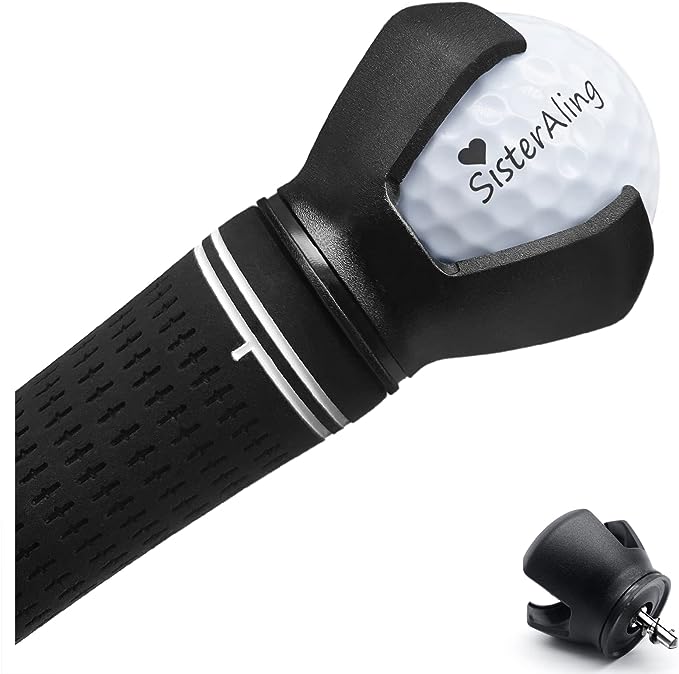
    SisterAling 3-Prong Golf Ball Retriever

    SisterAling 3-Prong Golf Ball Retriever

    • 3-Prong (Plastic, Alloy)
    $7

    1. Nickel Putter Ball Pick-Up

    Nickel Putter Ball Pick-Up

    Best Golf Ball Pick-Up Tool For Putter

    $21

    • Fits any golf putter grip.
    • Eliminates the need for bending over to retrieve the ball.
    • Effortless attachment without drilling or complex installation.
    • User-friendly and simple to use.

    This ingeniously designed device is a fantastic solution for golfers looking to save their backs from constantly bending over to pick up golf balls.

    It’s light years ahead of those frustrating suction cup pick-ups.

    The Nickel Putter Ball Pick-up effortlessly attaches to any golf putter grip without drilling or complicated installation.

    It makes the ball discreet and practically invisible, so you won’t even notice it’s there. And the best part? It works like a charm. No more struggles with rubber cups that either fall off or can’t pick up the ball.

    Using synthetic materials ensures that it’s highly durable, and for me, it’s worth every extra penny.

    If you’re a senior golfer dealing with the onset of back problems, this little gadget will easily become a lifesaver. It will allow you to stand upright and balanced while effortlessly retrieving your ball from the hole.

    It’s a small investment for a significant improvement in the golfing experience.

    What I like about this pick-up tool

    • It fits any golf putter. Grip
    • No more bending over to retrieve the ball.
    • Attaches easily with no drilling required.
    • Simple to use
    • Synthetic materials for high durability
    • Discreet—you won’t even know there

    What I don’t like about this pick-up tool

    • The flip top opens easily when taking the putter out of the bag.
    • Relatively expensive

    2. Club Champ Sports Rubber Ball Pick-Up Tool

    Club Champ Sports Rubber Ball Pick-Up

    Best Golf Ball Pick-Up Tool For Putter

    $7

    • Durable rubber construction.
    • Easily fits over the putter grip.
    • Integrated design with the putter grip for a snug fit.

    The highlight for me on this Club Champ Sports rubber ball pickup tool is how well it fits over my putter grip, specifically my Winn VSN grip.

    To make it fit snugly, I soaked the ball pick-up in hot water for two minutes and then firmly slipped it onto the grip until it bottomed out.

    It stays securely in place and has a squared-off shape that neatly integrates with the end of my grip.

    What’s convenient is that you can keep my favorite putting ball in this tool, ensuring it’s always within reach when you step onto the green to putt.

    The plastic claws grip the ball tightly, so I don’t have to worry about it getting lost.

    As an unexpected bonus, when I pick up my course ball and place it in the pick-up tool before a putt, I can use it against my body to stabilize my putting stroke effectively.

    It’s like having an extra pair of hands to steady my game.

    This fantastic tool comes at a great price, making it a valuable addition to your golf gear. The only minor drawback is that it doesn’t allow my putter to fit in my golf bag due to the bag’s design.

    What I like about this pick-up tool

    • Affordable
    • Pick up your ball without bending over.
    • Durable rubber
    • Fits over your putter grip

    What I don’t like about this pick-up tool

    • It works well, but it is huge. It may or may not fit in your golf bag when it’s on your putter.

    3. Nuobesty Suction Cup Grabber

    Nuobesty Suction Cup Grabber

    Best Golf Ball Pick-Up Tool For Putter

    $9

    • Crafted from high-quality PVC for durability and longevity.
    • Suitable for most putter grips with a diameter of 1.77 inches (4.5cm).
    • Particularly beneficial for individuals with disabilities, making ball retrieval effortless and reducing the need for bending.

    This ball grabber is crafted from high-quality PVC and is incredibly durable and long-lasting. Not to mention, it’s conveniently lightweight and easy to carry around.

    The added magnet inside the grabber is a brilliant feature, as it effortlessly attaches to the end of the putter grip.

    The vibrant red color and the combination of rubber and PVC materials give it a pleasing look and feel.

    With a diameter of 1.77 inches (4.5cm), it’s a good fit for most putter grips.

    While this grabber effectively picks up the ball as intended and is easy to use, I did encounter a minor issue with it slipping off my midsized putter grip when I pulled it out of my bag.

    So, I’d recommend it primarily for those with round putter grips.

    That said, the pick-up tool will tremendously help people with disabilities. Bending to retrieve a ball from the cup, which used to be a challenge, will become a breeze.

    You will no longer have to strain yourself, especially during mini-putt games.

    What I like about this pick-up tool

    • The red color makes it stand out.
    • Lightweight and handy to carry.
    • The magnet inside easily attaches to the end of a putter grip.

    What I don’t like about this pick-up tool

    • None so far.

    4. Maxfli Golf Ball Pick-Up

    Maxfli Golf Ball Pick-Up

    Best Golf Ball Pick-Up Tool For Putter

    $12

    • Features a fixed 3-prong design that securely grabs the golf ball from the hole.
    • Durable plastic construction for long-lasting convenience.
    • Easy attachment to the end of a standard putter grip for effortless ball retrieval.

    This nifty device attaches easily to the end of your standard putter grip, making ball retrieval a breeze.

    The fixed 3-prong design securely grabs your golf ball from the hole. It’s durably constructed, ensuring long-lasting convenience.

    I’ve experimented with a few other ball retrievers, including a large suction cup that often got stuck in my bag and a small suction cup that didn’t seal properly when dirty.

    The Maxfli tool, however, screws into the putter end and consistently grabs the ball without any issues.

    The only downside is that it won’t work with Superstroke or Odyssey putters.

    What I like about this pick-up tool

    • Grab a golf ball without bending.
    • A fixed 3-prong design grabs your golf ball from the hole.
    • Durable plastic construction

    What I don’t like about this pick-up tool

    • It doesn’t seem to work with Superstroke or Odyssey putters.

    5. SisterAling 3-Prong Golf Ball Retriever

    SisterAling 3-Prong Golf Ball Retriever

    Best Golf Ball Pick-Up Tool For Putter

    $7

    • Versatile – can be repurposed for picking up table tennis balls.
    • A great gift idea for fellow golfers.
    • Features a three-claw design made of durable plastic for quick and accurate ball retrieval.

    This ergonomic golf ball teeing device is designed to save golfers from bending over to retrieve their balls, significantly reducing back stress.

    The three-claw design made of durable plastic allows for quick and accurate ball retrieval.

    While it may not fit as snugly in a club handle as a dedicated stick, attaching it to a broken club shaft or lightweight bamboo/dowel rod works like a charm.

    It’s flexible yet sturdy, and I’m confident this option will serve you and stand the test of time.

    You can even repurpose it for picking up table tennis balls.

    What I like about this pick-up tool

    • High quality
    • Upgraded claw design
    • Portable design
    • Great gift idea

    What I don’t like about this pick-up tool

    • None so far.

    Wrapping Up: How to Choose the Best Golf Ball Pick-Up Tool

    When shopping for a golf ball pick-up tool for your putter, first confirm that the product is compatible with your putter’s grip size and design. Some pick-up tools are designed to fit specific putters.

    Look for a tool that is easy to use, allowing you to pick up golf balls without bending over excessively. The device should securely hold the golf ball, preventing it from falling off during use. The product reviewed in this article has a magnet but also uses suction and a 3-prong gripping mechanism.

    Also, think about the price. Golf ball pick-up tools are generally affordable. But still, set a budget and find an agency that offers good value for the price.

  • Garmin R10 Vs Mevo Plus: The Ultimate Comparison 

    Garmin R10 Vs Mevo Plus: The Ultimate Comparison 

    The Garmin R10 and Flightscope Mevo Plus are among the market’s most talked-about launch monitors.

    If you’re torn between both models, the good news is that there’s no bad decision. These two devices have proven to be reliable.

    But one will surely be more suitable for your needs than the other.

    The major selling point of the Mevo+ is the Wi-Fi hotspot, internal alignment camera, 17 practice ranges, five simulated courses, and lots of shot data. On the other hand, the Garmin R10 flourishes in archives club stats, being a driving range simulator, smartphone compatible, 10-hour battery life, waterproof, and rechargeable battery.

    I have had the Mevo Plus for a few months now and realized it’s a much better choice for scratch players and those who regularly compete in tournaments.

    The R10 appeared to be a better choice for a solid launch monitor at an affordable price.

    But other relevant performance factors lead to this conclusion, which I have detailed in the rest of this article.

    To begin with, I have created the table below to give a rundown of what sets the R10 and Mevo Plus apart to help you make a decision:

    Garmin R10 vs. Mevo Plus: Comparison Chart

    FactorsGarmin Approach R10Flightscope Mevo Plus (2023 Edition)
    Metrics capturedClub Head Speed, Club Face Angle, Club Path Angle, Angle of Attack, Ball Speed, Launch Angle, Launch Direction, Spin Axis, Spin Rate, Apex Height, Smash Factor, Carry Distance, Total Distance, and Deviation DistanceExisting Mevo data in addition to Horizontal Launch Angle, Lateral Landing, Angle of Attack, Total Distance, Roll Distance, Spin Axis, Spin Loft, and Shot Shape (20 in total)
    Phone software supportAndroid and iOSAndroid and iOS
    MaterialPlasticPlastic
    Battery Typeinternal rechargeable lithium-ioninternal rechargeable lithium-ion
    Battery LifeUp to 10 hoursup to 3 hours
    Water ProofYesYes
    E6 Connect CompatibleYesYes
    Price$600$1,979
    ImageProductDetailPrice
    <strong>Garmin Approach R10</strong>

    Garmin Approach R10

    • Club Head Speed, Club Face Angle, Club Path Angle, Angle of Attack, Ball Speed, Launch Angle, Launch Direction, Spin Axis, Spin Rate, Apex Height, Smash Factor, Carry Distance, Total Distance, and Deviation Distance
    $600
    <strong>Flightscope Mevo Plus (2023 Edition)</strong>

    Flightscope Mevo Plus (2023 Edition)

    • Existing Mevo data in addition to Horizontal Launch Angle, Lateral Landing, Angle of Attack, Total Distance, Roll Distance, Spin Axis, Spin Loft, and Shot Shape (20 in total)
    $1,979

    The App

    The Flightscope Mevo Plus runs with the FS Golf App, while the Garmin R10 runs on the Garmin Golf App.

    It’s cool that each device has its own dedicated app, and, to be fair, both are very good.

    However, after using the R10 for a while, I noticed that it’s more user-friendly, especially for someone breaking into the world of launch simulators.

    The way data is presented on the Garmin Golf App is easy to understand, but I can’t say the same for experience when it comes to making comparisons and digging into numbers.

    The FS Golf app seems to do it better. Many users have also reported difficulty connecting the Garmin Golf App with the iPad.

    I didn’t experience this issue, but it bears mentioning.

    The app offering of the FlightScope Mevo+ makes it feel professional. When you track with the Mevo+, it feels like you’re using a higher-end device like Trackman.

    The experience is similar.

    Data Metrics

    The data metrics offered by both devices are satisfactory.

    The Garmin R10 doesn’t offer as many metrics as the Mevo+, and I didn’t expect it to.

    But for its price range, it’s impressive that we can enjoy metrics like Face to Path or Club Path that are only included in the Pro Package with the Mevo Plus.

    Here’s a full image of what the Garmin R10 launch monitor offers:

    With the Flightscope Mevo+, you get 16 data sets, but you can upgrade to the Mevo+ Pro Package for an extra $1,000 to get 11 different metrics.

    This is a steal because it is affordable compared to getting the total package in a launch monitor that costs thousands of dollars.

    Here’s a full image of what the Flightscope Mevo + launch monitor offers:

    Regarding who offers more data metrics, Mevo+ is undoubtedly spot on.

    If you’re concerned with game improvement while shopping for launch monitors, this is the green light at the Mevo+.

    Performance 

    Regarding performance, it’s easy to conclude that both devices have a tie because they equally come with a mobile subscription to the e6 Simulator software, a well-known simulator option on the market.

    P.S.: You can’t connect the software to your PC or projector. It’s simply mobile subscription-based.

    It is worth noting that the R10 doesn’t track putts, whereas the Mevo+ will.

    So, the Flightscope sounds more appealing to someone who desires to play a full round of golf.

    The performance of the FlightScope Mevo+ and the Garmin R10 indoors is decent, but the Mevo+ has an edge for indoor use since it allows you to use an AC wall adapter for continuous power.

    The Garmin R10 doesn’t have this feature, but it compensates for its long-lasting battery life, which is up to 10 hours—seven hours more than the Flightscope.

    Ease of Use

    The Garmin R10 is Bluetooth-based, and the FlightScope Mevo+ has a Wi-Fi network to connect to. So, both are easy to use with their respective connection modules.

    However, some people using iPads with no cellular data plan usually experience data issues with the Mevo Plus.

    Since the R10 gets everything done within the Garmin golf app, it is easy to use. If you’re familiar with the Garmin ecosystem, using the R10 won’t be an issue.

    Using Garmin is easier. The physical design allows for a simple plug-and-play. If you don’t like professional-level devices, the FS Mevo+ will look cumbersome to use.

    The many options on the app can be a good thing but ironically, they turn out to be a not-so-great offering.

    Meanwhile, for ease of usage, the Mevo+ requires 16 feet of space (8 feet behind the ball and 8 feet in front), while the R10 needs 8 feet in front of the ball but only seven behind.

    In other words, both devices have similar space limitations.

    But the Mevo+ gave me more accurate readings when I moved it closer behind me.

    Accuracy

    Regarding accuracy, I wasn’t surprised to discover how the Mevo+ outranked the Garmin. It’s an expensive device, so I can only expect a lot.

    In all fairness, both devices are accurate for what they are.

    The difference in accuracy and performance between these two devices would probably not mean much if you’re an amateur golfer looking for some help in your practice sessions or for a fun garage simulator setup.

    To put things in perspective, only two in ten shots were misread while using the Garmin R10, which is interpreted as 80% accuracy.

    That’s not bad for a launch monitor below a thousand dollars. Plus, it’s easier and more accurate to use straight out of the box than the Mevo+.

    But the Mevo+ has superior accuracy that pro golfers will value.

    If you’re coming down from the Bushnell Lauch Pro or Trackman, you’d want to stick to the likes of Mevo+ because they offer close accuracy experience.

    Overall, the lie and loft angle of the device will determine its accuracy.

    Some people who have reviewed these two devices say Garmin is more accurate, and I can only imagine it’s due to weather and elevation settings, the type of ball, and other relevant factors that influence the accuracy of launch monitors apart from the device itself.

    Pros and cons

    Indeed, there’s no perfect product out there.

    There are always two sides to the coin. To further help you decide which of these launch monitors is best for you, consider the pros and cons of each:

    Garmin Approach R10

    What I likeWhat I don’t like
    It’s a great value for the money.It loses connection outdoors easily.
    Easy to set up and use. Also very portableIt can take a few swings of trial and error to get it at the angle where the horizontal misses and correct it.
    It allows you to save data from your practice sessions to view at any time.The launch direction accuracy was consistently off by at least 4 degrees.
    It is an affordable but reliable launch monitor.It would be better if slow motion were added to the video capabilities.
    Stronger battery life that lasts up to 10 hoursYou need to pay for a subscription to use the Home Tee Hero mode.

    Flightscope Mevo Plus

    What I likeWhat I don’t like
    It’s game-improvement-orientedmore expensive than the R10
    Onboard Wi-Fi hotspot for a stronger connectionShort-game accuracy is not so great.
    Stress-free alignment processNot as fast as the R10 when registering shot readings
    It works great for outdoorLagging performance indoors
    The shot data is impressive.Not as portable as the R10

    Verdict summary

    Both the Garmin R10 and Mevo Plus are great devices.

    I like the built-in stand of the Mevo Plus. The overall construction quality of the device feels more “pro level” than any of the other launch monitors under $2,000 I’ve used.

    The Garmin R10 itself is also impressive.

    To conclude, I had to observe their performance on portability and battery, setup, primary app, user experience, data points, accuracy, indoor and outdoor use, and even battery life.

    With these in mind, here’s my rating for both devices based on my experience with them:

    Rating Garmin Approach R10Mevo Plus
    Metrics provided7.510
    Accuracy 7.010
    Performance 8.59.5
    Ease of Use108
    Looks8.09.5
    TOTAL (50 points):41 points47 points

    In this comparison review, the Flightscope Mevo Plus launch monitor wins over the Garmin Approach R10.

    If you’re on a tight budget, the Garmin R10 is a more feasible option, and you won’t regret purchasing it. But I think the Flightscope Mevo Plus is a better launch monitor because it offers more.

    From the software quality to the data points offered and accuracy, the Mevo Plus is just great overall.

    You will only have to pay significantly more for it.

  • Garmin R10 Vs Skytrack Launch Monitor: The Ultimate Comparison

    Garmin R10 Vs Skytrack Launch Monitor: The Ultimate Comparison

    The Garmin Approach R10 is a handy and affordable little launch monitor you can take anywhere, while the Skytrak is a higher-end golf launch monitor. Still, it’s pretty much the opposite of the Garmin Approach R10. I tested both devices and will show you in this article how they measure up against each other.

    After multiple tests, the Garmin R10 proved to be a better option for taking swing videos, while SkyTrack stands tall for tracking swing data. Meanwhile, both devices do not measure club paths, which you can get on higher-end launch monitors. The SkyTrak struggles to work at its best outdoors but works better than the Garmin indoors. Still, the features of both devices overlap, and if one is better than the other, it’s only with a little margin (aside from the price difference, of course).

    I became more interested in placing these two devices head-to-head after watching how David Maxfield Golf, in a video, compared the Flightscope Mevo Plus to the Garmin R10, and both units tracked the shots simultaneously and were identical with every hit. So what about someone willing to spend a few extra hundred dollars for something better? Is the Skytrak launch monitor worth it?

    You will find out in this full review. In case you’re in a hurry, I have created the table below to give a rundown of what sets the R10 and Skytrack apart to help you make a decision:

    Garmin R10 vs. Skytrack: Comparison Chart

    The Skytrak shines in the area’s weather settings and the fact that it works by photometric readings. The wireless setup is also a huge plus. But the Garmin Approach R10 also has robust offerings, from archives club stats and a driving range simulator to smartphone compatibility and 10-hour battery life.

    FactorsGarmin Approach R10Skytrack Launch Monitor
    Metrics capturedClub Head Speed, Club Face Angle, Club Path Angle, Angle of Attack, Ball Speed, Launch Angle, Launch Direction, Spin Axis, Spin Rate, Apex Height, Smash Factor, Carry Distance, Total Distance, and Deviation DistanceBall speed, launch angle, back and side spin, side angle, carry distance, roll, total distance, club head speed, angle of decent, distance offline, a 3D flightpath with apex height and hang time
    Phone software supportAndroid and iOSAndroid and iOS
    MaterialPlasticPlastic
    Battery Typeinternal rechargeable lithium-ioninternal rechargeable lithium-ion
    Battery LifeUp to 10 hoursUp to 5 hours
    Water ProofYesYes
    E6 Connect CompatibleYesYes
    Price$599$1995
    ImageProductDetailPrice
    <strong>Garmin Approach R10</strong>

    Garmin Approach R10

    • Club Head Speed, Club Face Angle, Club Path Angle, Angle of Attack, Ball Speed, Launch Angle, Launch Direction, Spin Axis, Spin Rate, Apex Height, Smash Factor, Carry Distance, Total Distance, and Deviation Distance
    $599
    <strong>Skytrack Launch Monitor</strong>

    Skytrack Launch Monitor

    • Ball speed, launch angle, back and side spin, side angle, carry distance, roll, total distance, club head speed, angle of decent, distance offline, a 3D flightpath with apex height and hang time
    $1995

    Performance

    One peculiar thing about the Garmin R10 is the video recording feature that overlays your shot data onto the footage. It makes the device stand out because it allows you to repeatedly see your swing and mechanical data for better analysis.

    The R10 allows you to access virtual course simulations and game modes, which is great for players’ improvement.

    The Skytrak launch monitor’s performance revolves around using photometric technology to give short readings. Unlike radar technology, Skytrack maintains its accuracy outdoors with this design.

    I also love how the device simulates courses nicely on my tablet and laptop.

    Data parameters 

    The fact that the Skytrak costs more than the R10 is a shocker, especially when it doesn’t offer as many measuring metrics as the R10 does.

    When using the Garmin R10, you can track club head speed, club face angle, path angle, and angle of attack. The device also records ball speed, launch angle, direction, spin axis and rate, apex height, smash factor, and carry distance.

    With the R10, you can also see your total distance and deviation distance.

    On the other hand, the Skytrack launch monitor only measures ball speed, launch angle, back and side spin, side angle, carry distance, roll, and total distance.

    You can also track club head speed, angle of decent, distance offline, a 3D flightpath with apex height, and hang time.

    Ease of Use

    The Garmin R10 has a straightforward setup, making it easier to use than the Skytrack launch monitor.

    With the R10, you must connect the device to your phone or tablet via the Garmin Golf App.

    The R10 is also more portable than the Skytrack, which makes it easier to move around. It’s smaller than a smartphone when it’s not loaded into the foldable tripod. So that counts as something under ease of use.

    Accuracy

    The Garmin Approach R10 uses radar to track shots, which favoured me the most when swinging outdoors. The device was accurate during testing, with a total distance of about 3 yards. Sadly, this dropped by about 5 yards when I took it indoors.

    In the case of Skytrak, more accuracy was experienced indoors than outdoors. The high-speed cameras in this device ironically became a disadvantage for outdoor swings, especially because it was a sunny day and the light interfered with the cameras, which impacted the accuracy. This has been the experience of many other Skytrack owners.

    With this experience, I’d say the Skytrack works best as an indoor launch monitor, and even its fun course simulation complements this remark.

    I would recommend the Garmin R10 in a heartbeat if you want to practice at the range and need more reliable information.

    Pros and cons

    Indeed, there’s no perfect product out there. There are always two sides to the coin. To further help you decide which of these launch monitors is best for you, consider the pros and cons of each:

    Garmin Approach R10

    What I likeWhat I don’t like
    Record all the data you could want. It’s a great value for the money.You need to pay for a subscription to use the Home Tee Hero mode.
    Easy to set up and use. Also very portableIt can take a few swings of trial and error to get it at the angle where the horizontal misses and correct it.
    The automatic video recording feature is very helpful for analyzing your swing.The launch direction accuracy was consistently off by at least 4 degrees.
    It is still affordable, considering its high-techIt would be better if slow motion were added to the video capabilities.
    Stronger battery life than the Skytrack 

    SkyTrack Launch Monitor

    What I likeWhat I don’t like
    Reliable wireless connectionIt can take between 5 and 7 seconds to pull up shout metrics.
    The simulated renderings of famous courses look nice.It’s expensive for budget-conscious golfers.
    You can archive your shot data and review it whenever you want.It doesn’t offer as many shot metrics as the R10 or even the Mevo Plus.
     Not as portable as the R10

    Verdict Summary

    Although Skytrack is a solid device, it struggles a lot with the driver—high ball speeds—and with chipping and putting.

    Also, the R10 can be used outdoors and is amazing outdoors, but the sky track struggled to provide consistent results outdoors. And even indoors, it required sufficient lightning. If you don’t have the space for the R10, the Skytrak is a great option at the price point and is fun for its value.

    With these in mind, here’s my rating for both devices based on my experience with them:

    Rating Garmin Approach R10SkyTrack
    Metrics provided108.0
    Accuracy 9.57.0
    Performance 9.08.0
    Ease of Use9.08.5
    Looks7.510
    TOTAL (50 points):45 points41 points

    The bottom line is that the Skytrack launch monitor is a better option if you operate with limited space, as it can sit facing the golfer just outside the ball starting position. In contrast, you need at least 1.8 to 2.4 meters behind the ball-starting job for the Garmin R10.

    If you’re on a tight budget, the R10 is undoubtedly the best way to go, and you won’t regret the purchase.

  • Garmin R10 Vs. Rapsodo: Which Is Better?

    Garmin R10 Vs. Rapsodo: Which Is Better?

    Sports professionals typically use the best golf launch monitors, which can cost up to $1000 or more. If you’re just starting out or on a tight budget, options like Foresight Sports GCQuad or the Full Swing Kit will be overkill. Garmin Approach R10 and Rapsodo Mobile Launch Monitor (MLM) are among the few quality and budget-friendly launch monitors on the market presently, so it’s predictable for you to be conflicted between them. I tested both devices, and I will show you in this article how they measure up.

    In brief, the Rapsodo MLM is the easiest to set up for practice between the two. It supplies accurate but basic information on swings and will make a great addition to your setup at home. On the other hand, the Garmin Approach R10, during the testing, proved to be a better option that can double up as a simulator. It is also a better option for outdoor usage. Still, the Rapsodo MLM is undoubtedly your best bet if you’re on a tight budget.

    Maybe you’re looking to buy a personal launch monitor while under budget. The Rapsodo Mobile Launch Monitor (MLM)” and the Garmin R10 are expected to be the best options.

    I have documented valuable information about these devices and how they compare across many relevant factors in this article. If you’re in a hurry, the table below will explain what sets these two launch monitors apart.

    Garmin R10 vs. Rapsodo: Comparison Chart

    The best way to figure out which of these products is best for your game is to consider broadly the characteristics and specifications of both of them. I have created this comparison chart to help you with that:

    Factors Garmin Approach R10Rapsodo
    Data parameters providedClub Head Speed, Club Face Angle, Club Path Angle, Angle of Attack, Ball Speed, Launch Angle, Launch Direction, Spin Axis, Spin Rate, Apex Height, Smash Factor, Carry Distance, Total Distance, and Deviation DistanceCarry Distance, Side Carry, Spin Rate, Club Speed, Ball Speed, Vertical Launch, Smash Factor, Launch Angle, Apex Height, and Shot Type
    Battery lifeUp to 10 hours
    Up to 8 hours
    Connection BluetoothBluetooth
    Accuracy LessMore
    Phone software supportAndroid and iOSIOS
    MaterialPlastic Plastic
    Price$599$300
    ImageProductDetailPrice
    <strong>Garmin Approach R10</strong>

    Garmin Approach R10

    • Club Head Speed, Club Face Angle, Club Path Angle, Angle of Attack, Ball Speed, Launch Angle, Launch Direction, Spin Axis, Spin Rate, Apex Height, Smash Factor, Carry Distance, Total Distance, and Deviation Distance
    $599
    <strong>Rapsodo</strong>

    Rapsodo

    • Carry Distance, Side Carry, Spin Rate, Club Speed, Ball Speed, Vertical Launch, Smash Factor, Launch Angle, Apex Height, and Shot Type
    $300

    The App

    The app and subscription service of both launch monitors are decent, but the Garmin R10 seems to be more bang for your buck because you can access courses alongside the launch monitor.

    Rapsodo allows you to record every swing, but you only get 100 videos for free, which leaves you with two options: constantly delete videos or pay $99 for unlimited storage.

    Performance 

    I have tasted several other budget-friendly launch monitors enough to realize that certain features and performances are generally expected from any launch monitor. So, it would be too much to call them grand.

    But what sets the Garmin R10 apart is that it first requires you to set up a selfie stick or tripod to get a swing video, versus the Rapsodo MLM, which does this by default.

    The Rapsodo does not capture videos from the best angle, so it is hard to do much swing evaluation, but it is hassle-free.

    If set up properly, the Garmin is great. In the performance category, I’d say the Rapsodo does a bit better, but it is still up for debate because Garmin takes extra steps to get recordings, and the Rapsodo does not record from the best angle.

    Data Parameters

    There’s no straightforward way to make a judgment on which launch monitor outperforms the other when it comes to metrics. For instance, the Rapsodo and Garmin share such things as club speed, ball speed, apex, and distance, of which, during testing, results were pretty close to each other.

    However, I did notice that the R10 extrapolates for club path, swing direction, angle of attack, and spin rates. This is the edge the R10 has over Rapsodo.

    If you’re purchasing a launch monitor for fun and not necessarily for game improvement, then the Garmin R10 lapses won’t be a deal-breaker.

    However, if you are looking for significant swing changes, the data on the Rapsodo appears to be more reliable.

    Ease of Use

    Rapsodo MLM reeks of simplicity, from the design to the usage. But it doesn’t defeat the Garmin on this one.

    On the Garmin R10, there’s information overload—so many metrics to track, which can be a good thing and, ironically, a not-so-great item for those who just want a simple device for basic measurement.

    Because I use an iPhone, I noticed while at the range that the Garmin was much easier to read all of your metrics, while Rapsodo requires you to exit the sessions and return before seeing some metrics. I wish the Rapsodo worked on this because it’s a hassle to leave the session and produce, especially when it’s single-swing data I want to look at.

    The interface is different when you use an iPad, but many people use their iPhone, so it’s a flaw on the part of the Rapsodo.

    Pros and cons

    Indeed, there’s no perfect product out there. There are always two sides to the coin. To further help you decide which of these launch monitors is best for you, consider the pros and cons of each:

    Garmin R10

    What I likeWhat I don’t like
    Record all the data you could want. It’s a great value for the money.The course simulator costs $10 a month and is cartoony and not worth it compared to simply doing the practice range.
    It comes with a companion app that makes it super easy to use.Temperamental with alignment
    With the R10, you can access courses to play if you want to use the portable device as a simulator.No ball normalization feature
    It is still affordable, considering its high-techIt would be better if slow motion were added to the video capabilities.

    Rapsodo 

    What I likeWhat I don’t like
    Easy to set and useIt doesn’t display spin numbers.
    Visual aid for your shotsShort battery life
    It helps to track your performance with each club individually.Not compatible with Android phones

    Verdict Summary

    Based on this elaborate comparison, the Garmin R10 appeared to be a better golf launch monitor than the Rapsodo, but it’s with a less significant margin. The R10 wins as the best launch monitor for under $600.

    I think the ability to double as a sim can make the range a little bit more fun. This is what you won’t get with the Rapsodo MLM.

    P.S.: The R10 comes with five courses and a driving range on E6, which is supposed to be a major bonus, but E6 sucked on my iPhone. It was so choppy and did a battery hog.

    We’ve also explored other areas and how these two devices measure against each other. With these in mind, here’s my rating from my experience with using these two launch monitors:

    Rating Garmin Approach R10Rapsodo
    Data Offered106.5
    Accuracy 6.58.5
    Performance 8.09.5
    Ease of Use6.57.0
    Looks9.06.0
    TOTAL (50 points):40 Points37.5 Points

    I’ve used the Rapsodo for a while before purchasing the R10 for this review. The R10 came as a recommendation because I was particular about knowing advanced metrics such as swing path, club face, and angle of attack.

    I am a little disappointed in those metrics based on what I see online compared to advanced launch monitors like Trackman.

    Of course, the R10 won’t perform like a $15,000 device, but the fact that the advanced metrics offered were even shaky doesn’t fully justify upgrading from Rapsodo.

    However, this is because I already have a Rapsodo MLM. If you don’t have a launch monitor and this is your first purchase, I recommend the Garmin R10.

  • Flightscope Mevo VS Garmin R10: A Side-by-side Comparison

    Flightscope Mevo VS Garmin R10: A Side-by-side Comparison

    Flightscope Mevo and Garmin Approach R10 are powerful radar-based launch monitors that instantly come to mind when considering options well under $1,000. This is why many amateur golfers (even some pros) are often conflicted about which to choose. So which is best for you?

    After testing both devices, I realized that the Garmin Approach R10 offers much more than the FlightScope Mevo (and even Mevo Plus). I noticed more precision with the R10’s metrics, richer visual graphics in game modes, water resistance for outdoor playing, and access to over 41,000 courses worldwide with E6 compatibility that Mevo doesn’t have.

    Although the Mevo deserves its flowers, you can understand your shots better; the device has great battery life and receives constant feedback with the audio function. However, it does not measure horizontal and vertical launch angles and estimates spin based on club path and horizontal movement, as seen in the R10.

    It could be that you’re looking to invest in a tracker without spending a fortune—just to be able to practice from home. The Mevo is more budget-friendly if you are seriously on a tight budget. But what will you be missing by forgoing R10 because of an additional hundred dollars?

    You will find out in the rest of this article as I compare the Flightscope Mevo and Garmin Approach R10 launch monitors side-by-side.

    Mevo vs. Garmin R10: Comparison Chart

    The best way to figure out which of these products is best for your game is to consider broadly the characteristics and specifications of both of them. I have created this comparison chart to help you with that:

    FactorsFlightscope MevoGarmin Approach R10
    Metrics capturedCarry Distance, Spin Rate, Club Speed, Ball Speed, Vertical Launch, Smash Factor, Apex Height, and Flight TimeClub Head Speed, Club Face Angle, Club Path Angle, Angle of Attack, Ball Speed, Launch Angle, Launch Direction, Spin Axis, Spin Rate, Apex Height, Smash Factor, Carry Distance, Total Distance, and Deviation Distance
    Phone software supportAndroid and iOSAndroid and iOS
    MaterialPlasticPlastic
    Battery Typeinternal rechargeable lithium-ioninternal rechargeable lithium-ion
    Battery LifeUp to 8 hoursUp to 10 hours
    Water ProofNoIPX7
    CompatibilitySmartphone/Mevo Golf AppSmartphone/Garmin App
    E6 Connect CompatibleNoYes
    Price$449$599
    ImageProductDetailPrice
    <strong>Flightscope Mevo</strong>

    Flightscope Mevo

    • Carry Distance, Spin Rate, Club Speed, Ball Speed, Vertical Launch, Smash Factor, Apex Height, and Flight Time
    $449
    <strong>Garmin Approach R10</strong>

    Garmin Approach R10

    • Club Head Speed, Club Face Angle, Club Path Angle, Angle of Attack, Ball Speed, Launch Angle, Launch Direction, Spin Axis, Spin Rate, Apex Height, Smash Factor, Carry Distance, Total Distance, and Deviation Distance
    $599

    The App

    FlightScope Mevo is known for its user-friendly “Mevo Golf” app. It offers a wide range of features, making it a popular choice among golfers looking to improve their game.

    The app provides real-time data, including launch angle, ball speed, clubhead speed, spin rate, and more. It also tracks shot dispersion and offers club data to help you analyze your swing.

    One standout feature of the Mevo app is its video integration, which allows you to overlay your swing data on your recorded swings for better analysis.

    The Garmin Approach R10 uses the “Garmin Golf” app for data analysis. The app also lets you record your shots and review your session data.

    One advantage of the Garmin app is that it connects to a broader ecosystem of Garmin devices, which can be appealing if you already use Garmin products.

    Performance

    It is undeniable that the Garmin R10 wins the Mevo in terms of performance. Garmin offers you a 6-course license for E6. So you can do realistic simulations on those courses. Other launch monitors, like Mevo (not Mevo Plus), only give you the driving range app.

    If we compare the Garmin simulator app with Mevo’s, I’ll choose the latter because Gramin’s interface is very cartoony-looking. I also struggled with distance accuracy.

    The saving grace is that it comes with E6 with 6 courses and a driving range, and I have found that to be spot on accuracy-wise and much more realistic-looking than anything offered in the Mevo.

    The downside to the performance of the R10 is that consistent setup is important—you need 8 feet from ball to net or screen, and the R10 needs to be 7 feet behind you.

    I’ve been using the Mevo indoors in my garage, but the R10 works greatly outdoors, thanks to the waterproofness that’s not present in the Mevo.

    Data Parameters

    The metrics captured are another area where the Garmin R10 wins against the Flightscope Mevo.

    The Garmin R10 will measure club head speed, face angle, path angle, angle of attack, ball speed, launch angle and direction, spin axis and rate, apex height, and even smash factor.

    You can also track carry, total, and deviation distances with the R10.

    Unfortunately, the Mevo only records carry distance, spin rate, club speed, ball speed, vertical launch, smash factor, height, and flight time.

    Ease of Use

    When using the Mevo, you simply turn it on, sync Bluetooth, set it 6 feet behind your swing line, and fire away. The setup is straightforward, and you can use your phone (Android or iOS) to see results, including video.

    The ease of setting up the R10 is arguable because the unit needs to be 6-7 feet behind and level with your ball. It’s hard to have that setup.

    So I get surprised when many “experts” on forums recommend this unit for those looking for an entry-level shot tracker and simulator. (The price, maybe?)

    Generally, you won’t struggle with any of these launch monitors if you’re not tech-savvy. Their designs are simple and easy to navigate around.

    Accuracy 

    On many review platforms, users have agreed that the Garmin R10 sometimes doesn’t read some shots. During my first testing sessions, I set the R10 up next to a launch monitor that cost about 10 times the R10 price.

    The distances were +/- 2 yds, the speeds were within five mph, and the Garmin provided some metrics the other unit didn’t offer (such as angle of attack). The spin rates were way apart (+/-1000 RPM).

    So, I strongly believe that many reported cases of inaccuracy in the R10 have to do with positioning, which can take some time to get correctly. An alignment stand and a small height riser may be needed to make it catch your shots at the range. This tells us why the Mevo seems easier to use than the R10.

    For the price, the Flightscope Mevo is an impressively accurate launch monitor. It missed only two of more than 100 shots taken during testing. And it gave accurate information regarding my swings.

    Pros and cons

    Indeed, there’s no perfect product out there. There are always two sides to the coin. To further help you decide which of these launch monitors is best for you, consider the pros and cons of each:

    Flightscope Mevo

    What I likeWhat I don’t like
    Among the most accurate golf launch monitors are those under $500. You can rely on the FlightScope Mevo data to improve your swing.It relies on your mobile device for its features.
    The Mevo FS Golf App is simple and easy to navigate. It is ideal for non-tech-savvy golfers.Not accurate with shorter shots
    Easy to move aroundThe app consumes your phone battery quickly, especially when running in the background.
    Instant feedback with the audio function 

    Garmin Approach R10

    What I likeWhat I don’t like
    Record all the data you could want. It’s a great value for the money.The course simulator costs $10 a month and is cartoony and not worth it compared to simply doing the practice range.
    It comes with a companion app that makes it super easy to use.It can take a few swings of trial and error to get it at the angle where the horizontal misses and correct it.
    With the R10, you can access courses to play if you want to use the portable device as a simulator.Setup can be a bit finicky sometimes.
    It is still affordable, considering its high-techIt would be better if slow motion were added to the video capabilities.
    Stronger battery life than the Mevo 

    Verdict Summary

    Based on my comparison, I’ll crown the Garmin R10 as the superior device because it has a serious advantage over the ordinary Mevo. It could have stood a chance if the comparison was between Meco Plus. However, Mevo is an older model, so you can expect to miss out on a lot by sticking with it.

    With this in mind, this is my verdict rating on a scale of 0 to 10 for each device based on my experience with them:

    Rating Flightscope MevoGarmin Approach R10
    Data Options7.010
    Accuracy 8.56.5
    Performance 69.5
    Ease of Use8.56.0
    Looks7.010
    TOTAL (50 points):37 points42 points

    In a list of popular portable launch monitors, it’s hard to ignore the Flightscope Mevo and Garmin Approach R10.

    In this article, I have attempted to pit the Mevo versus the Garmin R10 across key areas that should help you decide which is best based on your specific golf simulator needs.

    Despite the win of the R10, there’s no clear winner when comparing the FlightScope and Garmin R10, as they both have pros and cons. If you’re on a tight budget, the Mevo is the sure bet, and you won’t regret the purchase.

    The FlightScope is slightly more accurate when measuring ball flight, but the Garmin R10 is more user-friendly and has more features. But the E6 compatibility of the R10 will easily win buyers over.

    What do you think about these two launch monitors? Let me know in the comments.

  • Flightscope Mevo VS Rapsodo: Which Is Better?

    Flightscope Mevo VS Rapsodo: Which Is Better?

    If you’re looking for a launch monitor under a $500 budget, the FlightScope Mevo and Rapsodo MLM are two profound options you can never go wrong with. I’ve tested both, and I can say that none are bad. But let’s be real; you probably won’t buy both. So which is a better option for you than the other?

    Long story short, its user-friendliness makes the Rapsodo better than the Flightscope Mevo. However, the Mevo showed more accuracy during my testing than the Rapsodo.

    People buy launch monitors for different reasons. Your reason for getting a budget-friendly launch monitor can influence how you see these two rival products. In my case, I don’t have an indoor hitting space; my primary usage for a launch monitor is enhancing my practice at the range. So, I was more interested in a tool that could accurately collect my ball and swing stats, gapping, gamification, fun, etc.

    I learned a lot of differences between the Flightscope Mevo and Rapsodo, which I have decided to document in this review to help anyone who is conflicted between the two products and needs to make a decision.

    Rapsodo vs. Mevo: Comparison Chart

    The best way to figure out which of these products is best for your game is to consider broadly the characteristics and specifications of both of them. I have created this comparison chart to help you with that:

    Factors Flightscope MevoRapsodo
    Data parameters providedCarry Distance, Spin Rate, Club Speed, Ball Speed, Vertical Launch, Smash Factor, Apex Height, and Flight TimeCarry Distance, Side Carry, Spin Rate, Club Speed, Ball Speed, Vertical Launch, Smash Factor, Launch Angle, Apex Height, and Shot Type
    Battery lifeUp to 8 hoursUp to 8 hours
    Ease of useHarderEasier
    Connection BluetoothBluetooth
    Accuracy MoreLess
    Phone software supportAndroid and iOSIOS
    MaterialPlasticPlastic
    Price$449$300
    ImageProductDetailPrice
    <strong>Flightscope Mevo</strong>

    Flightscope Mevo

    • Carry Distance, Spin Rate, Club Speed, Ball Speed, Vertical Launch, Smash Factor, Apex Height, and Flight Time
    Buy Now
    <strong>Rapsodo</strong>

    Rapsodo

    • Carry Distance, Side Carry, Spin Rate, Club Speed, Ball Speed, Vertical Launch, Smash Factor, Launch Angle, Apex Height, and Shot Type
    Buy Now

    The App

    The Rapsodo seems to have an edge over the Flightscope Mevo in the app interface and design. I like the slick graphics, video, and audio readout of statistics and tables for post-round analysis in the Rapsodo App.

    Although the Rapsodo app is less customizable compared to the Mevo On Mevo, you can remove shanks or mishits that don’t represent your normal shot. You also get visual and audio readouts of stats during practice.

    But most importantly, the states and tables are easily digestible.

    The graphics on the Mevo app aren’t incredible, and there’s no visual overlay or real gamification.

    The Rapsodo shines in these areas—there’s a graphical overlay based on a GPS map of your range.

    Both launch monitor apps can sync video if you mount the phone somewhere.

    Performance

    Regarding performance, the Mevo will take the crown because, during my testing, it only missed two shots out of more than 100 ball hits. I was expecting the app to crash, but it didn’t, and the stats are all customizable and accessible.

    I also like how, with the Memo, the software is ready for the next shot before the first one hits the ground, which is good if you’re interested in simple rapid-firing practice.

    On the other hand, Rapsodo did perform well, with pretty impressive results. But it was not the best experience for usage. At one point, the device stopped recording video due to my iPhone XR overheating. It also missed about 8% of the shots, many of which were pitch shots.

    Still, these won’t make me deny how impressed I was with the Rapsodo’s great visuals for the shots and games that make the overall experience fun.

    The battery performance of both launch monitors appeared to be equally decent.

    Data Parameters

    As mentioned earlier, Flightscope Mevo will capture ball speed, club speed, backspin rpm, carry yards, launch angle, smash factor, peak height, and time in the air.

    I was disappointed to discover that it doesn’t record sidespin or angle. In other words, when using the Mevo, you can’t know how far offline you are.

    Rapsodo, on the other hand, captures all the data that the Mevo does, but it also records launch direction. So this is the launch monitor to choose if you seriously prioritize knowing how far you are offline with each shot.

    The Rapsodo still does not record backspin rpm, which is a deal-breaker when hitting drivers and wedges. But again, it boils down to your preference for these parameters.

    Ease of Use

    Based on the comparison I documented when testing both launch monitors, I think it is fair to say that the Mevo is superior to the Rapsodo regarding ease of use. But I still have reservations about this conclusion.

    When using the Mevo, you simply turn it on, sync Bluetooth, set it 6 feet behind your swing line, and fire away. The setup is straightforward, and you can use your phone (Android or iOS) to see results, including video.

    Rapsodo has the same procedure for usage. However, you have to set your iPhone to line up with your swing for automatic video.

    The hugest edge in terms of ease of use that the Mevo will have over the Rapsodo is that it allows for both Android and iOS, while Rapsodo works with iOS only.

    Pro Tip: 

    • You must mount your phone separately when using video to see results.
    • Don’t bother buying Rapsodo if you don’t have an iPhone or iPad.

    Accuracy

    For the price, the Flightscope Mevo is an impressively accurate launch monitor compared to the Rapsodo. It missed only two of more than 100 shots taken during testing. And it gave accurate information regarding my swings.

    The Mevo does lag in tracking launch angle and spin rate. But it does other sites decently.

    Meanwhile, Rapsodo is also one of the most accurate devices for its price, but the lag in spin rate affects the overall accuracy. So, while it gets the job done, I have more confidence in the memo when it boils down to precision.

    Pros and cons

    Indeed, there’s no perfect product out there. There are always two sides to the coin. To further help you decide which of these launch monitors is best for you, consider the pros and cons of each:

    Flightscope Mevo

    What I likeWhat I don’t like
    You can understand your shots better with the feature-rich app.It relies on your mobile device for its features.
    Drive accuracy is decent.Not accurate with shorter shots
    The device has great battery life.The app consumes your phone battery quickly, especially when running in the background.
    Instant feedback with the audio function 

    Rapsodo 

    What I likeWhat I don’t like
    Easy to set and useNot a great launch monitor for outdoor use
    Visual aid for your shotsShort battery life
    It helps to track your performance with each club individually.Not compatible with Android phones

    Verdict Summary

    Overall, based on my comparison, I’ll crown the Rapsodo as the superior device because, if you think about it, the only real advantages Mevo offers are visuals from different angles, video playback options, and spin rate measurement (a small silver sticker installation on each ball is even needed to make this happen).

    With this in mind, this is my verdict rating on a scale of 0 to 10 for each device based on my experience with them:

    Rating Flightscope MevoRapsodo
    Data Options5.07.0
    Accuracy 8.56.0
    Performance 9.08.5
    Ease of Use6.59.0
    Looks8.58
    TOTAL: 37.538.5

    Flightscope Mevo and the Rapsodo MLM will remain among the best options for budget-friendly launch monitors.

    In a perfect world, I’d love to merge some of the perks of the Rapsodo with those of the Mevo. One falls short in the area where the other shines. So, you have to forgo a particular advantage.

    They are both enjoyable to use. To be fair, both are great, which explains the marginal win. So you don’t have to be worried about investing in a bad option. However, when it comes down to it, you’d want to buy one.

    In that case, I’d recommend the Rapsodo over the Flightscope Mevo.

  • PXG Vs. Callaway: The Ultimate Comparison

    PXG Vs. Callaway: The Ultimate Comparison

    If you’re particularly torn between the Callaway Rogue ST and the PXG Gen 4 driver, this review is for you. I bought and played both drivers to see how they compare to each other and have documented the entire experience in this review.

    Both driver brands are dramatically different. The Rogue ST is game-improvement-oriented, as it offers forgiveness and distance. It’s chunky with a medium swing weight, and somehow, it feels like you’re hitting the ball with a toaster.

    On the other hand, the PXG Gen 4 provides a premium feel and customization options, so it’s the best fit if you prioritize precision and personalization. There’s a lot of tech in these drivers, but they’re not a hollow cavity back (since they’re filled with foam) and do not feel like a hollow cavity back.

    Being a mid-high handicapper, I have a naturally low ball flight and have trouble hitting the ball thin; the light swing weight and flat sole of the Rouge ST exacerbate that.

    But there’s still much more to it than separating these drivers, which would ultimately influence your pick. Here’s a quick comparison chart on the differences between these drivers:

    FactorCallaway Rogue STPXG Gen 4
    PerformanceForgiving, designed for distancePrecision and customization
    FeelGood feel with moderate feedbackPremium feel, softer feedback
    Distance ControlHigh launch, distance-orientedMore control and workability
    ForgivenessHigh forgiveness on off-center hitsModerate forgiveness
    Price Value $400$200 (limited offer)
    ImageProductDetailPrice
    <strong>Callaway Rogue ST</strong>

    Callaway Rogue ST

    • Forgiving, designed for distance
    Buy Now
    <strong>PXG Gen 4</strong>

    PXG Gen 4

      Detail
    Buy Now

    The Performance 

    One thing I quickly discovered is that these clubs are both very forgiving. I also noticed both of them, on those low hits, still fly pretty well on both drivers.

    I only had to get a little higher than I usually do. (I am yet to determine the reason, but I get better ball flight with these clubs when I tee up just a hair longer than normal.)

    First hits

    Second hits

    Third hits

    On several swings, the PXG was in a much better spot with a lower miss hit on the club, while the rogue was just off in the rough but a little bit longer.

    Looks, Sound, and Feel

    I seriously like the looks of the PXG Gen 4 driver. It’s an appealing view when you look down on the club. It pulls your eyes in the way that those lines are angled on the top of the club head. So it has an appealing edge over the Callaway.

    In terms of feel and sound, the Callaway Rogue ST wins the belt, in my honest opinion, because it has a nice, pleasant thud to its impact and gives wonderful feedback from the club. That way, you can easily identify when you have mishits.

    The best way I can describe the sound of the PXG Gen 4 is like snapping a gym towel. You don’t get the most pleasant sound when you hit this club, but it makes up for the result.

    Forgiveness

    Judging forgiveness with these drivers will be tricky because they are both good. However, the Rogue ST drivers incorporate VFT technology, meaning the face thickness varies across the clubface.

    This helps to optimize ball speed on off-center hits, making mishits less punishing and providing more consistent distance.

    PXG Gen 4 drivers are designed to offer a premium feel and precision, and while they still provide forgiveness, they may not have the same level of forgiveness as the Rogue ST drivers.

    From my experience with these drivers, I figured PXG focuses more on customization and providing a premium experience. So, we can expect this to lead to a slightly different design philosophy.

    Workability 

    If you’re super intentional about your improvement, workability should be an important consideration when picking between these two tough drivers.

    You want to know which of them can help your ability to shape their shots intentionally, whether it’s drawing the ball (curving it from right to left for right-handed golfers) or fading it (turning it from left to right for right-handed golfers).

    I hit that low hooking shot with both drivers pretty much the same. There was a slightly higher trajectory with the Callaway Rogue and a downward trajectory with the PXG.

    There’s nothing much between these two, and I didn’t expect to see much because both are truly forgiving clubs.

    Shafts

    Regarding shafts, I believe a good club is not just about the head. The post, in combination, will do the magic.

    Many people think that once you can find a quality shaft, you can put it in every driver’s head, which is not always ideal because both components must work in tandem.

    For this reason, I stuck with stock configurations that you can easily find off the rack. I try to pair a stiff 60g when possible with the stock configuration of the manufacturer.

    For the PXG, I used the Hazardous Smoke Yellow Shaft, 60 grams. For the Callaway Rogue, I paired it with the Mitsushibi Tensei Shaft 55 gram and stiff flex.

    Price Value

    The PXG sells for $529 but at a limited discount of $200. It is an incredible value, dollar for dollar. They also offer military discounts. But I believe $200 is still a great value for what you’re getting. The Callaway Rogue, on the other hand, costs $400 with a stock shaft configuration.

    The gap is already a big difference in expense when shopping for golf, which is a pretty expensive sport.

    Which of these drivers should you play?

    The comparison is pretty definitive. The Callaway Rogue ST takes the lead regarding forgiveness, distance, and accuracy. But again, it depends on your playing style and your budget.

    The Rogue ST offers forgiveness and distance. I’ll strongly recommend it as a game-improvement club. The PXG Gen 4 also wins on many grounds, but it would be the best if you need precision and customization options.

  • Best Putter Holder For Golf Bag

    Best Putter Holder For Golf Bag

    Putters, especially the ones with larger heads, like to interfere with how the rest of the clubs stand in golf bags. This can cause aesthetic damage to the other clubs. If you’re worried about this, then you need a putter holder. Sadly, many options online are cheap, with discouraging reviews. So far, I’ve been able to test and review the three best options.

    Here’s a list of the best putter holders for golf bags and why I recommend them:

    Key Takeaway: I strongly recommend the Club Champ Sports Premium Putter Holder if you need an all-round, versatile, sturdy, and affordable putter holder. However, options like the Dwawoo Golf Club Putter Clip Holder offer great value for money because it is packed with five pieces and has a 180-day return policy. If you want an option that’s the easiest to use, the Horne Golf Mighty Putter Clip Holder is your best bet.

    People need putter holders for different reasons. In my case, I had a putter with an oversized counterweighted grip. As someone who used the Callaway Warbird bag, it was not practical to store putters with large grips because they caught inside the bag. I eventually invested in the Club Champ Sports Premium Putter Holder, which has been bliss. However, it’s not the only option I’ve tested.

    In the rest of this article, I will explain in detail how these top recommendations work to help you decide which is best for you. In case you’re in a hurry, here’s a table comparing all the products across relevant buying factors:

    List of the Best Putter Holders for Golf Bags

    ImageProductDetailPrice
    Club Champ Sports Premium Putter Holder

    Club Champ Sports Premium Putter Holder

    • A soft TPR insert protects the shaft.
    $9 for 1 unit
    Horne Golf Mighty Putter Clip Holder

    Horne Golf Mighty Putter Clip Holder

    • high-strength nylon
    $10 for 1 unit
    Dwawoo Golf Club Putter Clip Holder with Ball Markers

    Dwawoo Golf Club Putter Clip Holder with Ball Markers

    • Tough plastic
    $10 for 5 units

    1. Club Champ Sports Premium Putter Holder

    Club Champ Sports Premium Putter Holder

    Best Putter Holder For Golf Bag

    $9

    • Features a soft TPR insert to protect and dry the putter shaft.
    • Made with durable plastic for long-lasting use.
    • The red part of the holder stays intact even after 30 rounds of use.
    • Appreciated for its minimal design and easy maneuverability.

    I love the Club Champ Sports Premium Putter Holder! This handy accessory easily clips onto your bag, ensuring your putter is always within reach.

    The soft TPR insert is a great touch, protecting and drying the putter shaft. Plus, it’s incredibly easy to attach to the side of a golf bag.

    Made with durable plastic, it guarantees longevity. Quick access is a breeze, and it fits most bags seamlessly.

    Unlike most other options, it keeps falling off after the first use. And the red part won’t pop out after 30 rounds, which I have experienced with other similar products.

    What I like about this putter holder

    • Clips onto your bag
    • Keeps your putter handy
    • A soft TPR insert protects the shaft.
    • Minimal design and easily maneuverable

    What I don’t like about this putter holder

    • None so far.

    2. Horne Golf Mighty Putter Clip Holder for the Golf Bag

    Horne Golf Mighty Putter Clip Holder

    Best Putter Holder For Golf Bag

    $10

    • Ideal for cart golf bags with grips pointing upwards.
    • Preserves the grip and ball retriever prongs.
    • Facilitates easy ball retrieval from the cup.
    • Crafted from heavy-duty nylon, offering greater durability than standard putter clips.

    The Horne Golf Mighty Putter Clip Holder is a top choice due to its effortless installation. This handy accessory is perfect for cart golf bags with grips pointing upwards.

    The sturdy plastic clip easily hangs my putter from the bag’s edge, although it’s a tad loose on a soft Sunday bag I occasionally use. If it were slightly larger, it would grip better.

    The clip includes two installation rings for versatile attachment to any golf bag. Crafted from heavy-duty nylon, it’s more durable than standard putter clips.

    It’s fantastic for smaller bags or those with bulky grips, ensuring your putter stays put on the cart.

    What I like about this putter holder

    • It saves the grip and ball retriever prongs.
    • makes it so easy to pick up your ball from the cup.

    What I don’t like about this putter holder

    • The putter holder is built of strong nylon and not hard plastic.

    3. Dwawoo Golf Club Putter Clip Holder with Ball Marker

    Dwawoo Golf Club Putter Clip Holder with Ball Marker

    $10

    • Serves to safeguard clubs from damage and is an excellent putting companion.
    • Includes a warranty guaranteeing durability.
    • Made of tough plastic, offering stability and longevity for everyday use.
    • The wide clip easily clamps onto the side of your golf bag.

    The Dwawoo Golf Club Putter Clip comes in a pack of five clips that serve various purposes, including safeguarding clubs from damage and serving as an ideal putting companion.

    Even better is the included warranty, which guarantees the clip’s durability. Overall, if you seek a top-notch, sturdy putter clip with a reliable ball marker, the Dwawoo Golf Club Clip is a wise investment.

    What I like about this putter holder

    • Made of tough plastic, it is stiff and stable enough to endure everyday use.
    • The wide clip can easily clamp onto the side of your golf bag.
    • packed with 5 pieces
    • Holding the putter in place by its jaws
    • This golf putter clip ball marker is an ideal putting partner.

    What I don’t like about this putter holder

    • None so far.

    Should I mount the putter holder internally or externally on the golf bag?

    I recommend mounting your putter holder internally because it can provide a cleaner and sleeker look for your golf bag as it keeps the putter holder hidden from view.

    Also, your putter is more protected from potential damage when mounted internally, as it is shielded within the bag.

    However, mounting it externally would be ideal if you desire quick and easy access to your putter, especially during your round. Also, when you mount it externally, your putter is more visible, which can be a visual reminder to use it more often or a conversation starter with other golfers.

    If you have multiple putters or frequently switch putters, external mounting makes more sense since, that way, you can easily change putters.

    Finally

    Using putter holders separates the putter from the rest of the bag so that club heads don’t stack against each other.

    The putter holders reviewed in the above article can be mounted externally and internally on your golf bag, depending upon the need.

    Many cheap products are out there, so this review has few recommendations. I only focused on putter holders that are sturdy, well-designed, and easy to install.

    I hope this helps.

  • Best Low-Compression Golf Balls

    Best Low-Compression Golf Balls

    The best low-compression golf balls are softer in their core and have an overall feel off the club face. Their ability to compress easier will be beneficial if you have a slow swing speed because it translates to maximized distance. Looking for the best models to pick for low compression? Here are the best options I’ve tested so far:

    Here’s a list of the best compression golf balls and why I recommend them:

    One of the lessons I’ve learned in my ten years of playing golf and watching other professionals is that spending a lot doesn’t always guarantee your game will improve. Regarding golf balls, many beginners think they should be playing a Titleist Pro V1 or TaylorMade TP5.

    Apart from the fact that these balls cost upward of $6 each, they may not be the best match for you. Each golf ball model is designed for a special purpose. Hitting low-compression golf balls as a beginner, senior golfer, or player with a slower swing speed will put you on the right track to improving your game.

    In case you’re in a hurry, the table below gives you a rundown of the top recommendations I’ll review in this article and how they individually measure up in areas of compression, wedge spin, layer, and, of course,

    olf ballLayer ConstructionCompression Price (a dozen)
    TaylorMade Noodle Long & Soft260$25
    Bridgestone E12 CONTACT346$30
    Callaway Supersoft238$25
    Srixon Q-Star Tour372$35
    TaylorMade Tour Response Stripe370$43
    Srixon Soft Feel260$23
    Vice Pro Soft335$38

    *at the time of publishing

    Picking one out of the myriad of options on the market can be challenging. I have created this review to serve as a guide for you. I encourage you to read further to learn how each ball is performed as a low-compression golf ball.

    1. TaylorMade Noodle Long & Soft

    TaylorMade Noodle Long & Soft

    Best Low-Compression Golf Balls

    $25

    • Budget-friendly at just $1 per ball
    • Urethane cover allows for spin with wedges and short irons
    • They are beginner-friendly, delivering distance off the tee and playability on the greens
    • Tailored for slow swing speeds, the TaylorMade Noodle golf balls provide a soft feel and low to average spin, making them a solid choice.

    You will easily find your perfect match in the TaylorMade Noodle golf balls if you have slow swing speeds. They balance low to average spin and a soft feel, saving you from the agony of using harder options.

    At just a buck a ball, I don’t cringe when a few go missing during a round. The latest edition’s medium compression score complements my moderate swing speed, thanks to the Impact Propulsion Core that aids energy transfer.

    Moreover, the soft urethane cover allows your wedges and short irons to create spin, although it’s no tour ball. These balls are a beginner’s dream—long off the tee, gentle on the greens, and budget-friendly.

    What I like about this golf ball

    • Offers easy launching
    • Affordable set of golf balls
    • It provides low and long-gam spin
    • You will achieve straighter flights with these balls.

    What I don’t like about this golf ball

    • Because it provides straighter flight, it has a lower workability than most other low-compression balls.
    • It’s not a good option for more experienced players.

    2. Bridgestone E12 CONTACT

    Bridgestone E12 CONTACT

    Best Low-Compression Golf Balls

    $30

    • Offers a soft feel off the club face.
    • The innovative “FLEXATIV” Surlyn cover adapts to swing, improving speed and spin control
    • The Bridgestone e12 CONTACT, with its low-compression design, enhances game by delivering straighter shots

    The updated Bridgestone e12 CONTACT is a top choice for golfing with a low-compression ball. It can improve your game by delivering straighter shots and adding distance.

    The innovative “FLEXATIV” Surlyn cover can adapt to your swing, enhancing speed and spin control. Each dimple design minimizes sidespin for more precise shots.

    The Active Acceleration Mantle boosts initial velocity, which is perfect if you do once-a-week games with limited practice.

    This ball consistently performed with my driver, Cobra F7+, irons, and wedges. While not a pro-level ball, it is suitable for recreational golf, ensuring you enjoy the game with your family.

    It’s durable and worth the price, and it can easily become your favorite go-to ball.

    What I like about this golf ball

    • The Flexiv Cover is Straighter Off the Tee
    • Dimples, slow sidespin
    • Soft feel off the club face
    • Available in different colors for enhanced visibility on the golf course.

    What I don’t like about this golf ball

    • None so far.

    3. Callaway Supersoft

    Callaway Supersoft

    Best Low-Compression Golf Balls

    $25

    • The Callaway Supersoft ball impresses with its “HyperElastic SoftFast” core, delivering increased ball speed without compromising the soft feel.
    • Excellent choice for golfers seeking consistency, greenside control, and a super soft feel.
    • Improved durability, while the “Hex Aerodynamic” dimple pattern ensures longer and higher flights.

    While testing the Callaway Supersoft ball for this review, the most terrific discovery is that the new “HyperElastic SoftFast” core boosted ball speed while maintaining that signature soft feel.

    The hybrid cover provided low spin on long shots, a great feel on short game shots, and improved durability. The “Hex Aerodynamic” dimple pattern ensured longer and higher flights.

    Additionally, the SuperSoft Alignment Aid improved putting accuracy. The Soft Compression Core delivered maximum ball speed, high launch, and low spin for extra distance.

    These balls are perfect for golfers seeking consistency and greenside control, offering a super soft feel and excellent putting experience.

    My drives gained 10 yards, and iron shots went 15 yards further, making a noticeable difference in the game.

    I highly recommend it to anyone struggling with their score.

    What I like about this golf ball

    • The new HyperElastic SoftFast Core offers faster speed.
    • More durable cover
    • Thanks to Hex Aerodynamics, it reduces drag.
    • 30-Day “Performance Guarantee”

    What I don’t like about this golf ball

    • It’s not even manageable for players with faster or medium swing speeds.

    4. Srixon Q-Star Tour

    Srixon Q-Star Tour

    Best Low-Compression Golf Balls

    $35

    • Offers low compression for moderate swing speed
    • Spin Skin with SERM Technology
    • Delivers increased friction and maximum spin for wedges and irons
    • Seamlessly combines distance with a soft feel, enhancing the overall performance

    Many people place the Srixon Q-STAR TOUR golf ball alongside the Callaway SuperSoft. For the sake of this review, I had to try both with this comparison in mind.

    If you have moderate swing speed, the Q-STAR TOUR’s low compression will deliver the distance you need to outperform your competition and the greenside spin necessary to tackle tough pins.

    The FastLayer Core seamlessly combines distance and a soft feel, while the Spin Skin with SERM technology ensures maximum spin for your wedges and irons.

    The new longer side stamp aids in crucial putt alignment. Despite a slightly higher price tag than the SuperSoft, the Q-Star Tour is worth every penny for a superior golfing experience.

    What I like about this golf ball

    • Increased friction and maximum spin.
    • FastLayer Core offers distance and a soft feel.
    • A new longer side stamp helps align those critical putts.

    What I don’t like about this golf ball

    • Quite pricey compared to others

    5. TaylorMade Tour Response Stripe

    TaylorMade Tour Response Stripe

    Best Low-Compression Golf Balls

    $43

    • Strikes a perfect balance between driver distance and green control
    • Great design and feel
    • Premium, lower-compression ball that delivers enhanced performance
    • Featuring the 360° “ClearPath Alignment” feature, it aids in faster and more consistent putt aiming

    The TaylorMade Tour Response Stripe is a top choice for golfers seeking a premium, lower-compression ball that elevates performance from the tee to the greens.

    The 360° “ClearPath Alignment” feature aids in faster, more consistent putt aiming and displays chip shot spin.

    With a 3-piece construction focused on maximizing energy transfer for increased ball speed and a 100% urethane cover, it offers excellent spin and feel.

    It strikes the perfect balance between driver distance and green control.

    The Response Stripe enhances alignment and practice, making it ideal for all-around golfers.

    What I like about this golf ball

    • Great design and feel.
    • Visually appealing
    • It is easy to find and really helpful when lining up for putting.

    What I don’t like about this golf ball

    • Not the best option for budget-conscious buyers
    • Expensive

    6. Srixon Soft Feel

    Srixon Soft Feel

    Best Low-Compression Golf Balls

    $23

    • Speed dimple pattern reduces drag and increases lift for enhanced distance
    • Popular for casual golf rounds due to affordability, easy launch, and softness
    • 338 Speed Dimple Pattern results in a higher ball flight
    • Soft center and firm outer edge strike a balance between softness and distance

    The Srixon Soft Feel has become another popular choice for casual golf rounds thanks to its affordability, easy launch, and delightful softness.

    While it may not match the spin of high-end tour golf balls, it surpasses most distance-oriented options.

    For golfers with moderate to slow swing speeds, it’s a fantastic value. The FastLayer Core impressively compresses on impact, offering a quick rebound and lower spin.

    This combination results in a good distance off the tee and on long approaches.

    The speed dimple pattern aids in reducing drag and increasing lift, enhancing overall distance.

    Its soft center and firm outer edge create a perfect balance of softness and distance.

    What I like about this golf ball

    • There is a perfect amount of spin for all short-game shots.
    • FastLayer Core provides plenty of distance off the tee.
    • 338 Speed Dimple Pattern results in higher ball flight
    • Great on games like chips, pitches, and putts due to the softer feel.

    What I don’t like about this golf ball

    • Only available in white and yellow

    7. Vice Pro Soft

    Vice Pro Soft

    Best Low-Compression Golf Balls

    $38

    • Vice Golf balls, like the Vice Pro Soft, impress despite being a newer brand in the market.
    • Features the “High Energy Speed Core” and a 318 dimple design.
    • Ultra-thin urethane cover for improved performance.
    • Vice alignment line ensures precise cutting.

    I’ve been thoroughly impressed with Vice Golf’s balls, despite their relatively newer presence than a brand like Titleist in the golf ball market.

    With its innovative “High Energy Speed Core” and 318 dimple design, the Vice Pro Soft is an answered prayer for slower swingers. Thanks to the ultra-thin urethane cover, it delivers increased ball speeds and exceptional control around the greens. Plus, the vice alignment line ensures precise cutting.

    Having tried both Vice and Pro V1 balls, I noticed the main difference lies in spin for approach shots and chipping.

    Vice offers slightly less spin but better rollout, making them an excellent value, especially if spin isn’t your top priority.

    They remind me of Srixon Q-Star Tour balls. Vice Golf can easily win you with its fantastic feel and distance.

    What I like about this golf ball

    • Lower prices for bulk buying options
    • Optimized alignment lines

    What I don’t like about this golf ball

    • None so far.

    Final Thoughts: Who Should Use Low-Compression Golf Balls?

    Unlike high-compression balls, low-compression golf balls are softer and easier to compress. They will benefit ladies, high handicaps, and seniors because these categories of players would prioritize more distance.

    However, the added distance off the tee won’t necessarily include added accuracy unless you’re hitting well. So, as you invest in these low-compression balls, practice more to perfect your swing performance.

    I hope this article has simplified your search for the next low-compression golf balls you will buy.

  • Mizuno MP-33 Review – The Ultimate “Buttery Feel” Irons

    Mizuno MP-33 Review – The Ultimate “Buttery Feel” Irons

    The reason Mizuno MP-33 irons are so popular is that they are simple, clean, classic blades that have a minimum level of badges and branding on them and, of course, offer an over-the-top “buttery soft” feel compared to many other modern blade irons on the market today.

    Many tour professionals patronize Mizuno golf clubs more than other world tours. The Japanese brand is celebrated for selling many of the finest forged irons in the industry. The MP-33 models have been receiving lots of love, especially from players who love vintage golf gear. What’s special about the MP-33 irons, and should you game with them?

    I have been hitting three sets of MP-33s for a while now. And being blades, they require a consistent swing. This is the only way to enjoy the feel and trajectory that many praise these irons for.

    The lofts are traditional, so they will feel like they hit a little shorter, but accuracy is unmatched. One noteworthy thing is that after hitting the MP-33, I could hit any iron.

    In the rest of this article, I’ll review the Mizuo MP-33 irons to show you why it’s getting lots of love from players and how it might be a good fit for you.

    Mizuno MP-33 iron review

    When you look closer at the MP-33, you will notice a striking resemblance in design and aesthetics to the popular MS-3 blade. What truly sets the MP-33 apart is the updated profile and sole grind on the side region.

    Muzino rolled out the MP-33 two decades ago, primarily for workability but without sacrificing substantial forgiveness. Here are the key details of the MP-33 iron set:

    Mizuno MP-33 Iron

    Mizuno MP-33 Review

    $250-300

    • Low Center of Gravity
    • Forged from Select 1025 Mild Carbon Steel
    • Excellent fit for low- or mid-handicap players who prioritize control, shot-shaping ability, and a soft, responsive feel
    • Elegant, premium look with minimal branding
     
    MP-33 Iron Specifications Details
    Material Select 1025 Mild Carbon Steel
    Loft angle  Between 16° and 46°
    Length option  From 35.25″ to 39.75″ (0.5″ differences between each length option)
    Lie angle range From 57° to 63°
    Shaft  True Temper Dynamic Gold Steel
    Grip Golf Pride Tour Velvet
    Price  Available on the resale value on various websites. Usually between $250 and $550.

    The MP-33 is a curved muscle-back blade with an amazing lower center of gravity than many other blade models, so you can leverage this feature to boost your ball’s flight quickly. Here’s my full review of this iron set after playing it for a while:

    First Impression

    When I see Mizuno Irons, I think of Nick Faldo, an English retired professional golfer in the 90s. Mizuno has probably built this generation of irons on rock and roll because of their experiences with Nick Faldo and the other pros.

    This gives meaning to the good base and studding appearance that the MP-33 has. The first positive impression of this club is its look and design.

    This club combines the best features of various Mizuno irons with an MP-9 face profile, camber and radius, and the sole of the MP-14.

    As expected from forged irons, they offer excellent ball control and flight. Mizuno’s Select 1025 Mild Carbon Steel and their “Grain Flow Forging” process ensure a consistent feel and top-notch quality.

    The design enhancements, such as:

    • The sole chamber and optimized sweet spot provide maximum workability and trajectory control.
    • The sole shape minimizes turf dragging and digging.
    • The consistent offset throughout the set is a plus.

    One standout feature is the unique center of gravity (COG), which is lower than most, improving ball flight.

    Irons available on the MP-33 set:

    • Irons range from a 3-iron to a pitching wedge.
    • No hybrids or gap wedges are included.

    What year did the Mizuno MP-33 come out?

    The Mizuno MP-33 irons were initially released in 2002, so these irons have been on the market for over 20 years.

    Over time, we’ve seen newer blade irons with similar curved muscle back blades as the MP-33 and with even more unique tech features. However, the MP-33 still wins the interest of many today because it has a lower center of gravity than many other blade models.

    How did it perform?

    After playing these iron sets for a while, it quickly comes to mind whenever I think of the perfect iron feel of buttery smoothness, consistency, and feedback.

    The MP33s are pushing 20 years old, but I still play and love them. As someone who has played more recent blade irons, I can attest that it does feel like I’m missing out on the technology in more modern blades.

    Newer muscle back blades have a head size approximately 20% larger than blades produced during the 1980’s. The “technology” difference between the two eras is mostly head size.

    If you like your MP33s but want to try a larger head size, consider the MP69, produced about a decade ago.

    My biggest complaint about these irons is the same thing most people complain about. The wear on the face of these irons can be discouraging.

    We don’t see that happening on Callaway Hawk Eye VFT Titanium clubs and other similar irons.

    But that’s the price for the buttery, soft, and smooth feel.

    Are Mizuno MP-33 irons hard to hit?

    The Mizuno MP-33 irons are less forgiving and more demanding to hit than some of the more modern game-improvement irons I’ve played.

    They are designed with a traditional blade-style head, featuring a smaller sweet spot and less perimeter weighting.

    So skilled and consistent golfers will benefit from this design more than beginners. To fully enjoy hitting the MP-33, prioritize control and shot-shaping ability over forgiveness.

    If you have a consistent swing and good ball-striking skills, the MP-33 can offer exceptional precision and feedback.

    However, beginners or those with less consistent swings may find it difficult to hit consistently, which can translate to potentially lower performance in the long run.

    Who should play with the Mizuno MP-33 iron?

    If you’re a low- or mid-handicap player, the Mizuno MP 33 irons will work for you best. It will be useful if you want precision, shot-shaping ability, and a soft, responsive feel. However, if your top priority is distance and forgiveness, these irons aren’t the best choice for you on the market.

    Beyond the nostalgic and vintage appeal, this blade’s design offers excellent feedback. So it rewards well-struck shots with exceptional control, not the image of a beginner trying to find their way around hitting the greens.

    Pros 

    • Encourages improvement in strike quality and consistency
    • outstanding control and feel for those who consistently strike the sweet spot
    • Buttery feel
    • Elegant, premium look with minimal branding

    Cons

    • Off-center hits can be unforgiving.
    • It may be challenging for high-handicap golfers.
    • Largely available as pre-owned

    Final thoughts

    When it comes to quality forged blade irons, Mizuno needs no introduction. They are well known for their soft feel. The MP 33 is no longer in production but remains one of the purest-looking blades ever.

    If you’re a diehard fan of blades and are between mid- and low handicap, these are the sticks for you.

    But if you need something more modern, the MP-69 irons are the new version of the MP-33.

    Bottom line, the MP-33 still holds its title because they are simple, clean, classic blades and deliver the “buttery soft” feel that Mizunos are known for.

    Do you have any experience with the MP-33 irons? Feel free to share in the comments; let’s relive the nostalgic moments of golf sports.

  • 5 Best Rangefinders for Shaky Hands

    5 Best Rangefinders for Shaky Hands

    If you have shaky hands, getting accurate distance measurements with a standard golf rangefinder can be difficult. There are specialized rangefinders built for players with shaky hands. Unfortunately, not all devices in this category provide the ‘enhanced stability features’ they advertise.

    I reviewed a few top recommendations on the market, particularly those that prioritize vibrations, offer better grip options, and use advanced stabilization technology. These five devices stood out from the rest.

    Here’s a list of the best rangefinders for shaky hands and why I recommend them:

    I don’t struggle with golf rangers. I’ve had no issues using the Gogogo Sports Vpro for a while. However, when I planned to gift my father a rangefinder, I needed to be intentional about stability features. He’s a 70+-year-old amateur golfer who would seriously appreciate models that help with shaky hands.

    Though expensive, the Nikon Coolshot ProII did the trick, and it has been his favorite. If you’re in a similar situation, I strongly recommend you prioritize the factors I took into consideration:

    • A reliable built-in stabilization technique
    • Comfortable in your hands
    • Flag Lock technology
    • Quick and precise measurements

    All the devices I’ve ranked in this review excel in the above areas. However, you still have to pick one, right? I’ve provided a table below comparing these top recommendations across relevant factors to help you make a decision quicker, in case you’re in a hurry:

    ModelWeightMagnificationSlope SwitchStabilization TechnologyPrice
    Nikon Coolshot Pro II Stabilized180g6xYesHyperread technology$400
    Bushnell Tour V4340g5xYesjolt Technology$215
    Blue Tees Golf Series 2 Pro308g6xYesOptic Focus System$200
    Callaway EZ Laser5xNoThe built-in hand support strap minimizes shaking.$300
    Bushnell V5 Shift320g6xYesPinSeeker with Visual JOLT technology$320

    I encourage you to read about how each of these devices performs and why they work well for players with shaky hands. This can further help you decide the best pick for your situation.

    1. Nikon Coolshot ProII Stabilized: Best Overall

    Nikon Coolshot ProII Stabilized

    Best Rangefinders for Shaky Hands

    $500

    • Perfect accuracy, including a vibrational pin lock and multi-target mode.
    • Voted the best golf rangefinder in 2018 for golfers with shaky hands.
    • Red OLED display for easy reading against the green golf course backdrop.
    • Waterproof for all-weather use.

    Nikon’s decades of expertise in stabilization technology truly shine in this rangefinder. This is a dream gadget, from perfect accuracy and a vibrational pin lock to a multi-target mod and an adjustable display! Plus, it’s waterproof.

    Its white casing with cool blue accents looks stylish, rugged, and waterproof, ideal for those rainy golf days.

    What sets this rangefinder apart is its award-winning stabilization technology, which ensures precision in yardage measurements, regardless of hand stability. It was voted the best golf rangefinder in 2018 for golfers with shaky hands.

    The red OLED display is easily read against the green golf course backdrop. The slope toggle is convenient and tournament-legal when turned off. Plus, it comes with a microfiber towel and an extra battery for uninterrupted play.

    What I like about this rangefinder

    • It’s simply the perfect product for golfers with shaky hands.
    • Easily turn Slope on or off.
    • Image stabilization and laser stabilization
    • Sleek design.

    What I don’t like about this rangefinder

    • Expensive

    2. Bushnell Tour V4: Best feature-rich rangefinder

    Bushnell Tour V4

    Best Rangefinders for Shaky Hands

    $215

    • Precision powerhouse with laser accuracy within half a yard.
    • Impressive 1000-yard range with the ability to lock onto flags within 400 yards.
    • Accuracy within just one yard, making it a favorite among PGA Tour players.
    • Jolt technology for flag locking, ensuring precise measurements.

    This rangefinder is a precision powerhouse with laser accuracy within half a yard and Jolt technology for flag locking. It’s your perfect companion if shaky hands have been holding you back.

    With a 1000-yard range and the ability to lock onto flags within 400 yards, it’s impressively accurate, differing by just one yard. No wonder it’s a favorite among PGA Tour players, providing speedy and precise readings. The ergonomic case is comfortable, though some might find it much bulkier than newer models.

    What I like about this rangefinder

    • A favorite for many pro players
    • Flag acquisition and lock technology
    • Fast and accurate.

    What I don’t like about this rangefinder

    • A bit older version
    • It can be better in terms of lightweight.
    • Not budget-friendly

    3. Blue Tees Golf Series 2 Pro: Best value for money rangefinder

    Blue Tees Golf Series 2 Pro

    Best Rangefinders for Shaky Hands

    $200

    • Top-tier model in the Series 2 lineup, known for its excellent performance.
    • HD display with an adjustable optical focus system for crystal-clear visuals up to 800 yards.
    • Enhanced flag-lock feature for easy targeting of pins.
    • Tournament legal when the slope feature is turned off.

    This rangefinder is the top-tier model in the Series 2 lineup and truly lives up to its reputation.

    One of the standout features is the HD display with an adjustable optical focus system. It provides crystal-clear visuals up to 800 yards, ensuring you never miss a detail on the course. Plus, the enhanced flag-lock feature makes targeting pins a breeze.

    Its slope switch technology sets the Series 2 Pro+ apart, which accurately adjusts distances, factoring in hills and slopes for precise club selection. The best part is that you can easily turn off this feature for tournament play, ensuring compliance with the rules.

    Another noteworthy aspect is its durability. This rangefinder is built to withstand rain and dew, making it ideal for all-weather golfing.

    With its HD display, advanced slope switch technology, and weather-resistant build, it’s a true value for money if you’re looking for a less expensive but premium rangefinder for shaky hands.

    What I like about this rangefinder

    • Good Value
    • Pulse Vibration Lock
    • Tournament Legal
    • Advanced Optics

    What I don’t like about this rangefinder

    • It takes a second to hit the flag, but it is pretty accurate.
    • Water-resistant but not waterproof
    • The lightweight nature of this rangefinder makes it feel a little flimsy.

    4. Callaway EZ Laser: Best for maneuverability

    Callaway EZ Laser

    Best Rangefinders for Shaky Hands

    $300

    • EZ Mode for effortless flagstick locking with a simple button press.
    • Impressive Pin Acquisition Technology (P.A.T.) for targeting the pin up to 275 yards away.
    • 5X magnification ranging from 5-800 yards.
    • Remarkably accurate measurements within +/- 1 yard.

    The EZ Mode, activated with a simple button press, effortlessly locks onto the flagstick for precise distances. Its Pin Acquisition Technology (P.A.T.) is impressive, allowing you to target the pin up to 275 yards away. The Magnahold feature, with integrated magnets, makes it a breeze to attach to golf carts.

    What I love most is the exterior LCD, which confirms the internal distance reading, and the 5X magnification ranging between 5-800 yards. It’s remarkably accurate (+/- 1 yard) and has a built-in hand support strap that minimizes shakiness. Being water and fog-resistant adds to its appeal.

    If you’re a senior golfer who often walks the course, you’ll appreciate its user-friendly design that doesn’t falter with shaky hands. The display size is excellent, but I did notice it struggled a bit in heavy fog on the first fairway.

    Overall, I highly recommend the Callaway EZ Laser for its ease of use and impressive features.

    What I like about this rangefinder

    • Easy to use
    • Magna holds great
    • A lightweight rangefinder
    • The built-in hand support strap minimizes shaking.

    What I don’t like about this rangefinder

    • None so far.

    5. Bushnell V5 Shift: Best Premium Pick

    Bushnell V5 Shift

    Best Rangefinders for Shaky Hands

    $320

    • PGA Tour adoption and trust from over 99% of professional golfers.
    • Exceptional display with crystal-clear visibility up to 1,200 yards.
    • 6x magnification, 21mm objective lens diameter, and 16mm eye relief for precise targeting.
    • Wide range of 5–1,300 yards and an accuracy of 1 yard.

    This device is the cream of the crop, boasting top-notch features, precision, and even PGA Tour adoption. More than 99% of professional golfers trust Bushnell.

    The standout features include a slope-off indicator for tournament play, pinseeker and jolt technology for effortless flag-locking, and an exceptional display offering crystal-clear visibility up to 1,200 yards. With 6x magnification, a 21mm objective lens diameter, and 16mm eye relief, it’s got all the specs I need.

    What I love most is the ability to switch off the slope for official play with a clear visual indicator. Thanks to the magnetic strip, it’s also a breeze to attach to my golf cart. Whether I’m capturing accurate distances to the green or targeting multiple points, the Tour V5 delivers. Plus, it has a range of 5–1,300 yards and an accuracy of 1 yard.

    This rangefinder has all the bells and whistles, including slope calculation, which complements GPS measurements perfectly.

    What I like about this rangefinder

    • Jolt Technology to make accurate reads easy with shaky hands
    • High-end rangefinder
    • Free Bushnell App access
    • Crystal clear display
    • Magnetic cart mount

    What I don’t like about this rangefinder

    • Not waterproof
    • This rangefinder takes a few seconds longer than a few other options to key in on the flag pin.

    Wrapping Up

    Aside from budget constraints, shaky hands are a common reason many golfers avoid laser rangefinders. Fortunately, many manufacturers of these devices are incorporating technology that can get you accurate readings despite your ability to stabilize the unit.

    However, it also depends on how you handle the device. You could spend up to $300 on a premium golf rangefinder for shaky hands and still see no difference if you don’t use the device properly.

    If you have shaky hands, consider using two hands and flag lock technology when getting yardage. Still, a great rangefinder will allow for considerable movement, so your hand does not need to be held all that steady.

    The products reviewed in this article work well for such purposes.

    I hope this helped.

  • Best Cold Weather Golf Pants

    Best Cold Weather Golf Pants

    You can figure out the best cold-weather golf pants on your own once you pay attention to the size of the pants, the inseam, and the price range. However, not all golf pants advertised as ‘cold weather’ will give you warmth and protection from the elements.

    The best pants to pick must combine waterproof or repellent slacks with rain or wind pants. With extensive research, testing, and combing through reviews of fellow golfers, these five golf pants rank as the best for the cold season:

    Here’s a list of the best cold-weather golf pants and why I recommend them:

    1. Best Overall: Under Armour ColdGear Infrared Pants
    2. Best Waterproof: Nike Storm-FIT ADV Men’s Rain Pants
    3. Best for maneuverability: Adidas Men’s Frostguard Insulated Pant
    4. Premium golf pants: FootJoy DryJoys Tour L.T.S. Rain Pants
    5. Best for budget: Addidas Provisional Rain Pants

    Living in New Hampshire, playing deep into the fall is challenging. Still, I get to do it when possible, as long as I have the right golf gear. This is when cold-weather golf pants come in.

    I’ll be slightly biased to highly recommend the Under Armour ColdGear Infrared Pants as the best for cold weather because they have worked for me so far. However, players’ preferences vary, as do weather conditions. That is why I deemed it fit to review a few other products that also work great.

    Meanwhile, I have seen some golf buddies use heavier work pants and some fleece-lined jeans, but they don’t look great on the course because they get so much lower/body torso movement when swinging, so such a thermal base layer won’t work.

    Before we dive fully into the review of these top recommendations, here’s a table I’ve prepared to compare them across relevant factors to help you make a quick decision in case you’re in a hurry:

    PantsSizesColorsWaterproof/water-resistantPrice*
    Under Armour ColdGear Infrared Pants30, 32Black, NavyRepellant$75
    Nike Storm-FIT ADV Men’s Rain PantsXL, XXLBlack Waterproof$155
    Adidas Men’s Frostguard Insulated PantBlackRepellant$65-$100
    FootJoy DryJoys Tour L.T.S. Rain PantsS, M, L, XL, XXLBlackWaterproof$215
    Addidas Provisional Rain PantsXXLBlackrepellant$52

    *at the time of publishing

    As you read on to see what makes these golf pants stand out for cold weather conditions, you’ll realize why they are top recommendations. During my search and testing, I prioritized insulated, moisture-wicking, and wind-resistant options.

    Materials like fleece-lined or thermal fabric are common in high-quality golf pants for cold weather, with a snug fit to retain warmth. Some even feature zippered pockets and adjustable waistbands for extra comfort and functionality.

    Here’s my full review of the top options to help you decide the best fit.

    1. Under Armour ColdGear Infrared Pants

    Under Armour ColdGear Infrared Pants

    Best Cold Weather Golf Pants

    $75

    • Designed to provide warmth in sub-40-degree temperatures
    • Water-repellent and breathable
    • The stretch fabric allows for easy movement and flexibility, crucial for a golf swing
    • Suitable for golfers facing temperatures between 40 and 60 degrees

    The ColdGear Infrared technology works like a charm, trapping body heat while staying lightweight. Plus, they repel water without sacrificing breathability, making them versatile. I compared this with my bulky fleece pants for sub-40 temps, and they keep me warm without the added weight.

    Excellent golf pants for chilly weather between 40 and 60 degrees. The moisture-wicking material will keep you dry, and the 4-way stretch allows easy movement.

    The comfy waistband is a bonus. They’re perfect for workouts in the cold!

    What I like about this golf pant

    • The stretch waistband helps create the perfect fit.
    • Keep you warm in chilly weather, but not too hot when the temperature rises.
    • Not bulky
    • Very warm, but you won’t sweat.

    What I don’t like about this golf pant

    • It’s pricey compared to many other options, but it’s worth it!

    2. Nike Storm-FIT ADV Men’s Rain Pants

    Nike Storm-FIT ADV Men’s Rain Pants

    Best Cold Weather Golf Pants

    $155

    • These pants are designed to provide protection against wind and rain
    • The added stretch allows for unrestricted movement during golf swings and while walking on the course
    • Nike’s technology combines windproof and waterproof materials

    Nike Storm-FIT ADV Men’s Rain Pants may be a turnoff for buyers under the $100 budget, but they’re a great pair of pants for cold weather.

    These pants have covered you, whether it’s early tee times or unexpected rain. The added stretch is a real plus, allowing unrestricted movement during swings and walks on the green.

    I like how Nike uses their Storm-FIT ADV technology in this one to combine windproof and waterproof materials with smart engineering to ensure comfort in harsh weather.

    The fabric is slightly stretchy and fully seam-sealed, providing freedom of movement while keeping you dry.

    They come in a standard fit for that relaxed feel, with convenient hand pockets and water-repellent zippers.

    What I like about this golf pant

    • Legit quality
    • Waterproof
    • Name a brand that you can trust.

    What I don’t like about this golf pant

    • It fits a little baggy.
    • Expensive for its kind.

    3. Adidas Men’s Frostguard Insulated Pant

    Adidas Men’s Frostguard Insulated Pant

    Best Cold Weather Golf Pants

    $65 – $100

    • Machine-washable for easy maintenance.
    • Ankle zips for added convenience and style.
    • PFC-free water repellent finish for windproofing.
    • High-quality fabric for durability.

    These machine-washable trousers feature ankle zips and a tapered fit, ensuring my golf game remains unaffected by water and grass stains.

    If you’re a newcomer to winter golf attire, these pants are an ideal starting point. They offer a snug fit, high-quality fabric, and exceptional performance, keeping you warm and helping you perform at your best.

    These winter golf trousers excel in fit, material, and functionality, making them perfect for chilly rounds. Plus, the PFC-free water repellent finish provides decent windproofing.

    What I like about this golf pant

    • Like others on the list, these pants are machine washable.
    • Front and back pockets for great utility
    • Moderately priced

    What I don’t like about this golf pant

    • It is just a black option, which is sad for those who like to rock Addidas in other colors.
    • It is not as thick as other options in its class.

    4. FootJoy DryJoys Tour L.T.S. Rain Pants

    FootJoy DryJoys Tour L.T.S. Rain Pants

    Best Cold Weather Golf Pants

    $215

    • ThermoLite technology and DWR finish for warmth and protection in mist or light rain.
    • Gripper elastic waistband ensures a snug, slip-free fit.
    • 100% waterproof guarantee for two years, backed by a 3.5-hour round.
    • Multiple pockets for storing gloves, scorecards, tee/ball markers, and more.

    Firstly, the ThermoLite technology and DWR finish of these FootJoy DryJoys Tour L.T.S. Rain Pants keep you warm and dry, even in mist or light rain. The side pockets add convenience, and the gripper elastic waistband ensures a snug, slip-free fit.

    What truly amazed me was the 100% waterproof guarantee for two years, which they lived up to during my 3.5-hour round. They’re comfortable, easy to put on and take off, and offer adjustability.

    Though they come at a price, I believe these rainpants are worth every penny. I can’t wait to add the matching jacket to my golf gear collection.

    It is highly recommended for golfers who want to splurge for a golf pant that is not only premium but also ideal for cold weather.

    What I like about this golf pant

    • Easy on and off with shoes on.
    • Looks premium
    • Value for the money
    • plenty of pockets for gloves, scorecards, tee/ball markers, etc.

    What I don’t like about this golf pant

    • Sizing can be confusing if it’s your first time shopping for pants online.

    5. Addidas Provisional Rain Pants

    Addidas Provisional Rain Pants

    Best Cold Weather Golf Pants

    $52

    • Made of 73% polyester and 27% recycled polyester poplin, environmentally friendly and functional.
    • Fabric effectively blocks wind and water for all-day comfort.
    • Utilizes wind-resistant and water-repellent WIND.RDY technology.
    • Elastic waist with a drawcord for a secure fit.

    The fabric of the Addidas Provisional Rain Pants not only blocks wind and water effectively, ensuring comfort all day, but it also allows for natural movement as you tackle the course.

    The elastic waist with a draw cord provides a secure fit. Made of 73% polyester and 27% recycled polyester poplin, they are both environmentally friendly and functional, featuring wind-resistant and water-repellent WIND.RDY technology.

    The front and back pockets make them convenient to carry in case of rain without being bulky. They offer excellent rain protection and represent great value.

    I suggest going for your regular size if you plan to wear them as pants but consider a lighter underlayer to prevent sticking when sweating. Sizing up would be a good choice if you intend to wear them over shorts or pants.

    What I like about this golf pant

    • Fit great. 
    • Easy on/off. 
    • Pack down to a small size.
    • Super affordable
    • It still looks good when you pull them out for use.
    • They look much more expensive than they are.

    What I don’t like about this golf pant

    • None so far.

    Final Thoughts: Golf Pants vs. Layering for Cold Weather

    Many golfers have the opinion that layering is best in cold weather, instead of buying a golf pant that preaches waterproofing. I have tried wearing my regular golf pants with warm compression pants underneath, and I can tell you that it keeps you away from weather issues.

    However, it’s not as good as having the ColdGear line on you. Even if you don’t justify spending close to $200 for a new set of golf pants, you can get some compression tights, a pair of thermal long johns, and a $12 pair of pants from Walmart.

    This can keep you warm and flexible enough for your golf activity instead of being “swollen” from tiring layering.

    The problem with layering is that you would still need to remove the underlayer if you spent some time in the clubhouse after the round.

    So, you still need a good pair of waterproof golf trousers that you can wear the whole time, rather than ones you would pull over the trousers you already wear.

    I hope this article has helped you decide on your best choice.

    P.S.: If unsure what to pick, you can never go wrong with the Under Armour ColdGear Infrared Pants.

  • Best Putter Under $150

    Best Putter Under $150

    The best putter under $150 is undoubtedly the Wilson Infinite putter line, featuring seven sleek matte finish head shapes. The standout model, “The L” mallet, offers a game-changing counter-balanced technology for a smooth stroke. Its double-milled face ensures consistent impact and distance control, while the anti-glare finish adds visual appeal. Perfect for those who prefer face-balanced putters, this putter also offers an amazing grip for a comfortable feel in the hands.

    Even the best players worldwide do not find their ideal putter in a single search. Players on the PGA Tour often chop and charge to pick their favorite.

    This means that picking the best putter for your game, especially on a tight budget, is not always straightforward. However, certain models are praised for being affordable and quality.

    Here’s the list of the best putters that cost less than 150 bucks and why I recommend them:

    I started taking golf seriously with some secondhand clubs. I remember pondering the best putter to fill out the set, and I’ve always stuck with a blade style over a mallet. Finding options under the $150 budget was difficult because high-quality putters can get over $300.

    If you’re new to golf or on a tight budget, you understand how this can be a thing because it’s hard to see the worth of a high-tech putter when a budget-friendly one can get the job done.

    In my case, I had to head down to GolfTown and try out putters in my price range and eventually picked the Wilson “The L” Infinite putter, which has now become my favorite.

    Over time, I have played several cheap putters, and I have created this article to review four of the best worth your attention if you’re in the market for a seriously affordable putter offering premium value.

    ModelPrice*Loft (degrees)LengthLeft-handed options?
    Wilson “The L” Infinite$100334”, 35”No
    Cleveland Frontline Elevado Slant Neck$125-$150334”Yes
    Wilson Staff Women’s Windy City Infinite$100334”Yes
    Tour Edge Bazooka Pro$60334”, 35”No

    *at the time of publishing.

    Aside from the affordability, the key things I look into when ranking these putters are the weight and feel. The putting stroke is probably the easiest golf stroke to learn. You need the correct pace and reading a green, not just an expensive putter to drop your scores.

    Here’s my full review of these top recommendations to further help you decide which is best for your situation:

    1. Wilson “The L” Infinite

    Wilson “The L” Infinite

    Best Putter Under $150

    $100

    • Counter-balanced technology, which shifts the balance point closer to your hands for a smooth and controlled putting stroke.
    • Double-milled face for consistent impact, roll, and distance control.
    • A sleek matte finish to reduce glare and highlight sight lines.
    • A dark anti-glare finish with a new ultra-dark PVD coating for visual appeal and minimized distractions.

    The Wilson Infinite putter line offers seven head shapes with a sleek matte finish that reduces glare and highlights the sight lines. The real game-changer with “The L” mallet model is the counter-balanced technology, which shifts the balance point closer to your hands, resulting in a remarkably smooth and controlled putting stroke.

    One standout feature is the double-milled face, ensuring consistent impact, roll, and distance control. The dark anti-glare finish, featuring a new ultra-dark PVD coating, adds to its visual appeal while minimizing distractions.

    What I like about this putter

    • Amazing grip that feels good in the hands
    • Perfect for those who like a face-balanced putter

    What I don’t like about this putter

    • It may not be the best option for those seriously invested in a lighter putter with more feedback.
    • It may require a little getting used to.

    2. Cleveland Frontline Elevado Slant Neck

    Cleveland Frontline Elevado Slant Neck

    Best Putter Under $150

    $125 – $150

    • Exceptional face alignment with the eyeline for precise aiming.
    • Cleveland’s 2135 technology enhances alignment, accommodating various eye positions.
    • Speed-optimized face technology ensures consistent ball speed across the face, resulting in dependable distance control.

    What’s impressive about the Cleveland Frontline Elevado Slant Neck is how well the face aligns with the eyeliner during every putt, making it easy to aim accurately.

    With tungsten and a closer center of gravity, the forward weighting will add tremendous stability to your strokes, resulting in straighter and more precise putts.

    The speed-optimized face technology ensures consistent ball speed across the face, guaranteeing reliable distance on every putt.

    Cleveland’s 2135 technology aids alignment, regardless of your eye position. The various hosel configurations make it versatile, especially if you’re a straight-stroke player.

    What I like about this putter

    • The balance and design stand out from other similar options on the market.
    • Simple aiming tech
    • Very smooth roll
    • Nice grip

    What I don’t like about this putter

    • The hand orientation is left-only.

    3. Wilson Staff Women’s Windy City Infinite

    Wilson Staff Women’s Windy City Infinite

    Best Putter Under $150

    $100

    • A double-milled face for consistent impact, roll, and distance control.
    • Counterbalanced technology that shifts the balance point closer to your hands, promoting smoother and more controlled strokes.
    • A dark anti-glare finish to minimize glare and highlight sight lines.

    The double-milled face of the Wilson Staff Windy City Infinite putter ensures consistent impact, roll, and distance control. At the same time, the counterbalanced technology will bring the balance point closer to your hands.

    That way, you’re able to achieve smoother, more controlled strokes. The dark anti-glare finish reduces glare and highlights sight lines, and the new grip, with its perforated pattern, improves the feel.

    It’s a 33-inch putter with a heavier, perforated handle for better control and a higher center of gravity.

    What I like about this putter

    • Ideal for beginner female golfers
    • The horizontal lines give proper alignment on the putter head.
    • Anti-glare finish for reduced sun glare

    What I don’t like about this putter

    • None so far.

    4. Tour Edge Bazooka #4 Pro

    Tour Edge Bazooka #4 Pro

    Best Putter Under $150

    $60

    • Soft-feeling face insert with micro-groove technology
    • Reduced grip pressure and minimized clubhead rotation
    • Comes at a reasonable price point, making it an attractive option for golfers

    What impressed me most about the special-looking Tour Edge Bazooka #4 Pro (and will probably interest you) was the soft-feeling face insert with micro-groove technology, significantly reducing skidding off the front and providing a true roll to the cup.

    Moreover, including a jumbo grip in these Tour Edge Bazooka Pro Series putters will prevent your wrists from breaking down. This enables a smoother and more fluid stroke.

    The grip also reduced grip pressure and minimized clubhead rotation. So you’ll like the softer touch and a purer putting stroke.

    What I like about this putter

    • It has a good feel and a large grip.
    • Lightweight for decent feedback.
    • Solid construction
    • The lowest price on the list
    • Distinctive appearance

    What I don’t like about this putter

    • More suitable for advanced players

    How Do I Select the Best Putter Under $150?

    If you don’t wish to spend beyond $150 for a quality putter, the search becomes narrower, meaning you must prioritize some benefits over others. With this in mind, here are the key factors I keep in mind when picking a budget-friendly putter:

    Which putter type is best for you?

    You have to choose between blade and mallet putters. Blade putters have a traditional, compact design with a thin, flat clubhead. This is ideal if you need more feel and control without sacrificing the classic look and stroke.

    On the other hand, mallet putters have a larger, more forgiving clubhead with various shapes and alignment aids. It would be an ideal pick if you seek more forgiveness and alignment assistance.

    Shaft length and material

    The putter shaft length should be comfortable for your posture and setup. You can consider adjustable putters if you are unsure about your ideal shaft length.

    Also, most putters have steel shafts. Consider the material for its durability and feel. Some high-end putters have graphite shafts, which can reduce vibrations and offer a softer feel.

    Putter head weight

    The weight of the putter head affects the feel of your stroke. I prefer a heavier putter head for stability, but maybe you need more sense, and a putter with a lighter head will be best for you.

    Grip

    The grip can greatly influence your putting stroke. Consider the grip’s material (rubber, polyurethane, etc.) and size (thickness and length). Some putters come with oversized grips that promote a smoother stroke and reduce wrist action.

    Budget vs. value

    Stick to your budget of less than $150, but also consider the value you’re getting. Sometimes, spending more on a putter with advanced technology or better materials can be wise. For example, what a high-end putter like the Taylormade Spider Tour #3 putter offers is better than the experience with the Cleveland Frontline Elevado Slant Neck, even though the latter lives up to expectations.

    Try before you buy.

    As much as I’m seriously invested in helping new golfers and those on the budget get a bang for their buck when shopping for golf gear, I always recommend that you try out the putters on the practice green or in a golf store.

    The feel and performance of a putter can vary greatly from one model to another, so testing them out before shelling out cash will show you exactly how they suit your putting stroke (or if they don’t at all).

    Parting Thoughts

    A quick filtered search on platforms like eBay and Amazon for $150 putters will expose you to many options. But picking the best one for your game depends on knowing what you want.

    For example, if you struggle with putting, you’d pick a mallet-type putter like the Wilson “The L” Infinite Putter. It offers more balance throughout your stroke, and getting it back to the square when at impact will be easier.

    If you’re fond of the blade look already and want to spend less for your next putter, you really cannot go wrong with the Cleveland Frontline Elevado Slant Neck. I wish you luck.

  • 10 Best Women Left-Handed Golf Clubs

    10 Best Women Left-Handed Golf Clubs

    Finding a golf club set that is ideal for left-handed women golfers can be a bit challenging. This is ironic considering the National Golf Foundation’s (NGF’s) report of an 8% growth in female golfers in the USA a few years ago. For this reason, I was inspired to do more research and review ten of the best golf clubs specially designed for left-handed women golfers.

    Here are the best women’s left-handed golf clubs, in case you’re in a hurry:

    1. Best in the overall category: Callaway Reva
    2. Best high-end option: TaylorMade Kalea Premier
    3. Best for budget: Tour Edge Lady Edge
    4. Golf driver for lefty women golfers: Callaway Golf Paradym Driver
    5. Left-handed hybrid: Ping G430 Hybrid
    6. Best for serious left-handed female players: Cobra Golf Women’s T-Rail 2.0 Combo Iron Set
    7. Best for beginner left-handed female golfers: Callaway Strata 11 Piece
    8. Best for slow swing speed: Believe Founders Club Women’s
    9. Lightweight and high-performing option: Wilson’s SGI Complete Golf Club Set
    10. Best for lefthanded female seniors: Tour Edge Bazooka 370 Complete Golf Club Set

    Key Takeaway: The best women’s left-handed golf club set for you will depend on your preference and skill level. After testing the performance of these options, the Callaway Reva appeared to be the best, especially since I considered quality, forgiveness, and stylish design above other factors. If you’re on a budget and want a bang for your buck, stick with the Tour Edge Lady Edge set. The Kalea Premier from TaylorMade is for female players with no budget constraints. Ultimately, the choice should be based on fit, feel, and budget.

    ImageProductDetailPrice
    <a href="https://www.pgatoursuperstore.com/reva-11-piece-complete-set/2000000014916.html" rel="nofollow"><strong><a href="https://www.pgatoursuperstore.com/reva-11-piece-complete-set/2000000014916.html" rel="nofollow"><strong>Callaway Reva</strong></a></strong></a>

    Callaway Reva

    • Best in the overall category
    $1299
    <a href="https://www.pgatoursuperstore.com/kalea-premier-11-piece-package-set/2000000030778.html" rel="nofollow"><strong>TaylorMade Kalea Premier</strong></a>

    TaylorMade Kalea Premier

    • Best high-end option
    $1699
    <a href="https://shop.touredge.com/products/tour-edge-lady-edge-complete-womens-sets"><strong>Tour Edge Lady Edge</strong></a>

    Tour Edge Lady Edge

    • Best for budget
    $599
    <a href="https://www.pgatoursuperstore.com/paradym-star-womens-driver/2000000038526.html" rel="nofollow"><strong>Callaway Golf Paradym Driver</strong></a>

    Callaway Golf Paradym Driver

    • Golf driver for lefty women golfer
    $699
    <a href="https://www.pgatoursuperstore.com/g430-hybrid/2000000032563.html"><strong>Ping G43</strong></a>0 Hybrid

    Ping G430 Hybrid

    • Left-handed hybrid
    $299
    <a href="https://www.pgatoursuperstore.com/t-rail-womens-combo-set-w%2F-graphite-shafts/1149455001.html" rel="nofollow"><strong>Cobra Golf Women’s T-Rail 2.0 Combo Iron Set</strong></a>

    Cobra Golf Women’s T-Rail 2.0 Combo Iron Set

    • Best for serious left-handed female players
    $999
    <a href="https://www.pgatoursuperstore.com/strata-plus-14-piece-womens-package-set/2000000003638.html?dwvar_2000000003638_STK_COLOR=LTBLUE&cgid="><strong>Callaway Strata 11 Piece</strong></a>

    Callaway Strata 11 Piece

    • Best for beginner left-handed female golfer
    $499
    <a href="https://foundersclub.com/collections/ladies-believe-set/products/believe-complete-set-purple-left-handed" rel="nofollow"><strong>Believe Founders Club Women’s</strong></a>

    Believe Founders Club Women’s

    • Best for slow swing speed
    Price
    <a href="https://www.pgatoursuperstore.com/profile-sgi-womens-package-set-w%2F-cart-bag/2000000004345.html"><strong>Wilson’s SGI Complete Golf Club </strong></a>

    Wilson’s SGI Complete Golf Club 

    • Lightweight and high-performing option
    $400
    <a href="https://www.pgatoursuperstore.com/bazooka-370-17-piece-senior-complete-set/2000000009865.html"><strong>Tour Edge Bazooka 370 Complete Golf Club Set</strong></a>

    Tour Edge Bazooka 370 Complete Golf Club Set

    • Best for lefthanded female seniors
    $600

    My girlfriend has been golfing with male lefty sets. She struggles with the driver and iron lengths. In our search for an ideal women’s lefty golf club set last month, we came across and settled for the Kalea Taylormade set, which has proven to be a perfect option only because it is within the $1,700 price range, which can be a discouragement for budget-conscious women.

    To be honest, I can’t swing a lefty golf club even if you paid me to. I got my girlfriend to test these clubs at fittings, and I also tried the right-handed version of each set to give you a better idea of whether or not they are worth your consideration.

    I encourage you to read on and find out how each golf club could match your preferences.

    Full Review of the Best Women Left-Handed Golf Clubs

    A good golf club set for left-handed female players should include clubs with slightly shorter shafts for better control and lightweight materials for ease of swing. A well-balanced mix of irons, woods, hybrids, and a putter is also ideal. Here is my full review of the top recommendations. : 

    1. Callaway Reva: Best Overall

    Callaway Reva

    Best Women Left-Handed Golf Clubs

    $1299

    • The clubs are known for their feel and set makeup.
    • Features high forgiveness, two hybrids in the set, and high ball speed.
    • It’s an excellent choice for left-handed female golfers.
    • The set includes a Stroke Lab putter, graphite shafts, and a sand wedge.

    PRICE: $1,299

    When looking for left-handed golf clubs for women, what is very challenging to find exactly is an option that blends great feel with good set makeup. Fortunately, the Callaway Reva boasts these features, making it my favorite recommendation.

    The club set includes a tour-proven Stroke Lab putter, high-quality graphite shafts, and a sand wedge you can get to stop on the green. It has everything you need, especially if you’re just starting as a lefty female golfer.

    Indeed, it’s not the most affordable option, but you can draw comfort from the fact that you won’t replace it anytime soon.

    What I like about this left-handed golf club

    • It is highly forgiving.
    • You get two hybrids in a single golf club set.
    • You enjoy highball speed.
    • The aesthetic is enticing.

    What I don’t like about this left-handed golf club

    • The cart bag is the only option for left-handers.
    • It will be more beneficial to female players within the 10+ handicap range, based on my examination.

    2. TaylorMade Kalea Premier: Best High-End Option

    TaylorMade Kalea Premier

    Best Women Left-Handed Golf Clubs

    $1699

    • The set includes a variety of clubs, a putter, and a golf bag.
    • The soft and tacky grip is beneficial for players with small hands.
    • It is known for speed, accuracy, and forgiveness.
    • The set features speed pockets and slotted technology.

    PRICE: $1,699

    With the Taylormade Kealea Premier, you will pay more than when buying other options. But that’s what it will take to make your way with the pros on the green as a female lefty golfer.

    The 12-piece Kalea complete golf set is a relatively new line from Taylormade, and it comes with a 12-degree loft driver, 3FW (17-degree loft), 5FW (20-degree loft), 5H (26-degree loft), 6H (30-degree loft), 7 through 9 irons, 7-PW, SW, a putter, optional club covers, and a golf bag.

    I like that there is an option for color combinations, and many women speak positively about how lightweight the golf bag is.

    Searching for the left-handed version of this one with my girlfriend was no easy task, so I recommend you look for the individual clubs until the set is more readily available.

    What I like about this left-handed golf club

    • The tacky and soft grip is a huge plus if you have small hands.
    • There are a lot of positive reviews about its speed, accuracy, and forgiveness.
    • It is a beautiful, sleek, and classy golf club set.
    • The speed pockets and slotted technology make it ideal for female lefty players interested in lightweights.

    What I don’t like about this left-handed golf club

    • It’s expensive
    • I did not enjoy the speed at which the irons hit the face.
    • Only available in standard length. Only women around 5’5 will truly enjoy the shaft height, as they seem slightly shorter.

    3. Tour Edge Lady Edge: Best for Budget

    Tour Edge Lady Edge

    Best Women Left-Handed Golf Clubs

    $599

    • An affordable option for left-handed women golfers.
    • It includes fairway woods that are easy to launch and offer good distance.

    PRICE: $599

    Let’s face it: left-handed women golfers have few choices on the market. So, if you’re not ready to shell out above $1000, the option becomes as slim as possible.

    Fortunately, the Tour Edge Lady Edge is a budget-friendly option. Upon testing this one, I frowned at the large gap from the five woods down to the six hybrids because it required me to fill in with another club.

    But the good news is the affordability, which even allows you to buy that other hybrid. The club set has fairway woods that launch easily and bless you with distance.

    What I like about this left-handed golf club

    • Affordable 
    • Easy to launch

    What I don’t like about this left-handed golf club

    • If you’re not used to bulky irons, then you’ll have a hard time getting used to them.

    4. Callaway Golf Paradym Driver: Best Golf Driver

    Callaway Golf Paradym Driver

    Best Women Left-Handed Golf Clubs

    $699

    • 15-gram sliding-weight driver head that allows you to fine-tune desired ball flight
    • Offers left-handed golfers a range of shaft and loft options
    • Uses of AI (artificial intelligence) technology in the design enhances its performance
    • Features a lightweight design with a forged carbon sole and carbon chassis, promoting high ball speeds at impact

    PRICE: $699

    Not all golf courses are advantageous to lefty players. Still, you can use the customization opportunity in Callaway’s Golf Paradym driver for lefty players with a 15-gram sliding-weight driver head, allowing you to fine-tune your desired ball flight.

    This option excites me because lefty golfers have just as many shaft and loft options as righty golfers. The AI technology in the design of the program is also noteworthy.

    What I like about this left-handed golf club

    • It’s a lightweight club, thanks to the new forged carbon sole and carbon chassis.
    • High ball speeds at impact
    • Face and clubhead designed by artificial intelligence

    What I don’t like about this left-handed golf club

    • It’s quite expensive.
    • The appearance of the clubhead is big at the address.

    5. Ping G430 Hybrid: Best Left-Handed Hybrid

    Ping G430 Hybrid

    PRICE: $299

    If you need a hybrid club as a left-handed golf female player, I recommend the Ping G430. I love how it performs concerningly because this is an area of loophole for many market hybrid golf clubs claiming to target lefties.

    The insistency technology of the Ping G430 blesses you with plenty of extra distance. The club head is also adjustable, which gives you the leverage to change the loft and the lie to fine-tune this club to be a perfect fit for your game.

    This hybrid golf club for left-handed women golfers would be the best pick if you need reduced spin and prioritize plenty of distance and a little more control.

    What I like about this left-handed golf club

    • High ball speeds
    • Lower spin 
    • High launch 

    What I don’t like about this left-handed golf club

    • To fully enjoy the construction of this club, you have to play the Ping G430 irons as well.

    6. Cobra Golf Women’s T-Rail 2.0 Combo Iron Set: Best for Serious Players

    Cobra Golf Women’s T-Rail 2.0 Combo Iron Set

    Best Women Left-Handed Golf Clubs

    $999

    • Ping G430 hybrid club is designed to provide left-handed female golfers with extra distance.
    • It features Ping’s “insistency” technology, which helps promote higher ball speeds.
    • The club head is adjustable, allowing you to fine-tune the loft and lie to match your game.

    PRICE: $999

    The Cobra Golf Women’s T-Rail 2.0 Combo Iron Set stands out for its hollow baffler rails and E9 technology for turf interaction and accuracy. It comes with 4H, 6-9 irons, PW, and SW.

    The hollow Baffler Rail design in the long irons and sand wedges blesses your swings with accurate long-distance shots since it increases the flex behind the hitting zone. What I liked the most about this golf set is the 4-hybrid that helps with higher launches and more consistency.

    What I like about this left-handed golf club

    • It is ideal if you prioritize forgiveness.
    • It’s easy to carry around due to the lightweight
    • It works perfectly for distance.

    What I don’t like about this left-handed golf club

    • Despite being without a driver or wood, it’s expensive.
    • It might be nitpicking, but the golf head isn’t appealing for some.

    7. Callaway Strata 11 Piece: Best for Beginners

    Callaway Strata 11 Piece

    Best Women Left-Handed Golf Clubs

    $499

    • Designed to be forgiving and user-friendly
    • Includes a fairway wood and a hybrid club
    • Affordable option for left-handed golfers who are beginners.

    PRICE: $499

    The best investment for new golfers, left-handed or otherwise, as far as golf clubs go, is to get more forgiving than standard options. This is where the Callaway Strater 11 piece shines.

    It’s also a good option because you don’t have to break the bank as a beginner to lay your hands on a befitting left-handed golf club set.

    The Strata 11 Piece is an affordable, easy-to-use golf set for left-handed beginners.

    What I like about this left-handed golf club

    • Decently priced
    • Houses the best golf clubs for the beginner category
    • It comes with Fairway wood and a hybrid

    What I don’t like about this left-handed golf club

    • It does not include a pitching wedge.

    8. Believe Founders Club Women’s: Best for Slow Swing Speed

    Believe Founders Club Women’s

    Best Women Left-Handed Golf Clubs

    $429

    • Sleek and simple design
    • It comes with two hybrids.
    • The matching rain hood improves aesthetics.

    PRICE: $429

    I know it can be tricky to throw money into a golf brand that isn’t popular. It’s perhaps the most common idea many women have before investing in golf club sets, especially for the first time.

    But testing Beleive Founders Club Women’s proves otherwise. It was particularly impressive in the area of consistency. I recommend the hybrid club for those who crave ease of use and feel.

    It’s a lightweight club, which makes it ideal for ladies with slow swing speeds. I only had a challenge with the six-iron because the lower loft made it a little tougher to hit.

    But considering it has a shorter length, it’s still a 100 percent decent club.

    What I like about this left-handed golf club

    • Sleek and simple design
    • It comes with two hybrids.
    • The matching rain hood improves aesthetics.
    • You will enjoy an easier launch thanks to the wide sole irons.

    What I don’t like about this left-handed golf club

    • I’m yet to pinpoint an actual flaw in this golf club.

    9. Wilson’s SGI Complete Golf Club Set: Best for Lightweight and High Performance

    Wilson’s SGI Complete Golf Club Set

    Best Women Left-Handed Golf Clubs

    $400

    • Perimeter-weighted irons with a low center of gravity for improved launch.
    • Inclusive set with a driver, fairway wood, hybrid, and a range of irons, wedges, putter, and headcovers.
    • Lightweight golf bag with a padded shoulder strap for easy carrying.

    PRICE: $400

    The irons in the Wilson’s SGI Complete Golf Club Set are a deep perimeter-weighted design with a low center of gravity and plenty of launch (ball flight). It has a driver, fairway wood, hybrid, 6/7/8/9 irons, PW, SW, putter, cart or stand bag, and three headcovers.

    What I like about this left-handed golf club

    • The golf bag is lightweight, and it has a padded shoulder strap.
    • The club head is large and forgiving.

    What I don’t like about this left-handed golf club

    • It is not a great option for left-handed women golfers with high swing speeds.

    10. Tour Edge Bazooka 370 Complete Golf Club Set—Best for Seniors

    Tour Edge Bazooka 370 Complete Golf Club Set

    Best Women Left-Handed Golf Clubs

    $600

    • Forgiveness and distance, especially from the 460cc titanium matrix driver.
    • Inclusive set with a variety of clubs, including hybrids, irons, and a putter.
    • A golf cart bag with seven storage pockets for convenience on the course.

    PRICE: $600

    Left-handed senior female golfers will benefit more from the Tour Edge Bazooka 370 than other options in this review because this set offers lots of forgiveness, distance, and a fair price for the clubs, especially from the 460cc titanium matrix driver.

    It has a driver, three wood, five wood, four hybrids, 5-SW, a putter, and a golf cart bag.

    What I like about this left-handed golf club

    • I love the graphite senior flex shaft, which is incredibly forgiving.
    • The golf bag has seven storage pockets.

    What I don’t like about this left-handed golf club

    • The irons are forgiving, but I would rather that the five iron was a five hybrid.

    How Do You Know If A Club Is Left-handed?

    For left-handed golf clubs, the clubhead’s design is angled to the left for left-handed use. Also, the grip is oriented correctly for a left-handed golfer, with logos and alignment aids positioned accordingly.

    Some clubs have markings on the shaft indicating their handedness. But be sure to inspect the entire set for consistency, as all clubs should match your hand.

    When examining a left-handed club, don’t forget to take a test swing to help confirm if the club feels comfortable when held and swung left-handed.

    How do you know if you are a left-handed golfer?

    A left-handed golfer will primarily use their left hand for gripping and controlling the golf club, while their right hand plays a supporting role. So you can tell if you’re a left-handed golfer by observing your natural hand dominance.

    If your left hand leads during a golf swing and your right hand follows through, you’re left-handed. Also, when addressing the ball, a left-handed golfer will have their right side facing the target. If you naturally perform these actions, you are a left-handed golfer.

    Concluding thoughts 

    With a look at the market, clubs for left-handed golfers appear to be more expensive, possibly due to the smaller demand. But it’s a relief that manufacturers keep the basic designs similar to those of the clubhead facing the opposite way.

    Finding the best women’s left-handed golf club can be challenging, but I hope the recommendations in this guide will help you.

    I recommend the Callaway Reva in the overall category as it easily ticks the boxes of quality, forgiveness, and stylish design. But if the price is an issue, you won’t go wrong with the Strata set or Tour Edge Lady Edge.

    I hope this helped.

  • Honma TW-X Iron Review: Worth The Hype?

    Honma TW-X Iron Review: Worth The Hype?

    Beyond the muscle-back design and elegant finish, there seems to be a buzz about the Honma Tour World (TW) X Irons that attracts lots of love.

    These irons sell as players’ distance irons with game-improving performance. They offer distance with a high, playable trajectory for those who want a blade-like iron with game-improvement playability. But how do they perform?

    Key Takeaway: 

    • Honma TW-X irons make a positive first impression with their elegant look in every golf bag.
    • But performance-wise, these irons may not be as forgiving as some other game-improvement irons on the market. However, they have elite ball speed and plenty of forgiveness.
    • The TW-X gave me a premium feel I’ve not experienced in many irons.
    • Most of all, I’d recommend the TW-X Irons to someone who wants a mix of player irons and game improvement sets.
    • These irons are expensive but available in 4-10 and 5-11 set configurations. They cost $175 per club steel and $200 per graphite. You can get the TW-X iron set with steel shaft at a discounted price of $500 at the PGA Tour Superstore.

    Honma TW-X Iron

    Honma TW-X Iron review

    $499

    • Premium feel that sets them apart
    • Available in 4-10 and 5-11 set configurations
    • They offer elite ball speed and a good amount of forgiveness

    Honma TW-X irons became a sensation after the Japanese company revealed its endorsement deal with Justin Rose in 2019. After the rampant discussion in my community, I became more interested in testing these iron sets.

    You will love these irons if you want a ‘Players Distance’ iron with strong game improvement features. For context, before using the TW-X, I had tried a set of Wilson Staff irons and upgraded after a few years to some Cobra Radspeed irons. I have also played the Taylormade P790s. So, I will attempt to look back on my experience with the previous options as I review how the TW-X irons live up to the hype.

    Honma TW-X Iron Review

    Honma TW-X irons are available in a 4-10 full set configuration and a 5-11 full set design in steel and graphite shafts. You can also buy utility long irons to replace your difficult-to-hit longer irons.

    Here’s a rundown of the key specifications of these irons:

    TW-X IronLoft (deg)Lie (deg)FP (mm)OffsetLength
    31860.53.153.4639.0
    4216138.5
    52461.538.0
    627623.553.237.5
    73162.537.0
    835633.952.836.5
    93963.536.0
    1044644.352.435.5
    11496435.5

    Honma TW-X Iron Key features

    • Beautiful muscle-back design
    • Modern, forgiving, hollow construction
    • Fast, high-strength forged MS300 steel face
    • Forged 25C body, which provides exceptional feel, high launch, long carry, and stopping power from the low and deep CG
    • Forgiving ground contact from the wide, cambered sole
    • Full set inspired by PGA Tour-validated utility iron use

    First Impression 

    They say judging a book by its cover is not always good, but it’s no long shot with the TW-X irons. In the bag, these irons are stunning.

    The hollow body design gives it the appearance of a blade. It reinforces Honma’s typical style of keeping their products minimal, so it projects the arrow of a matte finish. So, the TW-X irons will win more visual interest before drawing any attention to their actual performance.

    As mentioned earlier, I had used a set of Wilson Staff irons for five years, and my next two upgrades were the Cobra Radspeed irons and the Forged Tec. Still, both lacked distance control and consistency (a separate review will come up soon), so I settled with the TW-X irons.

    Overall, on first impression, these irons have feel, workability, and stunning looks. But let’s look at how they measure up in terms of performance.

    How Did TW-X Irons Perform?

    I noticed the amazing sound and feedback on my first few swings to get initial numbers. Many players are looking for that, and I think this would live up to expectations. It doesn’t sound as clicky as the Taylormade P9720. It sounds fast but pure.

    It does not feel like a tech-cavity iron. I was tight on ball speed, launch, and spin. It’s indeed a hands-on, blade-level The ball flight I achieved from hitting the TW-X looks like what I’m used to, but it goes eight yards further, so I conclude it’s a bit quicker.

    I recorded two feet of difference in the first five shorts, so the performance was wild. I don’t know a golfer out there who wouldn’t benefit from such a level of consistency and a little added distance.

    The distance may not be exactly what you’re shopping for, but what people are normally put off within irons like this is the jumper.

    Overall, I immensely benefited from the distance and the forgiveness because the ball speed stayed the same except for a bit more applied loft and one that faded a little.

    So it performs and feels like irons such as Apex, the 2200s, P790s, and other similar ones on the market that have a clean appearance and are packed with performance.

    Who Is TW-X Irons For?

    With what I’ve learned from testing these irons, I’d not hesitate to recommend them to players within the mid- to low-handicap range, especially those who prefer a premium set of irons that prioritize maximum distance, accuracy, and forgiveness.

    It’s a serious golfer’s iron that befits those willing to invest in a great set of irons. You must be intentional and invested in your performance to justify paying a premium price for the TW-X irons.

    Even Chris McGinley, the brand’s vice president, says, “The new T//World-X irons truly offer something for every level of golfer who appreciates a blade iron but wants playability.”

    Pros

    • TW-X irons are made with premium materials.
    • The Vizard graphite shafts provide excellent stability and consistency.
    • Many other reviews of this iron set rave about the forgiveness of off-center hits.
    • The feel and feedback on shots from these irons are matchless.
    • Very compact
    • It’s a great iron for those who need maximum distance without sacrificing accuracy.

    Cons

    • It’s not a budget-friendly iron.
    • It’s not as forgiving as advertised (game-improvement iron), but it does the job well.

    Verdict Summary 

    • Accuracy: 7.5
    • Distance: 8.5
    • Forgiveness: 7.0
    • Feel and Feedback: 7.0
    • Appearance: 10
    • Workability: 7.5

    Final Thoughts 

    It’s rare for manufacturers to make irons that have lots of distance but still look and feel exceptional. So what Honma has done with the TW-X iron is impressive. These irons do not go up to become the Player’s Distance Most Wanted iron from MyGolfSpy for no reason.

    With what I’ve learned from playing these irons, I can confidently say that I like them. I find these irons way better than Taylor’s P790s. They are forgiving, with about the same number of offsets. However, they have very thick soles, which can be a dealbreaker for some. (If you’re on this table, you can look at the Mizuno MP-20 MMCs as the ideal alternative.)

    Meanwhile, the price of Honma TW-X irons can make budget-conscious players bat an eyebrow. Also, I noticed the iron is too much for me. It was turning over a little, but I play a draw anyway, so it was just turning over a little.

    These irons are fast and high off the face.

    Good clubs. I highly recommend it for serious golfers who want to play a beautiful blade iron.

  • 7 Best Value Golf Rangefinder

    7 Best Value Golf Rangefinder

    As you improve your game, you get to the point where knowing the yardage becomes more important than just eyeballing it. A random search for a golf rangefinder online can expose you to two sides of the divide: cheap-looking, less-quality options or high-end devices costing your children’s college funds.

    But you don’t have to break the bank to get a quality device. I have tested and reviewed some of the best budget golf rangefinders worth using because they are feature-rich.

    Here are the best value golf rangefinders, in case you’re in a hurry:

    1. Best in the overall category: Sureshot Pinloc 5000IP
    2. Simple design for value: Inesis Golf 900 Rangefinder
    3. Lowest price: Peak Pulse Golf 6S
    4. Outstanding clear optics with enhanced focus—TecTecTec VPro 500
    5. Quickest speed in the budget category: Precision Golf NX9
    6. The best range finder for shaky hands: Precision Pro NX10
    7. Lowest price but feature-rich rangefinder: Hawkray Golf Rangefinder

    Key Takeaway: I’d recommend the Sureshot Pinloc 5000IP overall. It is accurate, superfast, compact and lightweight, easy to use, packed with great features, and cheap. However, Peak Pulse Golf 6S will benefit you more if you’re on a seriously tight budget, while TecTecTec VPro 500 will be the perfect option if you’re a recreational golfer who wants something simple that works just fine.

    Being a golfer with around 20 handicaps and rapidly improving, I have tested dozens of rangefinders. New manufacturers keep popping up into the market with unique features to give the bigger brands a run for their money.

    While I’m always excited to review these devices, I’ve noticed a wide gap between less-quality options and high-end, expensive ones like a $300 Bushnell Tour V5. So what happens to the player looking to spend less than $150 on a quality rangefinder? That is why I decided to test and review my top recommendations.

    Whether you are looking for a model with a slope or a basic rangefinder, there’s something for you. Here’s a table comparing the features and specifications of the devices to be reviewed in this buying guide:

    ModelRangeMagnificationSlope functionalityPrice
    Sureshot Pinloc 5000IP1,100 Yards6xYes$219Buy Now
    Inesis Golf 9001,300 yards6xYes€155 ($165)Buy Now
    Peak Pulse Golf 6S​550 yards​7xYes$80Buy Now
    TecTecTec VPro 500540 yards6xNo$150Buy Now
    Precision Golf NX9600 yards7xYes$230Buy Now
    Precision Pro NX10600 Yards 6xYes$299Buy Now
    Hawkray Golf700 yards6xYes$70Buy Now

    You can see that these are budget rangefinders. But beyond being cheap, they offer great technology. So, no matter how hard it may seem, there’s something to learn before making your final purchase.

    1. Sureshot Pinloc 5000IP: Best Overall

    Sureshot Pinloc 5000IP

    Best Value Golf Rangefinder

    $219

    • Conveniently displays the distance for 15 seconds upon locking onto the target, aiding quick decision-making
    • The CR2 3V lithium battery provides extended battery life, exceeding 50 rounds of usage.
    • Its compact, lightweight, water-resistant, and shock-resistant design enhances usability and durability.

    We are talking value and cheap golf rangefinders, but the Sureshot Pinloc 5000IP laser rangefinder may not be the most budget-friendly option. Still, it stands out as a top-quality choice in its market category.

    One thing I loved the most about this option while testing is the “Intelligent Pulse Vibration Technology,” which gives a reassuring vibration once the target is acquired. It’s also a good thing this feature can be deactivated. The PinLoc feature conveniently displays the distance for 15 seconds upon locking onto the target, aiding quick decision-making.

    Its compact, lightweight, water-resistant, and shock-resistant design enhances usability. Additionally, it comes with a stylish case and clip for easy attachment to your golf bag. Based on my experience, it exceeds 50 rounds with the CR2 3V lithium battery.

    What I like about this rangefinder

    • For the price, the accuracy, features, and appearance challenges are some of the most expensive in the market.
    • Superfast
    • Compact and lightweight

    What I don’t like about this rangefinder

    • Despite being under the affordable margin, it could still be expensive for buyers under a tight budget.

    2. Inesis Golf 900 Rangefinder: Simple Design for Value

    Inesis Golf 900 Rangefinder

    Best Value Golf Rangefinder

    $165

    • The device offers accuracy within +/- 1 yard and the flexibility to measure distances in either yards or meters.
    • Convenient slope switch to disable it for tournament play
    • Simple and compact design

    From its outward appearance, nothing seems special about the Inesis Golf 900 Rangefinder beyond its compactness.

    But starting with the price, the device also has slope functionality and a slope switch to easily turn the feature off for tournament play.

    Having tested models like the Bushnell Tour V5 Shift, I can say this device measures up in terms of accuracy and ease of use. The device is accurate to +/- 1 yard and can measure in yards or meters.

    What I like about this rangefinder

    • It has decent features for its price.
    • Simple design 
    • Super compact

    What I don’t like about this rangefinder

    • It doesn’t have a premium look (an appearance that matches its performance value). It is easy to judge a book by its cover.

    3. Peak Pulse Golf 6S: Lowest Price

    Peak Pulse Golf 6S

    Best Golf Rangefinder Under $150

    $80

    • Excellent value for budget-conscious golfers
    • Impressive accuracy, boasting a +/- 0.5-yard precision
    • Yardage readings from 6 to 650 yards

    I recently stumbled upon the Peak Pulse Golf 6S rangefinder, priced at just $80, and it’s truly a standout among budget-friendly options. Its standout feature is its remarkable precision, boasting an impressive +/- 0.5-yard accuracy, far surpassing the standard +/- 1-yard estimate. In our tests, it rivaled a rangefinder five times its cost in terms of accuracy, proving you don’t have to compromise on quality due to a lower price.

    Impressively, the 6S has unexpected perks for its price point. It conserves battery by automatically turning off after 8 seconds, is water-resistant, and includes a durable magnetic closure carrying case with textured grip pads.

    What sets the 6S apart further is its two models, both offered at the same price. The “No Slope Model” offers yardage readings from 6 to 650 yards, while the “Slope Model” includes a toggleable “Slope Switch,” making it competition-ready.

    Both models share features like “Flag Acquisition Technology” and “Pulse Vibration Technology” for precise flag-locking from up to 650 yards away. The adjustable eyepiece provides up to 6X magnification for clear views.

    With these remarkable features, the Peak Pulse Golf 6S seems like the ideal budget-friendly rangefinder for this season.

    What I like about this rangefinder

    • Below $100
    • Still water resistant and have slop options available despite the price.
    • It comes with a 1-year warranty (no questions asked).

    What I don’t like about this rangefinder

    • Shorter range than some rangefinders on the market

    4. TecTecTec VPro 500: Outstanding Clear Optics, Enhanced Focus

    TecTecTec VPro 500

    Best Value Golf Rangefinder

    $150

    • Utilizes Pinsensor technology for accurate readings within 150 yards.
    • Comes with a two-year warranty and a 30-day money-back guarantee, providing peace of mind to users.
    • Impressive clarity and adjustability in the optics with a great zoom and focus.

    The optics on the VPro500 are impressively clear, offering great adjustability in zoom and focus. It’s also easy on the eyes during extended use. Its lightweight and compact design, coupled with a durable exterior and included carrying pouch, make it highly portable.

    Usability-wise, the Pinsensor technology excels within 150 yards, and its compact size ensures a comfortable grip. It may not be the best for shaky hands, though.

    Also, it lacks slope technology, which may be a drawback for some golfers. The TecTecTec VPro500 provides straightforward and accurate yardage readings if the slope isn’t crucial.

    Plus, its two-year warranty and 30-day money-back guarantee offer peace of mind if you’re a rangefinder newcomer.

    What I like about this rangefinder

    • It comes with a great carrying case.
    • Very clear optics
    • Accuracy to within one yard

    What I don’t like about this rangefinder

    • Requires steady, still hands
    • No-slope technology

    5. Precision Golf NX9: Quickest Speed

    Precision Golf NX9

    Best Value Golf Rangefinder

    $230

    • Built-in magnet for convenient attachment to golf clubs and golf carts.
    • Minimal variation in distances, reducing confusion during use.
    • Exceptional precision and reliability in delivering accurate yardage readings.

    I’m thrilled with the Precision Pro NX9 rangefinder because it lives up to its name by being incredibly precise and user-friendly. What’s even better is that Precision Pro Golf keeps affordability in mind. These rangefinders are fantastic without breaking the bank and they even provide free lifetime batteries!

    The minimal variation in distances eliminates confusion, a common issue with lower-end rangefinders. Plus, the stylish green and black design is a bonus.

    For golf cart users like me, the built-in magnet of the Precision Golf NX9 is handy, though it’s easy to forget due to its all-black color. I had to retrieve it from the course worker a few times.

    My only gripe is the wide crosshairs in the viewfinder, which can be frustrating when targeting pins against a busy backdrop. Nonetheless, the responsive company’s customer service and free lifetime battery replacement are fantastic perks.

    What I like about this rangefinder

    • Free battery replacements
    • Amazing accuracy and speed
    • Magnet attaches to clubs and golf cart

    What I don’t like about this rangefinder

    • The battery life is short.
    • There is a slight delay between locking onto the target and the pulse vibration.

    6. Precision Pro NX10: The Best Rangefinder for Shaky Hands

    Precision Pro NX10

    Best Value Golf Rangefinder

    $150

    • Clear visuals and a 600-yard range
    • Slope function for courses with elevation changes
    • Excellent accuracy

    Despite being slightly older, the Precision Pro NX10 still holds its own in the budget rangefinder market. The scanning mode is handy, providing distances to various objects as you move the device. The pin lock feature adds value by vibrating when you lock onto the flag, instilling confidence.

    What impressed me most was the slope function, which is perfect for courses with elevation changes. The only downside is the low-quality carry bag, but easy replacements are available.

    While it may not match the speed of pricier brands like Bushnell, it offers excellent accuracy at a fraction of the cost, making it ideal for you as a budget-conscious golfer.

    Plus, the vibration feature is a game-changer, especially for shaky hands. In the budget category, the Precision Pro NX10 is a clear winner with its slope feature.

    Just be wary of the magnetic feature, as it tends to get misplaced; consider using a magnetic strap instead.

    What I like about this rangefinder

    • 600-yard range
    • Adaptive slope technology
    • Very clear visuals

    What I don’t like about this rangefinder

    • Lacks a magnetic outer cover

    7. Hawkray Golf Rangefinder: Feature-rich Budget Rangefinder

    Hawkray Golf Rangefinder

    Best Value Golf Rangefinder

    $70

    • USB Type-C rechargeable design, eliminating the need for batteries.
    • Slope Mode for tournament play with a 3-700-yard range.
    • Flag-Lock feature with vibrations.
    • Lightweight design at just 6.3 oz, making it convenient to carry.

    The Hawkray Budget Golf Rangefinder is the perfect choice for golfers like me who want a lightweight, affordable rangefinder with features.

    What sets the Hawkray apart is its USB Type-C rechargeable design, saving you from buying batteries.

    Weighing just 6.3 oz, it’s incredibly light and convenient, plus it boasts a built-in magnetic mount for easy cart placement and a magnetic carrying case for secure transport.

    The rangefinder also offers Slope Mode for tournaments, a 3-700-yard range, Flag-Lock with vibrations, water resistance, and an anti-slip coating.

    It’s a golfer’s dream, ensuring you never drop it during play.

    What I like about this rangefinder

    • USB-C Charging Port (no need for batteries)
    • Side magnet for easy mounting to the golf cart
    • Anti-sweat and anti-slip outer coating
    • Slope Mode with On/Off Switch for Tournament-Legal Play
    • Range of 3 to 700 yards

    What I don’t like about this rangefinder

    • It’s so lightweight that it can be presumed to be flimsy.

    Is it worth buying a Cheap golf rangefinder?

    Yes, you can buy a cheap golf rangefinder worth the investment in the long run, but it has to be the right rangefinder. There are lots of models out there that come at cheap prices, but performance is lacking. I encountered this while testing for this review.

    With this in mind, I only ranked budget options that are cheap but still feature-rich and provide the value that an expensive one would.

    Final Thoughts

    You’re probably missing a chance to improve your game if you don’t have a rangefinder in your bag as a golfer. These devices help you hit shots more confidently, improve your course management, and learn the distances you hit each of your clubs.

    A common obstacle to purchasing a rangefinder for many golfers is price. Fortunately, there are plenty of quality, affordable options to be found. You just have to look in the right place.

    If you’ve been on the fence about getting a rangefinder or need to replace an old device without breaking the bank, I hope this guide has helped point you in the right direction.