Category: Best Golf Equipments

  • Ping Eye 2: Iron Specs (All You Need to Know)

    Ping Eye 2: Iron Specs (All You Need to Know)


    The Ping Eye 2 is a 1 to 9 iron with PW, SW, and LW. The loft angle is between 16 and 61°, while the Lie angle is between 58 and 64.5°. While the Ping Eye 2 irons are old clubs, they produce ridiculously high launch angles, which makes them still relevant today for players who struggle to get adequate apex height.


    Many people say that Ping Eye 2 is a fantastic club. I remember playing them in high school in the 80s when they were new clubs. The Ping brand sold them exclusively for many years after they were out of the market.


    The club design itself is still relevant today. The only issue is that it doesn’t have modern lofts, so you won’t hit them as far. This is why many people want to know the value of these clubs before buying them. An excellent place to start is by looking at the specs of this iron.


    In the rest of this article, you will learn about the Ping Eye 2 iron specifications, details about the club head design, loft options, club length, shaft options, and grip features. We will also look into other information about this 4-decade-old club to help you determine if it’s a good fit for you.

    Ping Eye 2 Iron Specifications


    One notable detail of the Ping Eye two-iron specifications is the cavity-back clubhead. However, there have been arguments as to how adaptable the loft options are.


    Meanwhile, the Ping Eye 2 Sand Wedge Loft has strong efficacy in chip shots, bunker shots, and delicate shots around the greens. Here are the specs of this iron:


    Shaft Options Ping JZ series steel, Ping 350 series graphite
    Groove Design V-shaped (1982), U-shaped (1984–1985), box groove (1986 onwards)
    Club Head Design Offset and Cavity Back
    Special Design Extreme-Perimeter Weighting
    Forgiveness Enhanced by Perimeter Weighting and Offset Design
    Game Improvement Emphasizes speed and forgiveness
    Sole Design Patented design with a top rail undercut
    Material Tungsten (for increased perimeter weighting)


    Iron Loft (°) Lie (°) Length (“)
    1 16 58 39.75
    2 18.5 58.50 39.25
    3 21.5 59.50 38.75
    4 25 60 38.25
    5 28.5 61 37.75
    6 32 61.50 37.25
    7 36 62.50 36.75
    8 40 63 36.25
    9 45 64 35.75
    PW 50.5 – 35.5
    SW 57.5 – 35.25
    LW 61 – 35


    The Ping Eye 2 Sand Wedge (SW) Design Specs


    Among the lines of the Ping Eye 2, the sand wedge has gained more attention because it excels in chip shots, sand traps, and delicate greenside maneuvers.


    The higher loft of the sand wedge empowers players to achieve greater ball height and precise trajectory control, particularly in challenging bunker scenarios.


    Here are the specs of this iron:


    Face Cavity back
    Head material Beryllium Copper
    Grooves U Grooves
    Forgiveness Very forgiving
    Distance Decent
    Feel Buttery
    Shaft options Ping Color Code
    Shaft length 35.5 inches
    Swingweight D8
    Loft 57.5°
    Lie Angle 64.5°


    Ping Eye 2 Clubhead Design Specs


    The Ping Eye 2 iron clubhead has a unique design with a hollow part at the back, making it forgiving and accurate even if you don’t hit the ball perfectly in the center.


    • This design also shifts weight around, making the “sweet spot” bigger and reducing the impact of not-so-great hits.
    • The smaller clubhead size helps you control your shots better, making it great for trying different types of images.

    Ping Eye 2: Iron Loft Options

    These irons come in different loft options, from short wedges to long irons, so players of all skill levels can find what works for them.


    The Ping Eye 2 Sand Wedge, for example, is carefully designed for shots around the green, with a loft that makes it easier to control the height and direction of the ball, especially in tricky sand situations.

    Ping Eye 2 Club Length Specs


    The length of the clubs in the Ping Eye 2 set is consistent, so when you switch from one club to another, it feels the same.


    This helps you keep a consistent feel and swing throughout your entire set of irons. The Ping Eye 2 is a 1 to 9 iron with PW, SW, and LW.

    Are the Ping Eye 2 Irons worth it?


    The Ping Eye 2 irons are 42 years old. Back in the day, they were fantastic, but technology has come a long way since then. They can still hit a golf ball, but the question is whether their nostalgia is worth it.


    I used a hand-me-down set of Eye 2s from 1995 to 2003, and I loved them.


    However, I wouldn’t pay $190 for them today, which is the average price they are being sold for currently, especially without confirming if they’re fitted to my swing type.


    For the same price, you could find a used set from this decade that’s more forgiving of different types of swings.


    Say you’re a golfer who usually breaks 100 on a good day, and you’re not expecting these clubs to work miracles for your game. In that case, it’s worth considering if the vintage charm is worth sacrificing some modern performance.


    Ping Eye 2 Irons Pros and Cons


    One of the significant benefits of the Ping Eye 2 that has always caught my attention is that you can outfit these irons with graphite shafts as well as the original steel shafts.


    However, I also observed that these irons have ridiculously weak lofts, which give them incredibly high launch angles.

    Here are the pros and cons of the Ping Eye 2 to consider if you plan to use them:

    Pros:


    • They have a soft feel.
    • Very durable construction
    • They produce effortless and very high apex height.
    • The dot-lie system
    • They are perimeter-weighted.
    • Stainless steel construction

    Cons:

    • The Ping Eye 2’s are dated in terms of manufacturing and features.
    • Narrow soles
    • Minimal distance
    • They are no longer in circulation and are slightly expensive.

    Comparing Ping Eye 2 specs with newer clubs


    Even though newer clubs tend to have lower loft angles than older ones, like the Ping Eye 2, the loft angle is just one part of the picture. The design of the club, the shaft, and how you swing all matter. It’s a good idea to try out different clubs and find what feels right for you.


    Back in the day, the Ping Eye 2 had standard loft angles, but today’s clubs are a bit different.


    These days, newer clubs generally have what we call “stronger lofts,” meaning the loft angles are lower.


    They designed them this way to help golfers hit the ball farther.


    For instance, a modern 7-iron might have a loft angle of 30 degrees, while the Ping Eye 2 7-iron had a loft angle of 34 degrees.


    The loft angle isn’t the only thing affecting how far the ball goes. The design of the club head, the type of shaft, and how you swing the club also play roles.


    Surprisingly, some new clubs with lower loft angles might not actually make the ball go farther than the older ones because of differences in how they’re made.


    A good example is the 7-iron in the PGM set, which features a loft angle of 29 degrees, whereas the Ping Eye 2 7-iron has a loft angle of 34 degrees.


    The PGM irons prioritize a sleek, aerodynamic clubhead design, assuming that it would translate into increased distance.


    Sadly, due to the trade-offs made in the pursuit of speed, the forgiveness and ball control aspects are compromised, based on my experience with the club.

    Who Should Use the Ping Eye 2 Irons?


    The Ping Eye 2 irons might be old, but they’re still great for high handicappers.


    Despite being outdated in terms of manufacturing and features, they are super forgiving, just like modern game-improvement irons.


    One cool thing about them is that they launch the ball really high, which is helpful for players struggling with getting the ball up in the air.


    Even though they’re kind of like a blast from the past, their forgiveness and ease of use make them a solid choice after all these years.


    I got a set last September for $425 and have broken 90 twice with them. They might not hit as far as newer clubs, but if you’re a beginner, that won’t matter much.


    The Ping Eye 2 irons continue to perform well and are a good investment, especially considering their affordability compared to more recent models.


  • The 5 Best 40-Gram Driver Shafts

    The 5 Best 40-Gram Driver Shafts


    40-gram shafts are lighter golf driver shafts that give high trajectories. This is perfect if you have a slower release action or don’t hit high-drive shots with much power. I strongly recommend the KBS TD 40-gram shaft for this category. It has higher torque stiffness and is ideal for slow-swing speed golfers. However, there are other worthy alternatives.


    As you play golf more, you’ll realize that the weight of the shaft plays a role in how easily your club swings through the ball, how far it goes, and how accurately it hits the ball.


    Last week, a customer at the fitting shop where I work was willing to pull the trigger on one of the PXG 0211 drivers, and I recommended a senior shaft with a 40g to give some extra club head speed while swinging slowly. But he expressed worry that it could feel too light.


    I threw this scenario up on my social media page and realized many people are also worried about using a 40-gram shaft. In this article, I have ranked and reviewed five of the best 40-gram driver shafts on the market, their pros and cons, and factors to help you determine which is best for your game.


    Comparing the Best 40-Grad Driver Shafts


    A recent study by My Golf Spy, one of the industry’s trusted voices of independent reviews, revealed that heavier shafts are best for faster swingers. In comparison, lighter beams are perfect for slower swingers.


    So, if you’re a slower swinger, a 40-gram shaft would likely fit you best. Here are the ideal 40-gram driver shaft options on the market that I’ve ranked and tested so far:


    40-gram driver shaft Remarks Price
    KBS TD Driver/Wood Shaft The best overall 40-gram driver shaft for more consistent dispersion $334
    Project X: Cypher Wood 5.0 Best in lightweight and stability $40 (Used)
    Mitsubishi C6 Red Graphite Wood Golf Shaft The best 40-gram driver shaft for senior players $127
    Fujikura Speeder 40-gram regular shaft The best value for money $99
    HZDRUS SMOKE Driver Shaft $159 (Used)


    These products are readily available, as listed on eBay. While some are brand new, others are used but in perfect condition. You can also purchase them in-store as long as you know the name of the shaft and its specs.


    Let’s look at these shafts and see how they compare.

    1. KBS TD Driver/Wood Shaft


    The KBS TD Driver/Wood Shaft by Kim Braly has the usual KBS feel but with a lighter and stiffer profile tailored for drivers and woods.


    Its mid-launch and low-spin characteristics make it an ideal choice if you want a tighter ball flight and enhanced consistency in dispersion.


    In my opinion, what sets the KBS TD apart is its optimized spin rate and launch because, during testing, this gave more distance and a level of performance that stands out in the crowded market.


    The shaft’s design features the KBS Butt to Tip Energy Transfer Performance, and it has a higher torque stiffness for that ideal blend of stability and responsiveness.


    What I like about this shaft


    • Results in a more predictable ball flight, tighter dispersion, and enhanced distance
    • Butt-to-Tip Energy Transfer Performance for Better Power Transfer
    • Reputable name
    • It is ideal for players who want a lighter feel in their driver and wood clubs.


    What I don’t like about this shaft


    • Higher price point
    • Those seeking a shaft for irons and wedges from the same line may need to explore alternative options.


    2. Project X Cypher Wood 5.0


    The Project X Cypher Wood 5.0 is another excellent 40-gram driver shaft worth considering.


    Its ultralight, low-resin design promotes a higher launch and maximizes distance.


    I particularly love this shaft’s OXS (Optimized Exterior Stability) technology, visible through a strategically placed graphite weave. This sets the cipher apart.


    It’s a thinner, lighter, and more efficient weave that enhances mid-section stability, ensuring a lightweight yet sturdy design.


    The bend profile matching creates a seamless transition between woods and irons, guaranteeing unmatched consistency throughout your bag.


    For those decoding distances, Cypher 5.0 is an absolute must-have.


    What I like about this shaft


    • Ultralight construction
    • OXS technology for impressive mid-section stability.
    • The bend profile matching in the Cypher family ensures a seamless transition between woods and irons.


    What I don’t like about this shaft


    • Golfers who prefer a more comprehensive range of weight options may find the choices in the Cypher family somewhat restricted.

    3. Mitsubishi C6 Red Graphite Wood Golf Shaft

    The Mitsubishi C6 Red Graphite Wood Golf Shaft has an active profile and arrives custom-assembled and ready for immediate installation into your driver’s head.


    With options to choose your flex and driver adapter, this shaft provides a personalized touch.


    Including the Tour Velvet 360 grip undoubtedly gives that ease of adjustment. And I like how that doesn’t compromise the logo’s position.


    Mitsubishi Chemical’s C6 Series prioritizes not just flex but also optimizes key factors like shaft frequency, weight, torque, and profile.


    Although the shaft is ready for immediate use, the wrench is not included in the package.


    What I like about this shaft


    • Customization options for Flex and driver adapters.
    • Active profile for optimal launch conditions and carry distance.
    • Versatile for players of all skill levels.
    • A unique blend of graphite and wood materials for balanced performance.


    What I don’t like about this shaft


    • Custom assembly may require an additional business day for shipment.
    • There is limited information on torque and specific launch characteristics.

    4. Fujikura Speeder 40 Gram Regular Shaft


    The Fujikura Speeder 40 Gram Regular Shaft is another fantastic option if you’re looking for lighter shaft options.


    This new, uncut shaft boasts a feather-light 40-gram weight and a 335 tip, making it perfect for drivers and fairway woods.


    The Air Speeder technology balances stability and speed, enhancing swing and ball speeds for increased carry distance and longer drives.


    Many reviewers first talk about applying straight-layer nanoalloy technology because it improves bending strength by 5%, ensuring durability.


    With features like a mid-high launch and various flex options, this shaft caters to golfers with different swing speeds.


    The maximum carbon fiber and low resin content contribute to its ultra-lightweight profile.


    Apart from that, it has a platinum finish that adds a touch of style.


    What I like about this shaft


    • It is versatile with a 40-gram weight and is suitable for drivers and fairway woods.
    • Air Speeder technology gives smooth rigidity distribution, reducing the burden for low-head speed golfers.
    • Offers a range of flex options (R3 to S) to accommodate a variety of swing speeds.


    What I don’t like about this shaft


    • Specific to a 335 tip, limiting compatibility with certain clubheads.
    • The focus on lightweight may not be ideal for players prioritizing a shaft with more counterbalance.
    • While the Pentium finish adds style, it might be susceptible to cosmetic wear.

    5. HZDRUS SMOKE Driver Shaft


    The HZRDUS SMOKE Driver Shaft proves to be a commendable improvement from the HZRDUS Black.


    While opinions on the feel may vary, Smoke offers a livelier experience, making the course more user-friendly.


    For those who admired the stout feel of the Black but sought a touch more launch and swing action, the HZRDUS SMOKE is the perfect choice.


    Particularly suitable for players who found the Black a tad overwhelming, this shaft balances familiarity and enhancement. You can’t go wrong with this if you’re looking for a lighter post.


    What I like about this shaft


    • Clean look
    • Stiff profile


    What I don’t like about this shaft


    • Muted feel


    How Do I Choose Shaft Size?


    Selecting the right golf shaft size involves considering your swing speed, tempo, and personal preferences.


    Faster swing speeds often benefit from stiffer shafts for control, while slower speeds may require more flex for added distance.


    Pro Tip:


    • Experimenting with different shaft lengths also influences your swing dynamics; longer shafts may provide extra distance but can be harder to control.


    Here’s an example of how I fit a player with the correct shaft size to match his playing style:


    Swing speed Idea Shaft recommendation
    High Golfers with a fast swing speed may benefit from a heavier and stiffer shaft for better control and accuracy. 65g X-stiff flex
    Low Players with a slower swing speed might opt for a lighter, more flexible shaft to generate more clubhead speed. 50g regular or senior flex


    Swing Tempo Idea Shaft recommendation
    Aggressive Golfers with an aggressive swing tempo may find a stiffer shaft to provide the stability needed to control their powerful swings. 60g stiff flex
    Smooth Those with a smoother tempo prefer a slightly softer shaft for improved feel and timing. 55g regular flex


    Shaft length Idea Shaft recommendation
    Longer shaft Golfers seeking extra distance might experiment with a longer shaft for increased clubhead speed. 45.5 inches
    Standard Players prioritizing control may stick with the standard shaft length for better accuracy. –


    Overall, I recommend you consult a professional club fitter and try various shaft options on the range.


    They will use launch monitor data and your feedback to recommend specific shaft characteristics tailored to your unique swing.


    This can further determine the optimal shaft size for your playing style.


    What Is the Best Weight for a Driver Shaft?


    The best weight for a driver shaft is typically between 55 and 65 grams. But a heavier 70+ gram shaft is ideal if you have fast transitions.


    The heavier the shaft, the more likely your golf ball will fly low and with less spin.


    Conversely, the ball will fly higher and spin more if the shaft is lighter.


    What is the difference between 40G and 50G shafts?


    The difference between a 40g and 50g golf driver shaft lies in their respective weights. The numbers refer to the shaft’s grams, indicating its mass.


    A 40-gram shaft is lighter than a 50-gram shaft, offering increased clubhead speed and distance.


    Lighter shafts may be suitable if you seek more flexibility and a higher launch angle.


    On the other hand, a 50-gram shaft provides more stability and control, potentially benefiting those with faster swing speeds.


  • Mitsubishi Tensei AV Blue 55 vs. 65

    Mitsubishi Tensei AV Blue 55 vs. 65

    The main difference between Mitsubishi Tensei AV Blue 55 and 65 is the weight of the shafts. The Tensei AV Blue 55 weighs 58 grams, while the Tensei AV Blue 65 weighs 66 to 69 grams. The Tensei AV Blue 65 offers a wider range of weight options than the Tensei AV Blue 55, allowing you to choose a shaft that best matches your desired feel and performance.

    Some buddies at the golf club were sharing stories of their experience with Mitsubishi Tensei AV Blue 55 and 65, and there was even an argument about which was better. Unfortunately, I have only tried out the Mitsubishi Tensei AV Blue 75. Not to feel left out of the conversation, I brought up the idea of testing out both shafts and casting a vote on which was better to determine which was truly the best.

    In this article, I’ll share my experience and give a detailed comparison between the Mitsubishi Tensei AV Blue 55 and 65.

    Specification Comparison

    Before I start sharing my experience with both shafts, I will be sharing a breakdown of the comparison of the specifications of the Mitsubishi Tensei AV Blue 55 and 65.

    Specification Mitsubishi Tensei AV Blue 55 Mitsubishi Tensei AV Blue 65
    Weight 58 grams 66 to 69 grams
    Flexibility Regular, stiff, and X-stiff Regular, stiff, and X-stiff
    Launch Mid-high Mid-high
    Spin Low-mid Low-mid
    Tip Diameter 0.335 inches 0.335 inches
    Butt Diameter 0.596 inches 0.598 inches
    Torque 4.4 degrees 3.9 degrees
    Kick Point MID MID
    Price $175 $175

    First Impression

    My first impression of the Mitsubishi Tensei AV Raw Blue 55 was pretty solid. The stiff (S) flex and 58-gram weight immediately struck a harmonious balance, offering a lightweight feel without compromising on stability—an ideal combination for golfers with a bit more power in their swings. The 46-inch length adhered to the standard for golf clubs, providing a comfortable and familiar feel that contributed to a balanced and controlled swing.

    However, with the Mitsubishi Tensei AV Blue 65, I found it to be a solid performer. The aluminum vapor coating, denoted by the “AV,” contributed to the shaft’s stability, and the graphite composite construction delivered an optimal flex for long drives. While using the shaft, I noticed it has effective loading and unloading during swings, translating to increased distance. The mid-launch and spin results were consistent, aligning well with modern player preferences. The shaft’s feel was notably satisfying, providing a nice whipping effect without feeling overly flexible.

    Ease of Use

    The Mitsubishi Tensei AV Blue 65 immediately stood out to me for its user-friendly design, which greatly contributed to improved overall performance. The shaft’s seamless loading and unloading dynamics allowed me to effortlessly generate power during my swing, resulting in a satisfying and controlled feel. The advanced aluminum vapor coating of the shaft’s design provided stability and contributed to a balanced and well-aligned impact at ball contact. It is incredibly easy to use, providing consistent and confident performance, which makes the Mitsubishi Tensei AV Blue 65 an excellent choice for golfers looking to optimize their driving experience.

    I also tried out the Mitsubishi Tensei AV Blue 55, and I can confidently say that it is remarkably easy to use. The shaft’s meticulous design, combining strength and lightweight properties, allows for a seamless swing experience. The stiff (S) flex, weighing 58 grams, perfectly fit my swing dynamics, striking a balance between power and control. The 46-inch standard length ensured a comfortable feel, promoting a smooth and consistent swing.

    Performance

    My experience with the Mitsubishi Tensei AV Blue 55 has been exceptional and has completely transformed my game on the golf course. The intricate design of this shaft, which combines strength and lightness, results in a swing that feels effortless yet powerful. Opting for the stiff (S) flex and a weight of 58 grams perfectly complements my swing style, offering a harmonious balance of control and responsiveness.

    The standard length of 46 inches provides a comfortable and well-balanced feel during the swing, contributing to a consistent and smooth motion. The Tensei AV Blue 55 stands out with its mid-launch flight characteristics, ensuring that the golf ball achieves the perfect combination of height and accuracy. The unique features, such as the “RAW” finish and the inclusion of Straight Flight Weighting (SFW), have noticeably improved the consistency of my shots.

    I experienced a noticeable sense of control and confidence throughout my rounds with the Mitsubishi Tensei AV Blue 55. The shaft’s ability to minimize shot fades and promote a slight draw through SFW has been particularly advantageous. Whether I am seeking more distance or aiming for precise accuracy, this shaft has proven to be a versatile companion on the course.

    On the other hand, the Mitsubishi Tensei AV Blue 65 is a standout performer on the golf course, offering a unique blend of features that cater to specific player preferences. It’s made with a graphite composite shaft that seamlessly incorporates materials like carbon fiber and an advanced aluminum vapor coating, which is why it’s called the “AV.”

    During testing, the Tensei AV Blue 65 showed impressive loading capabilities, allowing it to store energy at the top of the swing effectively. This energy is then unleashed efficiently during the downswing, resulting in a powerful and controlled release. The regular flex version of the shaft is particularly well-suited for players with moderate swing speeds.

    The Tensei AV Blue 65 produces mid-launch and mid-spin, making it ideal for players who prefer a balanced ball flight. The spin rates consistently stayed around 2800 RPM, while the launch angles ranged between 14° and 15°. These specifications align perfectly with the modern preference for a penetrating ball flight with moderate spin, especially among golfers with faster swing speeds.

    Price

    You can buy both shafts online or in any of your local stores.

    The starting price of a brand new Mitsubishi Tensei AV Blue 55 is about $175 at ClafAwayGolf. While a used one costs about $40,

    On the other hand, the price of the Mitsubishi Tensei AV Blue 65 for both old and new is similar. You can get a new one for as low as $175 and an old one for about $40.

    Pros and cons

    The Mitsubishi Tensei AV Blue 55 and 65 are shafts designed for golf clubs. They are pretty amazing, but they do have some drawbacks. I’ll share the disadvantages and advantages of the Mitsubishi Tensei AV Blue 55 and 65.

    Mitsubishi Tensei AV Blue 55

    What I liked What I Didn’t Like
    Low trajectory Not a great fit for low-launching players
    Moderate spin Poor rollout
    Great loading and unloading Not the best for high-handicappers

    Mitsubishi Tensei AV Blue 65

    What I liked What I Didn’t Like
    Lightweight Limited weight options
    Great for players with slower swing speeds Not as versatile as other shafts
    Mid-high launch and low-mid spin Expensive

    Final Thoughts

    That’s it for my comparison of the Mitsubishi Tensei AV Blue 55 and 65, and I’m hoping it provided interesting insights into their respective characteristics.

    Which should you choose?

    Choosing between the two options depends on your specific playing style and preferences.

    If adaptability and forgiveness, along with a mid-launch flight, are what you prioritize, then the Tensei AV Blue 55 could be a suitable choice for you.

    However, if you are looking for a lower trajectory and an explosive feel, especially with a smoother, moderate swing, the Tensei AV Blue 65 might be a better option.

  • Are Northwestern golf clubs any good?

    Are Northwestern golf clubs any good?

    For a beginner with no access to golf clubs, the Northwestern golf clubs are decent options to start with. However, these 30-year-old muscle-backs will not do you any good in the long run, especially if you want to improve your game, because they’re much less forgiving than most modern clubs.

    There’s indeed no proof of golf clubs getting bad with age. However, when you want to invest in a set, no matter how cheap, you like to know if it’s any good at all. Recently, I received mail from a reader trying to find a used set for his 15-year-old son’s first club and considering the Northwestern irons.

    This piqued my interest because I once used them as a beginner in my college days. After more research, I realized that many others want to know if these Northwesterner clubs are good enough to start the game or if it is encouraged to begin with higher-end ones.

    I have put this article together to share all the vital information you need to know about using Northwestern golf clubs.

    How Good Are Northwestern Golf Clubs?

    Some players may have sentimental value or comfort with older clubs, but modern clubs offer improved performance. If you’re a casual golfer, the 30-year-old Northwestern clubs may still be usable, but upgrading to newer technology could enhance your game.

    Of course, this brand has been making vintage golf equipment since the early 1900s, with over five decades of manufacturing experience.

    The sound you get from the impact when hitting Northwestern clubs is almost second to none. Also, the appearance is excellent. A closer look at the top paint reveals the club’s resistance to chips and scratches.

    The fact that you can get a set of Northwestern iron for half the price of a single modern club is also a key advantage, but in terms of performance, they are not really good. As a beginner, you will need something with newer technology and improved forgiveness actually to improve your game.

    But for the average beginner who is totally starting from scratch and doesn’t want to spend too much on golf gear, northwestern golf clubs are decent starters.

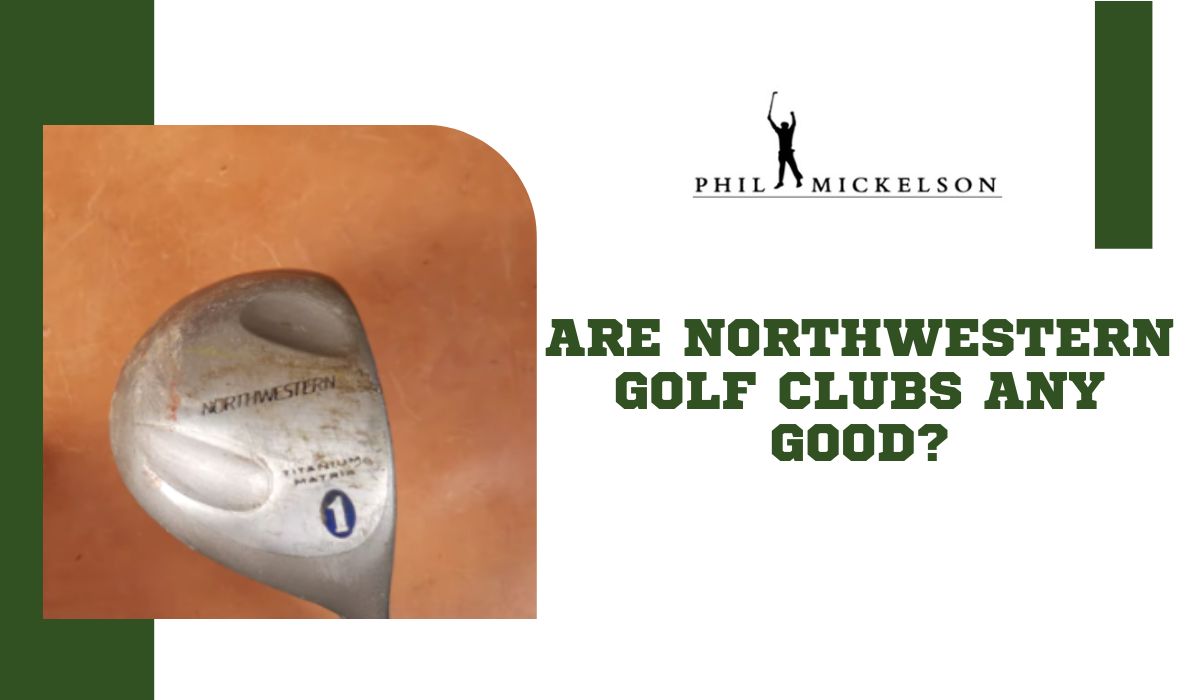
    Key Features of Northwestern Golf Clubs (Ti Matrix Driver in Review)

    The sole of the golf club reads “Northwestern Titanium Matrix,” which is, by the way, an excellent way of saying aluminum, along with the wood number.

    The club head

    • It has two diagonal little flutes on the sole.
    • It features a Callaway knockoff gery painted all the way around the club face.
    • The face is designed with tons of grooves, which the manufacturers expect players to hit out of the rough.
    • Aluminum oxidation layer on the club face
    • A triangle icon on the top line

    The Shaft

    • A little plastic feral at the edge of the club head connects the shaft.
    • Northwestern Golf Club uses a graphite shaft (x101), which I don’t see as really spectacular.

    The Grip

    Images credit: The Vintage Golfer

    First impression

    I’ve had the opportunity to use the northwestern irons since I first started, which today can be purchased for around a dollar each.

    These decades-long clubs worked fine, but the only bad thing about them, based on personal observation, was the grips, which I believe will easily be a struggle for beginners.

    In terms of ball movement, especially compared with the set of tailor-made drivers, I did notice the same big, sweeping slice off into nowhere.

    That shows it’s often more about the player than the club.

    So, if you’re considering Northwestern golf clubs, it would help if you prepared to invest in some name-brand clubs after getting good at hitting those old Northwesterns.

    Meanwhile, the “ping” sound that comes as feedback upon impact with the Northwestern golf clubs is lovable.

    Pros and Cons of Using Northwestern Golf Clubs

    Using 30-year