Blog

  • Tee Time Bliss: North Dakota’s Finest Golf Course Experiences

    Tee Time Bliss: North Dakota’s Finest Golf Course Experiences

    Welcome to an exciting journey through North Dakota’s hidden gem golf courses, where tranquility and breathtaking beauty meet the love for the game. In this article, we invite you to discover lesser-known but remarkable golfing destinations in the state, offering a unique golfing experience amidst serene landscapes. Join us as we explore the hidden treasures of North Dakota’s golf courses.

    The Appeal of North Dakota’s Golf Courses

    North Dakota’s golf courses hold a special allure for golf enthusiasts seeking a different kind of experience. These courses offer more than just a game; they showcase the state’s natural beauty, including picturesque prairies, rolling hills, and stunning vistas. Golfers are treated to a sense of tranquility, far from the hustle and bustle of urban environments.

    Hidden Gems

    Hawktree Golf Club

    Hawktree Golf Club is a hidden gem boasting an impressive course layout, with 18 meticulously designed holes that challenge golfers of all skill levels. Immerse yourself in the stunning views as you navigate through the undulating fairways and meticulously maintained greens. Hawktree Golf Club has garnered accolades for its exceptional design and is known for its challenging holes, including the signature par-5 14th hole that requires strategic shot placement.

    Bully Pulpit Golf Course

    Prepare to be captivated by the beauty and uniqueness of Bully Pulpit Golf Course. Nestled in the heart of the Badlands, this hidden gem offers a golfing experience like no other. The course’s design seamlessly integrates with the natural landscape, creating a harmonious blend of breathtaking views and challenging holes. Standout features include the awe-inspiring views of the Badlands formations and the famous par-3 14th hole, aptly named “The Badlands.”

    Rose Creek Golf Course

    One of North Dakota’s best-kept secrets is Rose Creek Golf Course, which showcases the state’s rich golfing heritage. Located in Fargo, this course offers a picturesque setting with a touch of history. Immerse yourself in the rolling fairways, framed by mature trees and natural water features. The course’s well-manicured greens and strategic bunkers provide a test for golfers of all skill levels. As you play, you’ll appreciate the serenity and charm that Rose Creek Golf Course exudes.

    Exploring North Dakota’s Golfing Scene

    North Dakota’s golfing scene extends beyond these hidden gems. While Hawktree Golf Club, Bully Pulpit Golf Course, and Rose Creek Golf Course steal the spotlight, numerous other notable courses await your exploration. Consider visiting courses such as Prairie West Golf Course, Fargo Country Club, or Minot Country Club to experience the diversity of golfing options in the state.

    Planning Your Golfing Trip

    If you’re considering a golfing trip to North Dakota, it’s essential to plan accordingly. The best time to visit is during the warm summer months when the courses are in prime condition. Be sure to check the local weather conditions and pack appropriate attire. When it comes to accommodations, North Dakota offers a range of options, from cozy hotels to charming bed and breakfasts, ensuring a comfortable stay during your golfing adventure. Don’t forget to explore nearby attractions, such as Theodore Roosevelt National Park or the International Peace Garden, to enrich your overall experience.

    Conclusion

    North Dakota’s hidden gem golf courses offer a delightful escape into the serenity of nature while indulging in your passion for golf. From Hawktree Golf Club’s challenging layout to Bully Pulpit Golf Course’s awe-inspiring vistas and Rose Creek Golf Course’s picturesque charm, these courses showcase the state’s golfing treasures. Step off the beaten path and discover the hidden gems that North Dakota has to offer. Plan your golfing getaway today, immerse yourself in the tranquility, and create memories that will last a lifetime.

    FAQs

    Q : Are these hidden gem golf courses suitable for golfers of all skill levels?

    A : Absolutely! While these hidden gem courses offer unique challenges, they cater to golfers of various skill levels. Each course provides different tee options to accommodate players with different abilities.

    Q : How can I book tee times at these hidden gem golf courses?

    A : To book tee times, we recommend visiting the official websites of the respective golf courses. Online booking systems are often available, allowing you to secure your preferred tee times in advance.

    Q : Are golf club rentals available at these hidden gem golf courses?

    A : Yes, all the mentioned golf courses offer club rental services. You can rent high-quality clubs on-site, ensuring you have the necessary equipment for a memorable round of golf.

    Q : Can I organize golf tournaments or events at these hidden gem golf courses?

    A : Absolutely! Many of these hidden gem courses have event spaces and can accommodate tournaments or private events. Contact the respective courses for more information and assistance in planning your golfing event.

    Q : Are golf lessons and instruction available at these hidden gem golf courses?

    A : Yes, all the featured golf courses provide instruction and lessons. Whether you’re a beginner looking to learn the basics or a seasoned golfer seeking to refine your skills, professional instructors are available to assist you on your golfing journey. Contact the courses for more information about their instructional programs.

  • Tee Off in Tropical Paradise: Exploring Kaanapali Golf Course

    Tee Off in Tropical Paradise: Exploring Kaanapali Golf Course

    Welcome to Kaanapali Golf Course, an exquisite tropical haven nestled within the stunning Kaanapali Resort area of Maui, Hawaii. In this comprehensive guide, we invite you to embark on an unforgettable journey into the world of golf at Kaanapali Golf Course. Immerse yourself in the breathtaking beauty, exceptional course design, and warm hospitality that make this destination a golfer’s paradise.

    Overview of Kaanapali Golf Course

    Kaanapali Golf Course holds a rich history and stands as a testament to Maui’s dedication to providing world-class golfing experiences. Established in 1962, this premier course has garnered numerous accolades and awards for its exceptional design and immaculate conditions. Located in the renowned Kaanapali Resort area, this gem attracts golf enthusiasts from around the globe.

    Scenic Beauty and Course Design

    Prepare to be captivated by the awe-inspiring beauty of Kaanapali Golf Course. Set against a backdrop of lush green landscapes and framed by panoramic views of the sparkling Pacific Ocean, the course’s surroundings are nothing short of breathtaking. Each hole is meticulously crafted to present a unique challenge, featuring strategically placed bunkers, pristine fairways, and undulating greens. As you navigate the course, be prepared to encounter the vibrant tropical flora that adds to the allure of every swing.

    Unparalleled Golfing Experience at Kaanapali

    Kaanapali Golf Course is committed to providing an exceptional golfing experience to players of all skill levels. From well-equipped pro shops offering top-of-the-line gear to comprehensive practice facilities where you can hone your skills, every aspect of your golfing journey is catered to with meticulous attention. The staff’s warm and welcoming demeanor creates an atmosphere of camaraderie, ensuring that your time on the course is as enjoyable as it is memorable.

    Membership and Green Fee Options

    Experience the ultimate in golfing privileges by becoming a member of Kaanapali Golf Course. Members enjoy exclusive benefits and access to the exceptional facilities, allowing for a truly immersive golfing experience. For non-members, a range of green fee options is available, allowing both resort guests and non-resort players to indulge in the world-class golf offered at Kaanapali. Keep an eye out for special discounts, packages, and promotions to make your golfing experience even more enticing.

    Golf Instruction and Improvement Programs

    Whether you’re a beginner looking to learn the fundamentals or an experienced golfer seeking to fine-tune your skills, Kaanapali Golf Course offers an array of golf instruction programs tailored to your specific needs. Experienced instructors, equipped with a deep passion for the game, provide personalized lessons, clinics, and improvement programs to help you unlock your full potential. Benefit from their expertise as they guide you towards mastering your swing and enhancing your overall performance on the course.

    Dining and Relaxation Options

    Indulge in culinary delights and unwind after an exhilarating round of golf at Kaanapali Golf Course. On-site restaurants like Roy’s serve delectable cuisine, crafted to satisfy your appetite. Alternatively, venture beyond the course to explore nearby dining establishments, where you can savor a diverse range of flavors. Afterward, treat yourself to moments of relaxation and rejuvenation with spa services or enjoy the comfort of inviting lounges, where you can bask in the tranquility of the surroundings.

    Nearby Attractions and Accommodations

    Beyond the greens, Maui offers a treasure trove of attractions waiting to be explored. Discover pristine beaches perfect for lounging or engaging in water activities, embark on scenic hikes with breathtaking vistas, or immerse yourself in the rich cultural heritage of the island. For a seamless experience, the Kaanapali Resort area provides a wide selection of accommodations, including hotels, resorts, and vacation rentals, ensuring a comfortable stay within close proximity to the golf course.

    Conclusion

    As we conclude our journey through Kaanapali Golf Course, we invite you to experience the epitome of tropical golfing paradise. With its stunning beauty, meticulously designed course, and commitment to providing an unforgettable experience, Kaanapali Golf Course is a destination that exceeds expectations. Whether you’re a seasoned golfer or new to the game, this captivating haven will leave you with cherished memories and a deep appreciation for the art of golf. Plan your visit today and discover the allure of Kaanapali Golf Course—where breathtaking scenery and exceptional golfing await.

    FAQs

    Q : Is Kaanapali Golf Course open to the public?

    A : Yes, Kaanapali Golf Course welcomes both resort guests and non-resort players to enjoy its facilities and play a round of golf.

    Q : Are golf lessons available for beginners?

    A : Absolutely! Kaanapali Golf Course offers comprehensive golf instruction programs for players of all skill levels, including beginners.

    Q : What are the dining options available at Kaanapali Golf Course?

    A : Kaanapali Golf Course offers on-site restaurants serving delectable cuisine, and there are also a variety of dining establishments in the nearby vicinity to explore.

    Q : Can I book accommodations near Kaanapali Golf Course?

    A : Absolutely! The Kaanapali Resort area offers a range of accommodations, including hotels, resorts, and vacation rentals, ensuring a convenient and comfortable stay.

    Q : Are there any nearby attractions to explore during my visit?

    A : Yes, Maui is known for its stunning attractions, from beautiful beaches and scenic hikes to cultural landmarks and water activities. There’s something for everyone to enjoy beyond the golf course.

  • A Guide to the Penn State Golf Course: Facilities, Rates, and More

    A Guide to the Penn State Golf Course: Facilities, Rates, and More

    Welcome to the Penn State Golf Course, where golf enthusiasts and Penn State enthusiasts come together to experience excellence on the greens. In this comprehensive guide, we will take you on a journey through the rich history, stunning course layout, top-notch facilities, attractive rates, and all the essential information you need to know about this premier golfing destination.

    Overview of the Penn State Golf Course

    Nestled in the scenic surroundings of Penn State University, the Penn State Golf Course has a storied history that dates back to its establishment in 1926. As a cherished part of the university, this exceptional golf course offers a memorable experience to players of all skill levels. Conveniently located near the campus, it provides easy access to students, faculty, staff, and the general public.

    Course Layout and Features

    Prepare to be captivated by the meticulously designed layout of the Penn State Golf Course. With its 18-hole masterpiece, every swing and putt becomes an exhilarating journey. Each hole possesses its own unique characteristics, including strategically placed bunkers, picturesque water hazards, and awe-inspiring views of the surrounding landscapes. Whether you’re a seasoned golfer seeking a challenge or a beginner looking to hone your skills, this course caters to all.

    Facilities and Amenities

    The Penn State Golf Course sets the standard for exceptional golfing facilities and amenities. Step into the clubhouse, a welcoming hub that exudes warmth and camaraderie. Inside, you’ll find a well-stocked pro shop offering the latest golf equipment, stylish apparel, and accessories to elevate your game. Convenient locker rooms provide comfort and convenience for golfers to prepare for their rounds.

    Indulge in a culinary experience at The Nineteenth Hole Cafe, where a delectable selection of dishes awaits to tantalize your taste buds. Whether it’s a quick bite before your tee time or a post-game celebration, this dining experience adds a touch of satisfaction to your golfing adventure. Additionally, the Penn State Golf Course offers practice areas with meticulously maintained putting greens and driving ranges, allowing you to refine your skills and enhance your performance.

    Rates and Membership Options

    Understanding the rates at the Penn State Golf Course is crucial for planning your golfing experience. The green fees are attractively priced, making it accessible to a wide range of individuals. Whether you’re a student, faculty member, staff member, or a visitor, there are options tailored to suit your needs.

    For avid golfers seeking even more value, becoming a member at the Penn State Golf Course unlocks a host of exclusive benefits. Enjoy discounted rates, priority tee times, and access to additional facilities. With various membership options available, you can choose the one that aligns perfectly with your golfing preferences.

    Keep an eye out for special promotions and discounts offered throughout the year. These opportunities allow you to experience the Penn State Golf Course at an even more affordable rate, making your golfing dreams within reach.

    Tee Time Reservations and Booking

    Planning your tee time at the Penn State Golf Course is seamless and convenient. Utilize the online booking system to reserve your preferred date and time effortlessly. For those who prefer a more personal touch, contacting the golf course directly ensures personalized assistance and guarantees your spot on the greens. It is recommended to book in advance, particularly during peak times, to secure your desired tee time.

    Golf Instruction and Programs

    The Penn State Golf Course is committed to helping golfers of all levels elevate their game. Expert instructors offer a range of golf instruction programs tailored to individual needs. Whether you’re a beginner aiming to learn the fundamentals or an experienced golfer seeking to refine your techniques, these programs provide invaluable guidance. Take advantage of private lessons, group clinics, or even junior golf programs to nurture the golfers of tomorrow.

    Hosting Events and Tournaments

    Make your next private event, corporate outing, or golf tournament an unforgettable success at the Penn State Golf Course. With its stunning event spaces, personalized services, and exceptional catering options, it is the perfect venue to host a memorable gathering. Whether it’s a small intimate celebration or a large-scale tournament, the dedicated event team will ensure every detail is meticulously planned and executed.

    Nearby Accommodations and Attractions

    Enhance your golfing getaway by exploring the nearby accommodations and attractions. From comfortable hotels to charming bed and breakfasts, there are various options to suit your preferences. Immerse yourself in the vibrant downtown scene, discover local landmarks, or indulge in outdoor adventures. Extend your stay and make the most of everything the area has to offer.

    Conclusion

    We hope this comprehensive guide has provided you with valuable insights into the world-class experience awaiting you at the Penn State Golf Course. From its rich history and well-designed course layout to its exceptional facilities, attractive rates, and dedication to golfing excellence, every aspect is designed to create an unforgettable golfing adventure. Plan your visit, immerse yourself in the beauty of the course, and create lasting memories at the Penn State Golf Course. We look forward to welcoming you and being a part of your golfing journey.

    FAQs

    Q : Can I play at the Penn State Golf Course if I’m not affiliated with the university?

    A : Absolutely! The Penn State Golf Course warmly welcomes both the Penn State community and the general public. Golf enthusiasts of all backgrounds can enjoy the exceptional facilities and experience the course’s beauty.

    Q : Are golf lessons available for beginners?

    A : Yes! The Penn State Golf Course offers comprehensive golf instruction programs suitable for beginners and golfers at all skill levels. Expert instructors are ready to guide you on your journey to improving your game and enjoying the sport to the fullest.

    Q : Can I host a private event or corporate outing at the Penn State Golf Course?

    A : Certainly! The Penn State Golf Course provides stunning event spaces, personalized services, and exceptional catering options for private events, corporate outings, and golf tournaments. Contact our dedicated event team to discuss your specific requirements and make your event a resounding success.

  • TruGolf Mini Review: Is It Worth The Buy?

    TruGolf Mini Review: Is It Worth The Buy?

    The TruGolf Mini storms the simulator market with a standout compact design, a realistic course experience, and an incredibly affordable price point. The portability, precise shot tracking, and immersive graphics are the highs of this product, but many golfers worry about the limited club selection and absence of actual ball striking. It’s an enjoyable indoor golf experience for passionate players but not perfect. 

    Every golfer would like a simulator in their house or office, but two things usually hold us back: first, it’s often expensive. Second, there is not enough space. The Trugolf Mini is an updated version of the Trugolf Home Swing Studio. It’s a 2-foot-long golf club (with no actual clubhead) with a sensor. It’s storming the market to counter these two issues: compatibility and affordability.

    In this article, I will review the Trugolf Mini simulator and share my experience using it. I’ll show you how it measures performance, playability, shot consistency, price and value, advantages, and hard-to-ignore pitfalls. Remember to stick to the end, as I’ll share overlooked details about this product and my honest opinion on whether or not it is worth buying. 

    TruGolf Mini Overview

    TruGolf Mini

    TruGolfMini_Review

    $259.99

    • Portability
    • Realistic Simulation
    • High-Quality Graphics
    • Variety of Golf Courses
    • Multiplayer Capabilities
    • Practice Modes and Game Options
    • Swing Analysis and Feedback
    • Compatibility and Integration

    The TruGolf Mini is a 2-foot-long golf club with a sensor that can be plugged into the grip. The club has a Bluetooth sensor that captures four crucial swing details. It calculates and measures the simulated clubhead path, face angle at impact, speed, and angle of attack. It runs on the E6 platform.

    The standout feature that separates it from other options in the market is that it doesn’t require golf balls and explores a weighted swing trainer without a club face.

    It’s designed for compactness and convenience. The club’s sleek and streamlined construction allows easy handling and control. 

    Package Unboxing

    The product comes with instruction cards, a license, and details for your E6 Essential subscription (which includes about five courses). In the box is the actual club (which looks like a medieval weapon) with a weighty grip and sleek design.

    The essential thing in the package is a rounded sensor (the brain) with an accelerometer and other high-tech components that track the club as it moves through your swing. It picks up the tempo, your swing, and the rotation.

    Performance and Playability 

    The TruGolf Mini simulator runs on the E6 platform. If you’ve been researching simulators, you’ve probably seen the E6 before because many other simulators are on this platform. 

    So with TruGolf, you’re connecting to the same software as you would with Flighscope  Mevo Plus. 

    There’s a nob installed in the club grip that powers the Bluetooth; then you get your iPad set up with the e6 downloaded, and then you can use an adapter to connect the iPad to a projector for a broader view on the wall.

    Once you turn on the knob, it pairs with your iPad, and you can navigate to TrueGolf Mini on the E6 platform. 

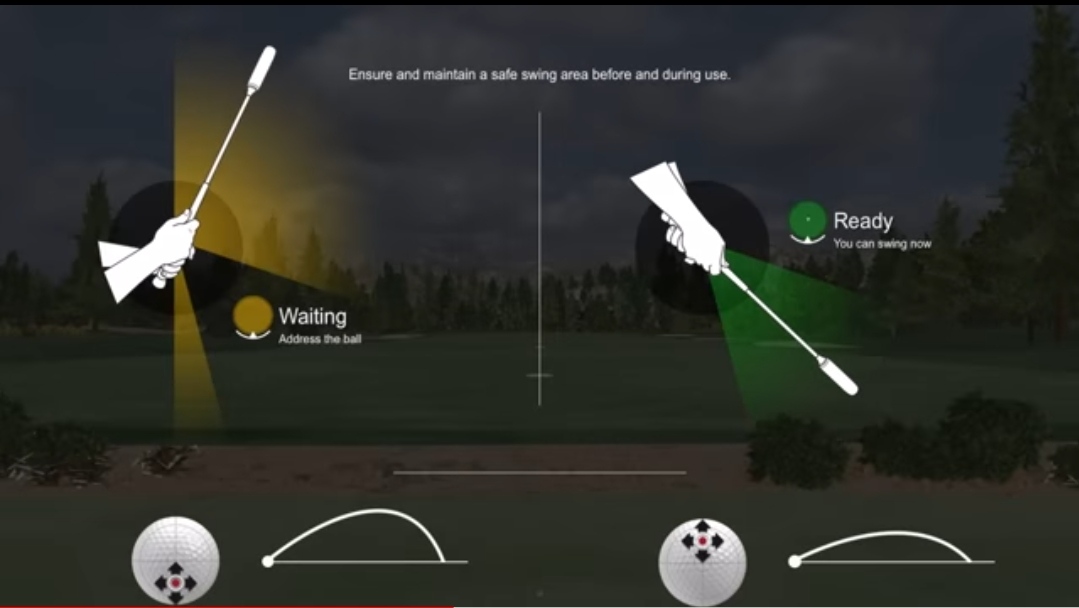
    The playability of this golf simulator is relatively straightforward. All you have to do is hold the club upright so that it senses you’re preparing to swing, then you address what would be the ball (because there’s no actual ball), and if you stay still for a second, you get a green light, as seen in the image below:

    The club is compassionate, so you don’t want to wag unnecessarily once you get to this position. 

    Another exciting thing is that the club makes an audio snap when you make a complete swing, which gives feedback, but honestly, it’s nothing close to hitting an actual ball. 

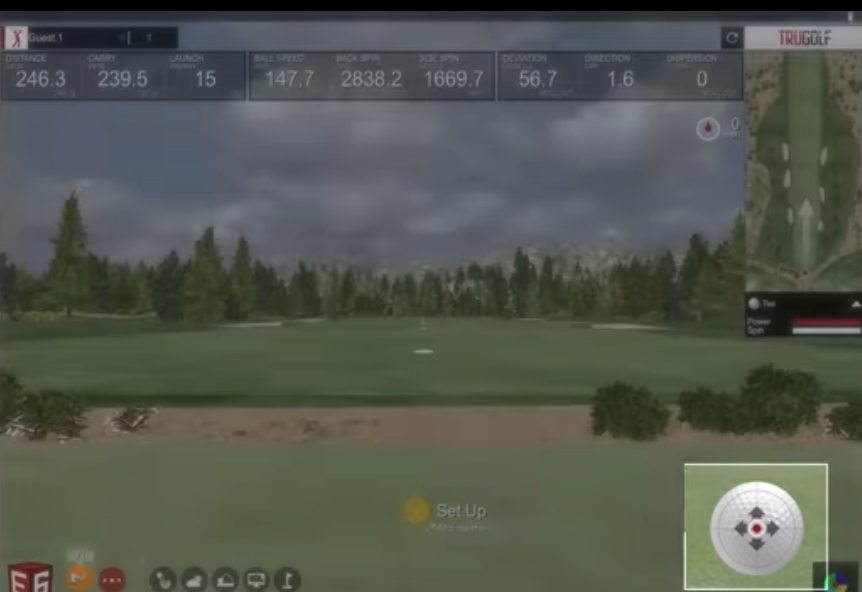
    Since there’s no ball contact, you can’t play different shots with spin and hit other parts of the ball. You’ll have to determine that on your screen using the icon as shown in the image below:

    Shot consistency

    Again, achieving and tracking shot consistency is challenging when no actual ball strikes. But I gave it a test using the seven iron, which is usually a 165 club for me. So I took a full swing with the TruGolf Mini and got a 165.1, which is pretty accurate. 

    Another impressive feature of this simulator is its swing analyzer, which allows you to look at your swing in a 360-degree 3D presentation. So this gives you an excellent visual to access your transitions, shallowing, club path, or straight path. 

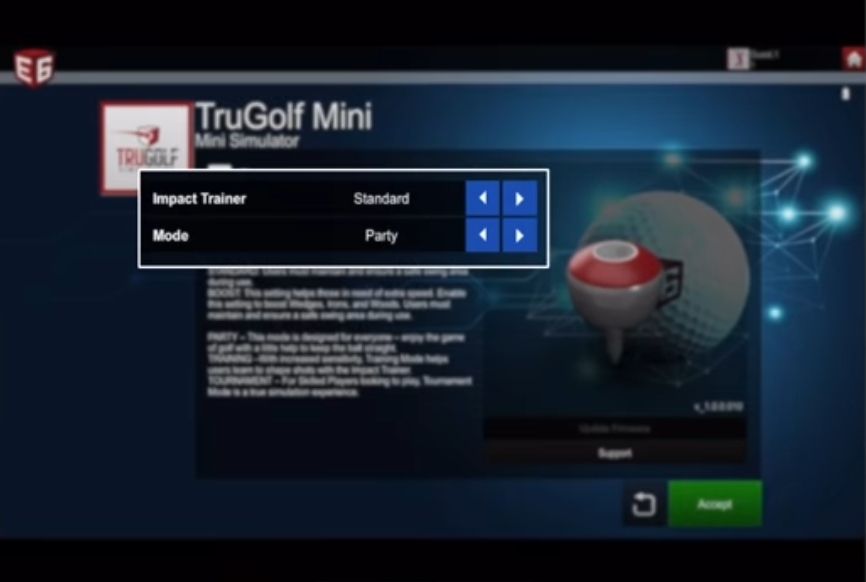
    Regarding forgiveness, three settings for this simulator determine how forgiving the club is. If you’re using the TruGolf Mini casually, you can set the configuration to its lowest mode, “Party Mode,” the most forgiving mode. This is ideal for beginner golfers.  

    As you advance, you change to Top Mode, a tournament that unlocks the club’s sensitivity. 

    But again, if you’re struggling with your ball striking—either thinning or fatting it—this golf simulator might give you inaccurate feedback because there’s no actual ball hitting.  It may look like you flushed it on the screen, but in real life, you didn’t. So that’s an important limitation on shot consistency. 

    Pros and Cons of the TruGolf Mini Simulator

    What I LikeWhat I Don’t Like
    Fast and easy setupNo simulated face to be sure if the club is facing the square before making a swing
    AffordableNo actual ball striking for spin accessibility
    CompactE6 subscription is essential (5 golf courses) and cannot unlock much more.
    Very mobileClub is shorter
    Scalability (You can have the display on your iPad or phone or presented on a large screen by connecting to a projector.)
     
    The club has the feel of the grip and is weighted like an actual golf club which offers similar swing speed.
     
    Audible simulated impact sound
     
    High-quality E6 graphics
     

    Customer Feedback and Reviews

    The reviews this product is getting from popular retail platforms are mixed. About 49 percent of users of the TruGolf on Amazon are delighted with the accuracy and value of this golf simulator 

    But one of the consistent complaints I observed from most reviews is that sometimes when you swing the club, the sensor doesn’t pick up the swing. I had this experience, too, so it sure takes a while to get used to it.

    But even the most critical reviews about this product still give it a thumbs up. The TruGolf Mini may not be the perfect affordable golf sim, but it’s fun and keeps those muscles remembering what a golf swing feels like during the off-season.

    Price and Value

    TruGolf, with this Mini simulator, presents an option to enjoy a golf experience even when you don’t have high ceilings, ample space, or fat purses. The TruGolf Mini sells for $250 on the official TruGolf website. But is this something you’d drop close to three hundred bucks for?

    Now, they do make a lofty claim. On the box, the manufacturer says, “The TruGolf Mini Sim is a professional grade golf tool that includes many of the features of simulators costing $50,000 or more.”

    But does it compete with $50,000 budget sims, or is that an exaggeration? From my experience with this product, I’d say it’s somewhere in between. 

    My concern is that even though the price meets the value and it can be fun to use (swing analyzer and all), there’s going to come to a point where it’s limiting, and you’ll want more. 

    But if you’re super confined on space and budget, this is relatively inexpensive, and you can pick up a cheap projector and achieve a detailed view of the Sim golf course

    Also, you’re not hitting an actual golf ball, so you won’t have to worry about the expense of a net, mat, or projection screen. 

    Comparing TruGolf Mini With Alternatives

    FeatureTruGolf Mini SimulatorTitle XPhigolf
    PortabilityPortable and compactPortable and lightweightPortable and lightweight
    TechnologyUses a projector and computer with simulation softwareUses sensor-equipped golf ball and mobile appUses sensors in golf clubs and mobile app
    Simulation realismOffers realistic graphics and physicsOffers basic graphics and physicsOffers realistic graphics and physics
    Game modesMultiple game modes, including driving range, closest to the pin, and complete rounds of golfLimited game modesLimited game modes
    Data analysisTracks and analyzes shot data, including ball speed, launch angle, and spin rateTracks and analyzes swing and shot dataTracks and analyzes swing data
    CustomizationCustomizable simulation settings, including course conditions and weatherLimited customization optionsLimited customization options
    Required equipmentHitting mat, projector, and computerTitle X sensor-equipped golf ball and mobile appPhigolf golf club with sensors and mobile app
    Price$250$150$220

    But what truly makes The TruGolf Mini Iron stand out is that it is highly portable, making it easy to carry and set up anywhere.

    The Mini Iron offers high-quality graphics, enhancing the immersive experience during gameplay. It also provides real-time swing analysis, allowing players to assess and improve their technique.

    My Final Remarks

    TruGolf Mini presents itself as an inexpensive golf simulator. It meets expectations if you want to understand your swing and improve your game, thanks to the swing analysis capabilities, but you have to be willing to put up with a bit of frustration at your first registration. 

    I’d call this mini simulator the perfect system when I’m stuck in a studio apartment and budget is a concern. In such a case, I can overlook the marginal guesswork that this product does since I want to get some swings in the winter. The requirements to use this device are minimal: an iPad (or phone), an internet connection, and perhaps a projector. 

    You’ll love it, especially if you’re a player working on tempo or swing path because those factors genuinely feel accurate. But if you’re particular about your ball striking improvement, this is not a guaranteed simulator because it may not give you the information you want for each shot you take. 

    The TruGolf Mini is not an all-around golf simulator solution. Still, it indicates that as technology evolves, golf at home will be more accessible (and affordable).

  • TN 87 Mizuno Review 2023: The ‘Holy Grail’ Golf Iron

    TN 87 Mizuno Review 2023: The ‘Holy Grail’ Golf Iron

    The Mizuno TN 87 Iron today is a golf enthusiast’s dream come true. It is classy, sleek, has an aerodynamic design, and combines powerful distance with pinpoint accuracy. The TN87 Iron features an optimized weight distribution for improved control. While it’s now rare and quite pricey, there’s more to this club that you’d want to know. 

    The Mizuno TN 87 was highly demanded in the late 80s, and they resurfaced in 2014 as a desired club with an eye-catching price tag of $4,000 but are about 80% less now. I have met a few golfers who speak of the thin copper layer under the chrome and swear it gives them a certain feel. I was lucky to purchase a set of Mizuno TN 87 irons off eBay (three for the pitching wedge), which are stunning in looks and price.

    This post will dive deep into the key features, design, performance, playability, feel and feedback, technology, pros, and downsides of the Mizuno TN 87. 

    The Mizuno TN 87 Specifications

    NoLoftLieLength (inchesSwing weight
    321.057.038.5D2
    424.058.038.0
    527.059.037.5
    631.060.037.0
    735.060.536.5
    839.061.036.0
    943.061.535.5
    PW48.062.035.0D3
    AW52.062.035.0
    SW56.062.035.0D4

    TN 87 Mizuno Review

    TN 87 Mizuno Review

    • Precision Forged Construction
    • Muscle Back Design
    • Grain Flow Forged HD technology
    • Premium Materials
    • Thin Top Line
    • Versatile Sole Design
    • Customization Options
    • Tour-Proven Performance

    Key Features and Design

    The TN87 Muzino Club features a sleek and innovative design that caters to golfers seeking enhanced performance. The club head of the TN87 Muzino iron is crafted with precision, showcasing a compact shape that combines the benefits of forgiveness and workability. The clubhead size is standardized, with a width of approximately 80mm (3.15 inches) and a length of around 95mm (3.74 inches).

    The construction of the TN87 Muzino iron incorporates advanced materials to optimize performance. 

    The Looks

    • Copper underlay 
    • Muscleback blade style
    • Clean lines and sleek appearance
    • Chrome plating on top of the classic design
    • 6.5 shafts (about half inches shorter than the modern MP 20 Mizuno iron)
    • Come through with precision which was made by Brunswick Golf back then.
    • Forged construction
    • Cavity back design

    This material choice allows you to achieve enhanced feedback and control, resulting in a more consistent ball flight and increased shot-making capabilities.

    The TN87 Muzino iron implements a progressive weighting system. The long irons have a lower center of gravity (CG) and more weight towards the sole, promoting higher launch and forgiveness. The CG gradually rises as you progress to the shorter irons, facilitating better control and shot shaping.

    Feel and Feedback

    To assess the feedback provided by this iron, I tested the 7-iron with a 35-degree loft, which is 8 degrees weaker than one of the super-cranked irons of modern-day models. 

    One thing an iron like this will tell you immediately after you hit the ball in the face is the sensational feedback. But it resurfaces the argument of whether blades make one a better ball striker. 

    From the feel of the impacts of iron like this, it tells us that you only enjoy the TN 87 when you are a reasonably good ball striker. Otherwise, it’s going to beat you up a little bit. 

    Anyway, with the TN 87, the ball seems to have melted off the club face, giving me the butter-soft feeling and feedback.

    Performance and Playability

    My shot swung at 86 miles an hour, and with the TN 87 Mizuno, I achieved a ball speed of 111 with a carry distance of 155. 

    I expected more backspin than the 5000 spins launching at 21 degrees, but the strike location was precise. 

    What I deduced from multiple shots and the data brings me back to the popular idea of why many pro golfers like to use the bladed iron: the consistency derived from yardages. 

    Technology and Innovation

    In 2014, the manufacturers decided to re-release the  Mizuno TN87 iron again, but in minimal amounts. So people had to buy them for three gats and sand wedges. They were not open to custom fitting and came with 2000 dynamic gold shafts. 

    Before then, the TN87 was innovated in the U.S. into what we now have as the MP-29, and then in Europe; the TN87 became the TP-20000s

    Pros and Cons

    Pros 

    • Feel and feedback is second to none: It has the reputation of providing excellent feel and feedback, and I’m happy I got to experience this for real. It offers a “buttery” sensation on every shot. 
    • Quality materials: The construction materials stood the test of time and are still a contender to many modern clubs. 

    Cons

    • Outdated club technology: Compared to its modern variations and other modern golf clubs, the TN 87 would be considered technologically obsolete because it doesn’t have contemporary performance-enhancing features as stylish clubs, such as forgiveness, shaft, launch, and distance improvement. 
    • The grip can be better: Many people fortunate to still have this historic iron often consider refurbishing it to improve the grip.
    • Little forgiveness: it has less forgiveness for missed hits. Off-center strikes might result in less distance and accuracy than more forgiving modern clubs like the Callaway Paradym X Iron.
    • Small sweet spot: The TN 87 has a smaller sweet spot, requiring high precision to achieve optimal results. This could make it less forgiving if you have inconsistent ball striking.
    • Rare: Given its age, finding Mizuno TN 87 in good condition is often challenging. 
    • Expensive: When it was re-launched in 2014, the Mizuno TN87, people had to pay about $4000 to get these clubs. But you can be lucky to get a better deal on retail platforms like eBay.

    Comparison to Other Irons

    The Mizuno TN-87 irons are seen as one of the best iron sets that Mizuno has ever produced, but newer versions have been introduced to the market and are heavy on more unique features. 

    For example, the Mizuno MP-20, nicknamed the ultimate Mizuno muscle-back, is known for its improved feel and feedback, even compared to what we get from the TN 87 because the MP-20 is layered with soft copper plating beneath a protective nickel chrome.

    Models like Mizuno’s JPX921 irons are specifically better than the above regarding explosive ball speeds and precision. Still, if you prefer to play with bladed clubs as a low handicap golfer with love for the bladed design, then the MP-32s released in 2004 are a better call than the TN 87.

    The MP-32s have a smooth feel and give great feedback on off-center hits.

    Customer Feedback and Ratings 

    A lot of golfers who express an interest in acquiring the Mizuno TN87 golf club are more particular about two aspects of this holy grail:

    • The buttery feel and feedback on the impact
    • The incredibly outrageous price for the special reissue in 2014.

    Credit: Hackers Paradise

    Credit: Hackers Paradise

    My Honest Verdict On Mizuno TN 87

    I played 9 holes with the Mizuno TN87 Iron, and it is a golf enthusiast’s dream come true. 

    I held the Mizuno TN 87 in my hands when I felt the quality craftsmanship and attention to detail that Mizuno is renowned for. The club head was expertly crafted using Mizuno’s Grain Flow Forging process, resulting in a soft and responsive feel at impact. This forging technique enhanced the club’s ability to deliver consistent distance and control, allowing me to attack any shot confidently.

    The TN 87’s design incorporated a traditional muscle back blade style, which appealed to me because I value workability and shot-shaping control. It provided a compact profile allowing precise shot-making, making it an ideal choice for skilled players who prefer a classic look and feel.

    When it came to performance, the TN 87 truly shined. The club offered a remarkable combination of forgiveness and playability, providing me with the best of both worlds. The thin topline and minimal offset inspired confidence at the address, while the club’s compact shape allowed for excellent turf interaction and versatility in various lies.

    Regarding ball flight, the Mizuno TN 87 delivered a penetrating trajectory with controlled spin. This helped me achieve optimal distance while maintaining accuracy, especially on approach shots and when shaping shots around the course. The club’s ability to work the ball both ways was another versatility that I could use.

    The Mizuno TN 87 is a fantastic golf club that caters to my needs as a skilled player who values precision and workability. Its forged construction, classic design, and exceptional performance made it a standout choice. The TN 87 would elevate my game.

    Wrapping Up

    If you want this historic iron, you should focus on two things.

    First, your wallet. Then secondly, the TN 87 has a smaller sweet spot, so it requires high precision to achieve optimal results. So you won’t get the most out of this classic club if you don’t have consistent ball-striking. In other words, they better suit Low-Handicappers.

    What do you think? Let me know in the comments.

  • 3-wood vs. 3-hybrid golf club: The Ultimate Comparison

    3-wood vs. 3-hybrid golf club: The Ultimate Comparison

    The main difference between a 3-wood and a 3 hybrid is their design and functionality. A 3-wood offers greater distance and trajectory, making it suitable for long shots from the fairway or tee. On the other hand, a 3-hybrid provides versatility, easier control, and better performance from various angles. The ultimate decision rests on the balance of your playing style.

     A 3 hybrid combines the characteristics of an iron and a wood, offering the versatility of an iron with the forgiveness and ease of hitting of a wood. At the same time, a 3-wood is designed for maximum distance, thanks to its oversized clubhead and lower loft. But it takes more than knowing these differences to determine the best option. Many golfers find it hard to make a sound choice today, so you’re not alone.

    I’ve owned the PXG Proto 3-wood (0341X Fairway) and hybrid (0317 X) for a while, but I usually only carry one of them for each play: if conditions are wet and the course is tight or rough-infested, I go with the hybrid; if they are dry and very windy, I take the 3-wood. I’ve been able to compare and contrast the nuances of these clubs and have done additional research on mastering their respective techniques

    I’ll explain my findings in this article, hoping you make an informed decision and elevate your game to new heights. 

    What Is The Difference Between a 3 Hybrid and a 3-Wood?

    3-wood-vs 3 hybrid

    A 3-wood hybrid and a 3-wood golf club serve different purposes in a golfer’s bag. 

    A 3-iron hybrid, also known as a rescue club, is designed to replace long irons and provide more forgiveness and ease of use. 

    It typically has a smaller clubhead size than a 3-wood, a rounded shape, and a deeper face. 

    The loft of a 3-hybrid is usually between 18 and 21 degrees, making it ideal for shots from the fairway or rough. 

    A hybrid’s shorter shaft and higher loft allow for better control and accuracy, especially in challenging situations.

    On the other hand, a 3-wood is a fairway wood primarily used for long shots from the fairway. It has a larger clubhead size and a shallower face than a 3-hybrid. 

    The loft of a 3-wood is typically between 15 and 18 degrees, which enables it to produce more distance off the tee or fairway. The longer shaft of a 3-wood generates incredible clubhead speed, resulting in higher ball speed and longer shots.

    Also Read: 3 Wood vs. 5 Wood

    Ease of Hitting: Wood vs. Hybrid: Is It Easier To Hit A Wood Or Hybrid?

    Many beginning golfers don’t realize early enough that the ease of hitting a golf club, whether a wood or a hybrid, depends on your skill level and swing mechanics.

    But, accurately, some general characteristics of woods and hybrids can be compared to understand their differences in ease of hitting.

    • Clubhead Size and Shape: Woods typically have larger clubheads compared to hybrids. The more oversized clubhead provides a more prominent sweet spot, making it slightly easier to make solid contact with the ball.
    • Loft and Launch: The Proto 3-wood has a more oversized clubhead, providing a more prominent sweet spot but less forgiveness on mishits. It has a lower loft, offering a lower ball flight and more significant distance potential. I found this a benefit because I only wanted distance and control off the tee or from the fairway. But if you have slower swing speeds or struggle with getting the ball airborne, the higher lofts of hybrids will benefit you more. 
    • Forgiveness and Playability: Hybrids are generally designed to be more forgiving. Combining a more prominent sweet spot and a lower center of gravity can help mitigate the adverse effects of off-center hits and provide more consistent results. A mishit with wood, especially with a smaller sweet spot, can result in more significant distance loss and a less desirable ball flight.

    Pros and Cons Of 3 wood or 3 Hybrid

    3-wood
    AdvantagesDisadvantages
    Potential for greater distance, especially off the tee. The preferred choice for experienced golfers with higher swing speeds. It can provide lower ball flight for better control in certain situations.The smaller sweet spot, less forgiving on mishits. Challenging to hit difficult lies. Requires a more consistent and precise swing to achieve optimal results.
    3 Hybrids
    AdvantagesDisadvantages
    They increased forgiveness and playability. More accessible to hit from various lies, including rough and tight fairway lies. It can help golfers get the ball airborne more easily, particularly with slower swing speeds.Generally shorter distances than woods—limited versatility for specific situations, such as hitting from the tee on longer par 4s or 5s.

    With all these in mind, I recommend that you attempt both types of clubs and consider factors such as distance requirements, swing characteristics, and playing conditions to determine which club is more accessible and more suitable for your game. But when you try to do that, you may realize that one is harder to hit than the other.

    Why Is A 3-wood So Hard To Hit?

    Hitting a 3-wood can be challenging due to its longer club length than an iron. It requires a different swing and timing, making it harder to control. The larger clubhead size also increases the margin for error, making it more challenging to make consistent contact with the ball. 

    Also, the lower loft of a 3-wood requires a more sweeping and shallow angle of attack. I still sometimes find this tricky to execute, so I imagine any player (beginner or intermediate) faces such a challenge. 

    So you’ll have to focus on a smooth and controlled swing tempo to maintain balance and timing. But to improve 3-wood shots, you have to practice sweeping the ball off the turf rather than trying to hit down on it like an iron. 

    “Most players have hit many more drivers in their practice sessions than 3-woods off the tee,” says Golf Top 100 coach Joe Plecker, “so making a tentative swing with a rarely used club is a recipe for disaster.”

    Teeing the ball up slightly higher can also help achieve better contact. Adjust your setup by positioning the ball slightly forward and widening your stance for stability. 

    Similarities and Differences in Hitting a 3-wood and a 3 Hybrid: Do you hit a 3-wood the same as a hybrid?

    There’s a widespread misconception that hitting a 3-wood and a hybrid are the same. If you have this idea, it’s forgivable because many golfers unconsciously believe it.  While both clubs are designed for longer shots, they have distinct characteristics that affect their usage and swing mechanics.

    The similarity between the 3-wood and the hybrid is that they are made for long shots, typically off the fairway or rough, to cover a considerable distance.

     Also, both clubs have relatively low lofts compared to irons, allowing for increased distance. 

    But when it comes to hitting them, there’s a vast difference in approach. 

    Aspect3-wood3 Hybrid
    Clubhead DesignMore oversized club head with a shallow face and a low center of gravitySmaller clubhead with a deeper face and a low center of gravity
    Ball Position Generally positioned slightly forward in the stance Positioned slightly back in the stance 
    Swing MechanicsA sweeping motion, similar to hitting a long iron               A more descending motion, similar to hitting a mid-iron 
    Shot Trajectory Typically produces a lower, penetrating ball flight Generally offers a higher, more forgiving ball flight
    Forgiveness Offers less forgiveness on mishitsProvides more forgiveness on mishits
    Distance ControlRequires consistent swing tempo and precise contact It offers better distance control due to the shorter shaft length
    Shot Shape Control Allows for shaping shots with proper technique and skillGenerally easier to shape shots due to a more forgiving design

    Why Is A Hybrid So Hard To Hit?

    Hybrid golf clubs’ design combines features of both irons and woods, which can take some adjustment in terms of swing mechanics. So this can pose a hitting challenge.

    But the most significant factor has to be their larger clubhead size and higher loft, which can affect how the ball interacts with the clubface, making it more challenging to achieve consistent contact. 

    Also, you could struggle with the club’s versatility and finding the proper distance and trajectory for each shot.

    Whatever the actual issue is, start by practicing proper swing mechanics with hybrids, focusing on a smooth and shallow approach. 

    Players who have gotten better at hitting hybrids have also experimented with different ball positions and stances to find the optimal contact point. 

    “Your hybrid club should be located in about the same place that you’d normally hit your iron from,” says Golf Expert Adam Ditcher. “So, for example, a 3-hybrid would be played closer to the front foot than a 5-hybrid just because of the loft of the club and the distance the club is meant to travel.”

    What Is The Correct Way To Hit A 3-Wood and 3-Hybrid?

    While the positioning of the 3-wood and hybrid is different for the perfect hit, there’s a generally correct way to handle this kind of club. You have to focus on your grip, stance, and setup.

    Grip

    • Grip the club with a relaxed but firm hold, allowing for control and flexibility.
    • Position your hands slightly lower on the grip for increased loft and launch.

    Stance and Setup

    • Position the ball slightly forward in your stance, closer to your front foot.
    • Adopt a slightly wider stance for stability and balance.
    • Align your body parallel to the target line.

    Avoid gripping too tightly, which can restrict clubhead speed and control. Also, if you place the ball too far back in your stance, you may have low and inconsistent shots.

    But at the same time, don’t take a narrow stance that will lead to losing balance and stability.

    Also, when handling 3-woods, over-swinging or trying to hit the ball too hard is always a precursor to loss of control.

    Distance Comparison: 3-wood vs. 3-hybrid

    Generally, a 3-wood is designed for longer shots off the tee or fairway and features a more oversized clubhead and longer shaft. For example, the TaylorMade SIM2 Max Fairway Wood provides an impressive distance, averaging around 240–260 yards for many golfers, compared to Callaway Apex 21 3 hybrids, with an average length ranging between 210–230 yards.

    Remember that a 3-hybrid has a smaller clubhead and a shorter shaft. So it’s more particular about offering better control and versatility, so much so that it sacrifices some distance compared to a 3-wood.

    Final thoughts

    The comparison between a 3-wood and a 3-hybrid is essential for golfers seeking the optimal club for their game. 

    A 3-iron hybrid combines iron and wood characteristics, offering versatility and easier ball control. 

    However, a 3-wood provides more distance due to its oversized clubhead and lower loft. 

    Knowing the correct technique for each club and its strengths and weaknesses will help you make an informed decision to enhance your performance on the course.

    If I had to pick a side, I would lean toward the 3-hybrids. The 3-hybrid offers me more versatility and forgiveness compared to the 3-wood. 

    It is also easier to control the 3-hybrids and performs well from different lies, making it a reliable choice for various situations on the golf course.

    Even professional golfer Padraig Harrington favors the hybrids, as he says they give him “extra height and so can stop it on the green as opposed to a three iron.

    Usually, the best way to know which of the two options is best for you is to test both options with multiple shots. But now that you’ve seen this guide, I hope you have enough heads up.

    I’ll be in the comment section. Let me know what you think about these two options.

  • 3 Wood vs. 5 Wood: Which Is Better?

    3 Wood vs. 5 Wood: Which Is Better?

    The 3-wood and 5-wood have advantages depending on your preference and skill level. However, the 3-wood offers more distance and a lower trajectory, making it ideal for long fairway shots and off the tee. On the other hand, the 5 wood provides slightly more loft and an easier launch, making it better for approach shots and shots from the rough.

    The 3-wood and 5-wood belong to the same family of large, long-shaft golf clubs designed for generating distance early on in the hole. The debate on which options to go for between these two is never-ending. I made a new friend on the golf course recently who has been working on correcting swing faults this year. He struggled to hit his 3-wood consistently off the deck and wondered if a 5-wood would be easier to hit and get a similar distance or if he would still have the same issues.

    I offered my advice to him, but I went on to do more research and found out many golfers (beginners and intermediates alike) are in a similar situation: they carry a three wood but never really get on with it. Should they be changing it for a 5-wood? 

    I conducted an extensive comparison test using the Talylormade Sim2 Max 3 wood and Callaway Mavrik 5 wood Test. I will show you my findings in this article, with the conclusion to help you decide on which is best for you. 

    3 Wood Vs. 5 Wood: The Comparison At A Glance

    3-wood-vs-5-wood-1
    Factors3-Wood5-Wood
    Loft Lower loft (around 15-18 degrees)Slightly higher loft (around 20-22 degrees)
    DistanceTypically hits the ball farther      Slightly shorter distance
    ControlMore difficult to control   Easier to control
    Launch AngleLower launch angleSlightly higher launch angle
    Ball FlightLower ball flight   Slightly higher ball flight 
    VersatilityBetter for tee shots and longer fairway shotsEasier for fairway shots
    AccuracyRequires more precision for accuracyMore forgiving and easier to hit accurately
    Playability from RoughMore challenging from thicker roughBetter playability from rough
    Club Length Slightly longer club length (43 inches)Slightly shorter club length (41-42 inches)
    Shot Trajectory ControlAllows for better trajectory control It offers a more consistent trajectory
    Shot Shape Adjustment  Easier to shape shots with a controlLimited shot shape adjustment 

    Loft and Distance

    The 3-wood typically has a lower loft angle, usually around 15 degrees, while the 5-wood has a slightly higher loft angle, around 18 degrees. The difference in the loft can affect the trajectory and distance of your shots.

    Due to its lower loft and longer shaft length, the 3-wood would offer more distance, so it’s preferable for long fairway shots and the tee since this allows you to achieve greater distance than the 5-wood. 

    For instance, a well-struck shot with a 3-wood might cover around 230–250 yards, while a 5-wood might reach about 210–230 yards.

    If distance is a priority and you have the skill to control a lower trajectory, the 3-wood is a better option. On the other hand, if you seek more loft and an easier launch, the 5 wood can be a valuable club for approach shots and shots from the rough.

    Club Length and Shaft

    The length of the club plays a crucial role in swing mechanics. The 3-wood is typically shorter than the 5-wood. This is a sign of better control and accuracy because the shorter length of the three wood makes it easier to generate clubhead speed and achieve a more consistent swing tempo.

    But we have to shift our focus to flex and material when it comes to shaft suitability. 

    My TaylorMade SIM 3 wood with a shorter length—a Fujikura Pro 56 shaft—offered better accuracy and control. 

    But playing with the Callaway Mavrik 5 wood with a longer length and a Mitsubishi Tensei CK Blue shaft gave me more distance and stability for higher swing speeds

    So you’ll have to choose a club and shaft combination that suits your swing characteristics for optimal performance. If you have a slower swing speed, a shaft with a softer flex like the Fujikura Pro 56 or the Project X EvenFlow Blue might suit you, as it helps generate more clubhead speed. 

    On the other hand, if you have a faster swing speed, a stiffer shaft like the Mitsubishi Tensei CK Blue or the Aldila Rogue Silver may be preferable to control the ball’s flight and reduce unwanted side spin.

    Ball Flight and Trajectory

    A 3-wood has a lower loft and a longer shaft than a 5-wood, resulting in a lower ball flight and potentially more roll. 

    This is good news if you seek distance off the tee or a penetrating trajectory. On the other hand, a 5-wood typically has a higher loft, which gives us a  higher ball flight and potentially more carry, which is a green light for players looking to hit higher shots with softer landings, especially from fairway lies. 

    So if you anchor your decision based on ball flight and trajectory, the choice between two clubs depends on your preference and shot requirements.

    Versatility and Shot Shape

    The three wood can shape shots by adjusting the swing path and clubface angle. But the five wood excels when a higher trajectory is required to clear obstacles or hold greens. 

    The 5-wood is better for shaping shots with a slight draw or fade, although not as much as the 3-wood.

    Now, I’m slightly biased in favor of the 3-wood regarding versatility. The lower loft makes it incredibly suitable for hitting from various lies and challenging course conditions, such as thick rough or firm fairways. 

    In all fairness, the five wood’s higher loft can help with shots from tight lies or softer conditions, preventing the club from digging into the ground. Still, your skill level, personal preference, and specific course conditions will determine which is for the greater good. 

    Control and Accuracy

    Upon close inspection, I noticed that the 5-wood generally offers greater forgiveness due to the larger head size. This makes it more forgiving on off-center hits and helps maintain stability through impact. 

    If you’re trying to make a choice solely based on accuracy and consistency on approach shots, it depends on the specific club models. 

    Distance Gaps and Club Selection

    Distance gapping is the variance between how far you hit each club in your bag. On average, the 3-wood is designed to travel farther than the 5-wood. 

    A well-struck 3-wood can cover distances between 220 and 240 yards, while a 5-wood usually reaches 200 to 220 yards. This gap of around 20 yards guarantees yardage coverage in different situations.

    Still, the distance gaps between a 3-wood and a 5-wood typically vary depending on your swing and club specifications.

    The 3-wood and 5-wood bridge the gap between the driver and long irons or hybrids. Their loft and distance characteristics provide versatility for fairway shots, tee shots on shorter holes, and long approach shots.

    On multiple shots, I noted the high forgiveness and distance from the SIM2 Max 3 wood, while the Mavrik Max 5 wood did not give much space but was easy to use and launch.

    Player Skill Level

    It is common for beginner-level golfers to struggle with consistent driver hits, so they often get wide-shot dispersion due to imparting too much spin. Now a 3-wood is substantially smaller than a driver, ensuring increased control and much tighter hit distribution. With this in mind, a beginner golfer is better off with a 3-wood. 

    But if you’re starting with the game, I recommend you go for a 5-wood because, at this skill level, you want to get the ball airborne with substantial forward progress. 

    Trial and Personal Experience

    After testing the 3-wood and 5-wood, I analyzed the results on club speed, head speed, dynamic loft, dynamic lie, path, and attack.

    The club speed swung the firewood the fastest, which again is a bit odd, to be fair, but it was only one mile an hour. It did a bit of a drop off the five wood, and efficiency lowered as I gained more loft, which makes sense.

    I delivered a two-and-a-half-degree dynamic loft difference between the 3-wood and 5-wood, which statistically are three degrees. (Let me mention that this would even pop up massively compared to a 7-wood because a high launch will be created.

    For peak height, the 5-wood average was 130 feet in the air and a decent angle of 46 and a half.  The 3-wood was 125 feet in the air with a 45-degree descent, which was only 4 feet lower than the 5-wood and had a margin difference in the angle of descent. 

    For the angle attack, both clubs did pretty much the same. The path was all around three degrees, so there was little difference. 

    The whole point of my observation is that you shouldn’t buy a 3 or 5 because you think they’d be right for you.

    Also Read: 3 Wood vs. 3 Hybrid

    Final Verdict

    Now that we’ve looked into the comparison between the three and five woods, it becomes more realistic that your ultimate decision depends on what you want from a club. 

    A 3-wood is likely to favor you more if you’re looking for an alternative to hitting the driver off the tee. But if your needs are centered around an easy-to-launch and confidence-inspiring club for attacking long shots, the 5-wood is the right call.

    Players who are shorter hitters and struggle with long irons will be satisfied with a five-wood because it’s a fantastic alternative and easier to hit than a three-iron. 

    But above all, don’t forget to consider the distance.

    Adding five woods to my collection was a sure bet because I’m not a beginner, and I’m looking to plug the gap between the longest iron in my bag and three woods.

    I hope you found this helpful. 

    FAQs

    Does a 5-wood go as far as a 3-wood?

    No, a 5-wood typically does not go as far as a 3-wood. The lower the number, the lower the loft and longer the shaft, resulting in more significant distance potential. A 3-wood has a lower loft and a longer shaft than a 5-wood, allowing for more distance off the tee or fairway.

    Is it better to have a 3 or a 5?

    The three wood offers more distance and a lower trajectory, making it ideal for long shots from the fairway or off the tee. The five wood, however, provides more loft and control, making it suitable for approach shots or hitting from the rough. So it depends on which club suits your game, but I recommend having both.

    How much farther does a 3-wood go than a 5-wood?

    A 3-wood tends to go approximately 10–15 yards farther than a 5-wood. However, these figures can vary depending on the specific clubs and your ability to strike the ball consistently.

    Why can I hit my 5-wood but not my 3-wood?

    Hitting a 5-wood successfully but struggling with a 3-wood could be due to a few factors. The three wood has a lower loft and a longer shaft, making it more challenging to control. Also, differences in swing mechanics, confidence, and club weight can affect the consistency of your shots. 

  • Is A 12 Handicap Good?

    Is A 12 Handicap Good?

    A 12 handicap in golf is generally considered average. It indicates a golfer who consistently shoots 12 strokes above the course rating. While there may be varying opinions on what constitutes a “good” handicap, a 12 handicap reflects a solid level of skill and performance in the game. 

    The handicap index in golf gives players different skills, abilities, and experience levels on a relatively even playing field. According to stats from USGA, 98.5% of golfers in America have a handicap, and beginner golfers average start at 28 and 36 (for men and women, respectively), while the average pro golfer has a handicap. 

    You may be wondering how ‘good’ a 12 handicap level is, especially when compared with other ranking factors. In the rest of this guide, you’ll learn what the 12 handicap level says about your golf skills and tips for lowering your handicap to become a better golfer. 

    What Does A 12-Handicap In Golf Mean?

    A 12 handicap in golf indicates a player’s average score is 12 strokes above the course’s par rating. Par is the predetermined number of strokes an accomplished golfer should require to complete a hole or an entire round. 

    If you’re a 12-handicap golfer, you probably possess solid ball-striking abilities, moderate consistency, and an understanding of course management.

    On par 72 courses, a 12-handicap golfer will shoot an average score of around 84. This means they consistently make bogeys on par 4s and par 5s while occasionally making a par or birdie.

     For example, if you’re a 12 handicap, you may reach the green in regulation and two-putt for a bogey on a par four hole, whereas on a par 3, you may require three shots to get the green and two-putt for a double bogey.

    Indeed, a 12-handicap golfer may occasionally shoot below or above their average, but this level indicates a strong foundation in the game with room for improvement.

    What Is A Respectable Handicap?

    A respectable handicap in golf is generally considered to be around 18 or lower for men and 24 or lower for women. This handicap indicates a player’s skill level and is calculated based on their average scores relative to the course and slope ratings. 

    Meanwhile, lower handicaps signify better players who consistently score closer to par, while higher handicaps represent players who score above par more frequently.

    The truth is that there’s no one-size-fits-all measurement for what a “good or ‘bad’ handicap is, but I have attempted to put a hierarchy to it so throw in enough perspective:

    Handicap levelRemarkDescription
    Above 36 for men and 45 for womenBadThese players struggle to execute shots consistently and often score well above par. They may have limited experience, technical challenges, or are relatively new to the game. 
    From 19 to 36 for men and 25 to 45 for womenGoodPlayers within this range have progressed in their game, displaying improved skills and more consistent scoring. They are capable of executing decent shots but still have room for refinement. 
    Around 10 to 18 for men and 18 to 24 for womenRespectableThese players have honed their skills and can consistently score closer to par. They display solid shot-making abilities, a good understanding of course management, and a higher level of proficiency overall.
    Between 4 and 9 for men and 10 and 17 for womenVery GoodPlayers at this level exhibit high-level skills, consistently scoring near or below par. They possess refined swing mechanics and excellent course management abilities.
    From 0 to 3 for men and 0 to 9 for women.Excellent Highly skilled, with exceptional shot-making abilities, precise control over their game, and extensive knowledge of golf strategies. They consistently score under par and compete at an elite level in tournaments and championships. 

    What Is Considered A Low Handicap In Golf?

    A low handicap indicates a skilled player who consistently scores less than their peers. 

    Opinions widely vary on what a low handicap is, but a handicap of 0 to 5 is typically recognized as a low handicap. 

    You possess excellent ball-striking abilities, strategic course management, and short solid game skills if you’re within this range. 

    For instance, professional golfers like Dustin Johnson or Justin Thomas, who consistently rank among the top players in the world, maintain low handicaps. 

    Achieving a low handicap requires a combination of talent, dedication, and relentless practice to refine one’s skills and compete at a high level.

    What Would My Handicap Be If I Shoot 110?

    Handicap calculations are based on your average score relative to the difficulty of the course you play. If you shoot 110 in a round of golf, your handicap would likely be between 30 and 40 

    Generally, for players shooting in the 110 range, their handicap would typically be in the high double or even triple digits. 

    To accurately get your handicap, divide your scores by multiple course rounds. The handicap system assesses the difficulty of the study and calculates a differential for each game played. 

    This differential represents the deviation from the course’s rating and slope. By taking the average of these differentials and applying the handicap formula, your handicap index can be calculated.

    What A 12 Handicap Means In Terms Of Skill Level

    A 12-handicap golfer, in terms of skill level, means you’re an intermediate player that has already honed solid fundamentals and consistency.

    It means you can hit the ball with decent accuracy and distance but may lack consistency in certain aspects of your game. 

    For instance, you may struggle with challenging shots from uneven lies or experience occasional difficulties with your short game. 

    It is unlike scratch golfers who consistently shoot par or better, showcasing superior shot-making abilities and a well-rounded skill set.

    A 12 handicap comparison to average golfer handicaps

    According to USGA’s real-time data, the most common handicap range for male golfers is between 13.0 and 13.9 for men and 27.0 – 27.9 for women.  But there are many more details when we look through the lens of comparative analysis. 

    When placed side-by-side with the recorded average golfer handicaps, a 12 handicap is a pretty decent level in 2023. 

    Here’s the illustration from USGA:

    You can access the complete analysis HERE.

    Evaluating your improvement as a 12-handicap golfer

    First, I’d recommend you analyze your scoring trends over time to assess consistency. 

    A decrease in scores signifies improvement. Secondly, focus on your tee shots, evaluating accuracy, distance, and club selection. With TrackMan or a high-quality driver such as the TaylorMade SIM2 Max, you can see valuable data and aid improvement in these areas.

    Apart from the above, consider your iron play and green approach. It’s progress when you achieve precise yardage and execute consistent ball striking. I recommend you use forgiving irons like the Callaway Apex CF19 or undertake lessons with a certified golf instructor for better (and faster) performance.

    Short-game proficiency is another critical aspect of lowering your handicap. This includes chipping, pitching, and bunker play. In this case, wedges like the Vokey SM8 come handy. You can also attend short game clinics like the ones at the Dave Pelz Scoring Game School

    Probably the best way to improve on your golf score is to enhance your putting. I recommend looking into putting mirrors, as every putt counts just as much as a drive or fairway shot, and making more putts will help you improve your score.

    The Takeaway

    Remember that handicaps are not solely about being labeled as average or good. They represent a golfer’s progress and dedication to the game. 

    A 12 handicap reflects the effort put into honing skills and achieving consistency. Whether you aspire to reach a lower handicap or enjoy playing at your current level, your passion for the game truly matters. 

    Also, each golfer’s journey is unique. Your 12 handicap should be celebrated as a testament to your commitment and love for the sport.

    If you want to lower your handicap, you can begin by getting fitted for equipment, improving your drive and precision, analyzing your game, and pinpointing your shortcomings. 

    Playing with low handicappers will also help you achieve low handicaps and become a better player. 

  • Does a 1-degree lie angle make a difference?

    Does a 1-degree lie angle make a difference?

    Yes, a 1-degree lie angle difference in golf clubs can noticeably impact shot direction and distance by two to four yards. For example, if your golf club has a lie angle that is 1 degree too upright, the ball may tend to veer left for a right-handed player. Adjusting the lie angle can help correct this tendency.

    The lie angle is the angle between your club’s sole and the shaft when the club rests on the ground. I realized that this factor is widely overlooked, but it impacts shots, and that’s why intelligent golfers like you want to know how significant the difference of a 1-degree lie angle is.

    Two weeks ago, I had my irons set one degree upright (recommendations from demo days). I hit many shots straight left – lovely shots – but I kept missing where I aimed, which, according to Trackman, was a 2 to 3 yards soft draw from the center line. When I switched to the standard lie angle, I achieved a straight to slightly right flight.

    I extensively researched the impact of lie angle on the shot direction and distance. I realized that even a one-degree upright could affect short or long irons’ performance.

    I have prepared this article to walk you through my findings. You’ll learn the significance of the 1-degree lie angle difference, factors influencing the optimal lie angle, equipment considerations, and significant myths and misconceptions about golf club settings.

    The significance of a 1-degree lie angle difference

    A 1-degree lie angle difference may seem small, but it can significantly impact golf club performance and your game.  Lie angle adjustments are sensitive because even a slight change can affect the direction and trajectory of the ball.

    A 1-degree difference can cause the clubface to be misaligned at impact, resulting in shots veering left or right. This can lead to inconsistent ball striking and inaccurate photos. 

    Remember when professional golfer Kurt Kitayama switched drivers before earning his first PGA Tour title this March at the Arnold Palmer Invitational?

    Kitayama changed from his regular TaylorMade’s standard Stealth 2 to the Stealth 2 Plus with a slight lie angle change of 10.5 degrees of loft. 

    According to GolfWRX, the club has a Graphite Design Tour AD-IZ 7X shaft measuring 44.75 inches with a 57-degree lie angle (1-degree upright on the hosel sleeve).

    Due to this lie angle difference, Kitayama hit two tee shots out-of-bounds at Bay Hill, but he also hit 39 of 56 fairways to tie for the first time in that statistic. His significant angle changes worked for him; he’s now a PGA TOUR winner.

    But it is essential to mention that differentiating between noticeable and negligible changes in lie angle depends on your skill level and sensitivity to equipment variations.

    If you’re a highly skilled player with a consistent swing and a good feel for your clubs, you’re more likely to notice a 1-degree difference.

    On the other hand, recreational golfers or beginners may not perceive the subtle variation as significantly as their swing mechanics and consistency may be less refined.

    Effects of A 1-Degree Lie Angle Adjustment on Shot Dispersion

    Does a 1-degree lie angle make a difference?

    A lie angle too upright or flat for a golfer’s swing can lead to inconsistent ball striking and erratic shot dispersion.

    When the lie angle is too upright, the toe of the club tends to be raised at impact, causing the clubface to close, resulting in shots that veer to the left for a right-handed golfer (or to the right for a left-handed golfer).

    Conversely, if the lie angle is too flat, the club heel is raised, leading to an open clubface and shots that tend to go to the right (or left for a left-handed golfer).

    This is where fine-tuning the lie angle to suit your needs comes in (for a few good reasons)

    Firstly, it promotes better alignment of the clubface at impact, which can result in more accurate and consistent shots. It’ll improve your ability to hit shots with the desired trajectory and shape. An adequately fitted lie angle enhances confidence and overall game enjoyment.

    However, there are a few drawbacks to consider when attempting to configure lie angles against the standard degree that the club comes with.

    Making frequent lie angle adjustments will require access to a fitting club facility or a professional club fitter.

    Also, you need more careful evaluation and experimentation to determine the optimal lie angle for your particular kind of swing.

    Apart from these, your swing characteristics change over time, necessitating further adjustments, which can be daunting.

    What are the factors influencing the optimal lie angle?

    Your height, posture, swing characteristics, swing plane, attack angle, and club length are the major factors that will determine what an optimal lie angle means to you.

    For example, taller players require a flatter lie angle to accommodate their height, while a shorter player may need a more upright lie angle.
    Also, your posture during the setup and swing can affect your ideal lie angle. If you have a more upright posture, you tend to benefit from a more upright lie angle, while a player with a more bent posture is better off with a flatter lie angle from the standard degree.

    The swing plane and attack angle also play a role in determining the optimal lie angle. The swing plane refers to the path the clubhead follows during the swing, and the attack angle refers to the direction the clubhead is moving when it strikes the ball.

    Assuming a steep swing plane or a downward attack angle, an upright lie angle of the standard degree can ensure proper contact with the ball.

    Conversely, a shallower swing plane or an upward attack angle requires a flatter lie angle.

    Consider your club length and fitting before deciding on your lie angle adjustments. Many golfers with longer clubs have testified that they maintain proper contact with the ball with a slightly flatter lie angle than the standard degree.

    Above all, a custom club fitting by a professional can help determine the appropriate lie angle for your peculiar needs.

    Understanding the impact of the lie angle

    https://youtube.com/shorts/A6QJH0F6eww?feature=share

    The most obvious impact the lie angle will have on your shots is the ball’s flight and shot accuracy.

    From my experience, a club with an improper lie angle can cause the clubface to be misaligned at impact, resulting in off-center hits and errant shots.

    For instance, if the lie angle is too upright, the clubface tends to close, leading to pulls or hooks. Conversely, a lie angle that is too flat can open the clubface, causing pushes or slices.

    Secondly, the lie angle influences the shot shape. A 1-degree upright lie angle encourages a draw, while a flatter lie angle promotes a fade.

    Imagine a golfer with a driver featuring a lie angle of 58 degrees; he might experience a tendency to slice. Adjusting the lie angle to 60 degrees (flatter) could help promote a straighter shot or even a slight fade.

    Similarly, a player using an iron with a lie angle of 62 degrees may struggle with hitting hooks but adjusting the lie angle to 64 degrees (more upright) could assist in promoting a straighter or drawing shot.

    Remember, the lie angle influences how the club interacts with the ground at impact. If the lie angle is incorrect (even by a 1-degree difference), the club’s leading edge may dig into the turf or bounce off it inconsistently, affecting the quality of the strike.

    Equipment considerations

    Many manufacturers now offer adjustable hosels that allow players to modify the club’s lie angle to suit their swing.

    For example, Titleist’s TSi2 and TSi3 drivers feature a SureFit hosel that offers loft and lie adjustments.

    The lie angle interacts with other club fitting elements, such as shaft length and grip size. As I mentioned, a flatter lie angle promotes a draw, while a more upright lie angle promotes a fade.

    Technological advancements have made lie angle customization easier. If you consider Mizuno’s JPX921 Hot Metal Pro irons, you’ll notice that they incorporate the Chromoly 4140M material, allowing for a thinner face and a more flexible design. A player using this iron will find it simpler to adjust lie angles without sacrificing performance.

    Lie angle myths and misconceptions

    Lie angle myths and misconceptions often plague golfers’ understanding of equipment fitting.

    While researching the lie angle impact on golf clubs, I stumbled on a few critical myths to debunk here.

    MythFacts
    Lie angle adjustments primarily affect low-handicap playersLie angle plays a crucial role in shot direction for golfers of all skill levels.
    Extreme lie angle changes can solve all swing issuesWhile lie angle adjustments can alleviate specific problems, they are not a panacea.
    Extreme adjustments can lead to unintended consequences, such as altered turf interaction or swing compensation.

    Always remember that lie angle adjustments are not a standalone solution for other swing faults, such as swing path or face angle.

    For example, assuming you switch between an 8-iron with a loft of 37 to 39 degrees to a 9-iron with 41-43 degrees of loft,  and you keep missing where you’re aiming by 20 odd yards, it is most likely not due to your club setting.

    In such a situation, you must try different shafts because the toe bends down more with some posts than others.

    Extreme yard misses, like 20–25, are not usually due to Lie angle adjustments.

    What is the standard golf iron lie angle?

    The standard lie angle is 56 and 60 degrees for drivers and woods. However, hybrid or rescue clubs’ standard lid is between 58 and 62 degrees.

    Iron and wedges’ standard lie angles are between 61 and 64 degrees, respectively.

    Ultimately, you must consider experimentation and feedback to find the perfect lie angle for your swing style and height. It would be best if you seek professional guidance for lie angle assessment.

    Finally,

    A 1-degree change in the lie angle can cause your ball to veer left or right by 2 to 10 yards.

    That seemingly insignificant angle can throw your shots off course like a confused GPS. That’s like aiming for the fairway but ending up in a sand trap—not fun!

    So, here’s the deal: personalized club fitting is your secret weapon for nailing that perfect lie angle.

    When your lie angle is spot on, it’s a game-changer. You’ll notice improved accuracy, consistency, and distance control in your shots.

    Happy swinging!

  • Bermuda Length Shorts – The Ultimate Guide For Golfers

    Bermuda Length Shorts – The Ultimate Guide For Golfers

    Bermuda-length shorts have become stable golfing clothing due to their optimal style, comfort, and performance combination. Designed with appropriate length and materials, they offer flexibility, breathability, and moisture-wicking properties essential for a golfer’s mobility and comfort on the course. Still, they are not immune to specific golf course dress codes and restrictions if you choose to wear them.

    A short is considered Bermuda length when its hem is around 1 inch (2.5 cm) above the knee. While the hem of the typical Bermuda shorts can be cuffed or uncuffed, it’s not gender-specific, as both male and female golfers can wear semi-casual attire on the golf course.

    In the rest of this article, I’ll work you through Bermuda length short’s relationship with golf dress codes and restrictions, what makes the apparel ideal for golfing, and how to pick and style one perfectly. As a bonus, I’ll show you a few golfing accessories in my wardrobe to complement my Bermuda shorts each time I head to the golf course, which you can get too.

    Bermuda Shorts: Golfing Dress Code And Restrictions

    Bermuda Length Shorts

    Most golf courses have dress codes and restrictions, including Bermuda-length shorts as the recommended apparel for golfers.

    Meanwhile, I have met many golfers with higher handicap scores who are still unsure about the dress codes. Most complain that muscle stiffness, lack of game knowledge, and dress codes slow their learning process.

    Golfing dress codes usually include Bermuda-length shorts, depending on the golf course.

    Different golf courses and their specific dress codes

    After extensive research, I realized that a plethora of golf courses specifically spell out Bermuda length shorts as dress codes, with just a few giving exceptions for players comfortable in shorter shorts or full trousers.

    Here are a few  golf courses that specify tailored Bermuda shorts as the accepted dress code:

    1. The Greenbrier
    2. The Country Club of Florida
    3. Vista Valley Country Club
    4. York Downs
    5. The Bedens Brook
    6. Forsyth Country Club
    7. El Caballero Country Club
    8. Hammock Dunes Club
    9. Quail Ridge CC
    10. Credit Valley Golf
    11. Knollwood Country Club
    12. Scarthingwell Golf Course
    13. The Golden Bear Club
    14. Aronimink

    Remember, this is not an exhaustive list. For the golf course, you will go on their website to confirm what kind of apparel they recommend for golfers.

    Exceptions And Limitations For Bermuda Length Shorts

    Some golf clubs like Royal Melbourne and  HoursesHoe Bay have pretty strict dress codes, and they emphasize that golfers avoid wearing golf shorts that are too short. The exception goes to juniors 12 & under, who may choose otherwise to wear camping, tennis, or cutoff shorts.

    But as a rule of thumb, many golf courses won’t accept tailored shorts worn with the hem beyond 4 inches above or below the knee.

    Benefits Of Bermuda Length Shorts For Golfers

    Since the length of Bermuda shorts typically falls just above the knee, it strikes a balance between comfort and style. This length also allows you to enjoy freedom of movement while maintaining a professional appearance. But the size is not the benefit alone.

    Fit

    Bermuda shorts often come with a relaxed or regular fit. This allows unrestricted movement during swings and prevents any discomfort hindering your performance. Some Bermuda shorts, like the Lefties (which has turned out to be my favorite), incorporate stretchable materials or elastic waistbands. It gives me extra flexibility and comfort.

    Design

    Features such as deep pockets for storing golf accessories, reinforced stitching for durability, and secure closures such as buttons or zippers to keep items in place during movement all come together as a benefit for wearing Bermuda shorts on a golf course compared to other golf shorts.

    The material and technology

    You probably already know that ideal golf shorts often utilize breathable fabrics that promote airflow, keeping golfers cool and comfortable. But Bermuda shorts are made of moisture-wicking properties that quickly absorb and evaporate sweat, preventing the shorts from becoming heavy or uncomfortable. Using stretch fabrics or including panels also provides flexibility, allowing for a more excellent range of motion.

    Choosing The Right Bermuda Length Shorts

    Here, Bermuda shorts are primarily used as walking or dress shorts. But they are versatile. If you’re picking one for golfing apparel, you must consider some factors prioritizing comfort and style.

    Length

    Bermuda shorts typically hit just above the knee, balancing comfort and professional appearance.

    If you’re over 5’5”, 7” inseam Bermuda shorts will be the perfect length. If you’re less than 5’5” or you want to show a little more thigh, then 5’ shorts will be ideal.

    But ensure the length of your Bermuda shorts complies with the dress code requirements at your golf course.

    Fabric

    Look for lightweight and breathable materials, such as polyester blends or performance fabrics, that wick away moisture and allow easy movement.

    Fit

    You can never go wrong with the Bermuda short styles with stretch or elastic waistbands. Not only does it guarantee flexibility, but it also allows for a full range of motion.

    Pockets

    Golf shorts should have functional pockets to accommodate golf balls, tees, scorecards, and personal items. Most Bermuda shorts have at least two pockets, but the denim versions have three to five.  You can opt for one with cargo pockets too.

    Comfort features

    Look for moisture-wicking properties, UV protection, and ventilation to keep you cool and comfortable during your game.

    Matching shorts with golf shirts and accessories

    • Color coordination: Choose shorts in neutral or classic colors like khaki, navy, or black, as they can be easily paired with various golf shirts.
    • Patterns and prints: Consider incorporating subtle designs or images into your shorts for added visual interest. No matter the idea of the Bermuda shorts, ensure that they complement the color scheme of your golf shirt.
    • Belt and shoe coordination: Select a belt and shoes that match or complement the colors of your shorts and shirt. If you have khaki or black Bermuda shorts, complete them with brown or black leather belts and golf shoes.
    • Socks: Opt for low-cut socks like the Adidas 3 Pack Low Cut or no-show socks such as the Lululemon Power Stride Tab Socks in a color that coordinates with your shorts and shoes

    Top Brands To Shop from for Bermuda Shorts

    Brand

    Top Bermuda shorts for golf

    Unique benefit

    Price

    Nike

    Dri-FIT UV

    Men’s 9″ Golf

    • 5 Pockets (including Tee pocket)
    • 6 Color Options

    $68

    Under Armour

    Under Armour Links Club Bermuda For Women

    • Water repellent
    • Stretch and flexible


    $39

    Adidas

    Adidas “Go-To Five-Pocket 10″ Shorts”

    • 5 Pockets
    • 10″ Inseam
    • Water Repellent

    $70

    Puma

    PUMA Jackpot Men’s Golf Shorts 2.0

    • 6 Colors
    • UV Resistance
    • 10″ Inseam

    $65

    Bonus: How I accessorize with my Bermuda Short For A Complete Golfing Look

    First, I currently use the Lesmart Mens Summer Bermuda Golf Shorts, and I pair them with a PGA TOUR Airflux mesh visor with UV protection to shield myself from the sun and match the logo to my overall outfit.

    I recommend investing in sunglasses with polarized lenses to reduce glare and protect your eyes during sunny rounds.

    But for gloves, I wear the Titleist Players Flex gloves. I love it above all other options because it does an excellent job of improving my grip on the club and preventing blisters. Whatever your choice brand is, ensure it fits you properly and complements your attire.

    Wrapping up

    Back in the day, Bermuda-length shorts for golf were the only short option for golfers. But nowadays, some golf courses allow players to wear full trousers.

    Before buying Bermuda shorts, go through your golf course’s dress code and limitations.

    Many golf courses will not allow blue camping, tennis, or cutoff shorts, denim, cropped tops, short shorts or skirts, or leggings (without shorts or a skirt) for women.

    However, exceptions may be made for juniors 12 & under.

    I hope this article helped.

  • The 6 Best Shafts for Driving Iron

    The 6 Best Shafts for Driving Iron

    The Project X HZRDUS Black Handcrafted is the best shaft for driving iron due to its exceptional stability, low spin, and optimized launch characteristics. Its handcrafted construction ensures premium quality. However, its limited availability makes it hard to find, which might justify considering other worthy choices.

    Picking the best shaft for a driving iron is no easy task, especially when you’re the type of golfer with a streamlined preference. I’ve used a KBS Tour V shaft (that I hate) for my 18* driving iron. I’ve considered replacing it with a shaft that will help maximize distance and accuracy.

    I eventually settled for the Project X HZRDUS Black Handcrafted because of its stiff tip section, which has, so far, promoted a powerful launch with reduced dispersion for every swing. It’s been bliss.

    Now, if you’re looking for the best shaft for your driving iron, I wouldn’t be quick to recommend the Project X HZRDUS Black Handcrafted for you, too, because every golfer’s preferences differ. However I have made a list and reviewed six of the best options on the market, mainly based on flex and material options, shaft weight, torque, and kick point.

    If you’re in a hurry, here’s a rundown of the 6 shafts for driving iron I’ll review in this article:

    ProductPriceUnique BenefitBuy Now
    Project X HZRDUS Black Handcrafted$69.99Stability, low spin, precisionLowest Price
    True Temper Dynamic Gold AMT$199.95Varying weights, optimized launchLowest Price
    KBS C-Taper$47Constant taper, controlled flightLowest Price
    Mitsubishi Tensei CK Pro White$317Stable, mid-high launchLowest Price
    Fujikura Pro 2.0$250Balanced distance and controlLowest Price
    Aldila Rogue Black 95$262Lightweight, low torque accuracyLowest Price

    1. Project X HZRDUS Black Handcrafted (Best Overall)

    1. Project X HZRDUS Black Handcrafted

    Best shaft for driving iron - Project X HZRDUS Black Handcrafted

    $69

    • The Project X HZRDUS Black Handcrafted Shaft is renowned for its stability and low spin characteristics, making it ideal for long and penetrating shots.
    • The handcrafted nature piqued my interest in this option, which ensures precision and consistency throughout the shaft. I like that it features a stiff tip section that promotes a powerful launch with reduced dispersion.
    • If you’re seeking maximum control and distance, this is your best bet because it has high-quality construction and premium materials that make it worth considering.

    What I like about this shaft

    • The HZRDUS Black Handcrafted provides exceptional stability, low spin, and a penetrating ball flight.
    • It offers precise craftsmanship, ensuring consistency in performance.
    • The stiff tip section promotes a powerful launch with reduced dispersion.

    What I don’t like about this shaft

    • There’s not much to say here, but the shaft may feel too stiff for players with slower swing speeds.
    • Also, it might require some time to adjust due to its unique characteristics.

    2. True Temper Dynamic Gold AMT (Best for Varying Weights, Optimized Launch)

    True Temper Dynamic Gold AMT

    Best shaft for driving iron - True Temper Dynamic Gold AMT (1)

    $199.95

    • The True Temper Dynamic Gold AMT (Ascending Mass Technology) shaft has a primary purpose for golfers: to provide a smooth weight transition throughout the set.
    • Its lighter long iron shafts help increase clubhead speed, while the heavier short iron shafts offer better control and accuracy. You’ll also like the AMT, which naturally promotes a more consistent trajectory and an improved feel.

    What I like about this shaft

    • The AMT’s ascending mass design enhances control, accuracy, and distance.
    • It offers a smooth transition in weight throughout the set, optimizing performance for each club.
    • The shaft is widely glorified for providing a consistent trajectory.

    What I don’t like about this shaft

    • If you prefer a consistent weight profile throughout their set, this option may not be worthwhile because it doesn’t meet expectations.

    3. KBS C-Taper (Best Budget)

    KBS C-Taper (Best Budget)

    Best-shaft-for-driving-iron-KBS-C-Taper

    $47

    • The KBS C-Taper shaft needs no introduction. It’s widely known for its exceptional stability and control. The lower trajectory and reduced spin attracted me to the KBS C-Taper shaft. It is a red flag if you seek piercing ball flight.
    • The shaft’s advanced design minimizes vibrations, enhancing feedback and feel—a quality every driving iron holder should prioritize when choosing a shaft.

    What I like about this shaft

    • The C-Taper provides exceptional stability, control, and a low trajectory.
    • Reduced spin and a piercing ball flight.
    • The shaft’s design minimizes vibrations.

    What I don’t like about this shaft

    • The lower trajectory may not suit players seeking a higher ball flight.
    • It may feel too stiff if you have slower swing speeds.

    4. Mitsubishi Tensei CK Pro (best for mid-high launch)

    4. Mitsubishi Tensei CK Pro (best for mid-high launch)

    Best-shaft-for-driving-iron-Mitsubishi-Tensei-CK-Pro

    $317

    • The Mitsubishi Tensei CK Pro White shaft combines a solid yet smooth profile with low torque for enhanced stability and control, making it perfect for your utility iron.
    • It incorporates carbon fiber and resin, producing a lightweight yet durable shaft. The carbon fiber material allows for precise weight distribution and flex control, providing consistency and stability during the swing.
    • There are only a few options in the market today that indeed do it, such as the Tensei CK
    • This shaft is the one-stop option for mid-launch trajectory and reduced spin. It comes to balancing distance and accuracy.

    What I like about this shaft

    • The hard reality is that Mitsubishi Tensei CK Pro White doesn’t outperform many shafts out there. But when stability and control are mentioned, they come to the center stage.

    What I don’t like about this shaft

    • After testing this shaft out, it was hard for me to place a finger on a defect. Many people argue that the price is not worth it. But this isn’t wrong if you’re more concerned about results than cost.

    5. Fujikura Pro 2.0 (Best for Balanced Distance and Control)

    5. Fujikura Pro 2.0 (Best for Balanced Distance and Control)

    Best shaft for driving iron - Fujikura Pro 2.0

    $250

    • The advanced multi-directional material layup in the Fujikura Pro 2.0 guarantees stability, feel, and control.
    • Measuring 46 inches in length, the Pro 2.0 shaft allows for an extended lever arm, generating extra power and clubhead speed during the downswing. Its low torque rating of 2.9 degrees minimizes twisting, promoting accuracy and consistency in ball flight.
    • The Pro 2.0 shaft features a high-modulus carbon fiber material that ensures exceptional strength, stability, and energy transfer during the swing. This contributes to increased clubhead speed and greater distance off the tee.
    • This shaft for driving irons will give you a mid-launch and mid-spin profile, making it appealing to a wide range of golfers. In other words, this is your best bet if you seek versatility.

    What I like about this shaft

    • The Pro 2.0 shaft incorporates a proprietary technology called “Phantium Finish,” which reduces drag and enhances aerodynamics, resulting in improved swing efficiency and faster clubhead speed.
    • The Pro 2.0 shaft’s low torque rating of 2.9 degrees minimizes twisting during the swing, promoting accuracy and consistency in ball flight. This feature is particularly beneficial for driving iron shots that require precision and control.

    What I don’t like about this shaft

    • It could impact swing control and feel for players accustomed to shorter shafts.
    • You may need to explore alternative shaft options for a more flexible or customized flex profile.

    6. Aldila Rogue Black 95 (best for accuracy)

    6. Aldila Rogue Black 95 (best for accuracy)

    Best-shaft-for-driving-iron-Fujikura-Pro-2.0-

    $262

    • With a weight of 95 grams, it provides the perfect balance between stability and control, allowing you to generate optimal power and accuracy off the tee.
    • The Aldila Rogue Black 95 is a lightweight shaft designed for increased swing speed without sacrificing control.
    • It features a stiff tip section and a firm midsection, offering stability and a consistent release. The Rogue Black 95’s low spin characteristics and mid-high launch make it a versatile option for players seeking distance and accuracy.
    • The shaft’s unique design incorporates advanced geometric patterns that optimize energy flow and reduce unwanted vibrations, resulting in a smoother feel and enhanced feedback.

    What I like about this shaft

    • Its mid-launch profile and stiff tip section help generate a penetrating ball flight, maximizing carry and roll for longer drives.
    • With its weight of 95 grams and low torque rating, the Rogue Black 95 offers exceptional stability and control.

    What I don’t like about this shaft

    • If you rely on a softer shaft for increased launch or enhanced shot-shaping capabilities, you may find the Rogue Black 95 too rigid for your preferences and swing style.
    • Customization options, such as different flexes or weight variations, are limited compared to other shaft models.

    How I Picked the Best Shaft for Driving Iron: A Buying Guide

    The key characteristics of a golf shaft that can affect driving iron performance are flex, weight, torque, and kick point. When picking the next shaft for your driving iron, you must focus on these areas.

    Flex Options

    Flex options for driving iron shafts typically include extra stiff (X), stiff (S), regular (R), and sometimes senior (A) or ladies’ (L) flex.

    The flex refers to the amount of bend in the shaft during the swing. A stiffer flex (e.g., X or S) requires more force to bend and is suitable for players with higher swing speeds, providing more control and a lower ball flight.

    A regular flex (R) balances control and distance and is suitable for players with moderate swing speeds. Senior (A) or ladies’ (L) flex is more flexible, assisting slower swing speeds with a higher launch and more distance.

    Flex affects your swing speed, as a stiffer flex can reduce the club head speed, while a more flexible shaft may increase it. Timing may be impacted, so you must match your swing tempo with the shaft’s flex profile.

    Shaft Weight

    When considering shaft weight for a driving iron, there are a few factors to consider to make an informed decision. The importance of the shaft can have a significant impact on your swing dynamics and overall performance.

    Firstly, lighter shafts offer increased swing speed, allowing you to generate more clubhead speed and achieve greater distance. However, they may also reduce control and stability, particularly if you have a faster tempo or a more aggressive swing. On the other hand, heavier shafts provide more stability and control, making them suitable for players with a smoother tempo or those seeking more accuracy and consistency.

    Also, consider your physical characteristics and strengths. A lighter shaft is better for you if you have a slower swing speed or struggle with generating power. Conversely, if you have a faster swing speed or possess greater strength, a slightly heavier shaft can help you maintain control and maximize your power potential.

    Torque and Kick Point

    Torque refers to the shaft’s resistance to twisting during the swing, with lower torque providing more stability and accuracy. A higher kick point means the shaft flexes higher towards the grip, promoting a more downward ball trajectory.

    Consider your swing speed, tempo, and desired ball flight to make the best decision. Higher swing speeds generally benefit from lower torque and a mid-to-high kick point for more control. Slower swing speeds may benefit from higher torque and a lower kick point to maximize launch and distance.

    Material Options

    Consider steel shafts when considering material options for a driving iron shaft. They offer stability, control, and a consistent feel. So, steel shafts are best if you seek accuracy and control. Graphite shafts, on the other hand, provide enhanced distance, a lighter weight, and improved vibration dampening, offering increased swing speed and forgiveness.

    Professional Fitting and Testing

    Professional fitting and testing become the most integral part of evaluating your decision on the best shaft for a driving iron.

    A reputable club fitter analyzes your swing dynamics, launch conditions, and clubhead data to provide tailored recommendations. You can consult local golf professionals or visit manufacturer websites for certified fitting centers to find reputable fitters.

    For conducting shaft tests, utilize resources like launch monitor-equipped fitting studios or demo days organized by manufacturers or golf retailers.

    The bottom line

    Selecting the right shaft for your driving iron can significantly impact your game. After considering factors such as flex, weight, and material, the Project X HZRDUS and Tensei CK Pro White seem to be the leading options that have the potential to maximize distance, accuracy, and overall performance off the tee.

    But remember, every golfer is unique; my honest recommendation may or may not apply to your swing style and goals.

    But I hope this guide has provided valuable insights and helped you understand the essential aspects to consider when choosing a shaft for your driving iron.

    I’d love to hear from you! Have you found the perfect shaft for your driving iron? Do you have any additional tips or recommendations? Please drop your thoughts and experiences in the comments section below.

    FAQs

    How do I find the best shaft for my irons?

    To find the best shaft for your irons, determine your swing speed and tempo first, then understand your ball flight and shot shape tendencies. You may need to consult a professional club fitter or golf instructor to test different shaft options (flex, weight, and material) to find the right fit.

    What shaft type do pros use?

    Many pros often use graphite shafts for their irons due to their lighter weight and ability to provide enhanced distance and control. Steel shafts are still common among professionals since they offer a solid feel and control.

    What is a driver’s iron?

    “Driving irons” or “utility irons” are golf clubs that offer a blend of distance and control. These clubs typically have a lower loft and a larger head size than traditional irons, resembling a hybrid or a small-headed fairway wood.

    What is the difference between 60 and 70 golf shafts?

    The difference between a 60 and 70 golf shaft lies in their flex ratings. A 60-degree shaft has a regular flex, providing a balance of control and distance for moderate swing speeds. A 70-degree shaft has a stiff flex, offering less flex and more stability for faster swing speeds, enhancing accuracy and control.

    How do I know what length of driver shaft I need?

    First, consider your height and arm length to determine the correct size for your driver shaft. If you’re taller, you’ll benefit from longer shafts. If you’re shorter, you may find shorter shafts more suitable. Also, your swing speed and accuracy can influence your choice. So it’s better to consult a professional club fitter who will analyze your swing characteristics and provide recommendations.

    How do I choose a driving iron shaft?

    Consider your swing speed, ball flight preferences, and shot dispersion when choosing a driving iron shaft. Alternatively, seek professional advice. Faster swing speeds require stiffer flex, while lighter shafts promote a higher ball flight.

  • Cleveland CBX2 Vs CBX Zipcore – Which Is Better

    Cleveland CBX2 Vs CBX Zipcore – Which Is Better

    The Cleveland CBX2 and CBX ZipCore are excellent options, but it ultimately depends on your playing style and preferences. The CBX2 offers enhanced forgiveness and versatility, ideal for players seeking forgiveness on approach shots. On the other hand, the CBX ZipCore provides improved spin and control, making it an excellent choice for players focused on shot precision. 

    I’ve had the CBX2 48/52/60 (56*) with no intentions of replacing it despite the fuzz about Zipcore. But recently, I forgot the wedge on a course at Key Biscayne and had to replace it with the CBX Zipcore eventually. The first and most significant difference I noticed was that CBX2 zipcore feels solid yet softer at impact. 

    I noticed a difference between the two models, so I decided to compare other areas relevant to golfers and write a post about it to help others who might be torn between them.

    Meanwhile, I’m a right-handed player and use a Srixon Soft Feel ball. So the review here is based on my honest opinion. However, the comparison in this article gives you a bird’s eye view of which option is worth buying.

    Using the Cleveland CBX2: My Honest Review

    Cleveland Men’s Cbx2 Black Satin Wedge 1

    $146

    • The Cleveland CBX 2 Wedge is a forgiving, versatile wedge optimized for golfers who play cavity back irons. It provides tour-level spin and control to help game improvement players upgrade their short game. Additional weight distributed to the perimeter offers more forgiveness at impact.
    • Three different sole grinds deliver more versatility to execute any shot on the course. Enhanced Feel Balancing Technology and a Gelback TPU Insert reduce vibration for a pure feel at impact.
    • Fourth-generation Rotex Face technology delivers our sharpest Tour Zip Grooves and the most aggressive face milling for maximum spin and short game control.
    Cleveland CBX2 vs Cleveland Zipcore

    The Cleveland CBX2 is a versatile wedge for golfers seeking forgiveness and playability around the greens. 

    It was first introduced in 2019. This wedge is crafted to address the needs of golfers who prioritize forgiveness and consistency in their short game. 

    It combines a cavity-back design with a wide sole to enhance stability and forgiveness on off-center hits. 

    The CBX2’s key feature is its Dual-V Sole, which promotes smoother turf interaction and improved versatility on different lines. 

    This unique design element sets it apart from the rest of Cleveland’s wedge lineup, catering specifically to golfers who desire forgiveness without compromising performance.

    That’s why Cleveland CBX 2 wedges were created,” says Brian Schielke, Marketing Director at Cleveland Golf, while introducing the lineup in a report. “They make the short game easier and more forgiving for most golfers playing game-improvement equipment.”

    What I loved while using Cleveland CBX2 wedges

    • Forgiveness and stability on off-center hits.
    • Exceptional feel and feedback.
    • Enhanced spin and control due to Rotex Face Technology.
    • Wide range of loft and bounce options for customization.
    • Versatility and playability from different lies and situations.

    What I didn’t like about Cleveland CBX2 wedges

    • Limited options for left-handed golfers (most models are right-handed).
    • Some players may prefer a more compact blade-style wedge for better shot-shaping capabilities.
    • Higher price point compared to some other wedges on the market.
    • The more comprehensive sole design may be less suitable for your swing style or course conditions.

    Using the Cleveland CBX Zipcore: My Honest Review

    Cleveland Golf RTX ZipCore Black Satin Wedge

    $140

    • ZipCore Technology: The RTX ZipCore wedge incorporates Cleveland’s innovative ZipCore technology, which involves removing weight from the clubhead’s center and redistributing it to the periphery. This enhances the overall feel, stability, and forgiveness of the wedge.
    • UltiZip Grooves: The wedge features Cleveland’s UltiZip grooves, which are deeper and sharper than previous models. These grooves maximize spin and control, especially on partial and greenside shots, allowing for better-stopping power and improved accuracy.
    • Heat Treatment: The clubhead undergoes a heat treatment process to increase durability and prolong the life of the wedge. This treatment ensures the wedge remains in excellent condition, even with frequent use.
    • Tour-Validated Design: The RTX ZipCore wedge is designed with input from professional tour players, ensuring that it meets the demands of the best golfers. The club’s shape, sole grind options, and overall performance have been refined to cater to the needs of players of all skill levels.
    • Multiple Bounce and Grind Options: Cleveland offers a range of bounce and sole grind options for the RTX ZipCore wedge, allowing golfers to choose the configuration that best suits their playing style and course conditions. This customization ensures players can optimize performance for various shots and turf conditions.
    Cleveland CBX2 vs Cleveland Zipcore

    The Cleveland CBX wedges changed my perspective about the short game. Most reviews highlighted this model’s extra forgiveness around the green.

    The loft options of the CBX ZipCore wedge are available in a range of lofts from 46 to 60 degrees. The head design features a cavity back design for forgiveness and perimeter weighting.

    CBX ZipCore wedge utilizes Cleveland’s ZipCore technology, which enhances spin and control. It also offers sole grind options for different playing conditions and swing types.

    Words on the street are that the Cleveland CBX ZipCore wedge is best used for short-game situations, including chipping, pitching, and bunker shots. 

    But my experience playing with it has convinced me that the forgiving cavity back design and optimized weighting make it suitable for a wide range of golfers, including mid-to-high handicappers looking to improve their short-game performance.

    What I loved while using the CBX ZipCore wedge

    • Unique spin and control on greens allow players to stop the ball quickly.
    • Forgiving design minimizes the impact of off-center hits, ensuring consistent performance.
    • Versatile sole grind options accommodate different course conditions and player preferences.
    • Multiple loft and shaft options allow golfers to optimize their wedge setup for their game.

    What I didn’t like about the CBX ZipCore wedge

    • Limited availability of loft options compared to some other wedge models on the market.
    • Higher price points compared to entry-level wedges, potentially making it less accessible for budget-conscious golfers.
    • It may require some adjustment for players transitioning from a different wedge brand due to variations in feel and performance.
    • You might find the cavity back design less appealing aesthetically compared to more traditional blade-style wedges.
    • While forgiving, the cavity back design may not provide the same shot-shaping control as specialized wedges of skilled players.

    Comparing Both Wedges 

    FactorsCBX2CBX ZipCore
    DesignCavity back designCavity back design with ZipCore technology
    Feel and FeedbackSoft, responsive feelSoft, consistent feel
    ForgivenessDecentEnhanced 
    Spin ControlModerateImproved
    Center of GravityLow center of gravity for higher launchLower, more centered CG for better control
    Sole Grind OptionsLimited sole grind optionsExpanded sole grind options for versatility

    Design and Construction

    The CBX2 wedge is known for its cavity-back design, which enhances forgiveness and stability during shots. It features a hollow cavity, redistributing weight to the perimeter, resulting in increased forgiveness on off-center hits. 

    The Dual-V sole grind aids versatility on different turf conditions and shot types. The CBX2 also incorporates a fourth-generation Rotex face for improved spin and control.

    On the other hand, the CBX ZipCore wedge introduces a unique construction. It features a low-density ZipCore design that moves weight from the center to the perimeter, increasing the moment of inertia and forgiveness. 

    This design also helps in achieving a higher launch and better control. The UltiZip grooves and heat-treated face increase spin and provide consistent performance.

    So in terms of design and construction, the CBX2’s cavity back design enhances forgiveness. Still, the CBX ZipCore’s innovative ZipCore construction offers a significant weight redistribution and higher moment of inertia, leading to improved forgiveness, launch, and control. 

    So if you are mainly concerned with design and construction,  the CBX ZipCore wedge has the edge over the CBX2.

    Performance and Feel

    Regarding spin control, the CBX2 wedge is designed with a Dual-V sole, which helps increase spin and versatility on various shots. 

    Meanwhile, let’s also recognize CBX ZipCore wedge’s new ZipCore technology that shifts the center of gravity for enhanced control and increased spin. 

    So both wedges offer excellent spin performance. I notice a big difference in the feel when using CBX ZipCore; this has to be courtesy of the ZipCore technology that provides a slight edge in this aspect.

    Regarding trajectory and distance control, both wedges excel. The CBX2 wedge incorporates a hollow cavity design, which promotes a higher launch and more forgiveness. 

    The CBX ZipCore wedge features a low-density core that enhances the consistency of the center of gravity, resulting in optimized trajectory and distance control.

    As for the feel and impact, the CBX2 wedge is known for its soft feel and crisp strike due to its Gelback TPU insert, providing excellent feedback to the golfer. Similarly, the CBX ZipCore wedge delivers a satisfying feeling upon impact thanks to its improved center of gravity location and optimized construction.

    Considering all these factors, while both wedges offer exceptional performance, the CBX ZipCore wedge edges slightly ahead due to its innovative ZipCore technology, providing enhanced spin control and optimized trajectory and distance control.

    Sole Design

    When comparing the CBX2 and CBX ZipCore golf wedges based on exclusive design, the CBX2 takes the lead in terms of versatility. The CBX2 features a V-shaped sole with substantial heel and toe relief, enhancing turf interaction and versatility across various conditions. 

    Its wider sole promotes forgiveness and stability, making it well-suited for bunker shots, flop shots, and challenging lies.

    However, the CBX ZipCore possesses a narrower and more traditional sole design, limiting its adaptability in comparison. 

    Don’t get me wrong, though. The traditional sole design can make the Zipcore excel in specific shot types like standard full shots and pitch shots, but its narrower sole may struggle in softer turf conditions or when confronted with bunkers or tight lies.

    Therefore, considering the ability to handle different turf conditions and shot types, the CBX2 is the superior choice due to its versatile sole design, accommodating a broader range of shots and improving performance across various scenarios.

    Groove Technology

    The ZipCore’s grooves have a unique shape, with a modified V-sole design that helps increase shot consistency and spin control. 

    The groove dimensions on the CBX ZipCore are optimized for maximum spin generation, promoting enhanced control and stopping power on the greens. 

    Apart from that, the grooves are strategically spaced apart to ensure better channeling of debris and moisture, resulting in cleaner contact between the ball and the clubface.

    Unfortunately (or fortunately for Zipcore loyalists), CBX2’s grooves are not as advanced as those found on the CBX ZipCore. 

    The ZipCore’s groove design gives golfers superior spin and control, making it the better choice for players seeking enhanced performance.

    Forgiveness

    The CBX2 incorporates features like perimeter weighting and a cavity-back design that enhance forgiveness. 

    As you probably already know, perimeter weighting involves distributing weight around the clubhead’s perimeter, which increases stability and reduces the adverse effects of off-center hits. This design ensures that mishits retain more ball speed and accuracy.

    So when comparing the CBX2 and CBX ZipCore golf wedges in terms of forgiveness, CBX2 takes the edge. 

    Moreover, the CBX2’s cavity-back design removes weight from the center and redistributes it to the heel and toe areas, resulting in a higher moment of inertia (MOI). 

    The increased MOI minimizes twisting and offers greater forgiveness on shots struck away from the sweet spot.

    While the CBX ZipCore wedge is still a reliable choice, the CBX2’s emphasis on perimeter weighting and cavity-back design gives it an advantage in forgiveness, making it a better option for those seeking maximum forgiveness on our wedge shots.

    Customization Options

    Since I started with the CBX ZipCore, I now believe it offers a broader array of choices than its counterpart.

    First, the CBX ZipCore allows for greater personalization through its loft and bounce combinations. It provides various loft options, ranging from 46 to 64 degrees, and multiple bounce options, including low, standard, and high. 

    This versatility lets me fine-tune my wedge selection to suit my playing style and course conditions.

    While the CBX2 also offers customization options, its range is comparatively limited. It provides fewer loft options, typically 48 to 60 degrees, and a narrower selection of bounce variations. 

    I speak for many golfers who seek a more precise fit for their game when I say that this narrower range is restricting.

    So considering the broader scope of customization options offered by the CBX ZipCore, it emerges as the better choice for golfers looking to tailor their wedges more precisely. 

    Price and Value

    When comparing the CBX2 and CBX ZipCore golf wedges based on price and value, the CBX ZipCore takes the lead. 

    While both wedges offer exceptional performance, the CBX ZipCore provides more excellent value for its price – not necessarily in terms of affordability but purely based on how the cost matches the value.

    2022 Cleveland CBX ZipCore Wedge sells for $155 on Amazon but ranges between $149 – $159 on the official Cleveland store, a little above the $140 for CBX2 steel and $150 for CBX2 graphite. 

    Despite the margin difference in price, it is fair to conclude that ZipCore’s reasonable price point makes it an attractive option for its value—innovative technology, including the low-density core and high-density perimeter weighting.

    User Reviews and Feedback

    When you’re on the edge of buying, you’d want to know what other users are saying about each wedge as they go a long way to help you pick.

    This particular Reddit thread piqued my interest during my research to swap my forgotten CBX2 for Zipcore.

    After perusing user reviews and various golf forums, I conclude that most golfers prefer the CBX ZipCore — many praise it for its exceptional feel, control, and versatility, allowing players to execute a wide range of shots confidently. 

    My feedback so far is that the ZipCore has improved spin and consistency on approach shots and around the green. 

    I realized that CBX2 received positive feedback for forgiveness and playability ever since Cleveland rolled it out. Still, the consensus leans towards the CBX ZipCore as the better option, providing golfers superior performance and shot-making capabilities.

    My Final Verdict

    As I finish, let me mention that above are my observations from using both wedges on the greens personally and the products of my research. 

    So I understand that individual golfers may have different experiences while using CBX2 or Zipcore and preferences based on their playing style, skill level, and personal preferences. 

    But we have common ground here. Suppose you’ve narrowed your search to choosing between the CBX2 and CBX Zipcore. In that case, you’re probably struggling around the greens and need a wedge that introduces another level of forgiveness that your blade-style wedges, perhaps, aren’t offering.

    I recommend you go for the Cleveland CBX ZipCore wedge to take care of chunking it short or flying it over the green.

    It has to be the best choice if you want exceptional spin, forgiveness, and versatility to enhance your short-game performance. 

    You only have to bear the limitations regarding loft options and price — areas where the CBX2 somewhat flourishes.

  • Phil Mickelson Correctly Called out the PGA Tour and Was Right

    If you’ve been following golf this past year, you know all about the LIV Tour and the how it’s impacted golf enthusiasts like me across the world. Unless you’ve been living under a rock this week, you probably also noticed that the PGA Tour succumbed to the money and ended up merging with the LIV Tour.  A year ago from yesterday, my favorite golfer, Phil Mickelson, spoke for the first time publicly since vanishing from the limelight in what is now an iconic interview.

    Phil Mickelson and His Exile to LIV Golf

    The quote heard ’round the world is posted in the image below, and as it turns out, he was right about every point he made about the PGA Tour.  Pretty much every news outlet is running with this story now, including Yahoo.

    Phil Mickelson Liv Quote


    This instantly went down in the history of golf’s greatest rants.  The proclamations made here were beyond accurate, in an almost nostradomus type accuracy.  While the merger between the PGA Tour and LIV Golf still has some hurdles to clear with the legal beagles, the leverage the golfers got have single-handedly changed the landscape of the PGA Tour as we know it.  Golf, as we knew it, has totally changed for the better.  Everything from higher purses, team play, and even events without cuts, are all on the table.

    Phil’s quotes about PGA Tour Commissioner Jay Monahan were spot on, as evidenced in how he treated his number one ally, golfer Rory McIlroy, who became a “sacrificial lamb” along the way.

    Always someone who prides himself as being right, Mickelson has the right to celebrate his iconic quotes.  The PGA Tour has compromised morality and decided to take the money and run after a full year of bashing the integrity of the LIV Golf Tour and anyone who joined or supported them.

    Some fans have claimed they are finished supporting golf, much like many of them said when they bashed anyone who went on to take the money to join the Liv Tour.

    Just this Spring, when fans at home were on the edge of their seat waiting to see how LIV Tour golfers would be treated at the Masters, they witnessed a majestic run by Mickelson to finish second place.  Rather than hide from the moment, Mickelson flashed a huge smile and shook hands with past Masters winners like there wasn’t an elephant in the room.

    Having won the Masters three times himself, he was said to be quiet at the Champions Dinner, something much different than in the past where he lit up the room with his persona.  But after playing an incredible tournament, all the weirdness subsided.

    Phil had his moment in the sun, in front of everyone who bad-mouthed him.

    And guess what?

    He will continue to do that because he is none other than the legend, Phil “Lefty” Mickelson.


  • Durarange Pop-up Golf Chipping Net Review

    Today, I want to share with you my thoughts on the DURARANGE Pop-up Golf Chipping Net. As someone who loves golf but can’t always be on the course, this chipping net has been a game-changer for me. It allows me to practice my chips anytime and anywhere, without having to worry about weather conditions or expensive trips to the driving range. Let’s dive into the details and explore why this product is worth your attention.

    Best Price:  Amazon.com.

    Design and Quality

    The DURARANGE Pop-up Golf Chipping Net features a compact and collapsible design that makes it incredibly portable. When folded, it measures only 12″ by 12″, making it easy to carry around. Once fully opened, it expands to 25″ by 25″, providing ample space for practicing your chipping skills. The net is made of durable 400D canvas material, ensuring its longevity even with frequent use.

    Setting up the chipping net is a breeze. It takes just seconds to assemble, thanks to its sturdy spring steel frame. The net pops up effortlessly, and you’re ready to start practicing in no time. When you’re done, it collapses back into an 11″ diameter for convenient storage. The ease of setup and teardown is a significant advantage of this product, saving you time and effort.

    This is among one of the best golf gifts you could give someone, along with these golf ball whiskey glasses!

    Key Features and Functionality

    The DURARANGE Pop-up Golf Chipping Net comes with a comprehensive set of accessories that enhance your practice sessions. It includes the Lawn Saver Mat, 6 driving range golf balls, 6 practice foam balls, and a removable rubber tee. This bundle not only saves you the hassle of shopping for these items separately but also reduces your overall cost.

    One of the standout features of this chipping net is its three targets training system. These targets are designed to help golfers of all skill levels practice their distance and trajectory control. Whether you’re a beginner or an experienced player, you can fine-tune your chipping skills and improve your accuracy using the different targets. Additionally, the side pockets on the net act as a ball catcher, ensuring that you don’t miss any shots.

    Comparison and Advantages

    Compared to other similar products on the market, the DURARANGE Pop-up Golf Chipping Net offers exceptional value for its price. Many competing chipping nets come with fewer accessories or are priced much higher. With this product, you get everything you need to start practicing right away, including the net, carrying bag, practice golf balls, foam balls, hitting mats, rubber golf tees, and ground nails.

    Moreover, the quality and durability of the DURARANGE Chipping Net are outstanding. The sturdy spring steel frame and 400D canvas material ensure that this net will withstand frequent use and last for a long time. You can practice your chips both indoors and outdoors without worrying about the net losing its shape or integrity.

    Best Price:  Amazon.com.

    Pros and Cons

    Let’s take a look at some of the pros and cons of the DURARANGE Pop-up Golf Chipping Net:

    Pros:

    • Portable and compact design for easy transportation
    • Quick and effortless setup with a sturdy spring steel frame
    • Comprehensive bundle with all the necessary accessories
    • Three targets training system suitable for golfers at all skill levels
    • Durable construction with 400D canvas material
    • Suitable for both indoor and outdoor use

    Cons:

    • The included greens may be slightly warped
    • The set comes with regular golf balls instead of foam or plastic, which may require separate purchase for indoor use

    chipping turf

    User Experiences and Testimonials

    Let’s hear what some genuine users have to say about the DURARANGE Pop-up Golf Chipping Net:

    • macsmith says, “This item is wonderful. It’s so great with just the two greens alone using them as a TBOX. My stepfather used it and it worked so well he sliced, and the golf ball went right through the bathroom window at their house. Merry Christmas, Mom!”
    • Amelia Rose shares, “I purchased this as a Christmas gift for my boyfriend, and it has been fantastic. The set includes the net, a carry case, two mats, two rubber tees, and two sets of golf balls. The value for the price is unbeatable. The net is well made and sturdy, and even our cat loves playing in it. Highly recommended!”
    • AverageFamilyMan adds, “Love this practice net. Very easy to set up and put away. The greens it comes with are a little warped, but it’s not a major issue. The portability and quick setup make it incredibly convenient. I recommend getting this or giving it as a gift.”
    • MommaG states, “Great gift for Father’s Day! Can be used indoors or outdoors.”

    Tips and Tricks

    To make the most out of your DURARANGE Pop-up Golf Chipping Net, here are a few tips and tricks:

    1. Start with short chips and gradually increase the distance to improve your accuracy and control.
    2. Experiment with different trajectories and targets to simulate real-game scenarios.
    3. Practice both indoors and outdoors to adapt to different playing conditions.
    4. Consider purchasing foam or plastic balls for indoor use to minimize the risk of damage.

    FAQ

    Q: Can this chipping net be used with real golf balls?

    A: Yes, the DURARANGE Pop-up Golf Chipping Net can be used with both real golf balls and the included foam balls.

    Q: Can the net be used for other golf shots, like full swings?

    A: The net is primarily designed for chipping and pitching practice. It may not provide the necessary support for full swings with driver or irons.

    Q: Is the net suitable for all skill levels?

    A: Absolutely! The three targets training system makes it suitable for golfers at all levels, from beginners to advanced players.

    Conclusion

    In conclusion, the DURARANGE Pop-up Golf Chipping Net is an excellent investment for golf enthusiasts who want to improve their chipping skills conveniently. Its compact design, quick setup, and comprehensive accessory bundle make it a standout choice among its competitors. While the included greens may have some minor warping, the overall quality and durability of the net make it a worthwhile purchase.

    Based on genuine user experiences and testimonials, the DURARANGE Pop-up Golf Chipping Net has received overwhelmingly positive feedback. Users appreciate its convenience, portability, and the ability to practice both indoors and outdoors.

    If you’re looking for an affordable and reliable chipping net that offers great practice for a beginner or an experienced golfer, this chipping net will help you hone your skills and take your game to the next level.

    To maximize your experience with the DURARANGE Pop-up Golf Chipping Net, here are a few additional recommendations:

    1. Find a suitable practice area: Look for a spacious and safe area in your backyard or a local park where you can set up the chipping net. Make sure there is enough space for you to swing your club freely without any obstructions.
    2. Use the included hitting mats: The DURARANGE Chipping Net comes with two hitting mats—one for a green surface and the other for rough terrain. Utilize these mats to simulate different course conditions and practice your shots from various lies.
    3. Practice different chip shot variations: Take advantage of the three targets on the net to work on different chip shot trajectories and distances. Practice low chips, high lobs, and everything in between to improve your versatility on the course.
    4. Incorporate drills into your practice routine: Create a structured practice routine by incorporating specific drills. For example, you can aim for specific targets or try to land the ball within a designated area. These drills will help you focus on specific aspects of your chipping game and improve your accuracy.
    5. Keep track of your progress: It’s essential to monitor your progress to see how you’re improving over time. Set goals for yourself and keep a record of your results. This way, you can track your performance and identify areas that need more attention.

    Now, let’s address a few frequently asked questions about the DURARANGE Pop-up Golf Chipping Net:

    Q: Can the chipping net be used indoors?

    A: Yes, the DURARANGE Chipping Net can be used indoors as long as you have sufficient space. However, keep in mind that using real golf balls indoors may pose a risk of damaging property. Consider using foam or plastic balls as an alternative.

    Q: How durable is the chipping net?

    A: The DURARANGE Pop-up Golf Chipping Net is constructed with a sturdy spring steel frame and 400D canvas material, ensuring durability and longevity. With proper care and usage, this chipping net will withstand regular practice sessions for an extended period.

    In conclusion, the DURARANGE Pop-up Golf Chipping Net is an excellent training aid for golfers of all levels. Its compact design, ease of setup, and comprehensive accessory bundle make it a top choice in the market. The positive feedback from satisfied users further reinforces its quality and effectiveness.

    If you’re looking for a versatile and affordable chipping net that allows you to practice anytime and anywhere, the DURARANGE Pop-up Golf Chipping Net is highly recommended. Improve your chipping skills, enjoy friendly competitions with friends and family, and elevate your golf game with this fantastic training tool.

  • Who Was the Kid That Played the Happy Gilmore Caddie

    Jared Van Snellenberg played Adam Sandler’s caddie in the instant classic golf comedy Happy Gilmore.

    Happy Gilmore’s Caddy – The Story Behind the Legendary Character

    Released in 1996, Happy Gilmore had a cast that included Sandler, Julie Bowen, and Christopher McDonald.  A cameo was made by Bob Barker, who famously fights Happy Gilmore after his meltdown on the green when the two are paired as partners.

    Back to the famous caddie, Jared Van Snellenberg made his name known due to the Billy Idol look of bleach blonde hair. Research shows he’s working in the field of psychiatry as an assistant professor at the Renaissance School of Medicine at Stony Brook University.

    Many people have compared the characters unique look to that of golfer Will Zalatoris!

    Will Zalatoris as Happy Gilmore Caddie Doppelgänger

    Adam Sandler famously congratulated Will Zalatoris on his first PGA Tour win since he has drawn comparisons to that of his young caddy in the movie Happy Gilmore.

    will zalatoris happy gilmore caddie
    See the resemblance?


    Check out the full cast of Happy Gilmore, and learn more about the timeless classic that I’ve watched 100’s of times.


  • How to Fix Your Golf Shank

    How to Fix Your Golf Shank

    Phew, you think you’re having a swell time golfing, then boom, everything goes south at the speed of light at your mix shot. Many have voiced expletives that start with the same letter “s” of this dreadful shot.

    The fear of this shot isn’t unwarranted. It simply belittles one’s effort as a player, putting one down a peg or two. Even the most seasoned players have found themselves striking this nightmare of a shot at one time or the other. And as much as it doesn’t take away their skill as golfers, it makes for an unpleasant watch.

    Think Ian Poulter, then consider watching his youtube compilation of past matches with these epic misses. If you find yourself cringing, you’re not alone.

    What, then, is this shot? You guessed right; it’s the shank.

    No, don’t cringe. You’re not on the golf course and haven’t missed your shot.

    So put a cork on the embarrassment and humiliation resulting from this shot. You’re still on your A game. Besides, you can still bounce back after this shot if you have a firm grip on your confidence and allow yourself to learn why it happened and take steps to fix it.

    Now let’s go into what golf shanks are, how to avoid them, and keep a firm grasp on your confidence. Let’s dive in.

    Golf Shank

    What Is a Golf Shank?

    Have you played a foursome at a golf course and gotten shushed at the mention of shanks? Yeah, I can see why that happened.

    Golf shanks are considered contagious, and no one wants to go into the game with that in mind.

    It’s like climbing Mount Olympus and thinking of falling. First, why would you think about that? As if the climb isn’t difficult enough. Anyways, Shanks happen when you miss your shot by hitting the ball with the hosel of the club instead of the clubface.

    When the ball hits the hosel, it exits right or left if you are left-handed. The shank can happen even if your clubface is open, closed, or square.

    Hence, golfers term it as a destructive shot.

    The rule of thumb is to keep your head in the game and not let the shank meddle with your mind. Letting it get to your brain is the number one way your day can go south in a heartbeat.

    What Causes the Shank To Happen?

    When you swing your club, you expect a clean shot that gets you appreciative smiles and claps. The shank thwarts that by having the clubface shut at impact enough for the club toe to hit the ground, steering the ball to the right, away from the intended direction.

    The ball going that far-right off-course with a closed face is unprecedented. It becomes all the more excruciating when the golfer imagines the shank happened because of an open face. This thought usually fixes the golfer on closing the club to hit a better shot, but alas! It only opens them up for more shanks.

    Here are why the shank happens

    • Moving the Club Excessively Inside on the Backswing

    Now is a good time to mention some golfing tricks and what doesn’t work. Now, when you take a shot, you have to take the club to the inside to ensure the swing path has good results at impact.

    It sounds like a knowledge every golfer already has at their fingertips, but I have it on good authority that some golfers think an excellent shot happens because the club is open at impact. Please disregard that idea. It doesn’t hold any water.

    • Weight Is Too Far Forward (On Your Toes)

    Are you thinking, is my weight causing me to shank? Most likely, especially if you’re not properly balanced mid-swing and your weight is off. Generally, you know you’re doing the right thing if your weight gets more on the toe and over the bill.

    What Causes the Shank

    Easy Drills To Show You How To Cure Shanks

    Now that we know what a shank is and its causes, let’s discuss a few drills you should imbibe to cure this nightmare.

    Here it goes

    Drill #1 – Driver Headcover Drill

    • For this, your driver headcover has to be on the outside of the ball. Then, ensure the club toe almost touches the head cover at the address.
    • Now, are you an over-the-top downswing? If you are, there’s a probability of you hitting or grazing the headcover for this.
    • Don’t sit on your laurels yet. Address the ball differently by placing it on the club toe for each tryout. The correct position is to swing from the inside and swing out toward your target.
    • With time and consistent practice, you will master swinging to produce draw swings from the inside.

    Drill #2 – David Leadbetter Heel Toe Anti-Shank Drill

    David Leadbetter offers an excellent tip for golfers that wish for extra actionable options to cure the shank. Kudos to David for his abilities, but I personally think there’s a probability of his tip causing more shanks.

    It requires you to know more about your swing path. Intermediate golfers will likely have a field day with it. Here it goes

    • David says you should address the ball from the heel while crowding the golf ball. Then while you downswing, aim to make an impact with the iron club toe and ensure your hands are close to your body.
    • Another thing of importance is your weight. You must ensure your weight is on your heel to avoid causing a shank with an over-the-top motion on an unevenly distributed weight in your downswing.
    • Now, a good tip is best appreciated when actionized. So, practice this shot with a short iron or a pitching wedge. It best characterizes where the shank often occurs.

    You can also use the below training aids to help you develop a more sound golf swing:

    How To Cure a Case of Shanking Wedges?

    Shanks are not just synonymous with pro golfing. You can still hit a shank while chipping or pitching on the greens.

    Shank Short Game Drill

    • Use either the pitching wedge or short iron and gap weight.
    • To start, insert two tees by the ball and ensure the ball is near the green in light rough or fringe. Now, make sure that you place the ee appropriately to accommodate your style. If you’re right-handed, angle the left tee to match the angle of the shaft position at the address. The proper tee, on the other hand, should be straight up and down as usual.
    • This way, when you hit the club on the toe, it will hit the correct tee, and if you hit the club off the heel, you will hit the left tee.
    • Go on and practice your swings till there’s no room in your mind that you’re good to go and you’re not grazing the proper tee. But avoid the left tee. It leads to the shank.

    How To Bounce Back After the Shank

    Regardless of Shanks’ negative connotations, you can bounce back from them. Think Ian Poulter once more; he has several shanks under his belt, but you don’t see him caving in and hiding from embarrassment. He bounced back from Shanks that, I may add, happened on the biggest golfing stages.

    So yes, you need to study shanks and learn how to come back stronger after hitting one. Also, experience has shown that if you play superbly and save par after the shank, people will remember the save more than the shank.

    Now let’s talk about the methods that will help you bounce back. There are as follows:

    • Calm Your Nerves and Stay Relaxed

    If you don’t discipline your mind, it’s easy to get overwhelmed with negative feelings when things are not going your way on the golf court. Emotions such as anger, frustration, and anxiety are prevalent.

    To make things worse, you might get it into your head to suppress your emotions, and not to show panic over the shank, thereby doubling the pressure to keep up your appearance. It shouldn’t be so. As much as golfing is a professional game, the reality of things is that mistakes do happen, and perfection is a myth.

    So how about you trade negative emotions for positive ones? In place of anger, sorrow, sadness, confusion, and anxiety, try laughing. Take a deep breath and count the shank as a minor setback that your next shot will correct.

    Ensure to calm your nerves before approaching your next. If you’re tense, your forearm will bear the brunt of your tension. So, how about you do this, take that deep breath, lighten your grip on the club, relax your forearms, focus, and take that swing.

    • Be Mindful of Your Weight 

    Keep your weight back to achieve a clean shot sans shanks. Your weight should be balanced more towards your heel for your next shot. Standing far off from the ball will put you in a position where your weight will be on your toes. And that would not do. So for a better golf shot, remember to stand close to the ball for a healthy swing path.

    • Picture Your Shot Making a Good Impact

    You know negativity quickly wells up when you’re feeling down? Yeah, that’s your survival instinct kicking in. Everyone experiences bouts of negativity, and you might walk down that part after hitting a shank; thinking, will I make the shot?

    Now, you need to shelf that negative thought. It’s only going to well up and build pressure in you and most likely cause you to hit the dreaded shank. Instead, picture yourself hitting a perfect shot to salvage the round.

    • What Is the Best Wedge for Golfers That Shank?

    The ideal wedge for golfers grappling with the shanks is the chipper. It combines a putter and an iron, with a shorter length similar to that of a putter. Additionally, the face of the chipper is less lofted compared to other wedges.

    It is designed for bump and run shots rather than high-lofted golf shots. If you swing the chipper similarly to a putter, it will cause the ball to go up in the air briefly before rolling toward the hole.

    With this, you eliminate the need to open and close the clubface, where most shank-prone golfers struggle. Therefore, a simple chipper would be the most effective wedge for the shanks.

    That aside, the chipper is unsuitable for full-swing approach shots to the green, requiring traditional wedges. But most golfers find executing full swings easier than half or three-quarter swings, which leads to confusion. That’s why you should find wedges to help make the game more comfortable and easier for you.

    You should know that while the chipper may be the best wedge for golfers struggling with shanks, it may be unsuitable for some types of shots.

    The chipper is specifically designed for bump-and-run type shots, where the ball rolls toward the hole after a short flight. It’s not suitable for full-swing approach shots to the green, where a higher trajectory and more loft are needed.

    I’ve been working with people all year round, using golf simulators to keep things moving when bad weather is upon us.  Practice makes perfect and golf is a sport you have to spend a lot of time on, especially if you have a case of the shanks!

    Conclusion 

    For some golfers, the shank happens because they weren’t paying attention and did not wing properly. A one-time mistake they correct with their next shot. But some other golfers don’t have such discipline. Shanks may be destructive, but you can still hit a perfect shot.

    I mean, would you rather walk away humiliated or salvage the situation and show you have the mettle to be a golfer? The latter pulls more weight.

    Follow the drills mentioned above to help correct your swing and avoid hitting a shank. Regardless of my preference, try the two drills and see which works best for your game. Feel free to record your swing in slow motion to know what causes your shank.

    Take pauses to clear your mind, and Remember, the shank only has power if you weaponize it. So don’t let it meddle with your mind. Be steadfast, think positive, and hit the shot.

  • Stableford Scoring System – A Complete Overview of How it Works

    Stableford Scoring System – A Complete Overview of How it Works

    Imagine you’re in the midst of a fantastic game of golf on an immaculate course. You’ve just wrapped up the front nine and feel like luck is on your side–you might as well have won the lottery! But then, disaster strikes: if you make even a few poor shots now, all that progress will count for nothing. It seems unfair, doesn’t it? I know! I think so too.

    There’s actually a legitimate scoring system available to help prevent these kinds of scenarios from occurring. The Stableford Scoring System rewards players for their accomplishments rather than penalizing them harshly for missed opportunities or errors–it encourages risk-taking instead! So, keep reading below to find out!

    Stableford Scoring System

    How the System Works

    Now, I know what you’re thinking. It sounds head-spinning. Although it may seem complicated at first, the Stableford Scoring System is actually quite easy to understand once you get accustomed to its logic. In essence, this system allots points based on how well your score measures up against par – think of it as a sliding scale that rewards success while penalizing poor performance. Are you with me till there? Great, let’s go on.

    So what are those point values? For instance, getting one stroke under par (a birdie) will earn you two precious points, much like landing in a pot-of-gold territory with an eagle worth three points when hitting two strokes below par. And if by some chance you hit a hole-in-one…well, then hold onto your hat because ten whopping praiseworthy links-points sounds golden!

    However, having said that, there is also their flip side-  You’re not without consequences should things go south. For example, you come out over-par – slipping behind means losing countable stable-ford-type reward equally commensurate to each incorrect move’s penalty rate: specifically, bogey increments represent stepping backward just once per add-on-penalty effect-at-costing tally progression but-double-bogeys, double trouble–as right there we face both cost-doubles accordingly.

    The summary is as follows:

    • If you have a double bogey or worse: -3 points
    • Have a bogey? -1 point
    • Have a par: 0 points
    • What about a birdie? 2 points
    • An eagle? 5 points

    Advantages of Stableford Scoring

    Are you tired of playing the same old boring stroke-play scoring system in golf? Listen, I have been for the longest time possible! Do what I did. You need to try the Stableford Scoring System. This innovative point-based system will motivate you to take risks and play aggressively. Who doesn’t love a little bit of danger in their game? You would be crazy if you didn’t!

    And let me tell you, the benefits of Stableford don’t stop there. Say goodbye to the days when one bad hole ruins your entire round. With Stableford, you get a second chance to make things right. Wow! It’s like a golfing miracle!

    But hold on there, partner! There’s more! Research has shown that Stableford can actually speed up your rounds of golf. This gotta be a joke, right? Nope, it isn’t! I mean, who doesn’t want to play faster and more efficiently? With only points to count, you can move faster between shots and get through your game in no time. It is especially helpful for all you high-handicap golfers out there. How considerate, ya’ll!

    So, are you ready to spice up your golf game and experience the thrill of the Stableford Scoring System? I sure hope so. Because I personally think it’s the bee’s knees.

    History of the Stableford Scoring System

    Way back in 1932, Dr. Frank Barney Gorton Stableford (a British golfer) realized that the traditional stroke play scoring system used within golf had some critical flaws but went about creating a more enticing alternative for avid players who were hungry to take on greater challenges head-on. The birth of the now iconic Stableford Scoring System! Big-ups to him!

    At the first iteration, however–relying upon simple hole-by-hole cumulative score comparisons revealed imperfections aplenty and suggested limitations. Nonetheless, he remained resolute by identifying faults and proposing resolutions until achieving perfection via his second attempt at building this promising strategy game changer.

    Stableford-based points get dished out based simply enough off each player’s relationally-scored performance when weighed against par: for example, something as seemingly trivial( yet valuable )as birdies(one point under Par)–qualifies an essential doubling up instantaneously! Another precious well-timed eagle(nailing two strokes beyond optimal marks), tipping over into those awarding three shiny gems instead.

    Among multitudes, ‘how-to-use-it’ tactics stand for unique quality that encourages all participants to maximize challenging opportunities granted without fear or loss anxiety since they understand there will always be fresh chances available if things don’t go according to plan.

    A stepping stone approach evolving our individual attainments through continued active nonjudgmental playful engagement focused solely around accumulative gain so playing more aggressively gets rewarded from every standpoint.

    Who wouldn’t want to top past personal best-performing your utmost even though setbacks are certain –since winning becomes a habitual practice using steadfast principles fostering a sense of humorous enjoyment where worries fade away with enthusiasts’ appetite kept burning bright? Jump on board too! You are already a winner, pal!

    Variations of the Stableford Scoring System

    Adding a twist to the traditional stroke count, golf courses are implementing the Stableford Scoring System, where points are scored per hole. While this system may vary among different locations, its foundation remains unchanged.

    I recall playing on one course that assigned point values based on scores earned from each hole. It created a cat-and-mouse strategic game as players had to be clever and comply with specific rules for every challenging or straightforward hole encountered.

    On another course I played at later, handicap systems were in place, which benefited me greatly since my skills did not match other experienced players. The fairness provided by these adjustments made the gameplay more satisfying, regardless of individual skill levels.

    Importantly, before beginning any round though, avid golfers must study up about all variations that could affect them while competing such nuances can make play harder on certain days, like how driving new cars requires knowing their quirks beforehand too.

    Ultimately what makes Stableford unique is it permits customizability & adds flexibility within settings making games stay engaging but fresh years ahead!

    Golf Scoring

    How to Implement Stableford Scoring in Your Game

    Now, this system isn’t a press-and-go one. You must study it for a deep understanding and effective use.  To effectively use the Stableford Scoring System, you’ve gotta get a grip on how score values are assigned. What will this do? Well, comrade, this knowledge will enable you to keep track of your point accumulation for each shot taken. Is that all? Nope. Changing tactics based on these value assignments must follow right after.

    Since scoring high rewards players using this scoring system, one may need some courage in taking risks whilst going for birdies or eagles. The higher the risk the bigger the rewards – or so they say. So,  instead of aiming at safer targets more conventional golf wisdom might be supported elsewhere.

    As a golfer, you ought to note that playing with this style could take a few rounds before mastery. Unless you are a golfing superhero we have yet to hear of, practice makes perfect. Therefore, you should not overlook practical sessions, but be encouraged thrice over! That’s exactly what I did! A change of mindset towards adapting consistent gameplay would benefit anyone wishing to reap the benefits afforded by Stableford’s unique approach. As the mind thinketh, so shall it be!

    Professional Golf and Stableford Scoring

    Observing professional golfers at work and being able to hit shots with surgical-like precision undoubtedly impresses many onlookers. After all, who doesn’t want to look like a pro?  However, what can be even more interesting is how they strategically use the Stableford Scoring System to their advantage.

    It comes as no surprise that professionals operate differently than everyday players – having high-level skills, technique & significant mental fortitude allowing them to frequently shoot under par levels consistently renders this subconscious. Irrespective of natural inclination though certain talents are present – The Stableford system serves up an extra opportunity for additional strategic decision making

    This scoring scheme reportedly encourages pro-golfing athletes’ aggressive approach in taking risks such as maneuvered birdie attempts or eagle plays towards racking up substantial scores; since it even rewards higher-scoring shots so much better off-the-mark decisions often reap sweeping benefits when successful, thus pushing gifted golfer’s game level full throttle.

    Interestingly enough too. Besides just going all-out aggressively, top pros still utilize customizable tactics taught by this same scoring method which provides forgiveness if poor hole showcases happened, acting like a shield against misfortune preventing total ruin from following

    Furthermore, the Stableford Scoring System can be useful for golfers of all skill levels. While professionals may use it to gain a competitive edge, recreational players can benefit from it as well by encouraging them to take risks and enjoy more aggressive play.

    This system also provides an excellent way for beginners to track their progress. By using Stableford scoring during practice rounds, they can easily compare results over time and see improvement in their scores.

    Criticisms of the Stableford Scoring System

    Now, buddy, nothing is perfect, right? As much as I am hailing praises for Stableford, there are divided opinions when it comes to the Stableford Scoring System. Admittedly, while there is great value and potential alongside this system, the criticism can’t be ignored either, particularly with some of these common gripes detailed below.

    To begin with: One issue raised by golfers since introduced has been its perceived complexity level- With point values assigned differently for scores earned in certain hole types along with other adjustments tailored within like handicap features attempting to keep track during gameplay risks resulting ineffectual or predicament causing missteps.

    Moreover, another known critique levied relates closely towards rewarding high-scoring play positions over more sustained consistency levels demonstrated otherwise, putting those always playing their best selves at a disadvantage – creating an unorthodox hierarchy that fundamentally alters most people’s perception about how rewards should work!

    Lastly, you may hear talks amongst seasoned veterans against such systems’ tendency to pull significance away from traditional counting strokes type scoring turning instead toward what seems increasingly gimmicky compared to non-Stableford competitions fought prior – potentially decreasing prestige linked to all pure gamely contesting done without any added support mechanisms existing elsewhere.

    But that’s it, folks! The criticisms aren’t a bucketful. However, you can consider them and weigh your options, the same as I did.

    Frequently Asked Questions (FAQs)

    Qn 1. How do I know if a golf course uses the Stableford Scoring System?

    Good question! After all, knowledge is power! Suppose you’re interested in playing Stableford golf. In that case, check your scorecard for courses offering this scoring system. Scared of seeming bothersome? Don’t fret. Ask the professionals if you need clarification. These experts possess more knowledge about golf than you ever will, so don’t let pride or fear hold you back from seeking their advice. It’s always better to understand the game beforehand instead of being confused and racking up strokes during playtime!

    Qn 2. Can I use the Stableford Scoring System for casual rounds of golf?

    Some people play casual games, while some play for the kill. The Stableford Scoring System is an incredibly potent tool that you can implement in any golf game. Whether playing a casual round with friends or competing in a high-stakes tournament, using the Stableford system will intensify your experience. It is literally the best of both worlds.

    It’s not just about adding excitement to your game. This state-of-the-art scoring method encourages players to take risks and step out of their comfort zones for maximum exhilaration rather than sticking with safe plays all day. Nothing good comes with playing safe – we can bet on it.

    Qn 3. Does the Stableford Scoring System apply to all types of golf tournaments?

    So, you are probably thinking that this system is in all tournaments. Well, I can’t blame you for that question. I’ve asked myself the same. Although the Stableford Scoring System is commonly used in golf tournaments, not all employ it. To ensure that you’re aware of which scoring system will be utilized at a tournament, double-check with the organizers or review the event rules beforehand. It’s not like you are doing anything illegal – just due diligence to ascertain that your favorite system is put to use!

    Familiarizing yourself with the tournament’s scoring system and rules is crucial to your overall performance. Knowing how points are tallied, or a winner is declared allows you to strategize accordingly, potentially increasing your chances of success on the greens. You will be one step ahead and is a surefire assurance of a seamless win!

    Plus, it saves you from any confusion during game time that could lead to mistakes or missed opportunities. Thus, do not hesitate in clearing up any doubts about the event format before hitting those balls off! Stay ahead of the game and blow your own trumpet!

    Final Thoughts

    Now, you’ve joined me on this fantastic ride of discovering the Stableford Scoring System. We’ve seen the ups and downs, highs and lows. I can tell you’re wondering, what now? Is the Stableford Scoring System worth using? As with many things in golf, it depends. While the system has drawbacks, it can also be a fun and exciting way to play the game, just as we have seen.

    In summary, the Stableford Scoring System encourages aggressive play and reduces the impact of a single bad hole. It can also increase the pace of play and be more forgiving for high-handicap golfers. However, the system may be a tad murky for some players, favor high-scoring players, and take away from the tradition of golf. Trust me, I know some old-school fellas who prefer the traditional ways of doing things. Can’t blame them!

    What’s my closing note? The Stableford Scoring System is a superb alternative to traditional scoring systems. It adds an element of excitement and encourages players to take risks. At the same time, it’s important to remember that the system is not perfect and may not be for everyone. Ultimately, it’s up to each golfer to decide if the system is right for them.

  • Golf Ball Coaster Glasses and Whiskey Glasses Review

    Golf Ball Coaster Glasses and Whiskey Glasses Review

    Golf is a social sport, unless you are playing on the PGA Tour and in a heated battle, of course.  Rare do I play a round without having a cocktail on the course, or about half a dozen or more on the 19th hole!  For people who aren’t into golf and may be shopping for golf gifts for a friend, the 19th hole doesn’t exist – it’s a reference to the clubhouse where many beers and cocktails are shared among fellow golfers.

    If you have a friend or family member that enjoys golf, and enjoys cocktails like whiskey, this is the perfect golf gift!  Here is my personal golf ball coaster and glassware set review based on my first hand experience of purchasing this for a friend of mine.  So raise a glass of your favorite libation and enjoy my analysis.

    Buy on Amazon —> Lowest Price

    golf ball glasses

    Hand Crafted

    The Golf Ball Coaster Glasses and Whiskey Glasses are meticulously handcrafted with attention to detail. The wooden coasters are embedded with real golf balls, giving them a unique and authentic look that any golf enthusiast will love.

    Unique Molded Whiskey Glass

    This set includes two specially molded whiskey glasses that perfectly fit onto the wooden coasters and golf balls. This design provides a stable base for your drink, ensuring a secure and enjoyable drinking experience.

    Quality Material

    The Golf Ball Coasters are made with high-quality materials. The set comes with two wooden coasters, each featuring a real golf ball embedded inside. This adds a touch of golf-themed decor to any home bar or tabletop.

    Perfect Gift for Golfers

    Whether it’s for a birthday, wedding, best man, or groomsmen, this golf gift set is a perfect present for anyone who loves golf or enjoys a good whiskey on the rocks. It comes in a stylish box, making it ready for gifting during the holidays or any special occasion.

    A Great Gift for Any Occasion

    Looking for a unique gift for a golfer in your life? Look no further than the Golf Ball Coaster Glasses and Whiskey Glasses set. Designed for both men and women golfers, this set is suitable for various occasions such as Christmas, weddings, Father’s Day, Mother’s Day, groomsmen gifts, bachelor parties, anniversaries, and more.
    These glasses are handcrafted with care and made from 100% Borosilicate. Each rocks glass is individually inspected in Minnesota to ensure top-notch quality before it reaches your hands. Rest assured that your purchase will arrive safely packaged, thanks to the durable packaging provided.

    Guaranteed to Be Awesome

    No matter the occasion, this gift set is guaranteed to impress. Whether it’s a birthday, Father’s Day, Christmas, graduation, wedding, or bachelor party, the Golf Ball Coaster Glasses and Whiskey Glasses are bound to bring a smile to the recipient’s face.
    Additionally, these glasses are not just for display. They are perfect for enjoying your favorite bourbon, scotch, or vodka after a long day of golfing. The golf ball coaster design adds a playful touch, making it a fun conversation starter during gatherings.

    If you’re looking for a funny gag gift, these glasses fit the bill. You can jokingly tell your recipient that you found something with a golf ball stuck as bad as their typical lie on the course.

    Real Golf Ball, Hand-Made with Real Wooden Coaster

    The Golf Ball Coaster Glasses and Whiskey Glasses set stands out from other products with its attention to detail. Each wooden coaster includes a genuine golf ball embedded inside, adding an extra touch of authenticity. The glasses themselves are hand-made to perfection, ensuring that you receive only the best quality.

    Buy on Amazon —> Lowest Price

    Let the Big Dog Bark

    If you’re an adventurous golfer who loves taking risks on the course, this product is perfect for you. It’s designed for players who are willing to pull out the big guns and take bold shots. If you’re the type of golfer who prefers going for the green instead of playing it safe, this unique set aligns with your fearless spirit.

    Top Reviews from the United States

    Here are some genuine user experiences and testimonials from customers who have purchased the Golf Ball Coaster Glasses and Whiskey Glasses set:

    Emilia Aldape

    “I bought this set as a gift for my golf-obsessed friend, and he loved it! The packaging was excellent, and the glasses arrived safely. The only thing to note is that the glass is somewhat thin, so be cautious while using them to avoid any accidental breakage.”

    TKing3378

    “I purchased this set as a gift, and I absolutely loved it! The glasses are well-made, and the design is fantastic. It made for a great gift!”

    Robert K. Burns

    “I gave this set as a gift, and it was well-received. It made for a great present!”

    V

    These glasses are an excellent gift for any golf enthusiast! My father-in-law loved them. They are of good quality, and they arrived quickly and well-packaged. I will definitely consider buying them as future Father’s Day gifts.”

    Molly

    “I love the uniqueness of these whiskey glasses. They are of great quality and perfect for any golfer in your life.

    Tips and Tricks

    1. To make the most out of your Golf Ball Coaster Glasses and Whiskey Glasses set, here are some tips and tricks:
      Handle the glasses with care due to their thinner construction.
    2. Clean the glasses using mild soap and water or a non-abrasive glass cleaner.
    3. Avoid using harsh chemicals or abrasive materials that may damage the glasses’ surface.
    4. Use the wooden coasters to provide a stable base for your drinks and protect your surfaces.
    5. Consider pairing these glasses with your favorite whiskey or other beverages to enhance your drinking experience.

    FAQs

    Q: Are these glasses dishwasher safe?
    A: Yes, the glasses are dishwasher safe. However, to ensure their longevity, it’s recommended to hand wash them.

    Q: Can I use these glasses for beverages other than whiskey?
    A: Absolutely! These glasses are versatile and can be used for various types of drinks, including bourbon, scotch, vodka, or even non-alcoholic beverages.

    Q: Can I purchase additional coasters separately?
    A: Unfortunately, the coasters are not sold separately. The set includes two coasters, each embedded with a golf ball.

    Conclusion

    In conclusion, the Golf Ball Coaster Glasses and Whiskey Glasses set is a unique and well-crafted gift for any golf enthusiast. The handcrafted design, quality materials, and genuine golf ball coasters make it stand out from other options on the market.

    While the glasses may be thinner than some alternatives, they still offer durability and a stylish aesthetic. The positive user reviews further validate the satisfaction of previous customers.

    For those who appreciate golf and enjoy sipping their favorite spirits, this set is a must-have, along with my favorite portable golf ball cleaner!  Whether you’re purchasing it for yourself or as a gift, the Golf Ball Coaster Glasses and Whiskey Glasses set will undoubtedly bring joy to any golf lover’s heart.

  • Portable Golf Ball Cleaner Washer Review

    Portable Golf Ball Cleaner Washer Review

    As an avid golfer, I understand the importance of keeping my golf balls clean for optimal performance on the course. That’s why I was excited to try out the Portable Golf Ball Cleaner Washer. This compact and convenient device offers a portable solution to keep your golf balls clean and in excellent condition. In this review, I will discuss its purpose and key features, the design and quality, its functionality and benefits, a comparison with similar products, the pros and cons, user testimonials, tips and tricks for maximizing its use, a FAQ section, and conclude with my recommendation for a specific audience.

    Buy on Amazon -> Lowest Price 

    portable golf ball cleaner

    Design and Quality

    The Portable Golf Ball Cleaner Washer boasts a sleek and ergonomic design that makes it easy to grasp and handle. It comes with a carabiner that allows you to conveniently clip it to your golf bag or secure it in a golf cart cup holder. The washer is built with four stiff brushes that ensure a thorough and efficient cleaning process. Furthermore, the lids of the washer feature rubber sealing rings, guaranteeing a leak-proof experience. Overall, the device exhibits excellent craftsmanship and durability.

    Key Features and Functionality

    This golf ball cleaner offers a simple and effective cleaning solution. To use it, you just need to place your dirty golf ball inside the washer, pull it up and down, and then wipe it dry with the included 100% cotton Golf Ball Towel. The washer’s brushes work diligently to remove dirt and grime, leaving your golf balls clean and ready for the next shot. This cleaner is suitable for use at home, in golf carts, or on golf courses, providing a portable cleaning solution wherever you go.

    Comparison with Similar Products

    When comparing the Portable Golf Ball Cleaner Washer to other similar products on the market, it stands out for its portability and convenience. Unlike larger and bulkier ball cleaners, this device is compact and lightweight, making it easy to carry with you during your golf rounds. The inclusion of a carabiner adds an extra level of versatility by allowing you to attach it to your golf bag for quick access. Additionally, the rubber sealing rings ensure that there are no leaks, providing a mess-free cleaning experience.

    Pros and Cons

    Pros:

    • Portable and lightweight design
    • Easy-to-use cleaning process
    • Durable construction and quality materials – heavy duty to support the weight of golf balls.
    • Rubber sealing rings prevent leaks
    • Includes a 100% cotton Golf Ball Towel
    • Versatile attachment options with the carabiner
    • Responsive and reliable customer service

    Cons:

    • Opening the cleaner requires twisting the top like a bottle, which may be a slight inconvenience for some users.
    • Longevity may be compromised if not handled with care, especially if exposed to rough handling or excessive force.

    Buy on Amazon -> Lowest Price 

    User Testimonials

    Several users have shared their experiences and opinions about the Portable Golf Ball Cleaner Washer. Gary Anderson states, “Cleans the ball,” highlighting the device’s effectiveness in cleaning golf balls. Richard McClung simply mentions, “good product,” expressing satisfaction without elaborating further. Andrew, a Vine Customer, appreciates the portable size, light weight, and the included clip for easy transportation. Kevin R. Mullins praises the product’s ease of use and durability, recommending it to others.

    Tips and Tricks

    To get the most out of the Portable Golf Ball Cleaner Washer, consider the following tips:

    1. Fill the washer with water before heading to the golf course to ensure you have it ready for immediate use.
    2. Clean the brushes and the interior of the washer regularly to maintain optimal performance.
    3. Treat the device with care and avoid rough handling or subjecting it to unnecessary force.
    4. Store the cleaner in a safe and secure place to prevent any accidental damage.

    FAQ

    1. How do I open the Portable Golf Ball Cleaner Washer? To open the cleaner, simply twist the top like you would open a bottle. This will allow you to access the interior and place your golf ball for cleaning.
    2. Can I use any type of towel with the cleaner? The Portable Golf Ball Cleaner Washer comes with a 100% cotton Golf Ball Towel, which is designed for optimal performance and absorption. While you can use other towels, using the provided towel ensures the best results.
    3. Is the cleaner waterproof? Yes, the Portable Golf Ball Cleaner Washer is designed with rubber sealing rings on the lids to prevent any leaks or water seepage. You can have peace of mind knowing that it will effectively contain the water during the cleaning process.
    4. How long does it take to clean a golf ball? The cleaning process is quick and efficient. Simply pull the golf ball up and down inside the cleaner for a few seconds to remove dirt and grime. The exact time may vary depending on the level of dirt on the ball.
    5. Can I attach the cleaner to my golf bag or cart? Absolutely! The Portable Golf Ball Cleaner Washer comes with a convenient carabiner that allows you to easily clip it to your golf bag or secure it in a golf cart cup holder. This ensures that it is always within reach during your rounds.
    6. Is there a warranty for the product? Yes, the Portable Golf Ball Cleaner Washer is backed by a warranty. If you encounter any issues or have concerns, the friendly and reliable customer service team will respond within 24 hours. They offer a 100% refund or exchange, providing you with peace of mind in your purchase.

    Conclusion

    In conclusion, the Portable Golf Ball Cleaner Washer is a valuable tool for any golfer looking to maintain clean and high-performing golf balls. Its portable design, durable construction, and efficient cleaning process make it a standout product in the market. While there may be some minor inconveniences, such as twisting the top to open and the need for careful handling, the overall benefits outweigh these drawbacks. Based on genuine user experiences and testimonials, this cleaner proves to be reliable and effective. I highly recommend the Portable Golf Ball Cleaner Washer to golfers who value cleanliness and want to optimize their golfing experience. With its ease of use, portability, and quality, it is a worthy investment that will keep your golf balls in excellent condition round after round.

  • What Is a Birdie in Golf?

    What Is a Birdie in Golf?

    Birdie in Golf

    In all honesty, the powers that be have chosen some incredibly funny words to describe the game of golf. Have you ever wondered where these words have come from? Have you ever wondered what they mean or why they were chosen? There’s no question that golfers love speaking their very own language!

    In particular, one specific golf term that you may have heard of on TV or during a golfing tournament is the word birdie. Do you know what it means? Do you have any idea where its origin came from?

    So, what is a Birdie in the game of golf? The word “birdie” is used in golf to refer to a particular score on a hole on a golf course. It references scoring one stroke under par. Each hole on a golf course has a specific par rating. In fact, most holes on the golf course are predominantly a par 4.

    This terminology is unusual to say the least. But there are a lot of funny phrases in golf, so it shouldn’t surprise anyone that this is a regular golf term. The term’s albatross and hole-in-one are definitely a little odd if you don’t know their meaning, but the word birdie really stands out to everyone.

    Have you ever heard anyone use this phrase in a golfing context? It’s a funny word to say the least. To get better at playing golf, you must understand the basic terms like Eagle, birdie, and par, if you’re going to improve and get better at this game.

    The Concept and Definition of the Term Birdie in Golf

    If you were to score one stroke below par on any given hole of a golf course, you would be awarded with a birdie. This is great if you’re trying to improve your overall golf score, because going one under par is a good thing and it definitely keeps your overall score low.

    It’s pretty common and fairly easy to get a birdie on different golf courses, yet it could seem nearly impossible on other courses, depending on their level of difficulty. This all comes down to what par is on a particular hole, which is predetermined by the golf course prior to beginning a round of golf. Understanding par on a golf game is the best way to better understand the overall scoring mechanics.

    The definition of par is described as the number of strokes a golfer should get the ball and on a single hole. On a par-5 hole, for example, the golfer must sink the ball in the hole in five strokes in order to remain even. If they do it in four strokes, they will have gotten a birdie. If they do it in three strokes, they will have scored an eagle. The fewer the strokes the better when it comes to your golf score.

    Players have adopted this system as a way to keep track of their overall score. If you start off the game and par twice to begin, you’ll be at even par, for example.

    In another example, if you open up your golf round by scoring two birdies back to back, you will remain at two under par for the entire round if you were to go even in par on all of the other 16 holes.

    Here’s an important note: if the overall par for a particular golf course is 70 strokes, you’ll discover that birdies are a more common score as opposed to eagles or albatrosses. On the other hand, if par for an entire golf course is over 100, many golfers will recognize that there are fewer opportunities to hit birdies during a particular round of golf.

    This fact alone is the reason why earning a birdie is very special and kind of sweet!

    So, what differentiates a birdie from the number of strokes? Essentially, by scoring a birdie on a particular hole, you essentially did better than the overall expectations set by the golf course creators. More than likely, you’re having a heck of a lot of fun at the same time as well!

    How to Calculate a Birdie in a Golf Game

    To calculate the score of a birdie in a golf game, it’s best to take the following steps to use on the various courses that you’ll play throughout the year. The steps include:

    • Discover the par amount on a particular hole, which in most cases is for
    • Take the number of strokes needed to get the par and divided by the number four – this will tell you how many shots over par are needed if all the other golfers did their best on each hole
    • If a golfer shoes better than par, they are shooting below par or below average. If someone does worse during a golf match and goes over, they are scoring above par in this particular instance

    With everything else taken into consideration, many golfers are very happy to shoot a birdie while completing a hole on a golf course.

    Par in a golf game makes it easier for golfers to understand the true definition of a birdie. By scoring three under par on a golf course, it means a player can go to under par or score even by shooting 27 strokes in 36 holes or 18 strokes for nine holes when par is set at 70.

    Keeping score in a golf game may sound very difficult and kind of complicated, but if you play long enough it becomes very easy to understand. An understanding par in golf makes it possible to track your golf game and know if you are shooting under the average or over the average, which is important to help you achieve your specific golf game goals. For many, this is shooting par, birdies, and eagles whenever you play a game of golf.

    Related Reading:  What is an Albatross in golf?

    What happens the next time you visit a golf course and someone shouts birdie? Well, now you know that they completed the hole while shooting one stroke under par.

    It’s never easy to score birdies on a golf course, and this is especially true if you’re struggling and not having fun while playing the game. At the same token, you’ll never find any golfers complaining when they can score a birdie while playing golf with friends, co-workers, and everyone in between!

    Golf Practice

    The History of the Birdie in Golf

    How did the term birdie become commonplace within the game of golf?

    For the most part, there are a few different accounts of the origin of the term birdie in golf. One particular account says that golfers began using the word birdie because it refers to a small bird.

    Why? Believe it or not, back in the day golf balls were actually made of feathers. The balls were stuffed tightly with feathers in leather pouches.

    On the other hand, there is another account that says the word birdie began as a regular golf term during the 19th century when they initially started playing in Scotland. The Scots have come up with the word birdie because the terms that they were using consisted of sounds made by various animals.

    Yet another main theory for this word comes from golfing professional Walter Hagan. He said the Earl of Bothwell, James Hepburn, came up with the term. He believed that he put it so well and had such control over the golf ball that he could actually hit little birds with the ball, which is why he gave it the name.

    The most recognized story of all says that the word birdie came into popular use in 1903 at the Atlantic City Country Club in New Jersey. The golf club even has a plaque commemorating the event of when the term was first used.

    It doesn’t really matter which origin story of this term you believe and it doesn’t really matter where it originally comes from. They are all very interesting stories. And if you love playing golf, or have any interest in its etymology, you should learn more about other strange golf terms used within this game.

    The Best Way to Score a Birdie in Golf

    To properly score birdie in golf, you must have experience and skills or you must get really lucky. A few tips to make it possible include:

    • Hit the ball favorably by hitting straight shots and keeping it on the green. This will be a lot easier for you because the court will remain level and you’ll stay out of the rough, the water, and the sand trap.
    • Choose the correct club so that you can properly control your power and speed of the ball. This walleye you have the best command possible during a golf round.
    • You’re never going to win a golf match if you cannot putt properly on the green. Pick the appropriate putter during the golf game and make putting a priority because it definitely counts in the game of golf.
    • Always remain courteous to the other players. Stay quiet, still, and be respectful to the other players while they take their shots. During a golf game, everyone must be courteous and respectful while match play is going on. The spectators should remain quiet and courteous as well.
    • Have fun while playing golf! Make sure your next golfing round is a fun time. This will make the game much more enjoyable and everybody will have a good time, which will make it much easier for you to score birdie. So no grumbling and arguing allowed!

    Learning More about the Game of Golf Is Always a Plus

    This next bit of news is very important for amateurs looking to improve their overall golf game:

    There are a lot of factors that will contribute to your ability to score a birdie during a golf game. Some factors include having a great partner playing with you, having a look on your side, not having to take too many tough shots preventing things from going wrong, or hitting the ball perfectly because you had an amazing shot, which is definitely what you need to do more often than not.

    Generally speaking, there isn’t one specific factor that will guarantee that you’d hit a birdie. Just keep that in mind and remember that all of the factors well contribute to whether or not you hit a birdie, plus strategy and skill level certainly counts for something.

    Keep Practicing At Every Chance You Get

    Remember, practice makes perfect. If you’re going to regularly hit birdies on the golf course, you’ll need to start practicing every day. It truly is that important, so make sure to practice to improve the command of your golf game.

    Final Thoughts

    By now, you undoubtedly had a great time getting an important golf lesson and you know more about the term birdie and its meaning than you ever did before. As a quick refresher, just remember that scoring a birdie means scoring one stroke under par for a particular hole.

    Remember, learning about the game and learning the different terminology will make it easier for you to calculate your overall scores. Better understanding words like albatross, eagle, birdie, park, and more will give you a better sense for the game. Soon enough, everything will begin falling right into place!